Softcover. NY, Whitney Museum of American Art, 1st, 1980, Book: Very Good, Dust Jacket: None, Softcover, 96 pages, many b&w illustrations, some in color. Issued in conjunction with a 1980 exhibition featuring geometric artwork by American artist Myron Stout (1908-1987). Catalogue lists 54 works. Selected bibliography. Includes selections from his journals, and an essay by Sanford Schwartz. Light tanning to top edge of wrappers, clean copy.
Softcover. New York, Harpercollins, 1st, 1987, Book: Very Good, Dust Jacket: None, 159 pages. Softcover with minor wear to edges. Color artwork throughout. Clean.
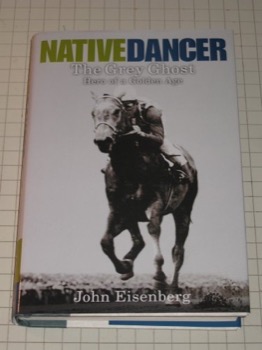
Hardcover. NY , Warner Books, 1st, 2003, Book: Very Good, Dust Jacket: Very Good, Hardcover in a bright, unclipped dust jacket, 288 pages, b&w illustrations. In the early 1950s, a rising star flickered across millions of black-and-white TV sets. Nicknamed "The Grey Ghost, " Native Dancer was a blue-blood thoroughbred with a taste for drama, courtesy of his come-from-behind running style, and impressive credits: He finished first in 21 of his 22 career starts, his only loss by a nose in the 1953 Kentucky Derby; was named Horse of the Year--twice; and was inducted into the National Museum of Racing's Hall of Fame. His popularity was so great, Time® magazine put him on its cover, and TV Guide named him one of America's top three TV stars, along with Ed Sullivan and Arthur Godfrey. Clean copy.
Hardcover. NY, Harcourt Brace & Company, BC Ed., 1949, Book: Very Good, Dust Jacket: Good, Hardcover in a worn, chipped dust jacket, 314 pages. A first Book Club Edition, as there is a small dot on bottom right of rear board, $3.00 price on front flap with "Book of the Month Club Selection". No statement of edition on copyright page. Previous owner's bookplate and name on front endpaper. Dust jacket has 1" gone from bottom of spine. No other markings.
Hardcover. Boston, Little, Brown and Company, 1st, 1947, Book: Good, Hardcover, beige boards with green and red text; light wear to corners and spine, light spotting to covers. Nash's poems set to music by Vernon Duke. Each song accompanied by playful two tone illustrations by Frank Owen. Inscription on front fly leaf, clean internally. 48 pages, no dust jacket.
Hardcover. New York, Clarkson Potter Publishers, 1st, 2019, Book: Very Good, Dust Jacket: None, 381 pages. Hardcover with no dust jacket. Color and b&w photos throughout. Bill Cunningham's photography captured the evolution of style, of trends, and of the everyday, both in New York City and in Paris. But his work also shows that street style is not only about fashion; it's about the people and the changing culture. These photographs (many never before seen, others having originally appeared in The New York Times and elsewhere) move from decade to decade, beginning in the 1970s and continuing until Cunningham's death in 2016. Here you'll find Cunningham's distinctive chronicling of the 1980s transit strike, the rise of 1990s casual Fridays, the sadness that fell over the city following 9/11, Inauguration Day 2009, the onset of selfies, and many other significant moments. Clean, tight copy.
Hardcover. New York, Clarkson Potter Publishers, 3rd printing, 2019, Book: Very Good, Dust Jacket: None, 381 pages. Hardcover with no dust jacket. Color photographs throughout. Clean, Tight copy.
Hardcover. Cheltenham UK, Edward Elgar Publishing, 1st, 2008, Book: Very Good, Dust Jacket: None, Hardcover in glossy pictorial boards, 264 pages. Here the example of the Russian oil industry in the context of transition from a planned to a market economy is used to develop a three-stage framework for organisational transformation. Four longitudinal case studies of Russian oil companies are drawn upon to explain the process of organisational transformation. The book highlights how and why this process differs between companies within the same industry, explores the complexity of the change process and discusses the importance of the top management team. Clean copy.
Hardcover. Flammarion, 1st, 2009, Book: Very Good, Dust Jacket: Very Good, Hardcover, 204 pages. The century that spanned from the 1850-1950 witnessed the golden age of travel and the exposure of an increasing number of Westerners to foreign cultures. The Maghreb became a source of exotic fascination and people grew particularly enchanted by the landscapes, peoples, and cultures of countries such as Morocco, Tunisia, and Algeria. Orientalist Photographs pays homage to the ultimate travel dream of that era. This collection of over 100 autochrome, sepia, and black and white photographs captures delicate, lost details: the dusty, labyrinthine walls of the casbah; the dappled sunlight on the market stall of a souk; the intricate metal work of traditional jewelry. Each image is accompanied by an informative text that situates the photograph in its historical reality, revealing how, for example, the richness of Algerian embroidery is not the product of hermetic tradition, as once perceived, but rather that of an innovative fusion of Spanish, Turkish, and native cultures. This book's haunting photographs and incisive texts vividly render all the mystery, the beauty, and the naivete of the West's encounter with a culture it found so radically different from its own.
Hardcover. Manhattan KS, Privately Published, 1st, 1985, Book: Very Good, Dust Jacket: None, Hardcover, gray cloth with blue stamping, 150 pages. Contains 12 chapters on paper-making, paper testing, printing paper grades, ink manufacturing, printing ink properties and classifications, press designs and their influence on printing, paper and ink at the Nip, densitometry and ink measurements, color and process-color printing, paper and ink in process-color printing, paper and ink problems, etc. Well illustrated throughout with drawings, diagrams, and photographs -- some highly magnified. Bibliography. Index. Five pages with light underlining, otherwise clean.
Softcover. Philadelphia, Owlswick Press, 1st pbk, 1989, Book: Very Good, Dust Jacket: None, Softcover, 180 pages. Foreword by L. Sprague de Camp, with essays, bibliography and index. Four b&w plates by Tim Kirk. Clean copy.
Softcover. New Haven CT, Yale University Press, reprint, 1998, Book: Very Good, Dust Jacket: None, Softcover, 384 pages, illustrations. Philip II of Spain--ruler of the most extensive empire the world had ever known--has been viewed in a harsh and negative light since his death in 1598. Identified with repression, bigotry, and fanaticism by his enemies, he has been judged more by the political events of his reign than by his person. This book, published four hundred years after Philip's death, is the first full-scale biography of the king. Placing him within the social, cultural, religious, and regional context of his times, it presents a startling new picture of his character and reign. Drawing on Philip's unpublished correspondence and on many other archival sources, Henry Kamen reveals much about Philip the youth, the man, the husband, the father, the frequently troubled Christian, and the king. Kamen finds that Philip was a cosmopolitan prince whose extensive experience of northern Europe broadened his cultural imagination and tastes, whose staunchly conservative ideas were far from being illiberal and fanatical, whose religious attitudes led him to accept a practical coexistence with Protestants and Jews, and whose support for Las Casas and other defenders of the Indians in America helped determine government policy. Shedding completely new light on most aspects of Philip's private life and, in consequence, on his public actions, the book is the definitive portrayal of Philip II. Clean copy.
Hardcover. Bulfinch, 1st, 2006, Book: Very Good, Dust Jacket: Very Good, Hardcover, 256 pages. Haynes provides an insider's look at the remarkable photographs and stories of UPI's news photographers, providing a unique window on the second half of the 20th century. Clean copy.
Hardcover. Boston, Houghton Mifflin , 1st, 1921, Book: Very Good, Dust Jacket: None, Hardcover, pale green cloth with decorative design and lettering in black. 12 photographic plates. A look into the life of a hunter exploring the South Carolina Plantation region, its changes, and the game that resides there. Clean copy, light shelf wear.
Hardcover. Chicago, Follett Publishing, 1st, 1950, Book: Very Good, Dust Jacket: None, Hardcover, glazed pictorial boards. 28 pages illustrated in color and 2-colors by Mary Miller Salem. Front hinge cracked, otherwise clean copy.
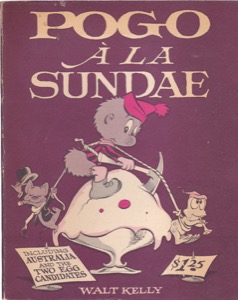
Softcover. NY, Simon and Schuster, 1st, 1961, Book: Very Good, Dust Jacket: None, Softcover, 127 pages in b&w. Purple pictorial wrappers. Walt Kelly's career in animation began in 1936 at Walt Disney Studios, where he contributed to Pinocchio and Fantasia. In 1941, Kelly resigned at the age of 28 to work at Dell Comics, where he created Pogo. He started drawing the comic strip in 1943 but it was not widely published until 1948. He based his characters on animals native to the Okefenokee Swamp. Pogo, a possum, was the central character and some of his friends were cigar chomping Albert the Alligator, Churchy LeFemme (a turtle), Dr. Howland Owl complete with glasses, and others. His biting political satire was aimed a Senator Joseph McCarthy (Kelly s nickname for him was Simple J Malarkey ), the FBI, the John Birch Society, Nikita Khrushchev, and later, Presidents Lyndon Johnson and Richard Nixon. Clean, bright copy.
Hardcover. NY, Thames & Hudson, 1st, 2011, Book: Very Good, Dust Jacket: Very Good, Hardcover in a bright dust jacket, 352 pages, color illustrations. While cameo and intaglio portraits, other forms of deluxe jewelry, medals, and miniatures featuring famous personalities have been surveyed, a historian and curator of jewelry and engraved gems, notes that their settings have surprisingly not attracted as much attention. Covering periods from 16th to early 17th centuries Renaissance Europe to the Napoleonic to World War I eras, the author describes the pieces and names their designers in historical and personal contexts. A chapter is devoted to the portrait diamond from the Medici dynasty to the fall of the Romanovs. Clean copy. DOMESTIC SHIPPING ONLY.
Hardcover. Cambridge MA, MIT Press], 2nd pr., 2010, Book: Very Good, Dust Jacket: Very Good, Hardcover in a bright dust jacket, 261 pages. The story of how diesel engines and gas turbines, used to power cargo ships and jet airplanes, made today's globally integrated economy possible. Clean copy.
Hardcover. Princeton University Press, 1st, 2025, Book: Very Good, Dust Jacket: None, Original pictorial boards (in publisher's unopened shrinkwrap). 280 pages illustrated in b&w and color. Alice Friedman tells the fascinating story of the queer avant-garde of the 1920s and '30s in New York, Paris, and Venice, as seen through the eyes of Max Ewing (1903-1934), a young musician, photographer, and man-about-town who, although virtually unknown today, moved in extraordinary circles. Among his friends and acquaintances, he listed Carl Van Vechten, Gertrude Stein, Muriel Draper, Romaine Brooks, Tallulah Bankhead. In his photographs and letters, we meet the rising stars of modern art, music, dance, and literature and enter a world of interracial friendship, "queer space," and experimentation that shone brightly before being swept away by the Depression.
Hardcover. NY, NYRB, 1st, 2025, Book: Very Good, Dust Jacket: None, Hardcover in pictorial boards, 166 pages, color throughout. Rea Irvin was The New Yorker's first art editor and creator of the magazine's iconic mascot, the butterfly enthusiast Eustace Tilley. In 1930, he ventured into new territory with the comic strip The Smythes. The Smythes--comprised of John, Margie, and their two forgettable children, Willie and Maudie--are a nice-ish suburban family, restless in their social stature, and eager to climb a sometimes wobbly social ladder. Irvin's distinct, graceful line renders the Smythes in all their glory and hilarity as they navigate ill-fated dinner parties with pompous socialites, fend off robbers dressed as Santa, and get chased out of restaurants by cleaver-wielding chefs. The Smythes drolly captures the joys, heartbreaks, and humiliations of being in a family. Handpicked by acclaimed cartoonists R. Kikuo Johnson and Dash Shaw--who also penned the introduction together--this new selection of Smythes strips also includes an enlightening afterword by comics historian Caitlin McGurk. An unsung masterpiece of cartooning, The Smythes is finally available to a new generation of readers ready to marvel at the full reach of Irvin's artistic abilities. Clean copy.
Softcover. Berkeley CA, University of California Worth Ryder Art Gallery, 1st, 1964, Book: Very Good, Dust Jacket: None, Softcover, b&w pictorial wraps. exhibition catalog, April-May 1964 23 pages, B&W frontispiece photo of artist in his studio, and 5 full color reproductions of artworks: "Fantasia," "Effervescence," "Le Gilotin," "The Lark," and "Heraldic Call."

 "Myron Stout by: Schwartz, Sanford")

 "Nineteen Eighty-Fourby: Orwell, George")


 "Ogden Nash's Musical Zoo by: Nash, Ogden; Duke Vernon")







 "Paper & Ink Relationships by: Williams, Roger L.")




 "Playland Pony by: Esther K. Meeks")
 "Portrait Jewels: Opulence and Intimacy from the Medici to the Romanovs by: Scarisbrick, Diana")

 "Pufendorf: On the Duty of Man and Citizen according to Natural Law by: Pufendorf, Samuel / James Tully (Ed.)")

 "Rea Irvin's The Smythesby: Rea Irvin (edited and with an introduction by R. Kikuo Johnson and Dash Shaw, afterword by Caitlin McGurk)")