Hardcover. New York , E. P. Dutton & Co., 1st, 1941, Book: Good, Dust Jacket: None, Hardbound, 205 pages. Black & white illustrations by Howard Simon. Review slip laid in. Residue from paper clip front endpaper. Top corners a bit bumped. Light soiling to covers.
Hardcover. US, PS Artbooks, 1st, 2013, Book: Very Good, Dust Jacket: None, Hardcover with no dust jacket. Clean, unmarked copy with only minor wear to covers. In matching slipcase.
Hardcover. East Yorkshire UK, PS Artbooks, 1st, 2013, Book: Very Good, Dust Jacket: None, Hardcover with no dust jacket. Clean, unmarked copy with only minor wear to covers. Black and white pictures throughout. In matching slipcase.
Hardcover. US, PS Publishing, 1st, 2013, Book: Very Good, Dust Jacket: None, 240 pages. Hardcover with no dust jacket. Clean, unmarked copy with only minor wear to covers. Color, Black and white pictures throughout.
Hardcover. NY, Rinehart & Company, 2nd pr., 1949, Book: Very Good, Dust Jacket: Poor, Hardcover in very worn, chipped dust jacket with tape repairs, 241 pages, frontispiece by Edward Shenton. Novel based on the historic 1780 Indian raid on Royalton, in the White River Valley of Vermont. No markings.
Hardcover. NY, Minton Balch & Co., 1st, 1932, Book: Very Good, Dust Jacket: None, 224 pages, illustrated in b&w by Diana Thorne. Blue cloth covers with black decoration. Previous owner's signature on front fly leaf.
Hardcover. NY, Atheneum, 1st, 2003, Book: Very Good, Dust Jacket: Very Good, Hardcover in a bright, unclipped dust jacket. Escaping into the fantasy world of the movies, where fathers don't disappear, mothers have no secrets, and little brothers don't cry over missing stuffed animals, twelve-year-old Ruby Miller, while performing community service for a crime she didn't commit, is forced to face the reality of her life. Clean, like new.
Hardcover. New York, Harper & Brothers, 1st, 1908, Book: Very Good, Dust Jacket: None, Hardcover, decorated cloth covers. 2 color, 8 tinted illustrations by Howard Pyle. Tissue guard over frontispiece. Lettering on spine a bit faded. Light edgewear and soil to covers, but gilt & design bright. Previous owner's sticker on inside front cover at bottom right. Clean, tight copy.
Hardcover . NY, Harper & Brothers, 1st, 1908, Book: Very Good, Dust Jacket: None, Hardcover with 2 color, 8 tinted illustrations by Howard Pyle. Tissue guard over frontispiece, top edge gilt. Light edgewear and soil to covers, but gilt & design bright. Previous owner's name and date on reverse of color frontis.
Hardcover. NY, Charles Scribner's Sons, 1st, 1885, Book: Very Good, Dust Jacket: None, Hardcover, 322 pages. Green cloth covers, gilt design, some wear to corners and edges. Light foxing on a few pages, otherwise inside is clean, with b&w illustrations by A. B. Frost throughout. A nice copy.
Hardcover. NY, Charles Scribner's Sons, 1st, 1970, Book: Very Good, Dust Jacket: Very Good, Hardcover in a bright dust jacket, 64 pages, illustrated by Paul Giovanopoulos. Dust jacket with mild edgewear. Tale of the young son of a Georgia sharecropper who loves animals & wants to be a zoologist. Clean copy.
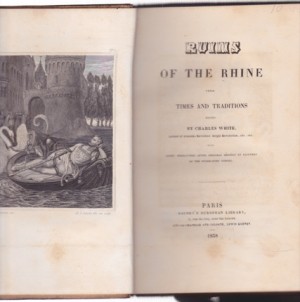
Hardcover. Paris, Baudry's European Library, 1st, 1838, Book: Very Good, Dust Jacket: None, Hardcover, calf binding with title label on spine. Illustrated with 8 b&w engravings. Well written, entertaining legends, history and folklore of the Rhine, including the Mouse Tower, Hildegard von Bingen, St. Ursula, etc. Cover is scuffed with surface scars, but binding is firm. 354 pages. Minor foxing. Aside from cover appearance, very good.
hardcover. London, SelfMadeHero, 1st, 2015, Book: Very Good, Dust Jacket: None, 256 pages. Hardcover with NO dust jacket. Color comic illustrations make up this graphic novel. Bottom corner bumps otherwise, bright, and lean, unmarked copy in excellent condition. Red decorative staining to page block and black satin ribbon marker.
Softcover. Ithaca NY, Cornell University Press, reprint, 1990, Book: Very Good, Dust Jacket: None, Softcover, 309 pages. A major contribution to the cultural and literary history of the Victorian age, Rule of Darkness maps the complex relationship between Victorian literary forms, genres, and theories and imperialist, racist ideology. Critics and cultural historians have usually regarded the Empire as being of marginal importance to early and mid-Victorian writers. Patrick Brantlinger asserts that the Empire was central to British culture as a source of ideological and artistic energy, both supported by and lending support to widespread belief in racial superiority, the need to transform "savagery" into "civilization," and the urgency of promoting emigration. Rule of Darkness brings together material from public records, memoirs, popular culture, and canonical literature. Brantlinger explores the influence of the novels of Captain Frederick Marryat, pioneer of British adolescent adventure fiction, and shows the importance of William Makepeace Thackeray's experience of India to his novels. He treats a number of Victorian best sellers previously ignored by literary historians, including the Anglo-Indian writer Philip Meadows Taylor's Confessions of a Thug and Seeta. Brantlinger situates explorers' narratives and travelogues by such famous author-adventurers as David Livingstone and Sir Richard Burton in relation to other forms of Victorian and Edwardian prose. Through readings of works by Arthur Conan Doyle, Joseph Conrad, H. Rider Haggard, Rudyard Kipling, John Hobson, and many others, he considers representations of Africa, India, and other non-British parts of the world in both fiction and nonfiction. Clean, bright copy.
Hardcover. NY, Doubleday, Doran & Company, 1st, 1928, Book: Very Good, Dust Jacket: None, Hardcover, orange cloth with red decoration, 279 pages. B&w, some color illustrations by Will Crawford. Previous owner's bookplate on inside cover, otherwise a clean, tight copy.
Hardcover. NY, Doubleday Doran, 1st, 1928, Book: Very Good, Dust Jacket: Good, 279 pages. Hardcover with dust jacket. Color, black & white illustrations by Will Crawford. Dust jacket with some heavy chipping.
Hardcover. Boston, Houghton Mifflin Company, 1st, 1939, Book: Very Good, Dust Jacket: None, 220 pages. Hardcover with no dust jacket. Previous owner's name on front fly leaf. Spine of cover faded. Tight copy. Illustrations by David Hendrickson.
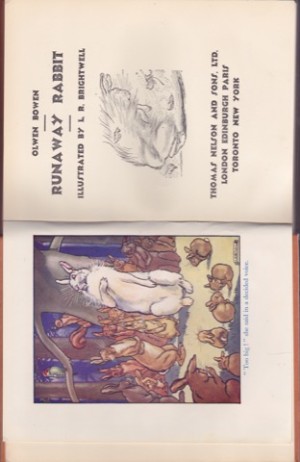
Hardcover. London, Thomas Nelson, 1st , no date (1949), Book: Good, Dust Jacket: None, Hardcover, orange cloth with mild soil, gilt lettering on spine. INSCRIBED BY BOWEN and dated September 1954 on front fly leaf. Color frontis, B&W drawings by L. R. Brightwell. The adventures of a large angora rabbit named Sultan when he escapes from his life in "Show" business.
Hardcover. Philadelphia, David McKay, 1st, 1944, Book: Very Good, Dust Jacket: None, Hardcover, blue cloth with white lettering and drawing of horse's head on cover. 144 pages. Black & white drawings and color frontispiece by Willy Pogany. Pink top edge. Previous owner's signature front end paper. Rubbing, light soiling to endpapers. The story of an old dapple-grey workhouse, Nebuchadnezzar, or Nebby, for short, and the two siblings who love him, Marigold and Noel, who live with their mean old aunt-in-law.
Softcover. New York, Bantam Books, 1st, 1959, Book: Very Good, Dust Jacket: None, 151 pages. Paperback. Bantam Mystery #1910. Cover art by Bayre Phillips. Light creasing to cover wrappers.
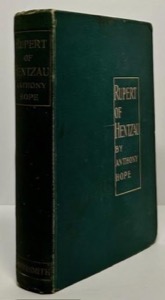
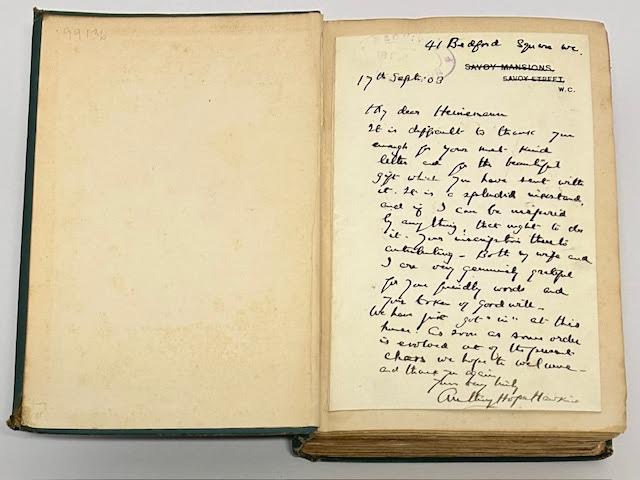
Hardcover. London, England, j.W. Arrowsmith, 1st Edition, 1898 , Book: Very Good, Dust Jacket: None, 385 pages. Hardcover. B/w frontispiece, illustrations throughout by illustrator, Charles Dana Gibson. Tanning from age throughout, pages untrimmed, deckled. Letter from the author dated "17th Sept: 03" laid in (see image), possibly to William Heinemann. Green cover boards, gilt title on spine, front cover. Some agewear to spine top and bottom. Binding very good, spine straight. Very good condition.
Hardcover. New York, Little, Brown and Company, 1st, 2016, Book: Very Good, Dust Jacket: Very Good, 368 pages. Hardcover with dust jacket. Black and white illustrations. Clean, unmarked copy with only minor wear to dust jacket.
Hardcover. Princeton NJ, Princeton University Press, 1st, 1993, Book: Very Good, Dust Jacket: Very Good, Hardcover in a bright dust jacket, 236 pages. INSCRIBED BY THE AUTHOR on the front fly leaf. In the three decades following Stalin's death, major underground Russian writers have subverted Soviet ideology by using parody to draw attention to its basis in utopian thought. Referring to utopian writing as diverse as Defoe's Robinson Crusoe, Dostoevsky's Notes from Underground, and Orwell's Animal Farm, they have tested notions of truth, reality, and representation. They have gone beyond their precursors by experimenting with the tensions between ludic and didactic art. Edith Clowes explores these "meta-utopian" narratives, which address a wide range of attitudes toward utopia, to expose the challenge that literary play poses to dogmatism and to elucidate the sense of renewal it can bring to social imagination. Using both structural analysis and reception theory, she introduces readers outside Russia to a fascinating body of literature that includes Aleksandr Zinoviev's The Yawning Heights, Abram Terts's Liubimov, Vladimir Voinovich's Moscow 2042, and Liudmila Petrushevskaia's "The New Robinsons."

 "Roundaboutby: Simon, Connie May")
 "Roy Thomas Presents Frankenstein Volume 3 Limited Slipcase Editionby: Briefer, Photographer) Dick (Author")
 "Roy Thomas Presents Frankenstein: Volume 4 Limited Slipcase Editionby: Briefer, Dick and Roy Thomas")
 "Roy Thomas Presents: THE HEAP: VOL 3: by: Thomas, Roy")
 "Royalton Raidby: Leon W. Dean")
 "Rrouby: Genevoix/Diana Thorne, Maurice")
 "Ruby Electric by: Theresa Nelson")
 "Ruby of Kishmoor, Theby: Pyle, Howard")
 "Ruby of Kishmoor, Theby: Pyle, Howard")
 "Rudder Grangeby: Stockton, A.B. Frost, Frank R.")
 "Rufus Gideon Grant by: Dean, Leigh/Paul Giovanopoulos")
 "Ruins of the Rhine: Their Times and Traditionsby: White, Charles (Ed)")

 "Ruinsby: Kuper, Peter")
 "Rule of Darkness: British Literature and Imperialism, 1830 1914 by: Patrick Brantlinger")
 "Rules of the Roadby: Joan Bauer")
 "Rumbling Wings and Other Indian Talesby: Parker, Arthur C.")
 "Rumbling Wings and Other Indian Talesby: Parker, Arthur C.")
 "Runaway Lindaby: Allee, Marjorie Hill")
 "Runaway Rabbit (SIGNED COPY)by: Bowen, Olwen")

 "Running Away WIth Nebbyby: Garrard/Willy Pogany, Phillis")
 "Running Man, Theby: Benson, Ben")
 "Rupert of Hentzau (W/SIGNED LETTER)by: Hope, Anthony")
 "Rush Oh!by: Barrett, Shirley")
 "Russian Experimental Fiction: Resisting Ideology After Utopiaby: Edith W. Clowes")