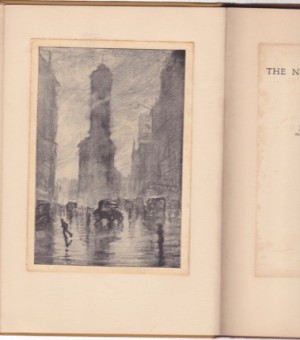
Hardcover. NY, Brentano's, 1st, 1921, Book: Very Good, Dust Jacket: None, Hardcover, mustard cloth covers with black lettering, A collection of 26 magnificent charcoal drawings of New York City, made in the early 1920s by Marcus. All with accompanying descriptions, all tipped-in. An Introduction by J. Monroe Hewlett (President of the Architectural League of NY), describes the native-born Marcus as a painter, not an architect. His atmospheric depictions capture the spirit of the city at the time. Bright, clean copy.
Hardcover. Secaucus NJ, Chartwell Books, 1993, Book: Very Good, Dust Jacket: Very Good, Hardcover, 255 pages, illustrated throughout in color and b&w. Folio. Light edgewear to dust jacket, else a clean, tight copy.
Hardcover. Minneapolis, Milkweed Editions, 1st, 2024, Book: Very Good, Dust Jacket: Very Good, Hardcover in a bright dust jacket, 252 pages. Some color photos. When National Geographic Adventurers of the Year Amy and Dave Freeman marry, they set out on an unusual honeymoon: a three-year, 12,000-mile journey across North America. From Alaska's Inside Passage to Florida's Key West, they traverse the continent by kayak, canoe, dogsled, and skis, encountering wildlife, sublime landscapes, and harrowing challenges.Along the way, the Freemans also bear witness to environmental degradation and climate change--from plastic-covered beaches to forest fires to retreating glaciers. And as they engage with Native and rural communities most impacted by the changes resulting from modern industrial society and meet individuals and organizations dedicated to protecting the natural world, their adventure deepens in ways they never imagined. Clean copy.
Softcover. Woodstock VT, Countryman Press, reprint, Book: Very Good, Dust Jacket: None, Softcover, 311 pages, b&w illustrations. Kate Austen was a young Australian nurse looking for adventure in the 1920s. She accepted an assignment working in a mission hospital in Labrador, Canada, and fell in love with the local people and harsh wilderness she found there. She also met and married her husband (the author) during her time in Labrador. Throughout the book, Kate relates in a no-nonsense voice the births, deaths, epidemics, injuries, burns and unusual medical cases she treated. She also tells affectionately of the people she served - trappers, wives, children, native Indians, fishermen, sailors, and various visitors. Some of the stories made me chuckle, and some of them made me hold my breath in suspense. She worked day and night to serve the community living around the hospital, which also served as general store and community center. The weather was dreadful most of the year, and they lived without running water, electricity, telephone, or indoor toilets. Kate reveled in the experience, often traveling hundreds of miles by dog-sled to treat sick people in out-lying homesteads. She loved the snow, ice, wind, and the dangerous ocean, and rarely complained about the primitive conditions or workload. Previous owner's inscription otherwise clean copy.
Hardcover. London, T. Nelson and Sons, reprint, 1876, Book: Very Good, Dust Jacket: None, Hardcover, terra-cotta cloth stamped with black and gilt design, 235 pages, engraved frontispiece and numerous other plates and in-text drawings. Light shelfwear, previous owner's inscription, signatures on front endpapers. Otherwise clean, tight.
Hardcover. Seattle, University of Washington Press, 1st, 1991, Book: Very Good, Dust Jacket: Very Good, 388 pages, hardcover. B&w plates. INSCRIBED BY ECKERT. Light foxing to edge and light wear to bottom edges of cover. According to conventional interpretations, the Japanese annexation of Korea in 1910 destroyed a budding native capitalist economy on the peninsula and blocked the development of a Korean capitalist class until 1945. In this expansive and provocative study, now available in paperback, Carter J. Eckert challenges the standard view and argues that Japanese imperialism, while politically oppressive, was also the catalyst and cradle of modern Korean industrial development. Ancient ties to China were replaced by new ones to Japan - ties that have continued to shape the South Korean political economy down to the present day. Eckert explores a wide range of themes, including the roots of capitalist development in Korea, the origins of the modern business elite, the nature of Japanese colonial policy and the Japanese colonial state, the relationship between the colonial government and the Korean economic elite, and the nature of Korean collaboration. He conveys a clear sense of the human complexity, archival richness, and intellectual challenge of the historical period. His documentation is thorough; his arguments are compelling and often strikingly innovative.
New York, Bernard Ackerman, 1st, 1944, Book: Very Good, Dust Jacket: Good, Hardcover, 59 pages. Black and brown line drawings by William Brady. previous owner's inscription front fly leaf. Dust jacket with edgewear.
Softcover. Albuquerque, University of New Mexico, 1st, 1981, Book: Very Good, Dust Jacket: None, Softcover, 113 pages, b&w and color illustrations. Light smudging to back wrapper; else a very clean, tight copy. This splendid publication, a compact guide to rug dating and identification, examines patterns, styles, and weaving materials of Navajo rugs. In order to produce this heavily illustrated volume, the author, a noted authority in the field, examined thousands of rugs in public collections and researched the catalogues turn-of-the century traders used for their rug customers
Hardcover. NY, Farrar Straus & Giroux, 1st, 2000, Book: Very Good, Dust Jacket: Very Good, Hardcover, 311 pages. A perceptive visitor's report of life on the Pine Ridge Indian Reservation, one of the poorest places in the United States. Profiles the Oglala Sioux living there and along the way a female basketball star. Clean copy.
New York, Macmillan , 1st, 1994, Book: Very Good, Dust Jacket: Very Good, Hardcover in a bright, unclipped dust jacket. Color illustrations by Judy Pedersen. Dust jacket with edgewear. Clean copy.
Hardcover. Jackson MS, University Press of Mississippi, reprint, 1996, Book: Very Good, Dust Jacket: Very Good, Hardcover, 115 pages illustrated throughout in b&w. Light edgewear to dust jacket, else a clean, tight copy. An Anniversary Edition of a book first published in 1971. New introduction by William Maxwell. Photodocumentation of the noted author's personal selection of images made in her native Mississippi soon after her return from college and as publicity agent for the state's Works Progress Administration office.
Hardcover. Flammarion, 1st, 2009, Book: Very Good, Dust Jacket: Very Good, Hardcover, 204 pages. The century that spanned from the 1850-1950 witnessed the golden age of travel and the exposure of an increasing number of Westerners to foreign cultures. The Maghreb became a source of exotic fascination and people grew particularly enchanted by the landscapes, peoples, and cultures of countries such as Morocco, Tunisia, and Algeria. Orientalist Photographs pays homage to the ultimate travel dream of that era. This collection of over 100 autochrome, sepia, and black and white photographs captures delicate, lost details: the dusty, labyrinthine walls of the casbah; the dappled sunlight on the market stall of a souk; the intricate metal work of traditional jewelry. Each image is accompanied by an informative text that situates the photograph in its historical reality, revealing how, for example, the richness of Algerian embroidery is not the product of hermetic tradition, as once perceived, but rather that of an innovative fusion of Spanish, Turkish, and native cultures. This book's haunting photographs and incisive texts vividly render all the mystery, the beauty, and the naivete of the West's encounter with a culture it found so radically different from its own.
Native American Indian fishing from shore, two-color art by N.C. Wyeth. 10.5 x 13.5", very good, mailing label. Light stain by masthead. PLEASE NOTE: The image shown is a scan of the actual product you are purchasing. What you see is what you get. The sheet may have some imperfections beyond the cropped area shown. You are buying THIS PAGE ONLY- not the entire magazine. Your order will be placed carefully between stiff paper and an acetate overlay, then packed in a rigid cardboard sleeve to prevent bending.
1936, Color art of Native American war dance by W.H.D. Koerner. 10 X 13". PLEASE NOTE: The image shown is a scan of the actual product you are purchasing. What you see is what you get. The sheet may have some imperfections beyond the cropped area shown. You are buying THIS PAGE ONLY- not the entire magazine. Your order will be placed carefully between stiff paper and an acetate overlay, then packed in a rigid cardboard sleeve to prevent bending.
Softcover. Indianapolis, Indiana Historical Society, 1st, 1994, Book: Very Good, Dust Jacket: None, Softcover 96 pages. Otto Ping began taking pictures of the people and places of his native Brown County, Indiana, in 1900 at the age of seventeen in order to make some extra money. He continued doing so for forty years while he worked at such other endeavors as peddling, farming, canning, and chicken raising. Unlike the painters and photographers who came to the county in these years to capture quaint and rustic scenes for sophisticated audiences elsewhere, Ping made his pictures for the people who were in them. Primarily a portraitist, Ping photographed individuals, couples, family groups, and larger gatherings. He had no studio and carried with him no lights or props. His portraits are characterized by hastily thrown up backdrops, stark lighting, and rigid poses. They have a documentary quality, and one senses in the faces that peer from these images the determination with which these people met lives of toil and hardship. Many of the portraits betray a sense of melancholy. Life was tenuous for both young and old, and the photographer often worked against time to provide a family with images of the living before his efforts became memorial. Ping photographed people at work and play. Images abound of stiffly posed groups in front of sawmills, churches, schools, and lodge halls; families in front of cabins or newly framed houses; couples with buggies; and children at play. Clean copy.
Hardcover. NY, Frederick A. Stokes, reprint, Book: Very Good, Dust Jacket: Good, Hardcover, green cloth stamped in black. 332 pages. This edition features a color frontispiece, full-page plates in both color and black & white, and in-text illustrations throughout by William Walworth Stilson. A reprint of the 1901 edition. No date, probably the 1930s. Owner's name on inside front cover, otherwise clean.
Softcover. Ketchikan AK, United States Indian School, 1st, 1950s, Book: Good, Dust Jacket: None, Softcover, stapled pictorial card covers. A chronicle of the Thlingets, Tsimpshean, and Haidias tribes of Ketchikan, Alaska with a map detailing their locations. Approx. 60 pages, line drawings and typewriiten text printed on one side of pages. Illustrated with black-and-white drawings of totem poles, basket designs, hats, fish, canoes, an Indian house, bowl, household box, etc. Topics include: various totem poles, a Legend of the Eagle Clan, tales, basketry, Indian fishing and rights, berries, canoes, gambling, houses, dances, seal and deerskin tanning, Potlatch, prayers, etc. Clear tape on edges of cover, bookplate on inside front cover.
Hardcover. n.p., L.T. Myers, unknown, Book: Very Good, Dust Jacket: None, Hardcover, red cloth covers, 3 color lithographs, many black & white illustrations. Color label on decorated cover. No publisher indicated,(C) by L.T. Myers. Areas of cover show fading, soil.
Hardcover. NY, Frederick A. Stokes, 1st, 1918, Book: Very Good, Dust Jacket: None, Hardcover, terra-cotta cloth with a color paste-down on cover, 263 pages, A collection of 35 Native American animal folklore tales. Wood-lore (or, the ways of wild things) are told in an engaging format - a wise old chief holds evening "story-time" sessions with his very curious grandson, Little Beaver. Running through the linked narrative is the little black bear Moween, of whom Little Beaver is particularly fond. Illustrated with 8 color plates, a color title page and an endpapers drawing by Paul Bransom. Light shelf wear.
Hardcover. NY, Frederick A. Stokes, 1st, 1918, Book: Good, Dust Jacket: None, Hardcover, terra-cotta cloth with a color paste-down on cover, 263 pages, A collection of 35 Native American animal folklore tales. Wood-lore (or, the ways of wild things) are told in an engaging format - a wise old chief holds evening "story-time" sessions with his very curious grandson, Little Beaver. Running through the linked narrative is the little black bear Moween, of whom Little Beaver is particularly fond. Illustrated with 8 color plates, a color title page and an endpapers drawing by Paul Bransom. Light shelf wear.
Softcover. Durham NC, Duke University Press, 1st, 2002, Book: Very Good, Dust Jacket: None, Softcover, 410 pages, b&w, color illustrations. INSCRIBED BY AUTHOR on the half-title page. Painting Culture tells the complex story of how, over the past three decades, the acrylic "dot" paintings of central Australia were transformed into objects of international high art, eagerly sought by upscale galleries and collectors. Since the early 1970s, Fred R. Myers has studied--often as a participant-observer--the Pintupi, one of several Aboriginal groups who paint the famous acrylic works. Describing their paintings and the complicated cultural issues they raise, Myers looks at how the paintings represent Aboriginal people and their culture and how their heritage is translated into exchangeable values. He tracks the way these paintings become high art as they move outward from indigenous communities through and among other social institutions--the world of dealers, museums, and critics.
Softcover. London, 1849, Book: Very Good, Dust Jacket: None, This is 64 page extract from a larger volume (pages 443 - 506), possibly London Magazine. This is the original printing and features 4 fold-out plans and illustrations, all in excellent condition. Bound in a clear acetate folder.
Hardcover. NY, Dutton, 1st, 1976, Book: Very Good, Dust Jacket: Very Good, Hardcover in a bright, price-clipped dust jacket. 256 pages, Index. Maroon cloth, stamped in gilt. Copiously illustrated with watercolors by Karl Bodmer. Map on endpapers. The Firsthand Account of Prince Maximilian's Expedition Up the Missouri River, 1833-34. Wonderful color plates by Swiss-born Bodmer accompany extracts from Maximilian's text, enhanced by historical background from Thomas and Ronnefeldt. Clean copy. DUE TO WEIGHT, DOMESTIC SHIPPING ONLY.

 "New York: The Nation's Metropolis by: Marcus, Peter")

 "North American Indian Wars by: Richard H. Dillon")
 "North American Odyssey: 12 000 Miles Across the Continent by Kayak Canoe and Dogsled by: Amy & Dave Freeman")
 "Northern Nurse by: Elliott Merrick")
 "Nuer Religionby: Evans-Pritchard, E. E.")
 "Ocean and Its Wonders, Theby: Ballantyne, R.M.")
 "Offspring of Empire: The Koch'ang Kims and the Colonial Origins of Korean Capitalism 1876-1945 (SIGNED COPY)by: Eckert, Carter J.")
 "Old Aztec Story Teller, Theby: Rickard, J. A.")
 "Old Navajo Rugs: Their Development from 1900 to 1940by: Rodee, Marian E.")
 "On the Rezby: Frazier, Ian")
 "On the Road of Stars: Native American Night Poems and Sleep Charmsby: Bierhorst/Judy Pedersen, John")
 "One Time, One Place: Mississippi in the Depressionby: Welty, Eudora")
 "Orientalist Photographs: 1870-1950by: Milet, Eric")
 "ORIG VINTAGE MAGAZINE COVER/ SATURDAY EVENING POST - JULY 18 1908 Illus. N.C. Wyethby: Wyeth (Illust.), N.C.")
 "ORIGINAL VINTAGE MAGAZINE COVER: Saturday Evening Post - April 4, 1936 - Indian Warriorby: W.H.D. Koerner (Illust.)")
 "Otto Ping: Photographer of Brown County, Indiana, 1900-1940by: W. Douglas Hartley")
 "OUR FERNS IN THEIR HAUNTS: A Guide to All the Native Species by: Clute, Willard N.")

 "Outdoor Life and Indian Stonesby: Ellis, Edward S.")
 "Over Indian and Animal Trails by: Thompson, Jean M. and Paul")
 "Over Indian and Animal Trailsby: Thompson, Jean M. and Paul")
 "Painting Culture: The Making of an Aboriginal High Art (SIGNED COPY)by: Myers, Fred R.")
 "Papers Relating to the First Settlement and Capture of Fort Oswego 1727-1756 (WITH FOLD-OUTS)by: O'Callaghan, E.B.")
 "People of the First Man: Life Among the Plains Indians in Their Final Days of Glory by: Thomas, Davis & Karin Ronnefeldt (Editors) Karl Bodner (Illust.)")