Hardcover. London, Oxford University Press, 1st, 1963, Book: Very Good, Dust Jacket: Good, Hardcover, 188 pages, b&w photos. An account by a Kenya African of his experiences in detention camps in the 1950s. Foreword by Margery Perham. In a lightly worn dust jacket.
Softcover. Lanham MD, Lexington Books, 1st, 2016, Book: Very Good, Dust Jacket: None, Softcover, 167 pages. Introduces basic information on Rwanda and how it has been viewed by the outside world. Chapter One describes early Rwanda's political and cultural development, traditional narratives, group migrations, the effects of German and later Belgian colonialism, and the introduction of Christianity. It concludes with a look at how this early history has been interpreted and reinterpreted. The second chapter discusses the end of Tutsi dominance and the 1959 Hutu Revolution. It details Hutu Power ideology, Belgian domestic politics, early acts of genocide, refugee movements, and economic and political stagnation. The text documents the development of the Rwandan Patriotic Front, its 1990 invasion, and the Arusha peace process. An account of the 1994 genocide follows. Drawing on numerous sources and fieldwork, it discusses this east central African nation's deeply seated cleavages, atrocious recent past, and the internal and external myths that have directed its history and national life. Clean copy.
Hardcover. Nairobi Kenya:, East African Publishing House, 1st, 1967, Book: Very Good, Dust Jacket: Good, Hardcover in a lightly worn dust jacket, 206 pages. 5 maps, biblio., index. "The Abaluyia are the third largest ethnic group in Kenya, numbering about 1,086,409 people." Previous owner's name on front fly leaf, otherwise clean.
Hardcover. London, The Hogarth Press, 1st, 1931, Book: Very Good, Dust Jacket: None, Hardcover reddish cloth, 173 pages. A classic farsighted expose of the destructive effects of colonialism on the indigenous social fabric in Kenya. Remains of dust jacket laid in. There are some handwritten notes on first and last blank pages of book, otherwise clean.
Hardcover. Chicago, A.C. McClurg, 1st, 1911, Book: Good, Dust Jacket: None, Hardcover, 445 pages, b&w photos by the author. Front fly leaf with top corner clipped. Tan covers and spine have discoloration, fading, internally very good. Map on front end paper. No markings.
Hardcover. New York, G. K. Hall & Company, 1st, 1996, Book: Very Good, Dust Jacket: Very Good, 319 pages. Hardcover with dust jacket. Minor dust jacket edge wear, otherwise, spotless and tight copy.
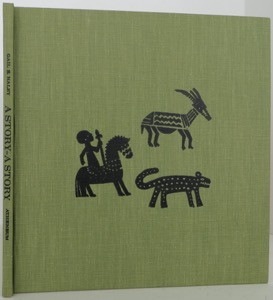
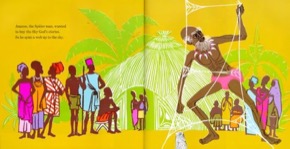
Hardcover. NY, Atheneum Books, reprint, Book: Very Good, Dust Jacket: None, Hardcover, green cloth stamped in black. Color art by Haley. Discover how an African trickster god made it possible for people to tell stories in this brightly illustrated, Caldecott Medal-winning picture book. Long, long ago there were no stories on earth for children to hear. All stories belonged to Nyame, the Sky God. Ananse, the Spider man, wanted to buy some of these stories, so he spun a web up to the sky to bargain with the Sky God. The price the Sky God asked was Osebo, the leopard-of-the-terrible-teeth, Mmboro the hornet-who-stings-like-fire, and Mmoatia the fairy-whom-men-never-see. Can Ananse capture these sly creatures and give the children of earth stories to tell? No dust jacket, clean copy.
Hardcover. NY, Albert & Charles Boni, 3rd pr, 1928, Book: Very Good, Dust Jacket: None, Hardcover, pictorial boards with a black cloth spine. 376 pages with illustrations, endpapers, and cover design by Miguel Covarrubias. Frontispiece loose, otherwise a clean copy.
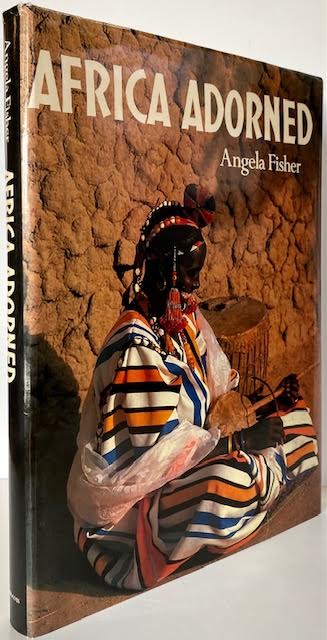
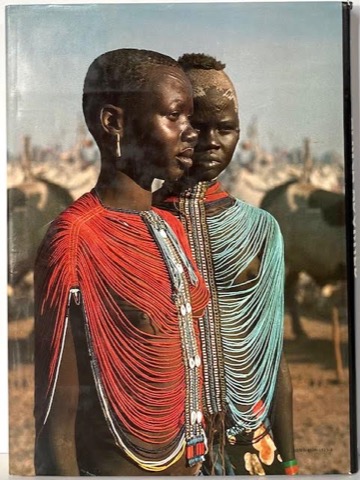
Hardcover. New York, Harry N. Abrams, inc., Reprint, 1985, Book: Very Good, Dust Jacket: Very Good, 304 pages. Hardcover. Color and b/w illustrations throughout (more than 400). Previous owner's bookplate on front endpaper. Brown cloth cover boards, bold gilt title on spine. In beautiful condition. Dust jacket unclipped, has small rip at bottom of front cover and wear at top of spine, otherwise very good. A look at the jewelry and body art of the African people.
Hardcover. NY, Alfred A. Knopf, 1st US, 1935, Book: Very Good, Dust Jacket: None, Hardcover, 337 pages, Index. Black & white photographic illustrations. Cream cloth with red & black illustration and lettering. The exciting story of the author's travels by car with Paris Benga, the famous Negro dancer, on a tour which zigzagged through the French colonies, the French and British mandates, and the Gold Coast to study the native dances in the districts most remote from civilization. This is also a study of the government and religion, the sex-life and marriage ritual, habits and customs, and the emotional and mental character of these West African Negroes. Mild stain to corners of front cover, not affecting the interior. Otherwise clean and tight copy.
Hardcover. New York, Assouline, 1st, 2006, Book: Near Fine, Dust Jacket: Near Fine, 80 pages, color illustrated. In publisher's shrinkwrap. t is not unusual to see the colors and hear the rhythms of Africa at runway shows in Paris, New York, or Milan. But despite its influence on Western designers, African fashion is still struggling to make itself known. With the ambitious goal of reinventing urban fashion, many young African designers are breaking away from the expectations imposed on them to infuse ethnic and folkloric themes into their work. This book brings together archival images, illustrations, and photographs to paint a lively picture of this constantly evolving world, featuring designers and labels including Alphadi, Xule Bet, Oumou Sy, Juliette Ombang, Mickael Kra, and more.
Hardcover. NY, Vantage Press, 1st, 1990, Book: Very Good, Dust Jacket: Very Good, Hardcover in a bright dust jacket, 312 pages. B&w photos in center section. Frontispiece map. A Canadian professor returns to visit the Tanzania village in the Southern Highlands which he left 40 years ago. Clean copy.
Hardcover. London/Colorado, Heinemann/Westview press, 1st, 1977, Book: Very Good, Dust Jacket: None, 310 pages. Yellow cloth, gilt lettering to spine. Lacks dust jacket. Previous owner's signature on front end paper. Else a clean, tight copy.
Hardcover. Westport CT, Negro Universities Press , reprint, 1970, Book: Very Good, Dust Jacket: None, Hardcover, brown cloth with gilt lettering on the spine. Originally published in 1852 this is an in depth study of the African people , both in Africa and in America. A great deal of material on slavery and the South, as well as early material on Liberia. Presented in a series of "conversations", this is an in-depth history of the African continent's peoples, the colonization of Africa, and subsequent African American slavery in the United States. Clean copy.
Hardcover. Boston, Little Brown/Bulfinch, 1st, 1994, Book: Very Good, Dust Jacket: Very Good, Introduction by Judith Jamison. Beautifully clean, new-looking condition. Really nice black & white photos by Ritts. Remainder line bottom edge. Hardbound, dust jacket. Unpaginated, but about 140 pages with some leaves printed one side only. Oblong, 14-1/2 by 12-1/4 inches. Seventy-five duotone photograph reproductions of people, landscapes and animals of Africa. DUE TO WEIGHT, DOMESTIC SHIPPING ONLY.
Hardcover. NY, St Martins Press, reprint, 1988, Book: Very Good, Dust Jacket: Very Good, Hardcover in a bright, unclipped dust jacket. First published in 1935, "This represents an accumulation of letters spanning thirty years the author received from big game hunters including F. C. Selous; C. H. Stigand; R. J. Cunninghame and many others. Most of this correspondence deals with hunting in Africa especially, for the Big Five, and rifle choices for use in various international locales."
Softcover. NY, Scala Arts Publishers/Cornell, 1st, 2020, Book: Very Good, Dust Jacket: None, Softcover, 112 pages illustrated in color. Featuring African textiles, clothing, headwear, and jewelery, this book celebrates African dress as a product of global interactions, generational conflict and continuity, and expressions of gender. Featuring African textiles, clothing, headwear, and jewelery, this book celebrates African dress as a product of global interactions, generational conflict and continuity, and expressions of gender. The book highlights the strength and resilience of long-standing practices that characterize African dress; the wide variety of cultural, religious, and political motivations for adorning oneself; and the varying identities reflected in analyzing African material culture of the last century and a half. Textile selections include hand-woven and dyed examples alongside factory-woven and machine-printed cloth. Items of adornment include amber and silver jewelery from North Africa, beadwork-embellished clothing from South Africa, and various headdresses from across the continent, to name a few examples. From formal European colonization, to independence for African countries, to the liberalization of African economies, this book will demonstrate how dress practices reveal personal and group identities, cultural traditions, religious associations, political affiliations, and aspirations. Clean copy.
Hardcover. NY, Africana Publishing , 1st US, 1974, Book: Very Good, Dust Jacket: Very Good, Hardcover in a bright dust jacket, 268 pages, b&w illustrations. In 1929 the author was awarded a Rhodes Trust Travelling Fellowship witha vague commission to study problems of race and colour. This book contains a section of her diary, essentially as she wrote it, devoted to Southern Africa including the Rhodesias and the Congo. She addressed a huge night time meeting of African workers called by Zulu union organizer, George Champion. In Bechuanaland she met the young and capable regent; in Basutoland she accompanied an Assistant Commissioner on a long trek on horseback into the interior. Thoroughly entertaining it also sets the scene for much of what was to follow in the subsequent history of the territories she visited. Clean copy.
Hardcover. NY, Africana Publishing , 1st US, 1974, Book: Very Good, Dust Jacket: Very Good, Hardcover in a bright dust jacket, 268 pages, b&w illustrations. In 1929 the author was awarded a Rhodes Trust Travelling Fellowship witha vague commission to study problems of race and colour. This book contains a section of her diary, essentially as she wrote it, devoted to Southern Africa including the Rhodesias and the Congo. She addressed a huge night time meeting of African workers called by Zulu union organizer, George Champion. In Bechuanaland she met the young and capable regent; in Basutoland she accompanied an Assistant Commissioner on a long trek on horseback into the interior. Thoroughly entertaining it also sets the scene for much of what was to follow in the subsequent history of the territories she visited. Clean copy.
Hardcover. New York, Thomas Yoseloff, 1st, 1960, Book: Good, Dust Jacket: Fair, 175 pages. Hardcover. 131 Illustrations, 16 color plates. Top corner bump, causing a light crease to pages at upper corner. Otherwise very good, clean. Dust jacket with light edge wear, chipping, mild soil.
Hardcover. London, Church Missionary Society, 1st, 1925, Book: Very Good, Dust Jacket: None, 118 pages, gray cloth with gilt titles, frontispiece color illustration and foreword by Randall Cantuar, Archbishop of Canterbury dated March, 1925. No publication date on copyright page, crease on frontispiece, minor corner and edge wear, otherwise, very clean and tight copy.
Hardcover. London, Macmillan and Co., 1st, 1955, Book: Very Good, Dust Jacket: None, Hardcover, bright blue cloth covers, 243 pages, 13 b/w illustrations. Author was an administrator in East Africa and the West Indies from 1908 to 1944. A memoir of 30 years of colonial rule in Africa by a lifetime member of the British Colonial Service. Beginning with his first glimpse of Africa on a tropical morning as a young man and ends with a last glimpse of Kilimanjaro after spending his entire working life as one of the last servants of the old Empire. Name on front fly leaf, otherwise clean.
Hardcover. Glasgow, Burns, 1st, 1962, Book: Very Good, Dust Jacket: Very Good, Hardcover in a lightly worn dust jacket. The author was a Catholic priest from Liverpool who was recuperating from several operations by sailing around Africa in 1960: his comments on the vovage and on the places where they stopped are very interesting. He chose to visit Africa because he thought it was the 'crossroads of the world' and 'possibly the place where the future of mankind will be decided.' He expresses strong anti-apartheid sentiments, describes visiting the site of the Sharpeville massacre, the pro-Nkrumah sentiment in Kenya, as well as discussions of the history and customs of Africa. Illustrated with photographs. 183 pages.

 "'Mau Mau' Detainee. The Account By a Kenya African of His Experiences in Detention Camps 1953-1960 by: Kariuki, Josiah Mwangi")
 "A History of Rwandan Identity and Trauma: The Mythmakers' Victims by: Fegley, Randall")
 "A History of the Abaluyia of Western Kenya. c. 1500-1930by: Were, Gideon S.")
 "A Last Chance in Kenyaby: Leys, Norman")
 "A Motor Flight Through Algeria and Tunisia by: Ayer, Emma Burbank")
 "A Narrative of the Negro: Missing Pages in American History : Revealing the Services of Negros in the Early Wars in the United States of America 1641-1815by: Wilkes,")
 "A Story- a Story: An African Tale Retold by: Gail E. Haley")
 "Adventures Of An African Slaver Being A True Account Of The Life Of Trader In Gold, Ivory & Slave On Coast Of Guinea; Own Story As Told In 1854 To Brantz Mayerby: Can")
 "Africa Adornedby: Fisher, Angela")
 "Africa and Africans in the Making of the Atlantic World, 1400-1800 by: Thornton, John")
 "Africa Dances: A Book about West African Negroesby: Gorer, Geoffrey")
 "Africa Is in Styleby: Geoffroy-Schneiter, Berenice")

 "Africa Revisited: A Diary of a Sentimental Journey of Returnby: SCHUELER, H. J.")
 "Africa's International Relations: The Diplomacy of Dependency and Changeby: Mazrui, Ali A.")
 "Africa's Redemption. The Salvation of Our Countryby: Freeman, Rev. F.")
 "Africaby: Ritts, Herb")
 "African Adventure: Letters from Famous Big-Game Huntersby: Lyell, Denis D.")
 "African Apparel: Threaded Transformations Across the 20th Centuryby: Ryan, MacKenzie Moon")
 "African Apprenticeship; An Autobiographical Journey In Southern Africa-1929 by: Perham, Margery")
 "African Apprenticeship; An Autobiographical Journey In Southern Africa-1929 by: Perham, Margery")
 "African Artby: Schmalenbach, Werner")
 "African Church in Building, Anby: Willis, Right Rev. J. J.")
 "African Crossroadsby: Dundas, Sir Charles")
 "African Diary by: Ripley, Francis")