Hardcover. NY, Times Books, 1st, 1979, Book: Very Good, Dust Jacket: Good, Hardcover in a lightly worn dust jacket that shows fading, 360 pages, b&w illustrations, endpaper maps. General John Burgoyne was a British army officer, politician and dramatist. He first saw action during the Seven Years' War when he participated in several battles, mostly notably during the Portugal Campaign of 1762. Burgoyne is best known for his role in the American War of Independence. During the Saratoga campaign he surrendered his army of 5,000 men to the American troops on October 17, 1777. Appointed to command a force designated to capture Albany and end the rebellion, Burgoyne advanced from Canada but soon found himself surrounded and outnumbered. He fought two battles at Saratoga, but was forced to open negotiations with Horatio Gates. Although he agreed to a convention, on 17 October 1777, which would allow his troops to return home, this was subsequently revoked and his men were made prisoners. Burgoyne faced criticism when he returned to Britain, and never held another active command. Clean copy.
Hardcover. Chapel Hill, University of North Carolina, 1st, 1991, Book: Very Good, Dust Jacket: Very Good, Hardcover, 514 pages, b&w illustrations, in a bright dust jacket. Biography of Union general Ambrose Burnside, reassessing his reputation as an "incompetent leader" by viewing his entire career as a soldier during the war: along the Carolina coast, at Antietam, and his capture of Knoxville in East Tennessee, while still recognizing the debacle at Fredericksburg.
Hardcover. New York, Harper and Brothers, reprint, 1890, Book: Very Good, Dust Jacket: None, Hardcover, blue cloth with gilt lettering and design, 295 pages, frontispiece portrait of author. The Indian War of 1876 in the Big Horn and Yellowstone campaigns. Previous owner's inscription on front fly leaf. Light fraying to bottom of spine otherwise very good, clean.
Hardcover. NY, Time Life, reprint, 1981, Book: Very Good, Dust Jacket: None, 546 pages. Hardcover with no dust jacket. Dark blue leather bound with gilt titles to front cover and spine. Embossed decoration on front cover. Gilt text block edges, red ribbon marker. Clean, tight copy.In 1863 Horace Porter, then a captain, met Ulysses S. Grant as Grant commenced the campaign that would break the Confederate siege at Chattanooga. After a brief stint in Washington, Porter rejoined Grant, who was now in command of all Union forces, and served with him as a staff aide until the end of the war. Porter was at Appomattox as a brevet brigadier general, and this work, written from notes taken in the field, is his eyewitness account of the great struggle between Lee and Grant that led to the defeat of the Confederacy.
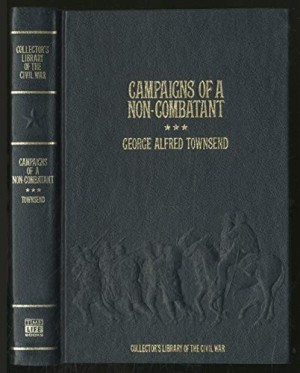
Hardcover. NY, Time Life, reprint, 1982, Book: Very Good, Dust Jacket: None, Hardcover with no dust jacket. Dark blue leather bound with gilt titles to front cover and spine. Embossed decoration on front cover. Gilt text block edges, red ribbon marker. Clean, tight copy. Facsimilie reprint of the 1866 edition.
Hardcover. Norman, OK, University of Oklahoma Press (, 1st, 1989, Book: Very Good, Dust Jacket: Very Good, Hardcover, 415 pages, b&w illustrations. Light edge wear to dust jacket, creases to front flap. Light soiling to edges. Else a clean, tight copy. The first major battle between the U.S. Army and the Cheyenne Indians took place on the south fork of the Solomon River in present-day northwest Kansas. In this stirring account, William Y. Chalfant recreates the human dimensions of what was probably the only large-unit sabre charge against the Plains tribes, in a battle that was as much a clash of cultures as of cavalry and Cheyenne warriors.
Hardcover. Urbana IL, University of Illinois Press, 1st, 1958, Book: Very Good, Dust Jacket: Very Good, Hardcover in a lightly worn dust jacket, 262 pages, b&w illustrations. A studied volume by an English military man and on-site witness to many of the events of the American Civil War enhanced with 16 pages of contemporary B&W photographs and drawings. The book was originally published in the 1860s and is one of the finest and most informative of the few records left by outside observers of the Confederacy in its own time. Name on front fly leaf otherwise clean.
Hardcover. NY, Time Life, reprint, 1983, Book: Very Good, Dust Jacket: None, 401 pages. Hardcover with no dust jacket. Dark blue leather bound with gilt titles to front cover and spine. Embossed decoration on front cover. Gilt text block edges, red ribbon marker. Clean, tight copy. This is one of the more impressive (and unfortunately little known) records of the American Civil War. John Beatty was a lawyer from Ohio who joined the Union Army when the South seceded. He started his service in western Virginia under General George B. McClellan. Although McClellan would later become one of the most well-known generals of the war, it was here that he first achieved the prominence that would lead to Lincoln promoting him to head Union forces on two separate occasions. Beatty, however, was clearly not enamored of McClellan. His journal opens with a description of arriving in one of the local railroad communities and subsequent entries describe the minutiae of camp life. Beatty is relatively unique among memoirists in that his book is largely a transcription of his original diary. As a result, his recollections are of recent events and have a degree of candor not present in many post-bellum narratives.
Softcover. Freetown MA, Freetown Historical Society, 1st, 2005, Book: Very Good, Dust Jacket: None, Softcover, light gray wrappers, 327 pages. John Milton Deane (January 8, 1840 - September 2, 1914), was an American Civil War Medal of Honor recipient and a major in the United States Army. Deane was born in Assonet, Massachusetts to John and Lydia (Andros) Deane. The diary he kept is here type-written out in chronological order. B&w photo of Deane as a Lieutenant in 1863. Clean, like new.
Hardcover. Freeport, NY, Books for Libraries Press, reprint, 1970, Book: Very Good, Dust Jacket: None, 165 pages. Blue cloth cover, very light wear to corners and edges, bottom edge slightly bumped. Some foxing and shadowing on front and rear endpages, otherwise inside is bright and clean. Three pages have light markings by previous owner, otherwise inside in unmarked. A nice, tight copy.
Hardcover. NY, Knopf, 1st, 1990, Book: Very Good, Dust Jacket: Very Good, Hardcover in a bright dustjacket, 402 pages, b&w illustrations. The biography of a seminal figure in American public life, whose active career spanned the years from Theodore Roosevelt through the early Cold War. Stimson was an intimate friend of Theodore Roosevelt's, and was the crucial figure linking Roosevelt's imperialist expansionism to the world of Truman, Eisenhower, and Kennedy.
Hardcover. York, George Shumway, 1st, 1978, Book: Very Good, Dust Jacket: Fair, 71 pages. Hardcover. Black & white illustrations. Stain along dust jacket spine and edge of front and rear dust jacket cover. No slipcase. Clean, tight copy.
Hardcover. New York, Appleton & Co., 1st, 1900, Book: Good, Dust Jacket: None, Hardcover, light green cloth with gilt and b&w decoration, 480 pages. Top edge gilt. Front and rear hinges tender. Cloth covers rubbed at corners and along edges. Clean copy.
Hardcover. NY, Time Life, reprint, 1984, Book: Very Good, Dust Jacket: None, 480 pages. Hardcover with no dust jacket. Dark blue leather bound with gilt titles to front cover and spine. Embossed decoration on front cover. Gilt text block edges, red ribbon marker. Clean, tight copy. A well written and well thought out story of the Confederate Secret Service. Headley tells the little known and forgotten story of Confederate operations in Canada.
Hardcover. Kent, OH, The Kent State University Press, 1st, 1998, Book: Very Good, Dust Jacket: Very Good, 348 pages. Hardcover with dust jacket. Very clean, unmarked copy still in publishers shrink-wrap. Conrad Wise Chapman (1842-1910) is unique among Civil War artists: he painted and sketched while on duty as a Confederate soldier who served in three theaters of the war. Chapman's first-hand knowledge is evident in his work. Ben Bassham has written both a critical study of Chapman's art and a biography, incorporating Chapman's correspondence and Civil War memoirs.
Hardcover. Boston, Little, Brown and Company, 2nd pr., 1950, Book: Very Good, Dust Jacket: None, Hardcover, blue cloth with gilt lettering on spine. Volume IV in The History of United States Naval Operations in World War II. 307 pages, illustrated with maps (one fold-out) and b&w photos. Gilt on spine with light fading, lacks dust jacket, otherwise clean, tight copy.
Hardcover. NY, Stein & Day, 1st, 1982, Book: Very Good, Dust Jacket: Very Good, Hardcover in a bright dust jacket. General MacArthur's troops retreated here after the first surrender ever of an American Army in the Field, on the Bataan Peninsula. Reenacts the events of the Bataan and Corregidor battles of World War II through the eyes of the doctors, nurses, and soldiers interviewed after the war. Clean copy.
Hardcover. New York, Charles Scribner's Sons, 1st, 1898, Book: Very Good, Dust Jacket: None, Hardcover, tan cloth covers stamped in blue and red, 360 pages. 116 b&w photos throughout, color maps in rear. In 1898 America intervened in the Cuban War of Independence, leading to conflict with Spain. This is a detailed account of this campaign, together with American military sea and land operations on the island of Puerto Rico during the Spanish American War. Cloth spine darkened otherwise clean, tight copy.
Hardcover. Philadelphia, J.B. Lippincott, 2nd Ed., 1865, Book: Very Good, Dust Jacket: None, Hardcover, dark green pebbled cloth with gilt lettering on spine, 4" x 6 1/4", 303 pages including index. A detailed instructional guide for the Civil War era soldier. Copyright page states 1964, title page says 1865. Probably a second edition. Still scarce in this nice condition. A few pages with dog ears, previous owner's pencil signature on front fly leaf. Otherwise clean, tight copy.
Hardcover. NY, Time Life, reprint, 1982, Book: Very Good, Dust Jacket: None, 288 pages. Hardcover with no dust jacket. Dark blue leather bound with gilt titles to front cover and spine. Embossed decoration on front cover. Gilt text block edges, red ribbon marker. Light scuffing to fore edge gilt. Otherwise, clean, tight copy. A History of the Andrews Railroad Raid into Georgia in 1862, Embracing a Full and Accurate Account of the Secret Journey to the Heart of the Confederacy, the Capture of a Railway Train in a Confederate Camp, the Terrible Chase that Followed, and the Subsequent Fortunes of the Leader and His Party. Reprint of the 1877 edition.
Hardcover. NY, Time Life, reprint, 1983, Book: Very Good, Dust Jacket: None, 274 pages. Hardcover with no dust jacket. Dark blue leather bound with gilt titles to front cover and spine. Embossed decoration on front cover. Gilt text block edges, red ribbon marker. Clean, tight copy. This memoir by Confederate General Richard Taylor is usually considered one of the best and least biased by a general officer. The work is full of considered analysis on both the strategy of the war and the personalities of his fellow officers. Taylor is always fair in his criticism and seems to have no real scores to settle. While he makes little mention of his own talents, his tactical brilliance and strategic insight does shine through. Many contemporaries said Richard Taylor was one of the best soldiers of the war, but he is comparatively little known due to his posting to peripheral theaters. While he was a man of his time, the work (with the exception of some of his Reconstruction writings) is much less tainted by Lost Cause polemics than most Confederate memoirs.
Hardcover. NY, Time Life, reprint, 1982, Book: Very Good, Dust Jacket: None, 224 pages. Hardcover with no dust jacket. Dark blue leather bound with gilt titles to front cover and spine. Embossed decoration on front cover. Gilt text block edges, red ribbon marker. Clean, tight copy. This Civil War classic of soldiering in the ranks debunks all the romantic notions of war. Like his Northern counterpart, the Confederate soldier fought against bullets, starvation, miserable weather, disease, and mental strain. But the experience was perhaps even worse for Johnny Reb because of the odds against him. Never as well equipped and provisioned as the Yankee, he nevertheless performed heroically. Carlton McCarthy, a private in the Army of Northern Virginia, describes the not-always-regular rations, various improvisations in clothing and weaponry, etc.
Hardcover. New York, Hovendon & Co., 1st, 1899, Book: Very Good, Dust Jacket: None, 366 pages. Blue cloth covers with bright gilt and 3-color design. Illustrated with black & white engravings and color plates. Previous owners inscription on front endpaper. Light fraying at top and bottom of spine. Otherwise clean, tight copy.

 "Burgoyne of Saratoga: A Biography by: Gerald Howson")
 "Burnsideby: Marvel, William")
 "Campaigning With Crook and Stories of Army Lifeby: King, Captain Charles")
 "Campaigning with Grant (Collector's Library of the Civil War)by: Porte, Horace")
 "Campaigns of a Non-Combatant, and His Romaunt Abroad During the War (Collector's Library of the Civil War)by: Townsend, George Alfred")

 "Cheyennes and Horse Soldiers: The 1857 Expedition and the Battle of Solomon's Forkby: Chalfant, William Y.")
 "Cities and Camps of the Confederate Statesby: Fitzgerald Ross, Editor: Richard Barksdale Harwell")
 "Citizen-Soldier, The; Or, Memoirs of a Volunteer (Collector's Library of the Civil War)by: Beatty, John")
 "Civil War Diaries of Major John M. Deane: 1861-1865by: John Milton Deane")
 "Civil War: A Narrative - 3 Volumes, Theby: Foote, Shelby")

 "Colonel The: The Life and Wars of Henry Stimson 1867 - 1950 by: Hodgson, Godfrey")
 "Colonial Riflemen in the American Revolutionby: Huddleston, Joe D.")
 "Commodore Paul Jonesby: Brady, Cyrus Townsend")
 "Confederate Operations in Canada and New York (Collector's Library of the Civil War)by: Headley, John W.")
 "Conrad Wise Chapman: Artist and Solider of the Confederacyby: Bassham, Ben")
 "Coral Sea, Midway and Submarine Actions: May 1942-August 1942 (History of United States Naval Operations in World War Ii, Volume 4)by: Morison, Samuel Eliot")
 "Corregidor: The End of the Line by: Eric Morris")
 "Cuban and Porto Rican Campaigns, Theby: Davis, Richard Harding")
 "Customs Of Service for Non Commissioned Officers and Soldiers as Derived from Law and Regulations and Practised in the Army of the United States by: Kautz, August V.")
 "Daring and Suffering: A History of the Great Railroad Adventure (Collector's Library of the Civil War)by: Pittenger, William")
 "Destruction and Reconstruction - Personal experiences of the late war (Collector's Library of the Civil War)by: Taylor, Richard")
 "Detailed Minutiae of Soldier Life in the Army of Northern Virginia, 1861-1865 (Collector's Library of the Civil War)by: McCarthy, Carlton")
 "Dewey and Other Naval Commandersby: Ellis, Edward S.")