Hardcover. NY, Columbia University Press, 1st, 1978, Book: Very Good, Dust Jacket: Very Good, Hardcover in a bright dust jacket, 295 pages including index.The polymathic Rivers was a pioneering neuroscientist, psychologist, and anthropologist who made substantial contributions to all these fields in the pre-WWI period. Interest in Rivers increased in recent years because he appears as a major and particularly sympathetic character in Pat Barker's outstanding trilogy of novels on WWI. Slobodin's book, which is the only effort at a biography of Rivers, deals mainly with his work as a pioneering ethnologist. Light foxing to rear dj panel, otherwise clean.
Hardcover. Cambridge UK, Cambridge University Press, 1st, 1986, Book: Very Good, Dust Jacket: None, Hardcover, green cloth with black and gilt stamping, 291 pages. Gift exchange plays a crucial role in the social and political organization of Mendi in Papua New Guinea. This book reveals how considerable light can be shed on Mendi society, particularly on its political economy, by examining both the well-known ceremonial exchange festivals and the hitherto relatively little-studied everyday gift-giving practices. The author shows that the latter are crucial for understanding inter-group politics, the process of leadership, male-female relationships and the status of women, and the production, distribution and circulation of wealth. Currently the only book available on this society, the work offers an unusual combination of a social structural analysis with a study of local history and change. It is also of interest for its integration of the study of gift exchange and politics with the study of gender roles and relationships. Clean, bright copy.
Softcover. Madison WI, University of Wisconsin Press, reprint, 1977, Book: Very Good, Dust Jacket: None, Softcover, 295 pages. Wisconsin Chippewa Myths & Tales, originally published in 1977, was the first collection of Chippewa folklore to provide a comparative and sociological context for the tales. These myths and tales were recorded between 1941 and 1944 by four young field workers who later became prominent anthropologists: Joseph B. Casagrande, Ernestine Friedl, Robert E. Ritzenthaler, and Victor Barnouw himself. The tales--which include stories of tricksters, animals, magical powers, and cannibal ice-giants--were told primarily by five members of the Lac Court Oreilles and Lac du Flambeau bands of Chippewa: John Mink, Prosper Guibord, Delia Oshogay, Tom Badger, and Julia Badger. Wisconsin Chippewa Myths & Tales is read as much for its fascinating stories as for its scholarship.
Hardcover. Honolulu, University of Hawaii Press, 1st, 1995, Book: Good, Dust Jacket: None, Hardcover, red cloth stamp in gilt, 197 pages, b&w maps. (Pacific Islands Monograph Series No. 12) An imaginative and thought-provoking study of clowning in Rotuma, especially of ritual clowning in contexts of marriage ceremonies and the weaving of fine mats. Pencil marking throughout text.
Hardcover. University of Chicago, 1st, 1978, Book: Very Good, Dust Jacket: Very Good, Hardcover in a nice dust jacket. 368 pages, index, bibliography, diagrams. Pigs, yams, women and valuables are items of exchange throughout Papua New Guinea. Ceremonial exchange does not arise from economic necessity, rather a social phenomenon reflecting interplay between kinship and marriage structures, the nature of political leadership and the religious and symbolic systems found in these cultures. This work copares 13 New Guinea societies focusing on these distinctive ceremonial exchanges. Clean copy.
Hardcover. Milan, Skira, 1st, 2001, Book: Very Good, Dust Jacket: Very Good, Hardcover, 224 pages. An outstanding photographic monograph from the Twenties and Thirties brings back the memory of ways of living, ceremonies, adorned bodies of an Africa that be aptly defined as "lost". These extraordinary, unpublished pictures, taken with great technical skill and with a sense of great dignity of the people portrayed, constitute a monument to the African continent as it was. Kazimir Ostoja Zagourski (1880-1941) was born in Poland and moved to Congo in 1924. Zagourski was the first professional photographer to travel throughout the interior of Congo and visited also the neighboring countries, Tchad, Rwanda, Burundi, Uganda, Kenya, and South Africa. During his long stay in Africa he took hundred of pictures, 500 of which, divided in two extraordinary series on different tribes, build up to a unique historic and ethnographic survey. In a sense, Zagourski's work constitutes the first "non-European" look, devoid of the colonial overtones that characterize much contemporary work. His forays into the depths of the African continent took him into the most remote villages of Kuba, Mangbetu, Bwaka, Tutsi, Masai, etc. where he took unprecedented pictures of great ethnographic interest. he documented for example, ceremonies (initiation, circumcision, excision, masked dances, etc.), the great African creativity in body ornament (from scarification to hair dresses, from jewels to lip plugs), clothes and all utilitarian objects placed in their appropriate cultural context (musical instruments, shields, stools, knives, containers, etc.).
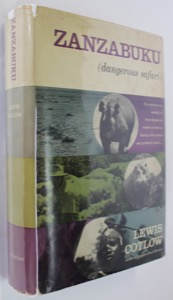
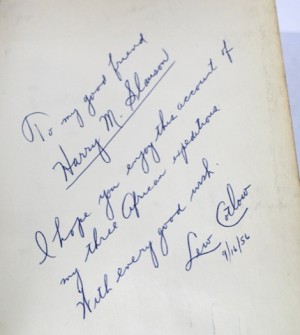
Hardcover. New York , Rinehart & Company, Inc., 1st, 1956, Book: Good, Dust Jacket: Fair, 370 pages. INSCRIBED BY AUTHOR TO HARRY M. SLAUSON ON FRONT ENDPAPER, LETTER TO SLAUSON FROM COTLOW ADHERED TO INSIDE FRONT COVER. Illustrated with black & white photographs. Green cloth cover, some wear to corners and edges. Dust jacket with chipping along edges, rear cover with stain on bottom edge - jacket now protected with clear plastic cover.
Hardcover. University of Texas Press, 1st, 1974, Book: Very Good, Dust Jacket: Good, Hardcover, with a foreword by Howard S. Becker, red cloth; gilt titles; 166 pages.; b/w illustrations; some edgewear and spine sunning to price-clipped dust jacket, INSCRIBED BY SELBY on front fly leaf. clean copy.

 "W.H.R. Rivers by: Richard Slobodin")
 "What Gifts Engender: Social Relations and Politics in Mendi, Highland Papua New Guinea by: Rena Lederman")
 "Wisconsin Chippewa Myths & Tales and Their Relation to Chippewa Lifeby: Victor Barnouw")
 "Woven Gods: Female Clowns and Power in Rotuma by: Vilsoni Hereniko")
 "Your Own Pigs You May Not Eat: A Comparative Study of New Guinea Societiesby: Abraham Rosman, Paula G. Rubel")
 "Zagourski: Africa Lostby: Pierre Loos")
 "Zambia Before 1890: Aspects of Precolonial History (SIGNED COPY)by: Langworthy, Harry W.")
 "Zanzabuka (Dangerous Safari): The Adventurous Account of Three Dangerous Safaris to Africa, Filming Wild Animals and Primitive Tribes (SIGNED COPY)by: Cotlow, Lewis")
 "Zapotec Deviance: the Convergence of Folk and Modern Sociology (SIGNED COPY) by: Selby, Henry A.")