Softcover. NY, Palgrave Macmillan, 1st, 2001, Book: Very Good, Dust Jacket: None, Softcover, 337 pages. Now a widely cited classic, this innovative book is the first comprehensive synthesis of economic, political, and cultural theories of value. David Graeber reexamines a century of anthropological thought about value and exchange, in large measure to find a way out of ongoing quandaries in current social theory, which have become critical at the present moment of ideological collapse in the face of Neoliberalism. Rooted in an engaged, dynamic realism, Graeber argues that projects of cultural comparison are in a sense necessarily revolutionary projects: He attempts to synthesize the best insights of Karl Marx and Marcel Mauss, arguing that these figures represent two extreme, but ultimately complementary, possibilities in the shape such a project might take. Graeber breathes new life into the classic anthropological texts on exchange, value, and economy. He rethinks the cases of Iroquois wampum, Pacific kula exchanges, and the Kwakiutl potlatch within the flow of world historical processes, and recasts value as a model of human meaning-making, which far exceeds rationalist/reductive economist paradigms. Clean copy.
Hardcover. Washington D. C., Island Press, First Edition, 1996, 235 pages. Hardcover. Off white cloth boards with orange titles to spine. Bright dust jacket with only light marginal wear. Very clean & unmarked. Crisp, tight copy.
Hardcover. London, Routledge and Kegan Paul, 1st, 1951, Book: Very Good, Dust Jacket: Good, Hardcover in a worn dust jacket. Summary of the effects of German, Japanese and Australian occupation and the subsequent cultural adjustments to change. Based on years of field and background research. Very detailed records of religion, work, trade, councils and courts, community dynamics. Illustrated by 2 maps, 16 pages of plates, 326 pages including index. Owner's signature on inside front cover, otherwise clean.
Softcover. UK, Cambridge University Press, reprint, 2005, Book: Very Good, Dust Jacket: None, Softcover, 299 pages, b&w illustrations. Brooke Larson's interpretive analysis of the history of Andean peasants reveals the challenges of nation making in the republics of Colombia, Ecuador, Peru, and Bolivia during the volatile nineteenth century. Nowhere in Latin America were postcolonial transitions more turbulent than in the Andes, where communal indigenous roots grew deep and where the "Indian problem" seemed so discouraging to liberalizing states. The analysis raises broader issues about the interplay of liberalism, racism, and ethnicity in the formation of exclusionary "republics without citizens" over the nineteenth century.
Softcover. Cambridge MA, Peabody Museum, 1st, 1947, Book: Very Good, Dust Jacket: None, Softcover, 527 pages, 10.25 x 7.75 inches. Scarce ethnological and archeological study of Liberia's culture and myths. Large fold-out colored map, measuring 20.25 x 43 inches, is slipped into the inner rear cover. Copious illustrations and diagrams throughout. Light chipping to paper covers but with a very good interior. Previous owner's signature on front fly leaf otherwise clean.
Hardcover. Chicago, University Of Chicago Press, 1st, 1980, Book: Very Good, Dust Jacket: Very Good, Hardcover in a lightly worn dust jacket. 187 pages. Summary: Tuhami is an illiterate Moroccan tilemaker who believes himself married to a camel-footed she-demon. A master of magic and a superb story-teller, Tuhami lives in a dank, windowless hovel near the kiln where he works. Nightly he suffers visitations from the demons and saints who haunt his life, and he seeks, with crippling ambivalence, liberation from 'A'isha Qandisha, the she-demon. In a sensitive and bold experiment in interpretive ethnography, Crapanzano presents Tuhami's bizarre account of himself and his world. In so doing, Crapanzano draws on phenomenology, psychoanalysis, and symbolism to reflect upon the nature of reality. Two pages with check mark/lines in margin, otherwise clean.
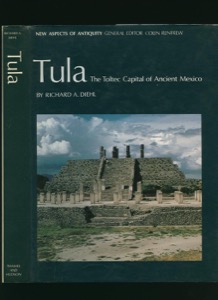
Hardcover. NY, Thames & Hudson , 1st, 1983, Book: Very Good, Dust Jacket: Very Good, Hardcover in a bright dust jacket, 184 pages. Traces the rise and fall of the Toltec civilization, and describes what has been learned about their culture from the excavation of Tula, their principal city. 130 illustrations, 15 in color.
Softcover. Lincoln NE, Bison Books, reprint, 2004, Book: Very Good, Dust Jacket: None, Softcover, 368 pages. Documents the generations of Native peoples who for twelve millennia have moved through and eventually settled along the rocky coast, rivers, lakes, valleys, and mountains of a region now known as Maine. Arriving first to this area were Paleo-Indian peoples, followed by maritime hunters, more immigrants, then a revival of maritime cultures. Beginning in the sixteenth century, Native peoples in northern New England became tangled in the far-reaching affairs of European explorers and colonists. Twelve Thousand Years reveals how Penobscots, Abenakis, Passamaquoddies, Maliseets, Micmacs, and other Native communities both strategically accommodated and overtly resisted European and American encroachments. Clean copy.
Hardcover. London, The Athlone Press, 1st, 1956, Book: Very Good, Dust Jacket: None, Hardcover, red cloth covers, 94 pages, bibliography. Previous owner's name otherwise a clean copy, no dust jacket.
Hardcover. Chicago, University of Chicago Press, 1st, 1987, Book: Very Good, Dust Jacket: Very Good, Hardcover in a lightly sunned dust jacket, 233 pages, b&w illustrations. Memoir of the author's experience living in a Botswana village. Glossary and A Note on the Setswana Language at back. Clean copy.
Softcover. Seattle, University of Washington Press, reprint, 1993, Book: Very Good, Dust Jacket: None, Softcover, 255 pages, b&w photos. A Peace Corps worker sent to the Sakel to establish a fish-farming project, the author lived with a family in a tiny Sengalese village near the Mauretania border. We share her initial feelings of dislocation as she contends not only with a primitive lifestyle, lack of creature comforts, and the overt sexism of the Moslem men she supervises, but also with her burgeoning relationships with the women in the little compound who become as much her family as her relatives in America. In a guileless narrative filled with affection and anger, Lowerre tells of the ill health and bureaucratic failings that beset her; she acknowledges the Pulaar people's love and good humor, and offers an unprettified closeup of daily life in an African village. Clean copy.
Softcover. Philadelphia, University of Pennsylvania Museum of Archaeology and Anthropology, 2nd Ed., 1997, Book: Very Good, Dust Jacket: None, Softcover, 247 pages, b&w drawings throughout. .This volume is designed to function as a self-teaching tool to help the neophyte, and yet be of value to scholars. It introduces the latest methods of analysis, illustrates techniques for computing Maya calendrics, uses the currently accepted orthography, provides syllabary and syntax, suggests new glyph readings, and presents various interpretations. The second edition includes updated versions of three publications on Maya hieroglyphs. Serving as a self-teaching tool, it introduces analysis methods, calendrics, orthography, syllabary, syntax, new glyph readings, and interpretations for both beginners and scholars. Light fading to spine, clean copy.
Softcover. Los Angeles, Society for Visual Anthropology, 1st, 1994, Book: Very Good, Dust Jacket: None, Softcover, magazine format, 108 pages. illustrated collection of provocative essays, occasional pieces, and dialogues with contributions from anthropologists, from cultural, literary and film critics and from image makers themselves. Includes: Narrative in a Papua New Guinean Swamp; Opportunities for 'Double Voicing' in Ethnographic Film; Images of Woman in Current Chinese Television Advertising; Interview with Filmaker Bob Connolly, other essays and reviews. Clean.
Softcover. Los Angeles, Society for Visual Anthropology, 1st, 1995, Book: Very Good, Dust Jacket: None, Softcover, magazine format, 144 pages. illustrated collection of provocative essays, occasional pieces, and dialogues with contributions from anthropologists, from cultural, literary and film critics and from image makers themselves. Includes: Articles on the cinema of Tim Asch, Paradise by James Clifford (on Papua New Guinea), Subtitling Ethnographic Films, other essays and reviews. Clean.
Softcover. Los Angeles, Society for Visual Anthropology, 1st, 1992, Book: Good, Dust Jacket: None, Softcover, magazine format, 144 pages. illustrated collection of provocative essays, occasional pieces, and dialogues with contributions from anthropologists, from cultural, literary and film critics and from image makers themselves. Includes: Shoot for the Contents, Films of Memory, Encounter with a Road Siren, other essays and reviews. Light rubbing to covers. Clean.
Softcover. Los Angeles, Society for Visual Anthropology, 1st, 1992, Book: Very Good, Dust Jacket: None, Softcover, magazine format, 120 pages. illustrated collection of provocative essays, occasional pieces, and dialogues with contributions from anthropologists, from cultural, literary and film critics and from image makers themselves. Includes: Reading Trash, Artaud, Rouch, & the Cinema of Cruelty; Remembering the Revolution, Forgetting the Empire; 'Thirty Centuries, the Splendors of Mexico'; What Is Real About Virtual Reality?; Marketing Alterity, other essays and reviews. Clean.
Softcover. Los Angeles, Society for Visual Anthropology, 1st, 1993, Book: Very Good, Dust Jacket: None, Softcover, magazine format, 180 pages. illustrated collection of provocative essays, occasional pieces, and dialogues with contributions from anthropologists, from cultural, literary and film critics and from image makers themselves. Special Issue on feminist approaches to the visualization of culture, other essays and reviews. Clean.
Softcover. Los Angeles, Society for Visual Anthropology, 1st, 1993, Book: Very Good, Dust Jacket: None, Softcover, magazine format, 180 pages. illustrated collection of provocative essays, occasional pieces, and dialogues with contributions from anthropologists, from cultural, literary and film critics and from image makers themselves. Special Issue on feminist approaches to the visualization of culture, other essays and reviews. Clean.
Softcover. Los Angeles, Society for Visual Anthropology, 1st, 1991, Book: Very Good, Dust Jacket: None, Softcover, magazine format, 124 pages. illustrated collection of provocative essays, occasional pieces, and dialogues with contributions from anthropologists, from cultural, literary and film critics and from image makers themselves. Includes: Post-Bourgeois Tattoo, The Ethnographer's Tale, Who's Story Is It?, other essays and reviews. Clean.
Hardcover. Seattle, University of Washington Press], 1st, 1967, Book: Very Good, Dust Jacket: Good, Hardcover in a lightly worn dust jacket, 282 pages. Clean copy.

 "Tongan Society at the time of Captain Cook's visits: Discussions with Her Majesty Queen Salote Tupouby: Elizabeth Bott/with the assistance of Tavi")
 "Toward An Anthropological Theory of Value: The False Coin of Our Own Dreamsby: David Graeber")
 "Traces of an Ominvoreby: Shepard, Paul/Jack Turner")
 "Transformation Scene: The Changing Culture of a New Guinea Villageby: Hogbin, Ian")
 "Trials of Nation Making: Liberalism, Race, and Ethnicity in the Andes, 1810??\"1910by: Brooke Larson")

 "Tuhami: Portrait of a Moroccanby: Crapanzano, Vincent")
 "Tula: the Toltec Capital of Ancient Mexicoby: Richard A. Diehl")

 "Twelve Thousand Years: American Indians in Maine by: Bruce J. Bourque")
 "Two Studies of Kinship in London (London School of Economics Mongraphs on Social Anthropology, No.15)by: Firth, Raymond (ed.)")
 "Under African Sunby: Marianne Alverson")
 "Under the Neem Treeby: Susan Lowerre")
 "Understanding Maya Inscriptions: A Hieroglyph Handbookby: Harris John F. and Stephen K. Stearns")
 "Vaudou/Voodoo/Vuduby: Jean-Dominique Burton, Jean-Dominique Burton")
 "Vermont's Stone Chambers: An Inquiry into Their Pastby: Neudorfer, Giovanna")
![Vestiges of a Proud Nation the Ogden B. Read Northern Plains Indian Collectionby: Markoe, Glenn J. [Ed.]](javascript:largeIMTop('https://www.browsingisarousing.com/shop/images/Vestiges-of-a-Proud-Nation-the-Ogden-B.-Read-Northern-Plains-Indian-Collection_by_Markoe-Glenn-J.-Ed378701-411947.jpg','https://www.browsingisarousing.com/shop/images/Vestiges-of-a-Proud-Nation-the-Ogden-B.-Read-Northern-Plains-Indian-Collection_by_Markoe-Glenn-J.-Ed378701-411947.jpg',0,'378701',0,'') "Vestiges of a Proud Nation the Ogden B. Read Northern Plains Indian Collectionby: Markoe, Glenn J. [Ed.]")
 "Visual Anthropology Review: Volume 10 Number 2/Fall 1994by: N/A")
 "Visual Anthropology Review: Volume 11 Number 1/Spring 1995by: N/A")
 "Visual Anthropology Review: Volume 8 Number 1/Spring 1992by: N/A")
 "Visual Anthropology Review: Volume 8 Number 2/Fall 1992by: N/A")
 "Visual Anthropology Review: Volume 9 Number 1/Spring 1993by: N/A")
 "Visual Anthropology Review: Volume 9 Number 1/Spring 1993by: N/A")
 "Visual Anthropology Review: Volume7 Number 2/Fall 1991by: N/A")
 "Voyagers of the Vitiaz Strait: A Study of a New Guinea Trade System by: Thomas G. Harding")