Hardcover. NY, Basic Books, 1st, 1968, Book: Very Good, Dust Jacket: Very Good, Hardcover in a bright, unclipped dust jacket, 172 pages. This study examines the realities that the Free North held a substantial population who opposed the abolition of slavery, describing the history of this phenomenon and the attendant aspects of racism towards Black Americans during this period. Name on front fly leaf, otherwise clean.
Softcover. New York, Stewart, Tabori & Chang, 1st, 1991, Book: Very Good, Dust Jacket: None, Softcover, 208 pages. Illustrated with black & white photographs by Charles Moore. With photographs throughout at the Selma March of 1965, of the Ku Klux Klan in North Carolina, of voter registration in Mississippi and more. With text by Michael S. Durham and an introduction by Andrew Young. Clean, tight copy.
Hardcover. Ithaca NY, Cornell University Press, 2nd pr., 1975, Book: Very Good, Dust Jacket: Good, Hardcover in a lightly worn, rubbed dust jacket, 576 pages. Name on front fly leaf, otherwise clean.
Hardcover. NY, Negro Universities Press, reprint, 1969, Book: Very Good, Dust Jacket: None, Hardcover, 175 pages. Brown cloth covers with gilt lettering. Originally published in 1864 by the American Anti-Slavery Society. Introduction by William Lloyd Garrison, President. Name on front fly leaf, otherwise clean.
Softcover. NY, W. W. Norton & Company, 1st, 2000, Book: Very Good, Dust Jacket: None, Softcover, 348 pages. Reflections in Black, the first comprehensive history of black photographers, is a groundbreaking pictorial collection of African American life. Featuring the work of undisputed masters such as James VanDerZee, Gordon Parks, and Carrie Mae Weems among dozens of others, this book is a refutation of the gross caricature of black life that many mainstream photographers have manifested by continually emphasizing poverty over family, despair over hope. Nearly 600 images offer rich, moving glimpses of everyday black life, from slavery to the Great Migration to contemporary suburban life, including rare antebellum daguerrotypes, photojournalism of the civil rights era, and multimedia portraits of middle-class families. DUE TO WEIGHT, DOMESTIC SHIPPING ONLY.
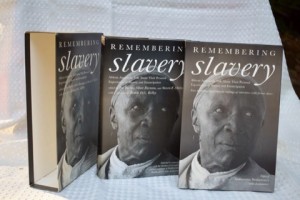
Hardcover. NY, The New Press , 1st, 1998, Book: Very Good, Dust Jacket: Very Good, Hardcover book with a bright dust jacket in a slipcase that also includes interview tapes. A startling first-person history of slavery. Using excerpts from the thousands of interviews conducted with ex-slaves in the 1930s by researchers working with the Federal Writers' Project, the astonishing audiotapes made available the only known recordings of people who actually experienced enslavement-recordings that had gathered dust in the Library of Congress until they were rendered audible for the first time specifically for this set. Two sixty-minute audiotapes: the first is original recordings of former slaves recorded in the 1930s, the second features dramatic readings by Esther Rolle, James Earl Jones and other black artists. Foreword by Robin D. G. Kelley.
Hardcover. Orangeburg SC, Sandlapper Publishing, 2nd pr., 1987, Book: Very Good, Dust Jacket: Good, Hardcover, 120 pages, b&w illustrations. The author documents the customs and lifestyles of a proud group of Sea Island blacks. Beginning with the first freedmen and their descendents, he reveals a colorful and provocative story, told in words of island natives and illustrated with photographs taken around the turn of the century. INSCRIBED BY DAISE on the half-title page. Clean copy with color fading to dust jacket spine and part of front cover.
Softcover. Columbia SC, S.C. Department of Archives and History, 1st, 1995, Book: Very Good, Dust Jacket: None, Softcover, 38 pages, b&w illustrations. Clean copy.
Hardcover. NY, Oxford University Press, 1st, 1999, Book: Very Good, Dust Jacket: Very Good, Hardcover in a bright, unclipped dust jacket. 455 pages, b&w illustrations. From John Hope Franklin, America's foremost African American historian, comes this groundbreaking analysis of slave resistance and escape. A sweeping panorama of plantation life before the Civil War, this book reveals that slaves frequently rebelled against their masters and ran away from their plantations whenever they could. For generations, important aspects about slave life on the plantations of the American South have remained shrouded. Historians thought, for instance, that slaves were generally pliant and resigned to their roles as human chattel, and that racial violence on the plantation was an aberration. In this precedent setting book, John Hope Franklin and Loren Schweninger demonstrate that, contrary to popular belief, significant numbers of slaves did in fact frequently rebel against their masters and struggled to attain their freedom. By surveying a wealth of documents, such as planters' records, petitions to county courts and state legislatures, and local newspapers, this book shows how slaves resisted, when, where, and how they escaped, where they fled to, how long they remained in hiding, and how they survived away from the plantation. Of equal importance, it examines the reactions of the white slaveholding class, revealing how they marshaled considerable effort to prevent runaways, meted out severe punishments, and established patrols to hunt down escaped slaves. Clean copy.
Hardcover. NY, The New Press, 1st, 2005, Book: Very Good, Dust Jacket: Very Good, Hardcover in a bright, unclipped dust jacket. Ellis and Smith provide a unique anthology of African American voices over the past 100 years. In doing so, they give voice to the voiceless with transcribed speeches of leading African American speakers of the twentieth century. Included are 2 80-minute CDs. Includes speeches by: Mary McLeod Bethune,Julian Bond, Stokely Carmichael, Shirley Chisholm, Louis Farrakhan, Marcus Garvey, Jesse Jackson, Martin Luther King Jr., Thurgood Marshall, Booker T. Washington, Walter White, others, Clean copy.
Hardcover. NY, Random House, 1st, 1970, Book: Very Good, Dust Jacket: Very Good, Hardcover in a bright, unclipped dust jacket, 429 pages. Brown cloth with embossed red image of Seale gagged and bound in the courtroom during the Chicago 8 Trial. A gorgeous copy of Bobby Seale's narration of the Black Panther Party's origins and his relationship with Huey P Newton. Written as Seale was on trial as part of the Panther 14 in New Haven and during the Chicago 8/7 Conspiracy trial. Dust jacket is bright with original $6.95 price intact and unclipped. Stated First Edition on copyright page. Clean copy.
Hardcover. NY, Birch Lane Press, 1st, 1998, Book: Very Good, Dust Jacket: None, Hardcover, white cloth covers with black lettering on spine, no dust jacket. 238 pages with b&w photos. Biography by nephew of Malcolm X. Clean copy.
Softcover. Baton Rouge, Louisiana State University Press, reprint, 1997, Book: Very Good, Dust Jacket: None, Softcover, 777 pages. The largest collection of annotated and authenticated accounts of slaves ever published in one volume. In them, the slaves of Thomas Jefferson, Robert E. Lee, Henry Clay, and others speak for themselves about their culture, plantation life, the adequacy of their food, clothing, and shelter, the sexual exploitation of black women, and the psychological response to bondage. The views given are those of house servants and field hands, docile slaves and rebels, urban slaves and rural slaves, slaves with kind masters and those with cruel ones. These wide-ranging documents, together with annotations, notes, an index, dozens of illustrations, and an incisive introduction, form a volume of unusual scope and character. Clean copy.
Hardcover. Urbana IL, University of Illinois Press, 1st, 1964, Book: Very Good, Dust Jacket: Good, Hardcover in a dust jacket with two small holes to front cover, 227 pages with index. "Slavery was a social and an economic institution of such power that it sustained and extended an economic system whose demands went far to determine the domestic and foreign policy of the "agrarian" party in our early history. For the agrarian politics of Jefferson, while possibly benefiting the small freeholder, very closely served the interests of the plantation system, at least as the planters conceived their interests." Name on front fly leaf, otherwise clean.
Softcover. Montgomery AL, Equal Justice Initiative, 1st, 2014, Book: Very Good, Dust Jacket: None, Softcover, 58 pages. Slavery in America: The Montgomery Slave Trade documents American slavery and Montgomery's prominent role in the domestic slave trade. The report is part of a project focused on developing a more informed understanding of America's racial history and how it relates to contemporary challenges.
Softcover. NY, The New Press, 1st, Book: Very Good, Dust Jacket: None, Softcover, 403 pages. Edited by Ira Berlin, the Bancroft Prize-winning author of Many Thousands Gone, and Leslie Harris, Slavery in New York brings together twelve new contributions by leading historians of slavery and African American life in New York. Published to accompany a major exhibit at the New York Historical Society, the book demonstrates how slavery shaped the day-to-day experience of New Yorkers, black and white, and how, as a way of doing business, it propelled New York to become the commercial and financial power it is today. Powerfully illustrated with images from the New York Historical Society exhibit, Slavery and the Making of New York will be the definitive account of New York's slave past.
Softcover. UK, Cambridge University Press, 1st pbk, 2003, Book: Very Good, Dust Jacket: None, Softcover, 352 pages, b&w illustrations. Wilma Dunaway breaks new ground by focusing on slave experiences on small plantations in the Upper South. She argues that a region was not buffered from the political, economic, and social impacts of enslavement simply because it was characterized by low black population density and small slaveholdings. By drawing on a massive statistical data base derived from antebellum census manuscripts and county tax records of 215 counties in nine states, on a vast array of slaveholder manuscripts, and on regional slave narratives, she pinpoints several indicators that distinguished Mountain South enslavement from the Lower South. These include a higher incidence of ethnic mixing between African and Native American slaves, heavier reliance on the field labor of women and children, and more frequent assignment of slaves to non-agricultural occupations. Dunaway also calls into question the notion that large numbers were necessary before slaves could engage in community building and resistance. Clean, bright copy.
Hardcover. NY, Farrar, Straus & Giroux, 3rd pr., 1968, Book: Very Good, Dust Jacket: Very Good, Hardcover in a lightly worn dust jacket, 290 pages. This book about slavery and the southern plantation system includes writings by Nat Turner, Frederick Douglass, Thomas Jefferson, and many others. Name on a blank prelim page, otherwise clean.
Hardcover. New York, John S. Taylor, 2nd pr., 1837, Book: Good, Dust Jacket: None, Hardcover, leather bound with gilt design on front and rear covers, spine also with gilt design with the title Cabinet of Freedom (the series under which the publisher issued this narrative). 517 pages with an extra illustrated title page dated 1836, the regular title page dated 1837. All edges gilt. First published by John Shugert in Lewistown PA a year earlier. Written with the help of Isaac Fisher, a white Philadelphia lawyer, who declares in his preface that he has edited the oral narrative Ball had dictated to him to omit any beliefs or feelings Ball may have expressed about slavery. This declaration of significant editing has led scholars to debate the authenticity of Ball's narrative, but most agree that it represents a true story. Ball describes his experiences as a slave, including the uncertainty of slave life and the ways in which the slaves are forced to suffer harsh and inhumane conditions. In particular, he recounts the qualities of his various masters, and the ways in which his fortune depended on their temperament. The leather has separated from the spine of the book but appears to be very repairable. The first 3 pages loose (a blank leaf and the two title pages), there is a light stain to the illustrated one and light foxing. The interior of the book is clean, tight with minimal foxing throughout.
Hardcover. Westport CT, Greenwood Press, 1st, 2003, Book: Very Good, Dust Jacket: None, Hardcover, glazed pictorial boards, 177 pages. Postma draws on primary sources and current historical scholarship to offer secondary readers and researchers a comprehensive and well-written history. He covers the entire Atlantic slave trade era, from the 1400s to the final abolition of chattel slavery in the New World in 1888. The focus is on Africa and the entire New World. While he describes the many horrors of the Middle Passage, he also examines how the slave trade contributed to the development of the modern international economy. The last chapters discuss the efforts to abolish the slave trade and its legacy. Throughout, Postma documents the sources that support his discussion and conclusions. Chapter notes are supplemented by an extensive annotated bibliography that includes books, articles, films, and electronic resources. The volume concludes with biographical sketches of important people and excerpts from primary documents written by enslaved Africans and white officials. The black-and-white reproductions of period illustrations add little to the text. Clean copy.
Hardcover. NY, Abrams Press, 1st, 2022, Book: Very Good, Dust Jacket: Very Good, Hardcover in a bright, unclipped dust jacket. Illustrations, 470 pages with index. A groundbreaking, timely history of the largely unknown early days of Black basketball, bringing to life the trailblazers, entertainers, gangsters, and supremely talented athletes who made the game From the introduction of the game of basketball to Black communities in 1904 to the integration of the NBA in 1950, there was a full era in the development of the game. It was a time when Black players were discriminated against and opportunities were limited, but entrepreneurial men and women nurtured the game and breathed life into a sport they loved. This period was known as the Black Fives Era (teams at the time were often called "fives"), and was akin to the golden age of the Negro Leagues. But despite fierce rivalries between big-city clubs, innovative managers, and star players, this period is almost entirely unknown to basketball fans. Claude Johnson has made it his mission to change that. An advocate fiercely committed to our history, for more than two decades Johnson has conducted interviews, mined archives, collected artifacts, and helped to preserve an important, culturally rich era that otherwise would have been lost. The Black Fives is the result of his work, a landmark narrative history that will braid together the stories of these forgotten pioneers and rewrite our understanding of the story of basketball.

 "Powder Keg: Northern Opposition to the Antislavery Movement, 1831-1840 by: Lorman Ratner")
 "Powerful Days - The Civil Rights Photography of Charles Mooreby: Moore, Charles/Michael S. Durham")
 "Problem of Slavery in the Age of Revolution, 1770-1823 by: Davis, David Brion")
 "Proceedings of the American Anti-Slavery Society at Its Third Decade-Philadelphia Dec. 3rd and 4th 1864by: Parkhurst, Henry M.")
 "Proceedings of the American Anti-Slavery Society, At its Second Decade, Held in the City of Philadelphia, Dec. 3d, 4th and 5th, 1853 by: N/A")
 "Reflections in Black: A History of Black Photographers 1840 to the Presentby: Willis, Deborah")
 "Remembering Slavery: African Americans Talk About Their Personal Experiences of Slavery and Emancipationby: Ira Berlin/Marc Favreau/Steven Miller")

 "Reminiscences of Sea Island Heritage: Legacy of Freedmen on St. Helena Island (SIGNED COPY)by: Daise, Ronald")
 "Rice and the Making of South Carolina: An Introductory Essay by: Littlefield, Daniel C")
 "Runaway Slaves: Rebels on the Plantationby: Franklin, John Hope & Schweninger, Loren")
 "Say It Plain: A Century of Great African American Speechesby: Catherine Ellis , Stephen Drury Smith (Editors)")
 "Scriptural Ecclesiastical and Historical View of Slavery from the Days of the Patriarch Abraham to the Nineteenth Century Addressed to The Right Rev. Alonzo Potter by:")


 "Seize the Time: The Story of the Black Panther Party and Huey P Newton by: Bobby Seale")
 "Seventh Child: A Family Memoir of Malcolm X. by: Collins, Rodnell P. w/Bailey, A. Peter")
 "Slave Testimony: Two Centuries of Letters Speeches Interviews and Autobiographies by: Editor: John W. Blassingame")
 "Slavery and Jeffersonian Virginia by: McColley, Robert")
 "Slavery in America: The Montgomery Slave Tradeby: N/A Bryan Stevenson (Introduction)")
 "Slavery in New York by: Ira Berlin; Leslie Harris (Editors)")
 "Slavery in the American Mountain South by: Wilma A. Dunaway")
![Slavery in the South: First-Hand Accounts of the Ante-Bellum American Southland from Northern & Southern Whites, Negroes, & Foreign Obervers by: Wish, Harvey [Ed.]](javascript:largeIMTop('https://www.browsingisarousing.com/shop/images/Slavery-in-the-South-First-Hand-Accounts-of-the-Ante-Bellum-American-Southland-from-Northern-Souther396380-446228.jpg','https://www.browsingisarousing.com/shop/images/Slavery-in-the-South-First-Hand-Accounts-of-the-Ante-Bellum-American-Southland-from-Northern-Souther396380-446228.jpg',0,'396380',0,'') "Slavery in the South: First-Hand Accounts of the Ante-Bellum American Southland from Northern & Southern Whites, Negroes, & Foreign Obervers by: Wish, Harvey [Ed.]")
 "Slavery in the Structure of American Politics, 1765-1820 by: Robinson, Donald")
 "Slavery in the United States: A Narrative of the Life and Adventures of Charles Ball, a Black Man, Who Lived Forty Years in Maryland, South Carolina and Georgia, as a Slave Under Various Masters, and was One Year in the Navy with Com")
 "The Atlantic Slave Tradeby: Postma, Johannes")
 "The Black Fives: The Epic Story of Basketball's Forgotten Era by: Claude Johnson")