Hardcover. New Haven, Yale University Press, 1st, 2004, Book: Very Good, Dust Jacket: Very Good, Hardcover, 376 pages. Clean, unmarked copy with only minor wear to dust jacket. George Sand was the most famous and most scandalous woman in nineteenth-century France. As a writer, she was enormously prolific. She wrote more than ninety novels, thirty-five plays, and thousands of pages of autobiography. She inspired writers as diverse as Flaubert and Proust but is often remembered for her love affairs with such figures as Musset and Chopin. Her affair with Chopin is the most notorious: their nine-year relationship ended in 1847 when Sand began to suspect that the composer had fallen in love with her daughter, Solange.
Hardcover. US, Rizzoli, 1st, 1988, Book: Very Good, Dust Jacket: Good, 319 pages, illustrated throughout with 235 illustrations, including 150 in full color. Faint soil to fore edge. Light edgewear and rubbing to dust jacket. Small tear on front end paper.
Hardcover. NY, Orion Press/ Trianon Press, 1st, 1961, Book: Very Good, Dust Jacket: Very Good, Hardcover in a bright dust jacket. 180 pages, profusely illustrated in b&w. 112 pages of photos, 3 fold-outs. The definitive study of the 12th-century French sculptor, responsible for almost all the sculpture and reliefs in the medieval cathedral in Burgundy. Spine cracked at preliminary spread before title page. No markings, clean copy.
Hardcover. New York, Berghahn Books, 1st, 2006, Book: Very Good, Dust Jacket: None, 268 pages. Hardcover with no dust jacket. Very clean, unmarked copy with only minor wear to edges. Small corner bump on front top right corner. Otherwise tight copy. Black and white images throughout.
Hardcover. New York, Harry N. Abrams, Inc., 1st English, 1972, Book: Very Good, Dust Jacket: Very Good, 527 pages. Hardcover. Previous owners name and brief inscription on front endpaper. Illustrated with black & white photographs. Dust jacket with light wear. Clean, tight copy.
Hardcover. New York, Tim Duggan Books, 1st, 2017, Book: Very Good, Dust Jacket: Very Good, Hardcover, 248 pages, b&w illustrations. The first great portrait photographer, a pioneering balloonist, the first person to take an aerial photograph, and the prime mover behind the first airmail service, Nadar was one of the original celebrity artist-entrepreneurs. A kind of 19th-century Andy Warhol, he knew everyone worth knowing and photographed them all, conferring on posterity psychologically compelling portraits of Manet, Sarah Bernhardt, Delacroix, Daumier and countless others--a priceless panorama of Parisian celebrity. Born Gaspard-Felix Tournachon, he adopted the pseudonym Nadar as a young bohemian, when he was a budding writer and cartoonist. Later he affixed the name Nadar to the facade of his opulent photographic studio in giant script, the illuminated letters ten feet tall, the whole sign fifty feet long, a garish red beacon on the boulevard. Nadar became known to all of Europe and even across the Atlantic when he launched "The Giant," a gas balloon the size of a twelve-story building, the largest of its time. With his daring exploits aboard his humongous balloon (including a catastrophic crash that made headlines around the world), he gave his friend Jules Verne the model for one of his most dynamic heroes.
Hardcover. Los Angeles, J. Paul Getty Museum, 1st, 2002, Book: Very Good, Dust Jacket: Very Good, 416 pages, profusely illustrated. After years of research, this complete retrospective offers, as no volume before it, an assessment of Le Gray's important place in the history of photography. His work had remained largely unknown by the general public until he was rediscovered in the 1960s and was deemed by connoisseurs to be the Monet of photography. Gustave Le Gray began as a young painter in Rome, then became a fashionable portrait photographer in Paris. He received commissions from Napoleon Ill, and astonished viewers with his painterly landscapes and ravishing seascapes. Facing bankruptcy, he feld Paris with Alexandre Dumas to Palermo, travelled to the Middle East, and finally settled in Egypt, where he became drawing master to the ruler's children and continued to make photographs until his death in 1884. Le Gray's work had remained largely unknown by the general public until he was rediscovered in the 1960s.
Hardcover. NY, Delano Greenidge Editions, 1st, 2003, Book: Very Good, Dust Jacket: Very Good, Hardcover, 396 pages, lavishly illustrated throughout in color and b&w. Light shelf-wear to dust jacket, else a clean, tight copy. Guimard is the pre-eminent architect of Art Nouveau in France. He influenced French architecture and design in the first half of the 20th century. He was also the architect of a number of Paris Metro entrances. He was regarded as an architect who wielded the greatest influence on the popular imagination in Paris during the late 19th- and early 20th centuries.
Hardcover. Leiden/Boston, Brill, 1st, 1999, Book: Very Good, Dust Jacket: Very Good, Hardcover in a dust jacket, 332 pages. Volume 77 in the 'Studies in Medieval and Reformation Thought Series'. Through the examination of over 250 sermons by the most popular preacher in Paris before the Religious Wars, Francois Le Picart (1504-1556), this book offers a close look at religious mentalites in the French capital in these critical years and offers insight into changing definitions of orthodoxy and heresy.
Hardcover. Baltimore, Johns Hopkins University Press, 1st US, 2012, Book: Very Good, Dust Jacket: Very Good, Hardcover, 394 pages, b&w illustrations. The adventures of Tintin and his dog, Snowy, have captivated people worldwide since they first appeared as an insert in the Belgian Catholic newspaper Le Vintieme Siecle in 1929. Available for the first time in English, this insightful biography delves deep into the psyche of Tintin creator Georges Remi and his public persona Herge. Author of the critically acclaimed Tintin and the World of Herge and the last person to interview Remi, Benoit Peeters tells the complete story behind Herge's origins and shows how and why the nom de plume grew into a larger-than-Remi personality as Tintin's popularity exploded. Drawing on interviews and using recently uncovered primary sources for the first time, Peeters reveals Remi as a neurotic man who sought to escape the troubles of his past by allowing Herge's identity to subsume his own. As Tintin adventured, Herge lived out a romanticized version of life for Remi.
Hardcover. New York, Robert Carter & Brothers, Reprint, 1867, Book: Good, Dust Jacket: None, 184 pages. Previous owners name on front endpaper. Foxing to pages. Cloth covers rubbed along edges and corners. Chipping to cloth at top and bottom of spine.
Hardcover. London, Richard Bentley, 1st, 1854, Book: Very Good, Dust Jacket: None, Two volumes, 503, 474 pages. Bound in calf with raised spine bands, marbled edges, marbled end papers. Spine labels chipped on Volume 1, missing on Volume 2. Spines age-darkened, light wear to top and bottom. Previous owner's inscription otherwise internally clean and bright.
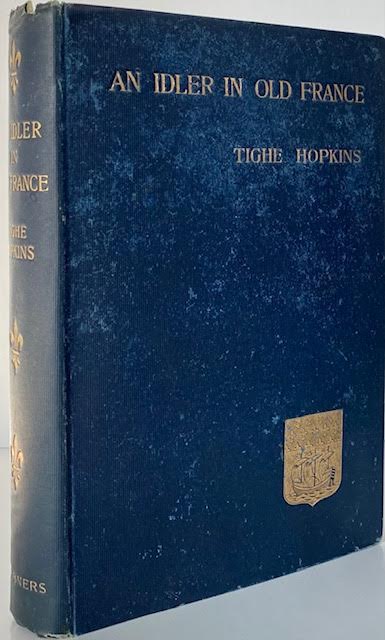
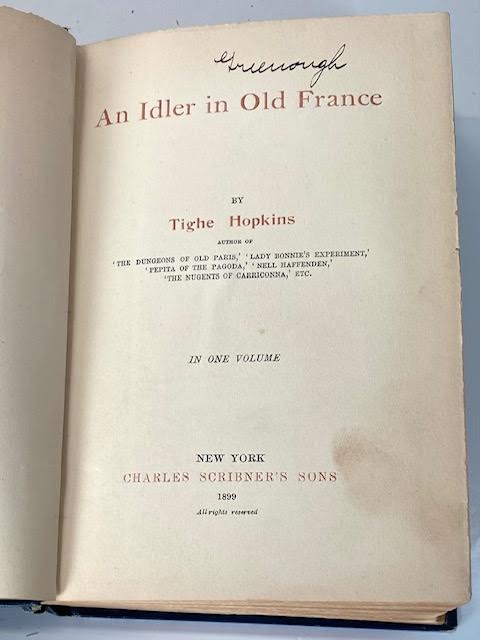
Hardcover. New York, Charles Scribner's Sons, 1st Edition, 1899, Book: Good, Dust Jacket: None, 330 pages. Hardcover. Blue cloth bound cover boards, gilt title on spine and front cover board with design. Some age wear to covers (see image). Some fingerprint smudges (see image) and tanning throughout. Original author's name written on title page (see image). In very good shape for its age, no pages missing. True and fictional shortstories about French culture.
Hardcover. NY, Penguin Press, 1st, 2019, Book: Very Good, Dust Jacket: Very Good, Hardcover in a bright, unclipped dust jacket., 310 pages, color and b&w illustrations. In Montparnasse begins on the eve of the First World War and ends with the 1936 unveiling of Dali's Lobster Telephone. As those extraordinary years unfolded, the Surrealists found ever more innovative ways of exploring the interior life, and asking new questions about how to define art. In Montparnasse recounts how this artistic revolution came to be amidst the salons and cafes of that vibrant neighborhood. Sue Roe is both an incisive art critic of these pieces and a beguiling biographer with a fingertip feel for this compelling world. Beginning with Duchamp, Roe then takes us through the rise of the Dada movement, the birth of Surrealist photography with Man Ray, the creation of key works by Ernst, Cocteau, and others, through the arrival of Dali. On canvas and in their readymades and other works these artists juxtaposed objects never before seen together to make the viewer marvel at the ordinary--and at the workings of the subconscious. We see both how this art came to be and how the artists of Montparnasse lived. Roe puts us with Gertrude Stein in her box seat at the opening of The Rite of Spring; with Duchamp as he installs his famous urinal; at a Cocteau theatrical with Picasso and Coco Chanel; with Breton at a session with Freud; and with Man Ray as he romances Kiki de Montparnasse.
Hardcover. NY, Oxford University Press, 1st, 2012, Book: Very Good, Dust Jacket: Very Good, Hardcover in a bright, unclipped dust jacket. In contemporary France, Charles de Gaulle has become a figure of legend, consistently acclaimed as the nation's pre-eminent "historical" figure. But paradoxes abound. For one, his personal popularity sits oddly with his social origins and professional background. Neither the nobility, nor the Catholic Church, nor the Army is particularly well-regarded in France today, as they are seen to represent antiquated traditions and values. So why, then, do the French nonetheless identify with, celebrate, and even revere this austere and devout nobleman, who remained closely wedded to military values throughout his life? In the Shadow of the General resolves this mystery and explains how de Gaulle has come to occupy such a privileged position in the French imagination. Sudhir Hazareesingh's story of how an individual life was transformed into national myth also tells a great deal about the French collective self in the twenty-first century: its fractured memory, its aspirations to greatness, and its manifold anxieties. Indeed, alongside the tale of de Gaulle's legacy, the author unfolds a much broader narrative: the story of modern France. Clean copy.
Hardcover. UK, Cambridge University Press, 1st, 2005, Book: Very Good, Dust Jacket: Very Good, Hardcover, 334 pages. Spanning his renunciation of the Salon in 1834 until his large retrospective at the crucial 1855 Universal Exposition, this book examines the critical writing and journalistic reportage on Jean-Auguste-Dominque Ingres. It demonstrates how Ingres shaped his career in the rapidly evolving art world of mid-nineteenth century Paris. While enjoying the benefits of his affiliation with the Academy, the artist also pursued certain modes of presentation, most notably the single-artist exhibition and illustrated monograph, through which he distanced himself from the embattled world of artistic officialdom.
Hardcover. Chicago, Henry Regnery Company, 1st, 1950, Book: Very Good, Dust Jacket: Fair, Hardcover in a worn, chipped dust jacket. Map endpapers, 176 pages, b&w photos. The first book by a German general published in America after the war, a German account of the D-Day & Normandy 'invasion' by Allied forces; the author was Rommel's Chief-of-Staff and therefore had an inside view of Rommel's efforts to get Hitler to negotiate a peace in the face of overwhelming Allied superiority. Speidel was a career military officer and trained historian; a German nationalist, he disagreed with racist Nazi policies, was involved in the 20 July plot to kill Hitler, and was important in rebuilding Germany's army after the war. Clean copy.
Hardcover. Cambridge MA, MIT, 1st, 2003, Book: Very Good, Dust Jacket: Very Good, Hardcover, pages. The story of how hysterics were "invented" in 19th-century Paris is a fascinating one. All the more so because the staged performances that Freud witnessed at the famous Salpetriere asylum were to form the basis of his theory of hysteria, a theory which had a lasting impact on both psychiatry and medicine. Photography played an important role in the way doctors learned about so-called hysteria, often under the guise of objectivity.
Hardcover. Lexington KY, University Press of Kentucky, 1st, 2023, Book: Very Good, Dust Jacket: Very Good, Hardcover in a bright dust jacket, 289 pages, b&w illustrations. The son of music hall performers, the Paris-born actor grew up in the entertainment business. His onscreen debut in the 1930's marked the beginning of many memorable roles in films such as La Grande Illusion (1937) and Emile Zola's La Bete Humaine (1938). His performances would earn him international recognition and establish his reputation as one of the greatest stars of film noir. Pausing his performances on screen, Gabin joined the Allied struggle of WWII. Serving under General Charles De Gaulle in the Free French Forces as a tank commander, Gabin was awarded several medals for his service. Upon his return to acting after the war, he became the embodiment of the uniquely French spirit a persona that would define his future roles. In Jean Gabin: The Actor Who Was France, Joseph Harriss tells the story of this French icon. This well-researched biography documents Gabin's life from his start as a reluctant singer and dancer in Parisian music halls to his rise to film superstardom. Clean copy.
Softcover. Philadelphia, Ratpac/Running Press, 1st US, 2016, Book: Very Good, Dust Jacket: None, Softcover, 942 pages, b&w photos. Clean, bright copy. Renoir made more than forty films from the silent era to the late '60s and today he is revered by filmmakers and seen by many as one of the greatest of all time. Previously unknown information including Renoir's close affiliation with Communism in the '30s is detailed in this definitive biography.
Hardcover. Paris, France, E. Plon, Nourrit , unk, nd, Book: Good, Dust Jacket: None, Hardcover. 47 pages. Color illustrations by the author. Red top edge. Yellow covers with green and gold decoration. Corners and spine rubbed. Light soiling to covers. Spine a bit loose.
New York, Grosset & Dunlap, 1st, 1933, Book: Very Good, Dust Jacket: Good, Hardcover, pictorial boards, 60 pages, illustrated in color by O.D.V. Guillonnet. Large format in a edgeworn, lightly chipped dust jacket.
Hardcover. NY, Harry N Abrams, 1st, 1989, Book: Very Good, Dust Jacket: Very Good, 264 pages, illustrated throughout in b&w. Clean, unmarked copy with only minor wear to dust jacket. "A lavish, information-packed look at the people and places of an important, exciting era in art history. "?Publishers Weekly. From 1900 to 1930, Montparnasse was the center of artistic life for the whole world. A major contribution to the social and cultural history of the period? with its informative text and hundreds of photographs?. As The Washington Post said, Kiki's Paris "celebrates the people who made the modern movement in art, music and literature, most of whom were friends or lovers of Kiki, the woman Hemingway called 'The Queen of Montparnasse.'"
Hardcover. Jersey FR, Charles Le Feuvre, 1st thus, 1881, Book: Very Good, Dust Jacket: None, 420 pages, Green cloth binding with black stamping. Reimpression editee avec de legeres annotations. French text. Previous owner's bookplate, otherwise clean and tight copy.

 "George Sandby: Harlan, Ms. Elizabeth")
 "Georges Braque, Life and Workby: Zurcher, Bernard")

 "God's Eugenicist: Alexis Carrel and the Sociobiology of Declineby: Reggiani, Andres Horacio")
 "Gothic Sculpture in France 1140-1270by: Sauerlander, Willibald/Max Hirmer")
 "Great Nadar, The: The Man Behind the Cameraby: Begley, Adam")
 "Gustave Le Gray, 1820-1884by: Aubenas, Sylvie")
 "Hector Guimard: Architect, Designer (1867-1942)by: Vigne, Georges")
 "Heresy and Orthodoxy in Sixteenth-Century Paris - Francois Le Picart and the Beginnings of the Catholic Reformationby: Taylor, Larissa Juliet")
 "Herge: Son of Tintinby: Peeters, Benoit")
 "Historic Doubts Relative to Napolean Buonaparte, and Historic Certainties Respecting the Early History of Americaby: Whately, Richard")
 "History of the Reigns of Louis XVIII and Charles X (2 Vols.)by: Crowe, Eyre Evans")
 "Idler in Old France, Anby: Hopkins, Tighe")
 "In Montparnasse: The Emergence of Surrealism in Paris, from Duchamp to Daliby: Sue Roe")
 "In the Shadow of the General: Modern France and the Myth of De Gaulle by: Hazareesingh, Sudhir")
 "Ingres and his Critics by: Shelton, Andrew Carrington")
 "Invasion 1944: Rommel and the Normandy Campaign by: Hans Speidel")
 "Invention of Hysteria: Charcot and the Photographic Iconography of the Salpetriereby: Georges Didi-Huberman and Alisa Hartz")
 "Jean Gabin: The Actor Who Was France by: Joseph Harriss")
 "Jean Renoir: A Biographyby: Merigeau, Pascal")
 "Jeanne D'Arcby: De Monvel, M. Boutet")
 "Joan of Arc: The Martyr Maid of Franceby: Lowe, Viola Ruth")
 "Ki Ki's Paris: Artists and Lovers 1900-1930by: Kluver, Billy/ Julie Martin")
 "L'Ancienne Coutume de Normandieby: De Gruchy, William Laurence")