Hardcover. London, Chapman & Hall, 1st, 1912, Book: Fair, Dust Jacket: None, Hardcover, 312 pages. 16 B&W illustrations. Brown cover with gilt title to spine. Sun-fading and spotting. Unfinished front edge. Heavy foxing to all edges. Ex-Lib sticker on front end page. Tissue-protected frontispiece. Soiling to end pages. Overall, a clean, tight copy. A biography of Agnes Sorel, known by the sobriquet Dame de beaute, was a favorite and chief mistress of King Charles VII of France, by whom she bore four daughters. She is considered the first officially recognized royal mistress of a French king.
Softcover. NY, John Wiley & Sons, 1st pbk, 2002, Book: Very Good, Dust Jacket: None, Softcover,452 pages, b&w illustrations. Harlow Unger's Lafayette is a remarkable and dramatic account of a life as fully lived as it is possible to imagine, that of Gilbert de Motier, marquis de Lafayette. To American readers Unger's biography will provide a stark reminder of just how near run a thing was our War of Independence and the degree to which our forefathers' victory hinged on the help of our French allies, marshaled for George Washington by his 'adopted' son, Lafayette. But even more absorbing and much less well known to the general reader will be Unger's account of Lafayette's idealistic but naive efforts to plant the fruits of the American democracy he so admired in the unreceptive soil of his homeland. Short inscription to half-title page, otherwise a clean, bright copy.
Hardcover. Montreal, Poirier, Bessette & Co., unk., 1893, Book: Good, Dust Jacket: None, 546 pages, many b&w illustrations including maps and fold-outs. Binding is shaken and both covers loose with cracked hinges, front fly leaf loose. Internally good. Leather spine and corners with pink pebbled cloth covers, marled end papers.
Hardcover. London, Sampson Low, Marston, Searle Rivington, 1st, 1885, Book: Very Good, Dust Jacket: None, Hardcover, 328 pages, frontispiece engraving of Napoleon. Chronicles the political intrigue that propelled Napoleon from military leader to Emperor. Bound in three-quarter black leather over blue cloth, raised bands on spine, gilt decorations and lettering on spine. Top edge gilt, light corner wear.
Softcover. Paris FR, Centre National de la Photo Graphie, 1st, 1984, Book: Very Good, Dust Jacket: None, Softcover, 96 unnumbered pages, 40 b&w plates. FRENCH TEXT. The panoramic photography of Jacques-Henri Lartigue, taken between 1922 and 1929; the catalogue for an exhibition. Wonderful work. Text by Michel Frizot. Unpaginated, 40 full-page duo-toned b&w plates; 11 x 10.25 inches. Bibliography, chronology, exhibitions list.
Hardcover. Boston, Houghton Mifflin, reprint, 1882, Book: Very Good, Dust Jacket: None, Hardcovers, two-volume set complete. Matching dark brown cloth covers stamped in black and gilt, top edge gilt. 639; vi, 653 pages; index, bibliography, frontispiece portrait in each volume - one a quite formal portrait of Voltaire in his prime, the other a sketch of him in old age. Covers show light wear, name on title pages. This is the second printing, the first published a year earlier. A comprehensive life of the great Enlightenment writer. PLEASE NOTE: DUE TO WEIGHT, DOMESTIC SHIPPING ONLY.
Hardcover. Cambridge UK, Cambridge University Press, 1st, 1953, Book: Very Good, Dust Jacket: Good, Hardcover in a worn dust jacket with a chunk gone from rear panel, 309 pages. This book gives a complete account of all that Locke saw, did and heard during his four years in France. The entries vary from laconic jottings to detailed accounts - full of colour and wit - of life in Paris and the provinces. Locke's variety of interests presents a vivid and thorough account of France at that time. He observed and recorded the absolutism of Louis XIV and the poverty of the peasants, the growing persecution of the Protestants and the external manifestations of Catholicism, recent developments in science and technology - even agricultural methods and the system of taxes. So that this is a book for the general reader as well as for the student of Locke, the social historian and the historian of science. Three b&w plates including a map of his travels. Name on front fly leaf, rubber withdrawn stamp on copyright page, otherwise clean.
Hardcover. Paris, Moutard, 1st, 1789, Book: Good, Dust Jacket: None, Hardcover, leatherbond, chipped and worn, marbled endpapers, 336 pages. Vol. 1 only (of 4). FRENCH TEXT. Interior pages very good. Anquetil (1723 - 1806) became prior of the abbey of La Roee, in Anjou, in 1759 and soon after was appointed director of the college of Senlis, where he taught history and theology. He published this work just on the eve of the French Revolution (the Approbation is dated 30 September 1788) and was imprisoned during the Terror for his troubles.
Hardcover. La Fabrica, 1st, 2009, Book: Very Good, Dust Jacket: Very Good, Like new in publishers shrink-wrap. Hardcover, 391 pages, profusely illustrated. This excellent catalog contributes a wealth of new information, providing a valuable contribution to our understanding of Man Ray. The treasure trove of images and objects collected here is drawn from the large archives of the Man Ray Trust in Long Island, New York, and includes little known early works, documents and objects from his private life, working drawings and sketches for major works as well as innumerable familiar masterpieces.
Hardcover. University Park, Pennsylvania State Univ Press, 1st, 1984, Book: Very Good, Dust Jacket: Very Good, Two hardcover volumes in bright dust jackets. Professor Armi posits that the great third abbey at Cluny is the building where regional masons of different traditions first combined their talents to develop a new design, and that the artisans responsible for the masonry also created its sculpture. Volume I Text, 204 pages; Volume II contains 238 b/w Illustrations.
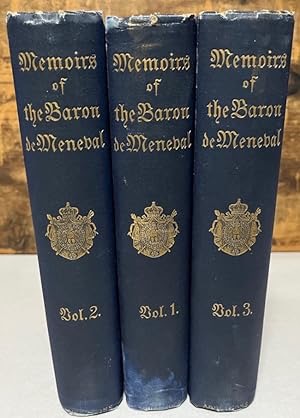
Hardcover. NY, D. Appleton & Company, 1st US, 1894, Book: Very Good, Dust Jacket: None, Hardcovers, Three volumes complete, blue cloth hardcovers with gilt titles and oval decorations on the front covers. Gilt titles and decorations on the spines. Top edges gilt. Volume I: 421 pages, [4] pages advertisements, Volume II: 484 pages, [8] pages advertisements, Volume III: 541 pages, [2] pages advertisements. Illustrated with frontispieces in the three volumes. Illustrations and folding facsimile autographs and manuscripts. Previous owner's inscriptions written on inside front cover of Vol. 1, Otherwise a bright, clean set. PLEASE NOTE: DUE TO WEIGHT, DOMESTIC SHIPPING ONLY.
Softcover. NY, Seven Stories Press, reprint, 2012, Book: Very Good, Dust Jacket: None, Softcover, 431 pages. A fascinating document of an extraordinary life, Memoirs of A Breton Peasant reads with the liveliness of a novel and bristles with the vigor of an opinionated autodidact from the very lowest level of peasant society. Brittany during the nineteenth century was a place seemingly frozen in the Middle Ages, backwards by most French standards; formal education among rural society was either unavailable or dismissed as unnecessary, while the church and local myth defined most people's reasoning and motivation. Jean-Marie Deguignet is unique not only as a literate Breton peasant, but in his skepticism for the church, his interest in science, astronomy and languages, and for his keen--often caustic--observations of the world and people around him. Born into rural poverty in 1834, Deguignet escapes Brittany by joining the French Army in 1854, and over the next fourteen years he fights in the Crimean war, attends Napoleon III's coronation ceremonies, supports Italy's liberation struggle, and defends the hapless French puppet emperor Maximilian in Mexico. He teaches himself Latin, French, Italian and Spanish and reads extensively on history, philosophy, politics, and literature. He returns home to live as a farmer and tobacco-seller, eventually falling back into dire poverty. Throughout the tale, Deguignet's freethinking, almost anarchic views put him ahead of his time and often (sadly, for him) out of step with his contemporaries. Deguignet's voluminous journals (nearly 4,000 pages in total) were discovered in a farmhouse in Brittany a century after they were written. This narrative was drawn from them and became a surprise bestseller when published in France in 1998. Clean copy.
Hardcover. NY, Harcourt Brace And Company , reprint, nd, Book: Very Good, Dust Jacket: Good, Hardcover in a lightly worn and chipped dust jacket. 424 pages, 10 tipped-in color plates & 48 double-sided b/w plates. index. This book is an attempt to tell the story of modern French painting as developed by the Impressionists and subsequent adventurers in the last hundred years in Paris. No date, most likely early 1950s. Clean copy.
Hardcover. London, Hodder and Stoughton, 1st, 1916, Book: Fair, Dust Jacket: None, 158 pages. Hardcover. Features 46 tipped-in plates. Foxing throughout. Front hinged cracked. Covers worn with areas of staining, darkening to spine cloth.
Hardcover. London, Arthur L Humphreys, 2nd pr., 1900, Book: Very Good, Dust Jacket: None, Hardcover, maroon cloth with gilt staping. 261 pages including index. 261 pages. Written almost 80 years after the Emperor's death, the author attempts to bring together all the contemporary biographies and memoirs relating to the sojourn on St Helena. Mild foxing, otherwise clean.
Hardcover. Washington, D.C., U.S. Government Printing Office, 1st, 1935, Book: Good, Dust Jacket: None, Hardcover, 653 pages. Gilt top edge. Minor spine and cover edge wear. Minor soiling on cover and spine. Otherwise, a clean and tight copy. Foreword by President Roosevelt and a preface by Captain Dudley W. Knox. plus 10 plates including 2 folded maps and the frontispiece. Fp: U.S. Ship of War Delaware. Cloth cover, gilt title on spine.
Hardcover. Washington, D.C., U.S. Government Printing Office, 1st, 1935, Book: Good, Dust Jacket: None, Hardcover, 624 pages. Gilt top edge. Minor spine and cover edge wear. Minor soiling on cover and spine. Otherwise, a clean and tight copy.
Softcover. New York, Oxford University Press, 1st paperback, 1968, Book: Very Good, Dust Jacket: None, 355 pages. Softcover. Light pencil underlining in a few places. Wrapper good, with a touch of agewear, no tears, some slight moisture damage at the bottom of the back cover.
NY, The Press of the American Institute of Architects., 1st, 1925, Book: Good, Dust Jacket: None, Hardcover. Complete with 24 watercolor prints and 44 plates. Loosely bound in case with cloth ties which has cracking along spine. Interior very good. Number 677 of 1000. Elephant folio 23" tall. "A Series of Historical Examples from Roman Times to the End of the XVIIIth Century." An appreciation of historic French infrastructure that survived WWI. Beautiful large color reproductions of original watercolors of bridges by Pierre Vignal; 35 black and white drawings by Louis C. Rosenberg & Samuel Chamberlain; 44 measured drawings, photographs, diagrams, and maps. DUE TO SIZE & WEIGHT, DOMESTIC SHIPPING ONLY.
Hardcover. New Haven CT, Yale University Press, 1st, 2018, Book: Very Good, Dust Jacket: None, Hardcover, 156 pages, no dj issued. An insightful new look at two renowned photographers, their interconnected legacies, and the vital documents of urban transformation that they created. In this comprehensive study, Kevin Moore examines the relationship between Eugene Atget (1857-1927) and Berenice Abbott (1898-1991) and the nuances of their individual photographic projects. Abbott and Atget met in Man Ray's Paris studio in the early 1920s. Atget, then in his sixties, was obsessively recording the streets, gardens, and courtyards of the 19th-century city--old Paris--as modernization transformed it. Abbott acquired much of Atget's work after his death and was a tireless advocate for its value. She later relocated to New York and emulated Atget in her systematic documentation of that city, culminating in the publication of the project Changing New York.
Hardcover. New Haven CT, Yale University Press, 1st, 2018, Book: Very Good, Dust Jacket: None, Hardcover, 156 pages, no dj issued. An insightful new look at two renowned photographers, their interconnected legacies, and the vital documents of urban transformation that they created. In this comprehensive study, Kevin Moore examines the relationship between Eugene Atget (1857-1927) and Berenice Abbott (1898-1991) and the nuances of their individual photographic projects. Abbott and Atget met in Man Ray's Paris studio in the early 1920s. Atget, then in his sixties, was obsessively recording the streets, gardens, and courtyards of the 19th-century city--old Paris--as modernization transformed it. Abbott acquired much of Atget's work after his death and was a tireless advocate for its value. She later relocated to New York and emulated Atget in her systematic documentation of that city, culminating in the publication of the project Changing New York.
Hardcover. Moscow, Progress Publishers, 1st, 1971, Book: Very Good, Dust Jacket: Very Good, Hardcover in a bright dust jacket, 357 pages. "On March 18, 1871, the workers of Paris expelled the bourgeois rulers of the city and took power into their own hands , a shining achievement never to be forgotten. Ten days later, on March 28, they set up the Paris Commune, the world's first proletarian state. It was of an entirely new type, being governed by the people and for the people, with all its social and political measures taken in the interest of the working people, the working class above all." -from the Preface. First printing of this selection, published for the centenary of the Commune. With ribbon bookmark. Clean copy.
Hardcover. Cambridge MA, Harvard University Press, 1st, 2018, Book: Very Good, Dust Jacket: Very Good, Hardcover in a bright dust jacket, 404 pages. The Napoleonic wars did not end with Waterloo. That famous battle was just the beginning of a long, complex transition to peace. After a massive invasion of France by more than a million soldiers from across Europe, the Allied powers insisted on a long-term occupation of the country to guarantee that the defeated nation rebuild itself and pay substantial reparations to its conquerors. Our Friends the Enemies provides the first comprehensive history of the post-Napoleonic occupation of France and its innovative approach to peacemaking. From 1815 to 1818, a multinational force of 150,000 men under the command of the Duke of Wellington occupied northeastern France. From military, political, and cultural perspectives, Christine Haynes reconstructs the experience of the occupiers and the occupied in Paris and across the French countryside. The occupation involved some violence, but it also promoted considerable exchange and reconciliation between the French and their former enemies. Clean copy.
Hardcover. NY, Holt Rinehart & Winston, 1st, 1981, Book: Very Good, Dust Jacket: Very Good, Hardcover in a bright dust jacket with minor edgewear, 294 pages. Depicts the German occupation of Paris during World War II from the perspectives of both the defeated Parisians and the victorius Germans, accompanied by 116 contemporary photographs in b&w, some color. Clean copy.

 "Lady of Beauty, Theby: Hamel, Frank")
 "Lafayette by: Harlow Giles Unger")
 "Lake St. Louis Old and New and Cavelier de La Salleby: Girouard (transl.), Disire")
 "Last Days of the Consulate, Theby: Fauriel, M. and M. L. Lalanne(Ed.)")
 "Le Passe Compose: Les 6 x 13 de Jacques-Henri Lartigue. by: Lartigue, Jacques-Henri and Michel Frizot")
 "Life of Voltaire: 2 Volume Setby: James Parton")

 "LOUIS XIV SA COUR ET LE REGENT- tome I onlyby: ANQUETIL Pierre Louis")
 "Man Ray: Despreocupado Pero No Indiferente / Unconcerned But Not Indifferent (English and Spanish Edition)by: Jacob, John P. and Noriko Fuku")
 "Masons and Sculptors in Romanesque Burgundy: The New Aesthetic of Cluny III (2 Volumes)by: Armi, C. Edson")
 "Memoirs Illustrating the History of Napoleon I from 1802 to 1815 (Three Volumes)by: Meneval, Baron Claude-Francois De; Meneval, Napoleon Joseph De (edited by)")

 "Memoirs of a Breton Peasant, 1834-1905by: Jean-Marie D?©guignet")
 "Modern French Paintersby: R.H. Wilenski")
 "Mr. Poilu - Notes and Sketches with the Fighting French by: Ward, Herbert")
 "Napoleon The Last Phase by: Lord Rosebery")
 "Naval Documents Related to the Quasi-War Between the United States and France: Naval Operations from February 1797 to October 1798by: Swanson, Claude A.")
 "Naval Documents Related to the Quasi-War Between the United States and France: Naval Operations from November 1798 to March 1799by: Swanson, Claude A.")
 "Ninth of Thermidor, The: The Fall of Robespierre (Problems in European History: A Documentary Collection)by: Bienvenu, Richard (Editor)")


 "Old Bridges of France by: Emerson William and Georges Gromort")
 "Old Paris and Changing New York: Photographs by Eugene Atget and Berenice Abbottby: Kevin Moore")
 "Old Paris and Changing New York: Photographs by Eugene Atget and Berenice Abbottby: Kevin Moore")
 "On the Paris Commune by: Marx, Karl/ Engels, Friedrich")
 "Our Friends the Enemies: The Occupation of France after Napoleonby: Christine Haynes")
 "Paris in the Third Reich: A History of the German Occupation, 1940-1944 by: David Pryce-Jones")