Hardcover. New York, Arcade Publishing, 1st, 2005, Book: Very Good, Dust Jacket: Very Good, Hardcover, 440 pages, illustrations in color and b&w. Clean, unmarked copy with only minor wear to dust jacket. A pioneer of modern art and founder of Cubism, Georges Braque was a creative genius and tireless innovator, constantly pushing back the boundaries of the possible. In this magisterial work, Alex Danchev taps a wide range of new sources to reveal the heart and mind of one who helped usher in the greatest revolution in the ways of seeing since the Renaissance and changed the face of modern art. Chapters include: "Memories in anticipation:" The Confirmed Painter, "Mon vieux Wilbourg:" The Encounter with Picasso, "If I should Ide Out There:" The Great War, The prong of the rade" : Late Braque. And much more.
Hardcover. NY, Museum of Modern Art, 1st, 1949, Book: Very Good, Dust Jacket: Good, Hardcover in a bright, lightly chipped dust jacket. 170 pages, 135 illustrations with 10 in color. Bibliography. Bump to bottom of cloth cover otherwise a clean, square copy.
Hardcover. Washington DC, National Gallery of Art / Yale University Press, 1st, 1996, Book: Very Good, Dust Jacket: Very Good, Hardcover in a bright, unclipped dust jacket. Publisher's full red cloth, gilt lettering on spine, gold endpapers. Profusely illustrated with numerous full-color plates (many full-page) as well as B&W illustrations. Published to coincide with the exhibition held at the National Gallery of Art, Washington, and the Kimbell Art Museum, Fort Worth, October 1996 to May 1997. Includes essays by Jean-Pierre Cuzin, Gail Feigenbaum, Patricia Behre Miskimin, Edmund P. Pillsbury, and Leonard J. Slatkes; and also technical essays by Claire Barry, Barbara Berrie, Melanie Gifford, and Michael Palmer. Also includes Bibliography and detailed Index. . Both the volume and the unclipped dust jacket are in pristine condition.
Hardcover. Paris, Editions Gallimard, 1st, 2005, Book: Very Good, Dust Jacket: None, Hardcover, large heavy volume in glossy pictorial boards. 495 pages with index. Accompanying DVD in rear pocket inside cover. Girodet was one of the greatest French painters of the early 19th century. His career reached its height under the reign of Napoleon. Illustrated throughout in color, scholarly essays by various experts, a chronology. No dj issued, minor bump to lower corner of cover, otherwise like new. DOMESTIC SHIPPING ONLY.
Hardcover. NY, Orion Press/ Trianon Press, 1st, 1961, Book: Very Good, Dust Jacket: Very Good, Hardcover in a bright dust jacket. 180 pages, profusely illustrated in b&w. 112 pages of photos, 3 fold-outs. The definitive study of the 12th-century French sculptor, responsible for almost all the sculpture and reliefs in the medieval cathedral in Burgundy. Spine cracked at preliminary spread before title page. No markings, clean copy.
Hardcover. New York, Berghahn Books, 1st, 2006, Book: Very Good, Dust Jacket: None, 268 pages. Hardcover with no dust jacket. Very clean, unmarked copy with only minor wear to edges. Small corner bump on front top right corner. Otherwise tight copy. Black and white images throughout.
Hardcover. London, V&A Publications, 1st, 2007, Book: Very Good, Dust Jacket: Good, 224 pages. Hardcover with dust jacket. Soiling and wear to dust jacket edges. Light yellowing to inside pages. Small tears to dust jacket rear. An otherwise tight copy. 97 color plates, 80 black and white illustrations. In 1947, Christian Dior?s ?New Look? was greeted with both shock and delight, making headlines around the world. Accompanying the exhibition opening at the Victoria and Albert Museum in September 2007, this lavish book focuses on Parisian and British couture between 1947 and 1957, the decade Dior hailed as fashion?s ?golden age.? The ?New Look? symbolized a new femininity. The full skirts and hourglass silhouettes were considered highly decadent, synonymous with luxury and prosperity, in marked contrast to the austerity of the WWII years. Nevertheless, the ?New Look? caught the public imagination and ushered in a period of remarkable creativity. The Golden Age of Couture features stunning gowns and exquisite tailoring from Dior as well as from such designers as Balenciaga, Balmain, and Givenchy, along with evocative photographs by the likes of Richard Avedon and Cecil Beaton.
Hardcover. New York, Harry N. Abrams, Inc., 1st English, 1972, Book: Very Good, Dust Jacket: Very Good, 527 pages. Hardcover. Previous owners name and brief inscription on front endpaper. Illustrated with black & white photographs. Dust jacket with light wear. Clean, tight copy.
Hardcover. New York, Tim Duggan Books, 1st, 2017, Book: Very Good, Dust Jacket: Very Good, Hardcover, 248 pages, b&w illustrations. The first great portrait photographer, a pioneering balloonist, the first person to take an aerial photograph, and the prime mover behind the first airmail service, Nadar was one of the original celebrity artist-entrepreneurs. A kind of 19th-century Andy Warhol, he knew everyone worth knowing and photographed them all, conferring on posterity psychologically compelling portraits of Manet, Sarah Bernhardt, Delacroix, Daumier and countless others--a priceless panorama of Parisian celebrity. Born Gaspard-Felix Tournachon, he adopted the pseudonym Nadar as a young bohemian, when he was a budding writer and cartoonist. Later he affixed the name Nadar to the facade of his opulent photographic studio in giant script, the illuminated letters ten feet tall, the whole sign fifty feet long, a garish red beacon on the boulevard. Nadar became known to all of Europe and even across the Atlantic when he launched "The Giant," a gas balloon the size of a twelve-story building, the largest of its time. With his daring exploits aboard his humongous balloon (including a catastrophic crash that made headlines around the world), he gave his friend Jules Verne the model for one of his most dynamic heroes.
Hardcover. Paris, Guide Conty, 2nd Ed., circa 1902, Book: Very Good, Dust Jacket: None, Hardcover, blue cloth stamped in black and gilt, now faded. A charming pocket-size travel guide to the Loire/Orleans region. 336 + 56 + 72 + IV pages. No date but presumed circa 1900. Lots of ads, illustrations, several fold-out maps. ALL IN FRENCH LANGUAGE. Nice condition.
Hardcover. Los Angeles, J. Paul Getty Museum, 1st, 2002, Book: Very Good, Dust Jacket: Very Good, 416 pages, profusely illustrated. After years of research, this complete retrospective offers, as no volume before it, an assessment of Le Gray's important place in the history of photography. His work had remained largely unknown by the general public until he was rediscovered in the 1960s and was deemed by connoisseurs to be the Monet of photography. Gustave Le Gray began as a young painter in Rome, then became a fashionable portrait photographer in Paris. He received commissions from Napoleon Ill, and astonished viewers with his painterly landscapes and ravishing seascapes. Facing bankruptcy, he feld Paris with Alexandre Dumas to Palermo, travelled to the Middle East, and finally settled in Egypt, where he became drawing master to the ruler's children and continued to make photographs until his death in 1884. Le Gray's work had remained largely unknown by the general public until he was rediscovered in the 1960s.
Hardcover. NY, Delano Greenidge Editions, 1st, 2003, Book: Very Good, Dust Jacket: Very Good, Hardcover, 396 pages, lavishly illustrated throughout in color and b&w. Light shelf-wear to dust jacket, else a clean, tight copy. Guimard is the pre-eminent architect of Art Nouveau in France. He influenced French architecture and design in the first half of the 20th century. He was also the architect of a number of Paris Metro entrances. He was regarded as an architect who wielded the greatest influence on the popular imagination in Paris during the late 19th- and early 20th centuries.
Hardcover. New York , Harry N. Abrams, 1st, 2006, Book: Very Good, Dust Jacket: Very Good, 230 pages, published to accompany exhibition show in London, Paris, and Washington. Shows how Rousseau's captivating jungle paintings are best understood in relation to his work in other genres such as portraiture and landscapes. Beautiful color illustrations throughout. Deep green boards with lighter green tiger on front. In publisher's shrinkwrap.
Hardcover. New York , Abrams, 1st, 1962, Book: Very Good, Dust Jacket: Very Good, Hardcover, 210 illustrations, including 29 mounted color plates. 328 pages. Thick 4to, green cloth stamped in yellow. Dust jacket with light edgewear.
Hardcover. Leiden/Boston, Brill, 1st, 1999, Book: Very Good, Dust Jacket: Very Good, Hardcover in a dust jacket, 332 pages. Volume 77 in the 'Studies in Medieval and Reformation Thought Series'. Through the examination of over 250 sermons by the most popular preacher in Paris before the Religious Wars, Francois Le Picart (1504-1556), this book offers a close look at religious mentalites in the French capital in these critical years and offers insight into changing definitions of orthodoxy and heresy.
Hardcover. Baltimore, Johns Hopkins University Press, 1st US, 2012, Book: Very Good, Dust Jacket: Very Good, Hardcover, 394 pages, b&w illustrations. The adventures of Tintin and his dog, Snowy, have captivated people worldwide since they first appeared as an insert in the Belgian Catholic newspaper Le Vintieme Siecle in 1929. Available for the first time in English, this insightful biography delves deep into the psyche of Tintin creator Georges Remi and his public persona Herge. Author of the critically acclaimed Tintin and the World of Herge and the last person to interview Remi, Benoit Peeters tells the complete story behind Herge's origins and shows how and why the nom de plume grew into a larger-than-Remi personality as Tintin's popularity exploded. Drawing on interviews and using recently uncovered primary sources for the first time, Peeters reveals Remi as a neurotic man who sought to escape the troubles of his past by allowing Herge's identity to subsume his own. As Tintin adventured, Herge lived out a romanticized version of life for Remi.
Hardcover. New York, Robert Carter & Brothers, Reprint, 1867, Book: Good, Dust Jacket: None, 184 pages. Previous owners name on front endpaper. Foxing to pages. Cloth covers rubbed along edges and corners. Chipping to cloth at top and bottom of spine.
Hardcover. London, Richard Bentley, 1st, 1854, Book: Very Good, Dust Jacket: None, Two volumes, 503, 474 pages. Bound in calf with raised spine bands, marbled edges, marbled end papers. Spine labels chipped on Volume 1, missing on Volume 2. Spines age-darkened, light wear to top and bottom. Previous owner's inscription otherwise internally clean and bright.
Hardcover. Greenwich CT, New York Graphic Society, 1st, 1968, Book: Very Good, Dust Jacket: None, Limited to 1300 copies in English, this being #521. Two volumes in a slipcase with a label. Dark blue cloth covers, top edge gilt, spines with maroon and gilt design. Vol. 1: The Paintings, 446 pages with 208 b&w plates, 19 b&w text illustrations and tipped-in b&w photo of Daumier by Nadar as frontispiece. Vol. 2: The Watercolours and Drawings, 619 pages with 325 b&w plates(most with multiple images), 31 text illustrations, tipped-in errata slip. Previous owner's signature on front fly leaf of volume 1, otherwise clean, tight set. Slipcase is very good with some rubbing to blue cloth.
Softcover. NY, Feral House, 1st, 2015, Book: Very Good, Dust Jacket: None, Softcover. 224 pages. The book Horizontal Collaboration encompasses the Jazz Age, Depression, World War and Occupation, and Liberation. It concludes with the shuttering of the licensed brothels in 1946, which some Parisian intellectuals thought was the final "destruction of French civilization". The term "Horizontal Collaboration" refers to the sexual liaisons between French civilians and German occupiers from 1940 to 1944. These were extremely widespread and included both individual wartime relationships in addition to prostitution. As Allied armies swept across the French countryside, thousands of young women?and some men?were savagely punished by the authorities or by vigilante crowds, becoming a source of deep national shame. Author Gordon redefines the pejorative term to mean something much broader: French men and women "horizontally collaborated" to overcome all social obstacles, divisions, and regulations. These obstacles include married and unmarried couples, straights and homosexuals, foreigners and locals, gun-toting soldiers and their vanquished subjects. The natural yearning for sexual pleasure equally corrupted all cohabitating partners. Clean copy in publisher's shrinkwrap.
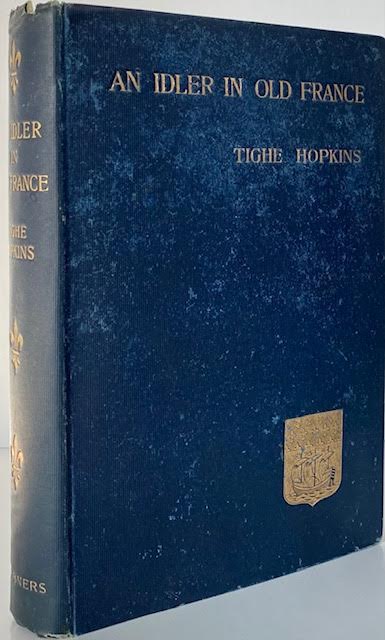
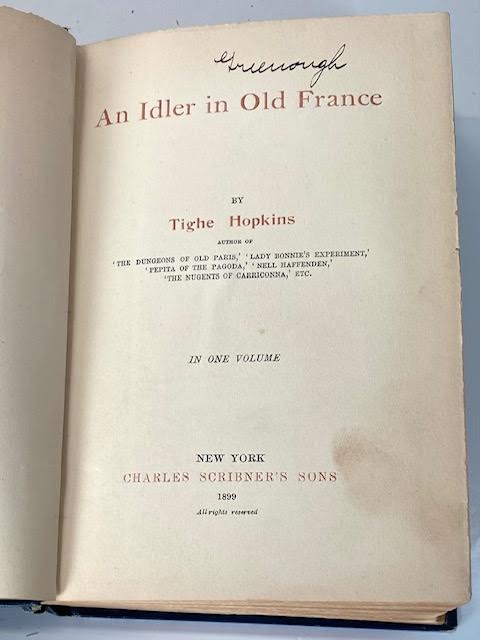
Hardcover. New York, Charles Scribner's Sons, 1st Edition, 1899, Book: Good, Dust Jacket: None, 330 pages. Hardcover. Blue cloth bound cover boards, gilt title on spine and front cover board with design. Some age wear to covers (see image). Some fingerprint smudges (see image) and tanning throughout. Original author's name written on title page (see image). In very good shape for its age, no pages missing. True and fictional shortstories about French culture.
Hardcover. NY, Penguin Press, 1st, 2019, Book: Very Good, Dust Jacket: Very Good, Hardcover in a bright, unclipped dust jacket., 310 pages, color and b&w illustrations. In Montparnasse begins on the eve of the First World War and ends with the 1936 unveiling of Dali's Lobster Telephone. As those extraordinary years unfolded, the Surrealists found ever more innovative ways of exploring the interior life, and asking new questions about how to define art. In Montparnasse recounts how this artistic revolution came to be amidst the salons and cafes of that vibrant neighborhood. Sue Roe is both an incisive art critic of these pieces and a beguiling biographer with a fingertip feel for this compelling world. Beginning with Duchamp, Roe then takes us through the rise of the Dada movement, the birth of Surrealist photography with Man Ray, the creation of key works by Ernst, Cocteau, and others, through the arrival of Dali. On canvas and in their readymades and other works these artists juxtaposed objects never before seen together to make the viewer marvel at the ordinary--and at the workings of the subconscious. We see both how this art came to be and how the artists of Montparnasse lived. Roe puts us with Gertrude Stein in her box seat at the opening of The Rite of Spring; with Duchamp as he installs his famous urinal; at a Cocteau theatrical with Picasso and Coco Chanel; with Breton at a session with Freud; and with Man Ray as he romances Kiki de Montparnasse.
Hardcover. NY, Oxford University Press, 1st, 2012, Book: Very Good, Dust Jacket: Very Good, Hardcover in a bright, unclipped dust jacket. In contemporary France, Charles de Gaulle has become a figure of legend, consistently acclaimed as the nation's pre-eminent "historical" figure. But paradoxes abound. For one, his personal popularity sits oddly with his social origins and professional background. Neither the nobility, nor the Catholic Church, nor the Army is particularly well-regarded in France today, as they are seen to represent antiquated traditions and values. So why, then, do the French nonetheless identify with, celebrate, and even revere this austere and devout nobleman, who remained closely wedded to military values throughout his life? In the Shadow of the General resolves this mystery and explains how de Gaulle has come to occupy such a privileged position in the French imagination. Sudhir Hazareesingh's story of how an individual life was transformed into national myth also tells a great deal about the French collective self in the twenty-first century: its fractured memory, its aspirations to greatness, and its manifold anxieties. Indeed, alongside the tale of de Gaulle's legacy, the author unfolds a much broader narrative: the story of modern France. Clean copy.
Hardcover. UK, Cambridge University Press, 1st, 2005, Book: Very Good, Dust Jacket: Very Good, Hardcover, 334 pages. Spanning his renunciation of the Salon in 1834 until his large retrospective at the crucial 1855 Universal Exposition, this book examines the critical writing and journalistic reportage on Jean-Auguste-Dominque Ingres. It demonstrates how Ingres shaped his career in the rapidly evolving art world of mid-nineteenth century Paris. While enjoying the benefits of his affiliation with the Academy, the artist also pursued certain modes of presentation, most notably the single-artist exhibition and illustrated monograph, through which he distanced himself from the embattled world of artistic officialdom.

 "Georges Braque: A Lifeby: Danchev, Alex")
 "Georges Braqueby: Hope, Henry R.")
 "Georges de la Tour and His World by: Conisbee, Philip, Tour Georges Du Mesnil De LA and Jean-Pierre Cuzin")
 "Girodet: 1767-1824by: Sylvain Bellenger")

 "God's Eugenicist: Alexis Carrel and the Sociobiology of Declineby: Reggiani, Andres Horacio")
 "Golden Age of Couture, The: Paris and London, 1947-57by: Wilcox, Claire")
 "Gothic Sculpture in France 1140-1270by: Sauerlander, Willibald/Max Hirmer")
 "Great Nadar, The: The Man Behind the Cameraby: Begley, Adam")
 "Guides Pratiques Conty - Bords de la Loire - Plages nantaises by: N/A")
 "Gustave Le Gray, 1820-1884by: Aubenas, Sylvie")
 "Hector Guimard: Architect, Designer (1867-1942)by: Vigne, Georges")
 "Henri Rousseau: Jungles in Parisby: Morris, Frances (Editor)")
 "Henri Rousseauby: Vallier, Dora")
 "Heresy and Orthodoxy in Sixteenth-Century Paris - Francois Le Picart and the Beginnings of the Catholic Reformationby: Taylor, Larissa Juliet")
 "Herge: Son of Tintinby: Peeters, Benoit")
 "Historic Doubts Relative to Napolean Buonaparte, and Historic Certainties Respecting the Early History of Americaby: Whately, Richard")
 "History of the Reigns of Louis XVIII and Charles X (2 Vols.)by: Crowe, Eyre Evans")
 "Honore Daumier: Catalogue Raisonne of the Paintings, Watercolours and Drawings (2 Vols.)by: Maison, K.E.")
 "Horizontal Collaboration: The Erotic World of Paris, 1920-1946 by: Mel Gordon")
 "Idler in Old France, Anby: Hopkins, Tighe")
 "In Montparnasse: The Emergence of Surrealism in Paris, from Duchamp to Daliby: Sue Roe")
 "In the Shadow of the General: Modern France and the Myth of De Gaulle by: Hazareesingh, Sudhir")
 "Ingres and his Critics by: Shelton, Andrew Carrington")