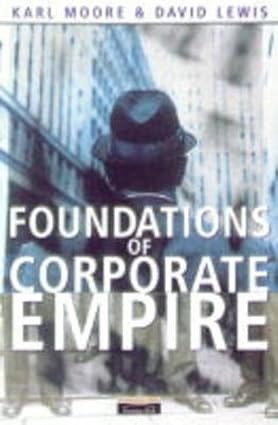
Softcover. London, Financial Times/ Prentice Hall, 1st, 2000, Book: Very Good, Dust Jacket: None, Softcover, 319 pages. An exploration of the future of corporate enterprise. Asks questions about the phenomenon of giant transnational companies and networked newer players working side by side. Wonders at the economic patterns that have begun to emerge in world commerce. "Foundations of Corporate Empire sketches the history of international business from the emergence of ancient Assyria around 2000 BC through the Phoenician, Carthaginian and Grecian periods up to the time of the Roman Imperium under Augustus, and then on the medieval and modern eras ending with today's post-modern times." "The history of these civilizations has developed around different economic models, which have regularly re-emerged across time and are still present today." "Foundations of Corporate Empire looks at our past economic foundations to better understand where we are today and where we should be tomorrow." --Jacket. Clean copy.
Hardcover. New Haven CT, Yale University Press, 1st, 1950, Book: Very Good, Dust Jacket: None, Hardcover. The Chronicles of America Vol. 51. 388 pages, b&w illustrations. Red gilt-decorated cloth, top edge gilt, no dust jacket as issued. A very nice, tight, clean copy in excellent condition.
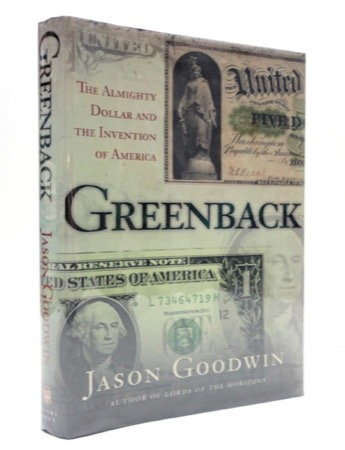
Hardcover. NY, Henry Holt, 1st, 2003, Book: Very Good, Dust Jacket: Very Good, Hardcover in a bright dust jacket, 320 pages. Money has always been at the heart of the American experience. Paper money, invented in Boston in 1698, was a classic of American ingenuity-and American disregard for authority and tradition. With the wry and admiring eye of a modern Tocqueville, Jason Goodwin has written a biography of the dollar, giving us the story of its astonishing career through the wilds of American history. Clean copy.
Hardcover. NY, Walker Books, 1st, 1997, Book: Very Good, Dust Jacket: Very Good, Hardcover in a bright, unclipped dust jacket, 214 pages. Over the past couple of decades, our national debt has become a favorite political football for Democrats and Republicans alike. Yet few Americans seem aware that the debt has a long and (mostly) honorable history. Alexander Hamilton considered it a kind of political Krazy Glue, which would also spur American industry by keeping taxes high. This borrowing power enabled the North to win the Civil War without wrecking its economy and rescued us from the Great Depression. John Steele Gordon doesn't deny the dangers of an entire nation living on credit; indeed, he believes that our fiscal affairs are a mess. But he puts this mess in fascinating perspective. And he's quick to see the human side of economic behavior: "One problem," he writes, "is that human nature predisposes us to recognize depression easily and quickly, but prosperity, like happiness, is most easily seen in retrospect." Name on front fly leaf, otherwise clean.
Hardcover. NY, Palgrave/Macmillan, 1st, 2003, Book: Very Good, Dust Jacket: Very Good, Hardcover in a bright dust jacket, 283 pages. Each chapter is devoted to a specific idea of, or a major influence on, Hayek. Foundational ideas incorporated into Hayek's thought are discussed (Darwinianism, German historicism, Austrian school economics) as are significant works that denoted major changes in his thought. Individual chapters deal with Mises, Keynes, Friedman and Popper, and another contrasts Hayek's thought with Marx, Mill, and Freud. Hayek's major economic thought is address in chapters devoted to both his early years and his later work. Ex-lib with stamp on top edge, residue on inside rear cover.
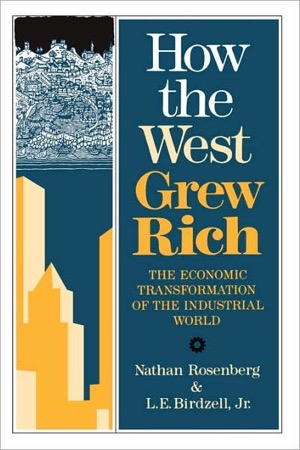
Hardcover. NY, Basic Books, 2nd pr., 1986, Book: Very Good, Dust Jacket: Very Good, Hardcover in a bright dust jacket, 416 pages. How did the West--Europe, Canada, and the United States--escape from immemorial poverty into sustained economic growth and material well-being when other societies remained trapped in an endless cycle of birth, hunger, hardship, and death? In this elegant synthesis of economic history, two scholars argue that it is the political pluralism and the flexibility of the West's institutions--not corporate organization and mass production technology--that explain its unparalleled wealth. Clean copy.
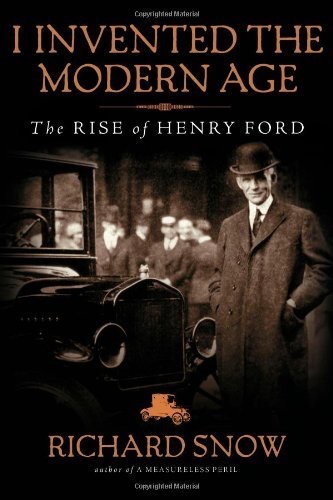
Hardcover. NY, Scribner, 1st, 2013, Book: Very Good, Dust Jacket: Very Good, Hardcover in a bright dust jacket, 364 pages, b&w illustrations. A fresh, meticulous, and entertaining account of Henry Ford, the Model-T, and the invention of the American car industry in the early twentieth century. Born the same year as the battle of Gettysburg, Ford died two years after the atomic bombs fell, and his life personified the tremendous technological changes achieved in that span. Clean copy.
Hardcover. Cambridge MA, MIT Press, 1st, 1974, Book: Very Good, Dust Jacket: Very Good, Hardcover in a price-clipped dust jacket, 162 pages. Japan's economy enjoyed unprecedented technological growth in the decades after World War II. At first stereotyped as an exported of shoddy goods, Japan enjoyed a worldwide reputation as an efficient manufacturer of high-quality products. This comprehensive analysis of Japanese management treats four related but distinct subject matters: the economic, social, cultural, and political environment pertinent to Japan's industrial and managerial system; the ideologies and background to the Japanese business elite structure and the relationship between government and business; and managerial practices (organizational structure, personnel practices, decision making). The book first describes the postwar technological environment in and outside Japan. It identifies the Schumpeterian characteristics of economic development and the particular set of relationships that Japan had with the United States and with developing nations in Asia that provided it with the incentive and the necessary mechanisms to advance technologically. Name on front fly leaf, otherwise clean.
Hardcover. New York, Kelley & Millman, Inc., reprint, 1956, Book: Very Good, Dust Jacket: Fair, 293 pages. Collection of lectures given by Smith at the University of Glasgow, as reported by a student in 1763. Edited and with introduction by Edwin Cannan. Dark blue covers, gilt titles to spine, white dust jacket. Edgewear and chipping to dust jacket, previous owner's ink signature to front endpaper, light pencil markings to a few pages, pencil notations to rear endpaper.
Hardcover. Oxford UK, Clarendon Press, 1st, 1991, Book: Very Good, Dust Jacket: Very Good, Hardcover set, complete in two volumes, both with bright dust jackets. Locke on Money presents for the first time the entire body of the philosopher's writings on this important subject (other than Two Treatises of Government). Accurate texts, together with an apparatus listing variant readings and significant manuscript changes, record the evolution of Locke's ideas from the original 1668-74 paper on interest to the three pamphlets on interest and coinage published in the 1690s. The introduction by Patrick Hyde Kelly establishes the wider context of Locke's writings in terms of contemporary debates on these subjects, the economic conditions of the time, and the circumstances of writing and publication. It shows, notably, that Locke's supposed responsibility for the 1696 recoinage is a myth. The account of what Locke derived from Mercantilist writings and of how he reformulated these in accordance with his philosophy illuminates his contribution to the evolution of economics, and will aid reappraisal of Two Treatises. The picture that emerges confirms Locke's status as major economic thinker, contrary to the prevalent view of recent decades. There are two volumes in the edition. The first contains the introductory matter, and the texts of the Early Writings on Interest, 1688-74, and Some Considerations. The second comprises Short Observations, Further Considerations, and the Appendices, Bibliography, and Index. 664 total pages. Name on front fly leaf in Vol. 1, otherwise clean.
Hardcover. NY, Garland Publishing, 1st, 1992, Book: Very Good, Dust Jacket: None, Black cloth with gilt lettering on the spine, 216 pages. A historical study of the textile industry in Lowell, Massachusetts. Clean copy.
Hardcover. London, Macmillan, reprint, 1924, Book: Very Good, Dust Jacket: None, 438 pages. Reprint of original 1885 first edition. Brown cloth covers, pasted labels with titles to front cover and spine, b&w frontispiece of Mathus's portrait. Slight rubbing to covers, spine label lightly soiled, wear to spine top edge, previous owner's signature to front endpaper dated 1947, stiff binding, pages crisp and unmarked; overall, a very clean, tight copy.
Hardcover. Northfield VT, Norwich University, 1st, 1916, Book: Very Good, Dust Jacket: None, Hardcover, light tan cloth with black lettering on front cover, 39 pages. A study of the social conditions in the counties of Vermont in the earl part of the 20th century. Flint was Professor of Political Science at Norwich University.
Hardcover. Chapel Hill NC, University of North Carolina, 1st, 1991, Book: Very Good, Dust Jacket: Very Good, Hardcover in a bright dust jacket, 363 pages. In examining the founding of New England towns during the seventeenth century, John Frederick Martin investigates an old subject with fresh insight. Whereas most historians emphasize communalism and absence of commerce in the seventeenth century, Martin demonstrates that colonists sought profits in town-founding, that town founders used business corporations to organize themselves into landholding bodies, and that multiple and absentee landholding was common. In reviewing some sixty towns and the activities of one hundred town founders, Martin finds that many town residents were excluded from owning common lands and from voting. It was not until the end of the seventeenth century, when proprietors separated from towns, that town institutions emerged as fully public entities for the first time. Name on front endpaper, otherwise clean.
Hardcover. Ithaca NY, Cornell University Press, 1st, 2004, Book: Very Good, Dust Jacket: Very Good, Hardcover in a bright dust jacket, 260 pages. From the dawn of the twentieth century to the early 1960s, public-sector unions generally had no legal right to strike, bargain, or arbitrate, and government workers could be fired simply for joining a union. Public Workers is the first book to analyze why public-sector labor law evolved as it did, separate from and much more restrictive than private-sector labor law, and what effect this law had on public-sector unions, organized labor as a whole, and by extension all of American politics. Joseph E. Slater shows how public-sector unions survived, represented their members, and set the stage for the most remarkable growth of worker organization in American history. Slater examines the battles of public-sector unions in the workplace, courts, and political arena, from the infamous Boston police strike of 1919, to teachers in Seattle fighting a yellow-dog rule, to the BSEIU in the 1930s representing public-sector janitors, to the fate of the powerful Transit Workers Union after New York City purchased the subways, to the long struggle by AFSCME that produced the nation's first public-sector labor law in Wisconsin in 1959. Slater introduces readers to a determined and often-ignored segment of the union movement and expands our knowledge of working men and women, the institutions they formed, and the organizational obstacles they faced.
Softcover. NY, Monthly Review Press, 1st, 1996, Book: Very Good, Dust Jacket: None, Softcover, 288 pages. "Robert Weil has written a brilliant, powerfully argued book that cuts through the hogwash pouring from the West and from China about the 'miracle' of the Deng reforms. Weil shows how Deng's use of 'capitalism to build socialism' has resulted in the use of 'socialism to build capitalism.' This is powerful stuff, must-reading for all those who care about the future of humanity." --William Hinton. Clean, bright copy.
Hardcover. New Deli, Academic Foundation, 1st, 2015, Book: Very Good, Dust Jacket: Very Good, Hardcover in a bright dust jacket, 158 pagea. Clean, bright copy.
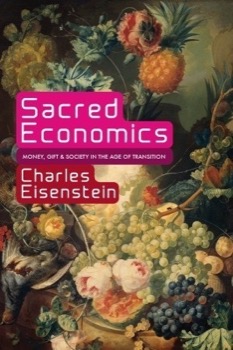
Softcover. Berkeley, Evolver Editions/North Atlantic, reprint, 2011, Book: Very Good, Dust Jacket: None, Softcover, 468 pages. Sacred Economics traces the history of money from ancient gift economies to modern capitalism, revealing how the money system has contributed to alienation, competition, and scarcity, destroyed community, and necessitated endless growth. Today, these trends have reached their extreme--but in the wake of their collapse, we may find great opportunity to transition to a more connected, ecological, and sustainable way of being. This book is about how the money system will have to change--and is already changing--to embody this transition. Clean copy.
Softcover. Princeton NJ, Princeton University Press, 1st, 2002, Book: Very Good, Softcover, 372 pages. Ten leading scholars explore how, over the past two centuries, the changing positions of the United States in the world economy and in the international political order have shaped U.S. political institutions and domestic politics. Ira Katznelson, Aristide R. Zolberg, and Robert O. Keohane demonstrate the central role that efforts to contend with foreign military and economic competition played in forming the major institutions of U.S. government from the framing of the Constitution through the Civil War. Clean copy.
Hardcover. London, Transaction Publishers, 2nd Ed., 2014, Book: Very Good, Dust Jacket: Very Good, Hardcover in a bright dust jacket. The late twentieth century witnessed rapid changes not only in Taiwan's economy, but also in its identity. Both economic as well as ideological restructuring have been basic elements in the transformation of postwar Taiwan, as rapid democratization opened a Pandora's Box, and stirred a whirlwind of social discord. This volume considers such important questions as whether the old Taiwanese work ethic is a relic of the past, and whether Taiwan is likely to become a battleground of ideological wars. The book addresses Taiwanese nostalgia for Chinese culture; the rise and fall of postwar Taiwanese agrarian culture; the transformation of farmers' social consciousness in the period 1950-1970; the place of Confucianism in postwar Taiwan; and the awakening of the "self" and the development of a Taiwanese national identity in the post-World War II period. Finally, it considers whether "mutual historical understanding" may be the basis for Taiwan-Mainland relations in the twenty-first century. This second edition includes a new chapter on the history of Taiwan after World War II, incorporating additional developments in Taiwan in the past decade.
Hardcover. Philadelphia, Temple University Press, 1st, 1991, Book: Very Good, Dust Jacket: Very Good, Hardcover in a dust jacket with fading to spine, 174 pages. In this interpretation of Bolivia?s political and social development, Carmenza Gallo focuses on the impact of the Bolivian tax code and its relationship to class structure. She argues that differences in state formation in primary export economies merge from variation of three main elements: class structure; the economic base and the export sector?s degree of integration into the domestic economy; and the reliance of fiscal resources on export sectors. Gallo produces a more complete view of the state?s responses to internal and international circumstances and a better understanding of the conditions under which officials of weak states, like Bolivia, act independently of upper classes.
Hardcover. Lawrence KS, University Press of Kansas, 1st, 2009, Book: Very Good, Dust Jacket: Very Good, Hardcover in bright dust jacket, 375 pages. The debate over the federal budget-and the deficit spending it tends to produce-has assumed a renewed urgency for reasons that are painfully clear to all of us. Over the past thirty-two years-from the presidency of Jimmy Carter through that of George W. Bush-the U.S. government has in fact balanced its budget in only four of them, while the fiscal challenges confronting President Obama make a balanced budget anytime soon a remote possibility. Iwan Morgan's book provides a much-needed historical perspective on this perennially troubling issue. Clean copy.


 "Hamilton's Blessing: The Extraordinary Life and Times of Our National Debtby: John Steele Gordon")

 "Japan's Technological Challenge to the West, 1950-1974:Motivation and Accomplishment by: Ozawa, Terutomo")
 "Lectures on Justice, Police, Revenue and Armsby: Smith, Adam")
 "Locke on Money. Edited together with Ancillary Manuscripts, an Introduction, Critical Apparatus, and Notes by Patrick Hyde Kelly.(2 Volumes)by: Locke, John and Kelly,")
 "Malthus and His Workby: Bonar, James")
 "Out to Work: A History of Wage Earning Women in the United States by: Kessler-Harris, Alice")
 "Poor-Relief In Vermontby: K.R.B. Flint")
 "Profits in the Wilderness: Entrepreneurship and the Founding of New England Towns in the Seventeenth Century by: John Frederick Martin")
 "Public Workers: Government Employee Unions, the Law, and the State, 1900-1962by: Joseph E. Slater")

 "Resurgent India: Ideas and Priorities by: Agarwala, Ramgopal; Kumar, Rajiv; Shah, Rajesh")
 "Shaped by War and Trade: International Influences on American Political Developmentby: Ira Katznelson , Martin Shefter (Editors)")
 "Socioeconomic History of Argentina 1776-1860by: Brown, Jonathan C.")
 "Taiwan in Transformation: Retrospect and Prospect/2nd Editionby: Chun-chieh Huang")

 "The Age of Deficits: Presidents and Unbalanced Budgets from Jimmy Carter to George W. Bushby: Iwan Morgan")