Hardcover. Lawrence KS, University Press of Kansas, 1st, Book: Very Good, Dust Jacket: Very Good, Hardcover in a bright dust jacket, 328 pages. By the end of the Civil War, fatalities from that conflict had far exceeded previous American experience, devastating families and communities alike. As John Neff shows, commemorating the 620,000 lives lost proved to be a persistent obstacle to the hard work of reuniting the nation, as every memorial observation compelled painful recollections of the war. Neff contends that the significance of the Civil War dead has been largely overlooked and that the literature on the war has so far failed to note how commemorations of the dead provide a means for both expressing lingering animosities and discouraging reconciliation. Clean copy.
Softcover. Seattle, University of Washington Press, 1st, 2000, Book: Very Good, Dust Jacket: None, Softcover. Like new in publishers shrink-wrap. Chief Joseph's exhausted words of surrender, 'Hear me, my chiefs, I am tired; my heart is sick and sad. From where the sun now stands, I will fight no more forever', are the accepted end of the Nez Perce War of 1877, in which several bands of Nez Perce attempting to find a new home outside their diminished Idaho reservation clashed with the U.S. military (and occasionally other Indians) along the Clearwater and Big Hole Rivers, and finally at the foot of the Bear Paw Mountains. However, a number of Nez Perce escaped transportation to Indian Territory with Joseph and continued their flight to Canada, with perhaps a hundred eventually joining Sitting Bull's Lakota."I Will Tell of My War Story" reproduces, describes, and discusses a remarkable series of drawings by an anonymous Indian artist who fought with Chief Joseph and later reached Canada. The drawings, in red, blue, and black pencil, include portraits of principal participants in the war, battle scenes, and views of Nez Perce camp life and celebrations during the war and after. The drawings are preserved in a small pocket ledger labeled 'Cash Book' on the front, which was acquired by Indian Agent Charles D. Warner in the 1880s. It was willed by him to a family living in northern Idaho, and is now in the collection of the Idaho State Historical Society. Scott Thompson worked closely both with the owners and with members of the Nez Perce community in preparing his manuscript. Thompson's detective work and research methods to identify Nez Perce and other parties pictured in the Cash Book make fascinating reading. He is careful to point out what is speculation and what has been documented or attested to by experts on dress, weapons, ceremony, and other aspects of Native culture. The Cash Book drawings are unique in several ways. They are one of very few firsthand pictorial records of the Nez Perce War, representing an even scarcer record of this war as seen from the Indian viewpoint. They contain invaluable historical and ethnographic information not only explicit in the form of military and Native dress, regalia, and quite graphic battle scenes, but also implicit. The drawings reveal an important stage of cultural adaptation as shown by the mixture of white and Native goods combined in Nez Perce material culture during the 1870s and 1880s, and by the artist's assimilation of white/European drawing techniques such as texture and perspective. The artist combined these drawing techniques with Native art traditions to make exceptionally effective pictorial communications. Scott M. Thompson is an art teacher at Chase Middle School in Spokane, Washington.
Softcover. Seattle WA, University of Washington Press, 1st, 2000-06-01, Book: Very Good, Dust Jacket: None, Softcover, 122 pages. Like new in publishers shrink-wrap.
Hardcover. New York, The Free Press, 1st, 2001, Book: Very Good, Dust Jacket: Very Good, 263 pages. Hardcover. Dust jacket unclipped. Color illustrations throughout. Gilt title on spine. A touch of foxing on spine, otherwise clean inside. Binding tight, in great shape.
Hardcover. NY, Time Life, reprint, 1983, Book: Very Good, Dust Jacket: None, 335 pages. Hardcover with no dust jacket. Dark blue leather bound with gilt titles to front cover and spine. Embossed decoration on front cover. Gilt text block edges, red ribbon marker. Clean, tight copy.
Hardcover. London, The Cresset Press, 1st, 1960, Book: Very Good, Dust Jacket: Good, 256 pages. Blue cloth cover, gilt lettering, some minor wear to edges of spine. Dust jacket has some wear, and a small tear on bottom of spine. Library sticker on front endpaper. Eight page section of b&w photographs. Inside is bright and clean. A nice copy.
Hardcover. London, John Lane the Bodley Head, 1st, 1913, Book: Very Good, Dust Jacket: None, Hardcover, 291 pages. Photographs and illustrations throughout. Minor spine edge wear. Gilt title on front cover and spine. A clean and tight copy.
Hardcover. Hartford CT, Hurlbut, Scranton & Co., 1st, 1864, Book: Very Good, Dust Jacket: None, Hardcover, 763 pages, illustrated with many full-page plates, most hand-colored (including second title page). Leather bound with some splitting along spine edges. Black spine label with gilt lettering. Internally very good, minor foxing.
Hardcover. NY, Alfred A. Knopf, 1st, 1986, Book: Very Good, Dust Jacket: Very Good, Hardcover in a bright, unclipped dust jacket. 550 pages. A fascinating historical study using newly-declassified documents from the time the British were in Indochina through the end of the war. A detailed, specific history of the debacle. Clean copy.
Hardcover. NY, Oxford University Press, 1st, 1991, Book: Very Good, Dust Jacket: Very Good, Hardcover in a bright, price-clipped dust jacket, 268 pages. Focusing mainly on the nine months from November 1964 to July 1965 VanDeMark describes how the Johnson administration progressed along a seemingly inevitable path to double the number of ground troops in Vietnam, polarize the American people, and destroy Johnson's presidency in the short term. Mining a wealth of recently opened material at the Lyndon Baines Johnson Library and elsewhere, Brian VanDeMark vividly depicts the painful unfolding of a national tragedy. Name on front fly leaf otherwise clean.
Hardcover. Boston, Houghton Mifflin Co , 1st, 1928, Book: Good, Dust Jacket: None, Set of two hardcover volumes. 1113 pages total. Illustrated frontispiece. B&w illustrations throughout. Includes extensive appendix. With worn, decorative slipcase. Light edge wear to dust jacket otherwise clean, unmarked copy with only minor wear to dust jacket.
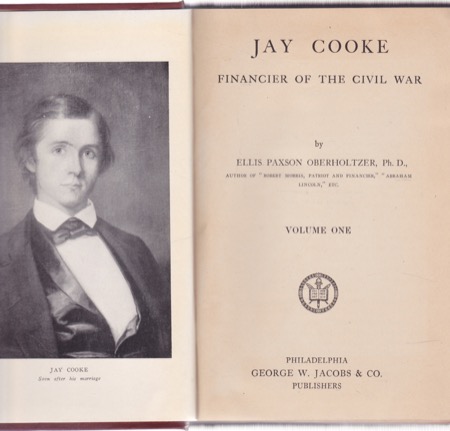
Hardcover. Philadelphia, George W. Jacobs & Co., 1907, Book: Very Good, Dust Jacket: None, Two matching hardcover volumes in maroon cloth with gilt-lettered spine titles. [1], xi, [1 blank], 658; [2], vi, 590 pages, as issued, with plates and folding maps. Jay Cooke was an American financier who helped finance the Union war effort during the American Civil War and the postwar development of railroads in the northwestern United States. He is generally acknowledged as the first major investment banker in the United States and creator of the first wire house firm. Over 75 illustrations, including foldouts. NOTE: Unlike most sets offered online, this one does not have blue cloth or top edge gilt. The copyright page states Published October, 1907. No other printings noted. No date on title page, so suspected reprint. Bookplate on inside front covers, otherwise clean and tight set.
Hardcover. Urbana IL, University of Illinois Press, 1st, 1961, Book: Very Good, Dust Jacket: Very Good, Hardcover in alightly worn dust jacket, 260 pages. "In this first biography of Warren since 1865, John Cary re-establishes Warren's deserved reputation as an American patriot and leading figure of the American Revolution. He ranks Warren with Samuel Adams as the two most important figures in the Massachusetts revolutionary movement." Name on front fly leaf, otherwise clean.
Hardcover. New Haven CT, Yale University Press, 2nd pr., 1922, Book: Good, Dust Jacket: None, Hardcover, marbled boards with gray cloth spine, 333 pages plus index. Endpapers map. Janet Schaw, a supporter of the Crown, illustrates the extent to which the American Revolution had, by 1775, become a close, personal insurgency, pitting neighbor against neighbor. Schaw was a young, well-educated Scottish woman who traveled to North Carolina to visit her older brother Robert, the owner of a plantation on the Cape Fear River near Wilmington. She arrived in March of 1775 and while in North Carolina witnessed, among other things, land clearing through controlled burning and the killing of an alligator. More important, she observed a society that was splitting asunder under the stress of revolutionary politics. The decisions of the Wilmington Committee forced men and women along the Cape Fear to take sides. Worn covers with spine cloth coming loose. Binding is solid.
Hardcover. Baltimore, Johns Hopkins University Press, 1st, 2003, Book: Very Good, Dust Jacket: Very Good, Hardcover in a bright dust jacket with a small closed tear to front panel. INSCRIBED BY HUDDLESTON on the dedication page. Huddleston has paired archival images of the first modern war with his own, contemporary color shots of the same locations, at the same time of year, at the same time of day. Some sites of suicidal charges have become Kmarts, mini-malls or swamps strewn with metal and plastic trash. The juxtapositions possess surprising power. In an overexposed and damaged archival shot of the Confederate prisoner of war camp at Andersonville, Ga., a filthy crowd of anonymous men packs the frame, while on the facing page Huddleston presents his own fine-tuned image of a muted, borderless sky. Office buildings, grocery stores and fast food franchises have sprouted where Union Major General George H. Thomas and Confederate General John Bell Hood slugged it out for December days in Nashville 141 years ago. Near the site of some of the heaviest fighting between blue and gray, a KFC sign now advertises discounts on the colonel's secret recipe. Clean copy.
Hardcover. Woodstock VT, Countryman Press, 4th pr., 1999, Book: Very Good, Dust Jacket: Very Good, Hardcover in a bright, price-clipped dust jacket, 416 pages, b&w illustrations. Now largely forgotten, the massacres of 1675 to 1676, known as King Philip's War, ended the harmonious relations that had existed between native Americans and the colonists since their arrival at Plymouth Rock in 1620. Tensions had been rising as the number of settlers grew, and the pillaging of an outlying farm by affronted young braves escalated into open hostilities. Pitched battles were fought from Rhode Island to Maine. Hundreds of English died as farmers fled and cowered behind stockades or in the few port towns. Thousands of natives were slaughtered and the rest dispersed or sold into slavery in the West Indies. The savagery resulted in the clearing of the native populations from southern New England and the unopposed expansion of the New England colonies. It also became the brutal model on which the United States came to deal with its native peoples. King Philip's War tells the story with such close attention to detail that each ambush, each burned-out farm, becomes a vivid image. The authors make abundant use of maps and photographs of old sites to enable the reader to follow the course of the war: the book forms an exhaustive guide for the armchair historian or anyone wishing to visit the monuments and battlefields today. Clean copy.
Hardcover. Boston, Little Brown, 1st, 1977, Book: Very Good, Dust Jacket: Very Good, Hardcover in a bright, unclipped dust jacket, 338 pages. Light edgewear to dj, remainder dot bottom edge. A novel of Henry Knox's 1776 winter raid on Fort Ticonderoga to bring cannon to beleaguered Boston. Endpapers map. Clean copy.
Hardcover. New York, Harcourt, Brace and Co, 1st, 1941, Book: Very Good, Dust Jacket: None, Hardcover, blue cloth covers with paper label on front and spine. 286 pages. B&w frontispiece and illustrations by Warren Chappell. Minor edgewear to cover and age staining to endpapers. Else a clean, tight copy.
Hardcover. London, England, Oxford at the Clarendon Press, 2nd Edition, 1955, Book: Very Good, Dust Jacket: None, 479 pages plus maps and fold-out family tree/timeline. Hardcover. Paste down presentation label on front flyleaf. Previous owner's signature on front flyleaf. Blue cloth cover boards, gilt title on spine (slightly faded). A touch of tanning to pages. In very good condition.
Softcover. Philadelphia, William S. & Alfred Martien, 1st, 1863, Book: Very Good, Dust Jacket: None, Softcover, 20 page booklet, blue wrappers. Two black lines on front cover otherwise clean.
Hardcover. New York, Naval History Society, 1st, 1915, Book: Near Fine, Dust Jacket: None, 240 pages, b&w illustration. White vellum spine and corners with blue-gray boards, gilt lettering on spine, top edge gilt. Limited to 600 copies, this is #590. Beautiful bright copy.
Hardcover. New York, Naval History Society, 1st, 1915, Book: Near Fine, Dust Jacket: None, 240 pages, b&w illustration. White vellum spine and corners with blue-gray boards, gilt lettering on spine, top edge gilt. Limited to 600 copies, this is #582. Beautiful bright copy.
Hardcover. Rhode Island Library, Brown University, 1st, 1927, Book: Very Good, Dust Jacket: None, 72 pages. B/w illustrations throughout. Pages untrimmed. Covered in navy blue fabric with gilt title on spine. Some very light fraying at top and bottom of spine, as well as corners of front and back boards. Pages lightly yellowed with age. Original correspondence of Abraham Lincoln, includes copied samples of actual letters.
Hardcover. Boston, Charles E. Goodspeed, 1st, 1902, Book: Very Good, Dust Jacket: None, 88 pages, hardcover. Edited by Charles Knowles Bolton. Correspondence during the American revolutionary war. Mild fading to spine and top edge. Mild rubbing and edgewear to boards as well. Rough cut top edge. Minor bumping to corners. Frontispiece intact. Unmarked. A bright and tight copy.

 "Honoring the Civil War Dead: Commemoration and the Problem of Reconciliation by: Neff, John R.")
 "I Will Tell of My War Story: A Pictorial Account of the Nez Perce War (Samuel and Althea Stroum Book)by: Thompson, Scott M.")
 "I Will Tell of My War Story: A Pictorial Account of the Nez Perce War (Samuel and Althea Stroum Book)by: Thompson, Scott M.")
 "Images From the Storm: 300 Civil War Images by the Author of Eye of the Stormby: Sneden, Private Robert Knox (Author/Illustrator), Charles F. Bryan, Jr., James c. Kel")
 "In and Out of Rebel Prisons (Collector's Library of the Civil War)by: Cooper, Alonzo")
 "In Peril on the Sea: War Exploits of Allied Seamen.by: Masters, David")
 "In the Wake of the Eighteen-Twelvers: Fights and Flights of Frigates and Fore-'n'-afters in the War of 1812-1815 on the Great Lakesby: Snider, C. H. J.")
 "Indian Races of North and South America, The: Including the Late Sioux War and Indian Massacre in Minnesotaby: Brownell, Charles de Wolf")
 "Intervention: How America Became Involved in Vietnam by: George McT. Kahin")
 "Into the Quagmire: Lyndon Johnson and the Escalation of the Vietnam Warby: Brian VanDeMark")
 "Ira Allen: Founder of Vermont by: Wilbur , James Benjamin")
 "Jay Cooke: Financier of the Civil War - Two Volumesby: Ellis Paxson Oberholtzer")

 "Joseph Warren: Physician, Politician, Patriotby: Cary, John")
 "Journal of a Lady of Quality Being the Narrative of a Journey from Scotland to the West Indies North Carolina and Portugal in the Years 1774 to 1776by: Andrews, Evang")
 "Killing Ground: The Civil War and the Changing American Landscape (INSCRIBED COPY)by: John Huddleston")
 "King Philip's War : The History and Legacy of America's Forgotten Conflictby: Eric B. Schultz, Michael J. Tougias")
 "King's Iron, Theby: Peck, Robert Newton")
 "Knight of the Sea: The Story of Stephen Decaturby: Lowe, Corinne")
 "Later Stuarts, The: 1660-1714by: Clark, Sir George")
 "League for The Union, The: Speeches of the Hon. George Bancroft and James Millikenby: Bancroft, George and James Milliken")
 "Letters and Papers Relating to the Cruises of Gustavus Conyngham, a Captain of the Continental Navy, 1777-1779by: Nesser (Ed.), Robert Wilden")
 "Letters and Papers Relating to the Cruises of Gustavus Conyngham, a Captain of the Continental Navy, 1777-1779by: Nesser (Ed.), Robert Wilden")
 "Letters of Abraham Lincoln (Heretofore Unpublished)by: Koopman (Preface), Harry Lyman")
 "Letters of Hugh Earl Percy from Boston and New York: 1774-1776by: Percy, Hugh Earl")