Hardcover. NY, James Pott & Co., 1st, 1905, Book: Very Good, Dust Jacket: None, Hardcover, blue cloth with bright gilt design to cover, gilt lettering on spine, 127 pages. Introduction by George Meredith. Bookplate/name on inside front cover. Otherwise a clean, bright copy.
Hardcover. Hoboken NJ, Wiley Publishing, 1st, 2003, Book: Very Good, Dust Jacket: Very Good, Hardcover in a bright, unclipped dust jacket. The Last Samurai traces Saigo's life from his early days as a tax clerk in far southwestern Japan, through his rise to national prominence as a fierce imperial loyalist. Saigo was twice exiled for his political activities - sent to Japan's remote southwestern islands where he fully expected to die. But exile only increased his reputation for loyalty, and in 1864 he was brought back to the capital to help his lord fight for the restoration of the emperor.
Hardcover. NY, Harry N. Abrams, 1st, 2022, Book: Very Good, Dust Jacket: None, Hardcover in pictorial boards, 271 pages. Journey into the mind and creative process of one of the most celebrated anime directors working today with The Man Who Leapt Through Film: The Art of Mamoru Hosoda. Written by renowned animation critic and historian Charles Solomon (The Art of WolfWalkers) and featuring exclusive interviews alongside hundreds of never-before-seen sketches, storyboards, background paintings, character designs, and concept art, this is the ultimate companion piece to Hosoda's work. Writer/director/animator Mamoru Hosoda's work includes Belle (2021), the Academy Award-nominated Mirai (2018); The Boy and the Beast (2015); Wolf Children (2012); Summer Wars (2009); and The Girl Who Leapt Through Time (2006). He is the cofounder of Studio Chizu, one of Japan's premier animation studios. Clean, bright copy.
Hardcover. Boston, David R. Godine, 3rd pr., 2008, Book: Very Good, Dust Jacket: Very Good, Hardcover in a bright, unclipped dust jacket. Tojiro, a nine-year-old orphan, sells rice cakes on the streets of 19th-century Edo, the bustling city we now call Tokyo. One of his customers is the grumpy, eccentric octogenarian Hokusai. The old man takes a liking to Tojiro, and soon employs him as his assistant. The boy's ignorance provides a convenient vehicle for introducing the artist's life and work. Much of the dialogue and action is written for the purpose of conveying information about Hokusai, as well as the technique of woodblock printing and the social customs of Edo. The book's greatest strength is not the text, but the art that enlivens every page. A combination of the author's watercolors and reproductions of Hokusai's drawings and woodblock prints, the illustrations are arranged in enticing and varied page designs.
Hardcover. NY, W. W. Norton & Company, 1st, 1972, Book: Very Good, Dust Jacket: Very Good, Hardcover in a bright, unclipped dust jacket. 430 pages illustrated in b&w and color by Yee. "Customs and rituals, dress and language, poetry and drama, painting and sculpture, kites and carp, trees and flowers, everything is revealed to us in Mr. Yee's inimitable text and delightful drawings. Familiar centers and out-of-the-way corners of Japan all come under the Silent Traveller's scrutiny -- Tokyo's Ginza, a Shinto dance at Ise, Kyoto's Phoenix Hall, cormorant-fishing in Gifu, Mt. Fuji, an Ainu village, the five hundred arhats, the beardless hippies of Tokyo, the perennial towel-bearing bathers at a resort hotel, the phenomenon of the marimos, red-crested cranes -- and much more. Clean copy.
Hardcover. NY, George Braziller, 1st, 1991, Book: Very Good, Dust Jacket: Very Good, Hardcover in a dust jacket, 191 pages, 74 pages illustrated in color by Chobunsai Eishi. Exquisite illustrations in color throughout connecting beautifully with the text which includes one poem in English and Japanese by each poet. Historical background for each poet. Mild sunning to bottom edge of dust jacket. Clean copy.
Hardcover. London, John Murray, 1st, 1905, Book: Very Good, Dust Jacket: None, 552 pages. Green cloth boards with gilt title on spine and cover. Moisture stain in upper right corner of front endpaper. Fold-out map of Japan shows light foxing. Endpapers age faded. Light soiling to front and back covers.
Hardcover. Scarsdale NY, Bradbury Press, 1st, 1974, Book: Very Good, Dust Jacket: None, Hardcover, beige cloth stamped in black. Folklore about a Japanese farmer who digs up a huge imo (yam). Ed Young style pencil drawings by Japanese artist Mitsu Yashima. No dust jacket. Clean copy.
Hardcover. Princeton NJ, Princeton University Press, 1st, 1979, Hardcover in a nice dust jacket with mild fading to spine, 347 pages. This work is the autobiography of Arai Hakuseki, the celebrated Confucian scholar who holds a prominent position in Japanese history as the influential adviser to Shogun Tokugawa Ienobu and his successor Ietsugu. Hakuseki's administrative reforms, his voluminous writings, and his advice on a multitude of topics--coinage, foreign trade, taxation, diplomatic protocol, justice, the samurai code and benevolent government, for example. governed most of the policies implemented during Ienobu's rule and influenced many of those of his successors. The book contains notes, biographical notes, appendices, a chronology, maps, and an index. Name on front flyleaf, otherwise a clean, tight copy.
Hardcover. Westport CT, Greenwood Press, 1st, 2003, Book: Very Good, Dust Jacket: None, Hardcover, maroon cloth covers stamped in silver, 242 pages. Previous owner's inscription on front fly leaf, otherwise clean. Over the course of the American Occupation of Japan, the U.S. attitude toward the Japanese Communist Party (JCP) gradually shifted from one of friendly cooperation to one of mutual opposition. This new study examines the initial approach toward communism in Japan; internal and external factors that affected American attitudes; the various phases of the relationship; and how Japan ultimately became a democratic nation. Oinas-Kukkonen investigates American information gathering techniques used at the time to determine possible links with the Soviet Union. He also discusses the possibility that Nosaka Sanzo, one of the main leaders of the JCP, was an American spy. Using previously secret records of General MacArthur's intelligence staff and plentiful archival materials on the Occupation, this study explores how the United States originally sought to utilize the JCP to assist in the democratization process. It identifies the perceived threat of a revolution in March 1947 as a key turning point in U.S. attitudes. Involved in a delicate balancing act with multiple Japanese interests, some American officials feared that elements of the extreme left might even evolve into extreme right-wing terrorists. In this comprehensive account, Oinas-Kukkonen includes information on the indirect role of the Europeans in this affair, as well as the roles of outsider groups such as the outcaste burakumin and the Koreans residing in Japan.
Softcover. Berkeley CA, University of California Press, 2nd pr., 2004, Book: Very Good, Dust Jacket: None, Softcover, 421 pages, b&w illustrations. Located only blocks from Tokyo's glittering Ginza, Tsukiji-the world's largest marketplace for seafood-is a prominent landmark, well known but little understood by most Tokyoites: a supplier for countless fishmongers and sushi chefs, and a popular and fascinating destination for foreign tourists. Early every morning, the worlds of hi-tech and pre-tech trade noisily converge as tens of thousands of tons of seafood from every ocean of the world quickly change hands. Clean, bright copy.
Softcover. NY, Japan Society, Inc, 1st, 1975, Book: Very Good, Dust Jacket: None, Softcover, pictorial wraps, 215 pages. With a preface by Maryell Semal and photographs by Michikazu Sakai. 8 color plates, numerous b&w photos. Clean, bright copy.
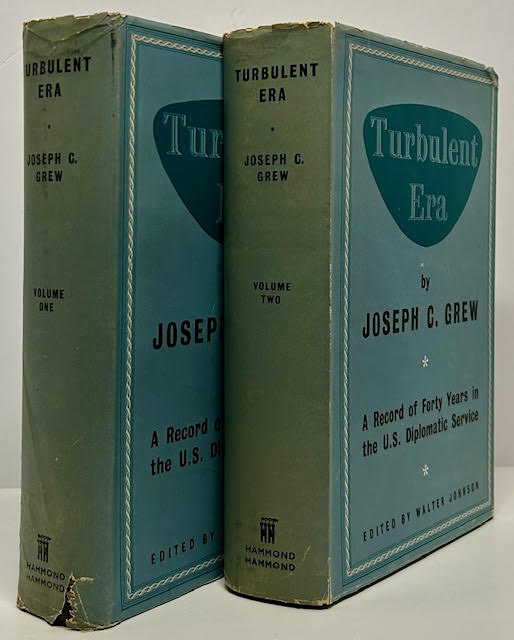
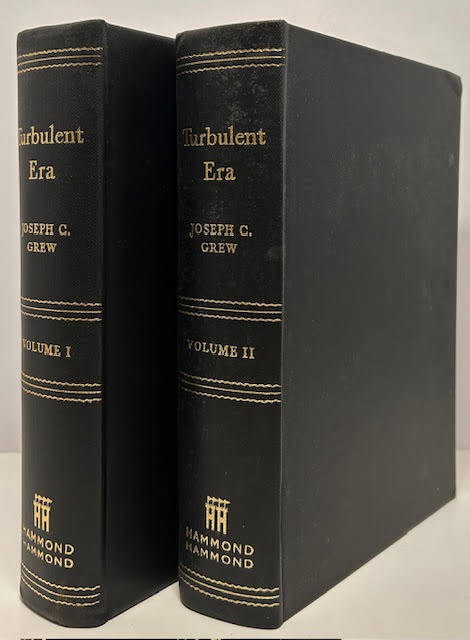
Hardcover. London, England, Hammond, Hammond & Co. Ltd., 1st Edition, 1953, Book: Very Good, Dust Jacket: Very Good, 2 Volume Set, DOMESTIC SHIPPING ONLY. 1560 total pages. Hardcovers. Black cover boards, gilt title on spine. Light tanning from age to pages. Bindings good. Spines straight. A record of one of America's most distinguished diplomatic careers.
Hardcover. New York, Gallery Books, 1st US, 1991, Book: Very Good, Dust Jacket: Very Good, 390 pages, illustrated throughout in color. INSCRIBED BY YOSHIDA on half title page. Large, very heavy book. Light shelf-wear to dust jacket. Clean, tight copy.
Softcover. Nara, Nara National Museum, 1st, 2002, Book: Very Good, Dust Jacket: None, 375 pages. Softcover. Exhibition catalog. Full color photographs. Primary language of catalog is Japanese - Foreword and Exhibition Checklist in English. Light wear. Clean, tight copy.
Hardcover. NY, Hobart Company, 1st, 1904, Book: Very Good, Dust Jacket: None, Hardcover, green cloth stamped in orange and black. Three introductory pages of text; balance of book consists entirely of 77 black and white photographs with descriptive captions. Plates showing temples, traditional Japanese residences and businesses, Japanese people at work and at play, a karuma carriage, Yokohama Bay, etc. Clean, bright copy.
Hardcover. Lewiston NY, Edwin Mellen Press, 1st, 1998, Book: Very Good, Dust Jacket: None, Hardcover, red cloth with b&w decoration to front cover, 295 pages. INSCRIBED BY AUTHOR on front fly leaf, possibly to the publisher Edwin Mellen. (the name has been corrected and is difficult to read.)
Hardcover. Philadelphia , Lippincott, 1st, 1917, Book: Very Good, Dust Jacket: None, Hardcover, 286 pages, color frontispiece, fold-out map of Tokyo Bay, cream colored cloth with Japanese characters on front. Previous owner's signature on front fly leaf otherwise clean, tight copy.

 "The Japanese Spirit by: Okakura Yoshisaburo")
 "The Last Samurai: The Life and Battles of Saigo Takamori by: Mark Ravina")
 "The Man Who Leapt Through Film: The Art of Mamoru Hosodaby: Solomon, Charles")
 "The Old Man Mad about Drawing: A Tale of Hokusaiby: Place, Francois")
 "The Silent Traveller in Japan by: Chiang Yee")
 "The Thirty-Six Immortal Women Poets: A Poetry Album by: Pekarik, Andrew J. (Ed.)/Chobunsai Eishi (Illust.)")
 "Things Japanese - Being Notes on Various Subjects Connected with Japanby: Chamberlain, Basil Hall")
 "Tobei: A Japanese Folktaleby: Durham, Mae/pictures by Mitsu Yashima.")
 "Told Round a Brushwood Fire: the Autobiography of Arai Hakuseki by: Arai Hakuseki /Joyce Ackroyd (Translator)")
 "Tolerance, Suspicion, and Hostility: Changing U.S. Attitudes toward the Japanese Communist Movement, 1944-1947by: Oinas-Kukkonen, Henry")
 "Tsukiji: The Fish Market at the Center of the Worldby: Bestor, Theodore C.")
 "Tsutsumu: An Introduction to an Exhibition of the Art of the Japanese Package by: Oka, Hideyuki; Sakai, Michikazu")
 "Turbulent Era: A Record of Forty Years in the U.S. Diplomatic Service, 1904-1945 (2 Volume set)by: Grew, Joseph C. , Walter Johnson (editor)")
 "Ukiyo-E: 250 Years of Japanese Art (SIGNED COPY)by: Yoshida, Susugu/Roni Neuer")
 "Ultimate Todai-ji - Incomparable Masterworks from Nara's Great Eastern Temple - Nara National Museum, Nara, Japan - April 20-July 7, 2002by: Nara National Museum")
 "Wonders of Japan: A Portfolio of Views in the Enchanted Bamboo Land by: N/A")
 "Yang Kuei-Fei Legend in Japanese Literature, The (Japanese Studies, Vol 6) (SIGNED COPY)by: Masako Nakagawa Graham")
 "Yotsuya Kwaidan, The: Or O'iwa Inariby: Benneville, James S. De")