Hardcover. NY, HarperCollins, 1st, 2002, Book: Very Good, Dust Jacket: Very Good, Hardcover in a bright, unclipped dust jacket. SIGNED BY PROSE on the title page. In a brilliant, wry, and provocative book, National Book Award finalist Francine Prose explores the complex relationship between the artist and his muse. In so doing, she illuminates with great sensitivity and intelligence the elusive emotional wellsprings of the creative process. Clean copy.
Lebanon NH, University of New Hampshire Press, 1st, 2005, Book: Very Good, Dust Jacket: Very Good, Hardcover in a bright dust jacket. 294 pages, b&w illustrations. Presents a succinct, articulate examination of the work of the pioneering but controversial archaeologist Roland Wells Robbins (1908-1987) and the development of historical archaelogy in America. In 1945, the self-taught Robbins discovered the remains of Thoreau's cabin at Walden Pond. He excavated the site, documented his findings, and in 1947 published a short book, Discovery at Walden, about the experience. This project launched Robbins's career in archaeology, restoration, and reconstruction, and he went on to excavate at a number of New England iron works and other sites, including the Philipsburg Manor Upper Mills in New York, Stawbery Banke in New Hampshire, and Shadwell, Thomas Jefferson's Virginia birthplace. Although lacking academic training, Robbins quickly developed remarkably sophisticated techniques for the period. However, his "pick and shovel" methods were considered suspect and increasingly frowned upon by the emerging American historical archaeological establishment. Clean copy.
Softcover. The Woodlands,TX, New Century Books, 1st, 2001, Book: Very Good, Dust Jacket: None, Softcover, 210 pages. With a typewritten letter laid in containing an inscription and the author's signature, "Tom". The Man Who Was Dr. Seuss is the first major personal and literary biography of Theodor "Dr. Seuss" Geisel. It describes the origins of the rhyme scheme he used for many of his books; his views of international justice; the morals for children in his books; why parents are seldom seen in Dr. Seuss books and finally, among fabulouse facts and fanciful fables, how and why Dr. Seuss eventually became an American icon. Clean copy.
Hardcover. NY, Viking Press, 1st US, 1977, Book: Very Good, Dust Jacket: Good, Hardcover in a lightly sunned, price-clipped dust jacket, 254 pages. "In this elegant memoir, Quennell turns from biographer of others to creating a self-portrait as well as frank and affectionate pictures of his parents. His father, C.H.B. Quennell, was an architect, a popular historian, and a formidable eccentric. The two men could scarcely have been more dissimilar, yet they shared many tastes and traits, and although they were lifelong adversaries the influence of the father had a determining effect on the education of the son." (from the jacket) Previous owner's inscription on front fly leaf which is tanned from clipping laid in.
Hardcover. London, Jonathan Cape, 1st thus, 1973, Book: Very Good, Dust Jacket: Very Good, Hardcover, 204 pages. With a portrait frontispiece. Original publisher's brown cloth, lettered in gilt, pictorial dustwrapper. Very minor shelf-wear, some spotting to dustwrapper. A 1973 reprint of the unexpurgated edition of T. E Lawrence's The Mint. Two editions were published simultaneously in 1955; an unexpurgated text in a limited edition, and an expurgated version (reprinted once in the same year); the present publication is a reissue of the former. The memoir records his service in the ranks of the R.A.F. Lawrence enlisted in 1922; in an effort to escape public and media attention he assumed the name John Hulme Ross. Upon the discovery of his identity he was discharged, but two and a half years later was permitted to re-enlist, this time using the name of Shaw, under which he had meanwhile served in the Tank Corps.
Hardcover. NY, Free Press, 1st, 1987, Book: Very Good, Dust Jacket: Very Good, Hardcover in a bright dust jacket, 270 pages, b&w illustrations. Light edgewear to dust jacket, else a clean, tight copy. Recounts the life of the English poet who died during World War I, looks at the group of his friends and fellow poets known as the Neo-Pagans, and discusses the influence of homosexuality on his life. His sonnet "The Soldier" and early death in World War I made British poet Rupert Brooke a key figure in the nation's myth of patriotism and youthful valor. Biographer Delaney places him among the Neo-pagans, a small circle of writers, artists, and intellectuals who flourished from 1908 to 1912. The group honored youth, comradeship, and the simple life and aimed to set aside the constraints of Victorianism. Delany shows how the internal dynamics of the group, not shock of war, led to its disintegration.
Hardcover. Milwaukie OR, M Press, 1st, 2006, Book: Very Good, Dust Jacket: Very Good, Hardcover in a bright, unclipped dust jacket. The third installment of Playboy interviews gives their claim some validity (although probably not enough). The first two collections were grouped under the topics of sports figures and film directors, while the latest simply has the designation "Larger Than Life," and indeed those interviewed were awfully big for their britches. The interviewees include Frank Sinatra, Marlon Brando, Bette Davis, Bob Dylan, Mae West, and Muhammad Ali, among others. The interviews--in true Playboy fashion--are revealing, but also fascinating to realize are the periods in which they occurred. Sinatra was interviewed in 1963, and the cold war was definitely on his mind. Bette Davis, in 1982, had a long career of ups and downs to sound off about. But Muhammad Ali is the perfect example of how honest these personalities could become when allowed to digress; asked why he flunked the army's preinduction test, he replied, "I have said I am the greatest. Ain't nobody ever heard me say I was the smartest." 398 pages, clean copy.
Hardcover. University AL, University of Alabama Press, 1st, 1981, Book: Very Good, Dust Jacket: Very Good, Hardcover, red cloth covers in a lightly worn dust jacket. Here are the passionate memoirs of the French Communard leader, a hero, saint and martyr to the socialists and anarchists battling the injustices of the Third Republic. 202 pages with a bibliography. Clean copy.
Hardcover. Chicago, Ivan R. Dee, 1st US, 1991, Book: Very Good, Dust Jacket: Very Good, Hardcover in a bright, lightly edgeworn dust jacket. 239 pages including index. Author of The Moonstone and The Woman in White, Wilkie Collins is widely regarded as "the father of the detective story." How curious that his own life has puzzled investigators despite numerous attempts to unravel it. Collins lived a publicly Victorian existence as a contemporary of Dickens, Wordsworth, Coleridge, and Blake in mid-19th-century England. Yet upon his death he left a will dividing his estate equally -- between two mistresses.
Hardcover. Canada, Bond Street Books, 1st, 2007, Book: Very Good, Dust Jacket: Very Good, Hardcover in a bright, unclipped dust jacket, 378 pages. Published to mark the 150th anniversary of his birth, The Several Lives of Joseph Conrad is a brilliant and highly readable biography of a literary figure of world-wide reputation. Conrad's impact has been so profound and far-reaching that, eighty years after his death, he remains an essential cultural reference point. Such phrases as "heart of darkness" and "The horror! The horror!" have entered the language, often cited without an awareness of their original contexts. His popular legacy extends to Latin American fiction, to the spy novel, to the terrorist and anarchist character, and to film. The writers he has influenced range from T. S. Eliot to William Faulkner to V. S. Naipaul and John Le Carre. For a writer of "difficult" fiction he has enjoyed a remarkably wide impact, yet as Marlow proclaims in Lord Jim of the figure whose story he tells,"he was one of us," and so Conrad remains in fascinating ways.
Hardcover. NY, Penguin Press, 1st, 2021, Book: Very Good, Dust Jacket: Very Good, Hardcover in a bright, unclipped dust jacket, 416 pages. In the summer of 1865, the former exile Dostoevsky found himself trapped in a cheap hotel in Wiesbaden, unable to leave until he'd paid the bill. Having lost the last of his money at the roulette table, his debts hung heavy over his head, his epileptic seizures were worsening, and his wife and beloved brother were dead. Desperate, a story came to him, a way to write himself out of his predicament: the murderer Raskolnikov, the hot, disorienting swirl of St Petersburg, the axe, the terrible crime, and the murderer's paranoia. The book was Crime and Punishment, and from the moment it was published it was a sensation. But how did this haunting tale of guilt come to be, and why does it still hold such a sway over us all these years later? The Sinner and the Saint gives us the story of the creation of a work of literature that has bewitched readers for over a century, and of the two men so central to it: Dostoevsky himself, and Pierre Francois Lacenaire, a notorious murderer and glamorous egoist who charmed and outraged Paris in the 1830s and whose sensational story provided the germ of the novel. Clean copy.
Hardcover. NY, Pantheon Books, 1st, 1966, Book: Very Good, Dust Jacket: None, Hardcover, light tan boards with pictorial cover in red and black. Sequence of events in Carroll's life and bibliography in back of book. B&w drawings by David Levine. Bright, clean copy, lacks dust jacket.
Hardcover. Berkeley CA, Frog Books, 1st, 2003, Book: Very Good, Dust Jacket: Very Good, Hardcover in a bright dust jacket. Amy Wallace's first meeting with Carlos Castaneda, the infamous anthropologist-turned-shaman, whose books described meetings with Yaqui Indian spiritual teacher Don Juan. Castaneda's rise was meteoric in the late 1960s as he wrote massive bestsellers, inspired many to experiment with psychedelics, and was dubbed "The Godfather of the New Age". The possibility that Castaneda's experiences may have been fabricated did little to compromise his legend. As the daughter of best-selling novelist Irving Wallace, Amy was rarely shy around famous people. When her father insisted she meet Castaneda, she at first demurred. Little did she know that a delightful first meeting would begin a 20-year friendship, followed by her descent into the dramatic and deeply troubled affair chronicled in this book. Wallace reveals the inner workings of the "Cult of Carlos", run by a charismatic authoritarian in his sixties who controlled his young female followers through emotional abuse, mind games, bizarre rituals, dubious teachings, and sexual excess. Bright, clean copy.
Hardcover. NY, E.P. Dutton, 1st, 1937, Book: Very Good, Dust Jacket: None, Hardcover, cream color cloth with green lettering. A memoir of growing up with the author George W. Cable written by his daughter. 189 pages, frontis of Cable. Inscription on front flyleaf, otherwise clean. Light fading to cloth covers.
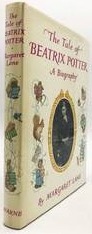
Hardcover. London, Frederick Warne, Revised Ed., 1968, Book: Very Good, Dust Jacket: Very Good, Hardcover in a bright, price-clipped dust jacket, 173 pages. Illustrated with 8 color and 30 b&w plates. Although Beatrix Potter is known and loved by generations of children brought up on "Peter Rabbit" and others, her life began in great joylessness and solitude. Drawing was her once fascination and her creative genius was able to flourish in the loneliness and isolation of her early years. Despite the fame that her skill was later to bring, she nevertheless preferred to maintain her privacy and hide behind the persona of a Lakeland farmer. Margaret's Lane biography recounts, with reference to letters and photographs, Beatrix Potter's sad childhood, her struggle for independence, her ill-fated love affair and happy marriage. Clean copy.
Hardcover. NY, Doubleday, 1st, 1999, Book: Very Good, Dust Jacket: Very Good, Hardcover in a bright dust jacket, 480 pages. A fascinating figure of English literary and political history, Radclyffe Hall was born in 1880 in Bournemouth, England. Hall suffered through an exceedingly unhappy childhood until her father's death. With her inheritance, Hall leased a house in Kensington and began to live the way she pleased. She started dressing in chappish clothes, called herself Peter, then John, and wrote her first collection of verse. She was a political reactionary, a reformed Catholic, a member of the Society for Psychical Research, fussy about food and obsessive about work. She got her pipes from Dunhill's, wore brocade smoking jackets, spats in winter, and had her hair cropped off at the barber's. Hall is most famous today for her book, The Well of Loneliness, which she wrote in 1928. A novel about lesbian love, the book caused an enormous scandal on its publication and it was suppressed both in the U.S. and the United Kingdom, where Hall was put on trial under the Obscene Publications Act.
Athens GA, University Of Georgia Press, 1st, 1995, Book: Very Good, Dust Jacket: Very Good, Hardcover in a bright dust jacket, 464 pages. Caroline Ferguson Gordon (1895-1981) was a notable American novelist and literary critic who, while still in her thirties, was the recipient of two prestigious literary awards, a 1932 Guggenheim Fellowship and a 1934 O. Henry Award . Offers the most complete and accurate portrait to date of the writer. Clean copy.
Hardcover. London, Jonathan Cape, 1st, 1937, Book: Very Good, Dust Jacket: None, Hardcover, blue cloth with gilt lettering on spine. Frontiepiece photograph of the author as Lord Beaconsfield. 392 pages. Autobiography dealing with the author's life up to the mid 1930s. He was the brother of A E Housman, and was well-known in his own right as a writer of plays, as well as being active in the women's suffrage campaign and in the pacifist movement. A prolific writer with around a hundred published works to his name, Housman's output eventually covered all kinds of literature from socialist and pacifist pamphlets to children's stories. He wrote an autobiography, The Unexpected Years (1937), which, despite his record of controversial writing, said little about his homosexuality, the practice of which was then illegal. Mild shelf wear. Clean copy.
Hardcover. Lanham MD, Lyons Press , 1st, 2020, Book: Very Good, Dust Jacket: Very Good, Hardcover in a bright dust jacket, 300 pages. James M. Cain was among the prominent member of the "hard-boiled" school of writing that characterized the 1930s and 1940s, one of the masters of the genre that included Dashiell Hammett and Raymond Chandler. His novels became such popular film noir classics as The Postman always Rings Twice, Double Indemnity, and Mildred Pierce, and his 1937 novel Serenade boldly portrayed its hero as a bisexual. Cain also taught journalism at various colleges in Maryland, wrote editorials for the New York World, and was for a brief time managing editor at The New Yorker. This is the first biography of James M. Cain written with the full cooperation of the late novelist's family.
Softcover. NY, New York University Press, 1st pbk, 1978, Book: Very Good, Dust Jacket: None, Softcover, 272 pages. With bibliography and index. A complete biography of Dahlberg's life and career with an examination of the writings. Contains fourteen illustrations. Clean copy.
Hardcover. NY, Knopf , 1st, 1976, Book: Very Good, Dust Jacket: Very Good, Hardcover in a bright, price-clipped dust jacket. The author's first book about growing up in Stockton, California with her immigrant parents from a small peasant village in China.
Hardcover. London, Methuen, reprint, 1990, Book: Very Good, Dust Jacket: Very Good, Hardcover in a bright dust jacket. 256 pages illustrated in color and b&w. Ernest Howard Shepard was an English artist and book illustrator, best remembered for his charming illustrations of the beloved anthropomorphic animals in The Wind in the Willows and Winnie-the-Pooh. This fascinating study of Shepard, detailing his childhood, education and artistic development, is richly illustrated throughout with his works. Clean copy.

 "The Lives of the Muses: Nine Women & the Artists They Inspired (SIGNED COPY)by: Prose, Francine")
 "The Man Who Found Thoreau: Roland W. Robbins and the Rise of Historical Archaeology in America by: Donald W. Linebaugh")
 "The Man Who Was Dr. Seuss: The Life and Work of Theodor Geisel by: Thomas Fensch")
 "The Marble Foot: An Autobiography, 1905-1938by: Quennell, Peter")
 "The Mintby: Lawrence, T. E.")
 "The Moon and Iby: Betsy Byars")
 "The Neo-Pagans: Rupert Brooke and the Ordeal of Youthby: Delany, Paul")
 "The Playboy Interviews: Larger Than Life by: Stephen Randall (Editor)")
 "The Red Virgin: Memoirs of Louise Michel by: Michel Louise edited by Bullitt Lowry and Elizabeth Ellington Gunter")
 "The Secret Life of Wilkie Collinsby: Clarke, William M.")
 "The Several Lives of Joseph Conradby: John Stape")
 "The Sinner and the Saint: Dostoevsky and the Gentleman Murderer Who Inspired a Masterpieceby: Kevin Birmingham")
 "The Snark was a Boojum: A Life of Lewis Carrollby: Wood, James Playsted/David Levine")
 "The Sorcerer's Apprentice: My Life with Carlos Castanedaby: Amy Wallace")
 "The Tail of the Cometby: Dennis, Mary Cable")
 "The Tale of Beatrix Potter: A Biographyby: Lane, Margaret")

 "The Trials of Radclyffe Hallby: Souhami, Diana")
 "The Underground Stream: The Life And Art Of Caroline Gordon by: Jonza, Nancylee Novell")
 "The Unexpected Years by: Housman, Laurence")
 "The Voice of James M. Cain: A Biography by: David Madden")
 "The Von Richthofen Sisters: The Triumphant and Tragic Modes of Love: Else and Frieda Von Richtofen, Otto Gross, Max Weber, and D. H. Lawrence in the Years 1870-1970 by:")
 "The Wages of Expectation: A Biography of Edward Dahlberg by: Charles L. DeFanti")
 "The Woman Warrior: Memoirs of a Girlhood Among Ghostsby: Kingston, Maxine Hong")
 "The Work of E H Shepard by: Knox, Rawle (ed.)")