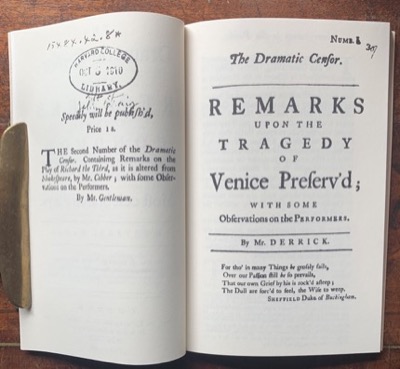
Softcover. Los Angeles, Augustan Reprint Society, reprint, 1985, Book: Very Good, Dust Jacket: None, Softcover, 80 pages. The Augustan Reprint Society Number 251-252. Introduction by Janet E. Aikins. Orig. tan card wrappers, stapled binding. An 18th century theatre critic's remarks regarding Otway's play. Clean copy.
Hardcover. Duke University Press, 1st, 2003, Book: Very Good, Dust Jacket: None, Hardcover, 440 pages. Black cloth, no dust jacket. The Edge of Surrealism is an essential introduction to the writing of French social theorist Roger Caillois. Caillois was part of the Surrealist avant-garde and in the 1930s founded the College of Sociology with Georges Bataille and Michel Leiris. He spent his life exploring issues raised by this famous group and by Surrealism itself. Though his subjects were diverse, Caillois focused on concerns crucial to modern intellectual life, and his essays offer a unique perspective on many of twentieth-century France's most significant intellectual movements and figures. Including a masterful introductory essay by Claudine Frank situating his work in the context of his life and intellectual milieu, this anthology is the first comprehensive introduction to Caillois's work to appear in any language. These thirty-two essays with commentaries strike a balance between Caillois's political and theoretical writings and between his better known works, such as the popular essays on the praying mantis, myth, and mimicry, and his lesser-known pieces. Presenting several new pieces and drawing on interviews and unpublished correspondence, this book reveals Caillois's consistent effort to reconcile intellectual rigor and imaginative adventure. Perhaps most importantly, The Edge of Surrealism provides an overdue look at how Caillois's intellectual project intersected with the work of Georges Bataille and others including Breton, Bachelard, Benjamin, Lacan, and Levi-Strauss.
Hardcover. NY, Sheed and Ward, 1st, 1974, Book: Very Good, Dust Jacket: Very Good, Hardcover in a lightly worn dust jacket with faded spine, 480 pages. Richard Kostelanetz's monumental evisceration of the American book world circa 1974--the self-appointed backslapping elites, the perpetual disdain for the unconventional, the laziness in book reviewing and fear of losing one's status when criticising the wrong thing--remains, as a final sadness, itself a rare out of print tome. Kostelanetz has written perhaps the most fearless exploration of literary politics in print, taking on and naming the titans at the top of the heap, dissecting the power structures that emerged in the 1950s and 60s, and the emergence of the plutocratic hierarchies that continue to dominate publishing. Outing the various cliques as mobs, and using apt and amusing mafia parallels, Kostelanetz is unrelenting in his meticulousness, and counteracts the status quo with a passionate defence of the avant-garde, using the second half of the book to bring light to the various emerging authors of experimental poetry, fiction, and mixed media works around the time. At times a touch long-winded and overfed with quotes, this nevertheless is an essential read for those requiring a hard slap as to the inherent evil of the corporate book world and why indie is the only way forward. Clean copy.
Hardcover. NY, Knopf, 1st, 1994, Book: Very Good, Dust Jacket: Very Good, Hardcover in a bright, unclipped dust jacket, 346 pages. An intimately perceptive account, by a poet who knew them all, of the brilliant circle of poets who lived and worked in Boston through the half-decade beginning in 1955. That was the year Peter Davison, coming to Boston as a book editor. was swept up in a world -- in a tumult -- of poetry. He rediscovered his father's old friend Robert Frost. He briefly squired Sylvia Plath. He came to know Robert Lowell (whose poems and private disasters dominated the period) and Adrienne Rich, Stanley Kunitz, Richard Wilbur. Anne Sexton, W. S. Merwin, and others who, closely bound together in friendship or rivalry or both, defined the shape of American poetry at mid-century Through their eves as well as his own, and often in their words, Davison presents a sharply fresh vision of the shift from confidence to a troubled questioning that overtook America -- a transformation that was, in a sense, foreshadowed in the sensibilities, in the writings, sometimes in the lives, of some of our finest poets. Clean copy.
Hardcover. NY, Columbia University Press, 1st, 1986, Book: Very Good, Dust Jacket: Very Good, Hardcover in a bright dust jacket, 248 pages. Clean copy.
Softcover. Durham NC, Duke University Press, 1st pbk, 1994, Book: Very Good, Dust Jacket: None, Softcover, 279 pages. Much recent critical theory has dismissed or failed to take seriously the question of the self. French theorists--such as Derrida, Barthes, Benveniste, Foucault, Lacan, and Levi-Strauss--have in various ways proclaimed the death of the subject, often turning to German intellectual tradition to authorize their views. Stanley Corngold's heralded book, The Fate of the Self, published for the first time in paperback with a spirited new preface, appears at a time when the relationship between the self and literature is a matter of renewed concern. Originally published in 1986 (Columbia University Press), the book examines the poetic self of German intellectual tradition in light of recent French and American critical theory. Focusing on seven major German writers--Holderlin, Dilthey, Nietzsche, Mann, Kafka, Freud, and Heidegger--Corngold shows that their work does not support the desire to discredit the self as an origin of meaning and value but reconstructs the allegedly fragmented poetic self through effects of position and style. Offering new and subtle models of selfhood, The Fate of the Self is a source of rich insight into the work of these authors, refracted through post-structuralist critical perspectives. Clean copy.
Hardcover. NY, The Free Press, 1st, 1965, Book: Very Good, Dust Jacket: Very Good, Hardcover in a lightly worn dust jacket, 330 pages. This book traces the central developments in American literature between and 1919. It opens with an account of the consolidation of realism as the dominant standard of critical value and brings the reader forward to the moment, at the end of World War I, when American writers began to take a recognized place among the masters of literary modernism. The ascendancy of the novel as the principal genre of the realists is presented against a broader cultural and historical background. Professor Berthoff reviews and evaluates American fiction from the time when Howells, Twain, and Henry James were still under attack by old-school idealizers, to the emergence of a new critical and testamentary realism with Crane, Dreiser, and Gertrude Stein. Clean copy.
Softcover. NY, New York Review Book, 1st, 1968, Book: Very Good, Dust Jacket: None, Softcover, light blue glossy wrappers, stapled. Covers with light soil, no markings.
Softcover. Cambridge MA, Harvard University Press, 1st, 1995, Book: Very Good, Dust Jacket: None, Softcover, 139 pages. How does a poet repeatedly make art over a lifetime out of an arbitrary assignment of fate? By asking this question of the work of four American poets--two men of the postwar generation, two young women writing today--Helen Vendler suggests a fruitful way of looking at a poet's career and a new way of understanding poetic strategies as both mastery of forms and forms of mastery. Fate hands every poet certain unavoidable "givens." Of the poets Vendler studies, Robert Lowell sprang from a family famous in American and especially New England history; John Berryman found himself an alcoholic manic-depressive; Rita Dove was born black; Jorie Graham grew up trilingual, with three words for every object. In Vendler's readings, we see how these poets return again and again to the problems set out by their givens, and how each invents complex ways, both thematic and formal, of making poetry out of fate. Clean copy.
Softcover. Berkeley, University of California Press, 1st, 1987, Book: Very Good, Dust Jacket: None, Softcover, 248 pages. Name on front fly leaf whited out, otherwise clean.
Hardcover. London, Weidenfeld & Nicolson, 1st, 1953, Book: Very Good, Dust Jacket: Good, Hardcover in a lightly worn dust jacket, 596 pages. Pieces originally published in the magazine Horizon including contributions by Dylan Thomas, Octavio Paz, Randall Jarrell, Bertrand Russell, Paul Eluard, Edith Sitwell, Kenneth Rexroth, Hermann Hesse and many others. A 21 year history attempting to reveal the best of this publication. Clean copy.
Hardcover. London, Alcove Press , 1st, 1972, Book: Very Good, Dust Jacket: Good, Hardcover in a lightly worn dust jacket with foxing, tanning. No markings.
Hardcover. Berkeley CA, Bern Porter, 1st, 1945, Book: Fair, Dust Jacket: None, Hardcover. No. 260 out of 750 copies bound for distribution. 157 pages. Tan boards with wear and soiling, gray cloth spine. Shelving information on spine. Front hinge cracked. Ex-library. Printed on various colored paper, with contributions by a lot of well known authors, including Williams, Patchen, Durrell, Lamantia, many others. Edges soiled. Interior very good.
Softcover. Cambridge MA, Harvard University Press, 3rd pr., 1997, Book: Very Good, Dust Jacket: None, Softcover, 541 pages. It wasn't all black or white. It wasn't a vogue. It wasn't a failure. By restoring interracial dimensions left out of accounts of the Harlem Renaissance--or blamed for corrupting it--George Hutchinson transforms our understanding of black (and white) literary modernism, interracial literary relations, and twentieth-century cultural nationalism in the United States. What has been missing from literary histories of the time is a broader sense of the intellectual context of the Harlem Renaissance, and Hutchinson supplies that here: Boas's anthropology, Park's sociology, various strands of pragmatism and cultural nationalism--ideas that shaped the New Negro movement and the literary field, where the movement flourished. Hutchinson tracks the resulting transformation of literary institutions and organizations in the 1920s, offering a detailed account of the journals and presses, black and white, that published the work of the "New Negroes." This cultural excavation discredits bedrock assumptions about the motives of white interest in the renaissance, and about black relationships to white intellectuals of the period. Clean copy.
Hardcover. Pinceton NJ, Princeton University Press, 1st, 1979, Book: Very Good, Dust Jacket: Very Good, Hardcover in a bright dust jacket, 315 pages. The Western ideal of individualism had a pervasive influence on the culture of the Meiji period in Japan (1868-1912). Janet Walker argues that this ideal also had an important influence on the development of the modern Japanese novel. Focusing on the work of four late Meiji writers, she analyzes their contribution to the development of a type of novel whose aim was the depiction of the modern Japanese individual. Professor Walker suggests that Meiji novels of the individual provided their readers with mirrors in which to confront their new-found sense of individuality. Her treatment of these novels as confessions allows her to discuss the development of modern Japanese literature and "the modern literary self" both in themselves and as they compare their prototypes and analogues in European literature. The author begins by examining the evolution of a literary concept of the inner self in Futabatei Shimei's novel Ukigumo (The Floating Clouds), Kitamura Tokoku's essays on the inner life, and Tayama Katai's I-novel Futon (The Quilt). She devotes the second half of her book to Shimazaki Toson, the Meiji novelist who was most influenced by the ideal of individualism. Here she traces Toson's development of a personal ideal of selfhood and analyzes in detail two examples of the lengthy confessional novel form that he created as a vehicle for its expression.
Hardcover. NY, Harcourt, Brace & World, 1st, 1955, Book: Very Good, Dust Jacket: Fair, Hardcover in a worn, chipped dust jacket, 309 pages. A collection of essays from the famed literary critic. Clean copy.
Hardcover. Charlestown MA, Printed and Sold By Samuel Etheridge, Revised Ed., 1810, Book: Very Good, Hardcovers, two volumes complete, 432 and 448 pages. bound in 3/4 calf, with red leather spine labels intact, bindings tight. New corrected edition. A collection of biographical studies on the life of important poets in the cannon of English literature, including: Cowley, Milton, Blackmore, Granville, Somerville, Thomson, Mallet, and Lyttelton. Written by Samuel Johnson, an English writer who made lasting contributions as a poet, playwright, essayist, moralist, critic, biographer, editor, and lexicographer. With the original advertisement to the first edition. originally published in 1779-81. Light edgewear to covers, mild water stain to first 4 pages of Vol. 2, otherwise clean, mild foxing, very good set overall.
Hardcover. NY, Pellegrini & Cudahy, 1st, 1952, Book: Very Good, Dust Jacket: Very Good, Hardcover in a mildly soiled dust jacket with tanning to spine,name on front fly leaf, otherwise clean.
Hardcover. NY, Free Press, 1st, 1987, Book: Very Good, Dust Jacket: Very Good, Hardcover in a bright dust jacket, 270 pages, b&w illustrations. Light edgewear to dust jacket, else a clean, tight copy. Recounts the life of the English poet who died during World War I, looks at the group of his friends and fellow poets known as the Neo-Pagans, and discusses the influence of homosexuality on his life. His sonnet "The Soldier" and early death in World War I made British poet Rupert Brooke a key figure in the nation's myth of patriotism and youthful valor. Biographer Delaney places him among the Neo-pagans, a small circle of writers, artists, and intellectuals who flourished from 1908 to 1912. The group honored youth, comradeship, and the simple life and aimed to set aside the constraints of Victorianism. Delany shows how the internal dynamics of the group, not shock of war, led to its disintegration.
Hardcover. Athens GA, University of Georgia Press, 1st, 1986, Book: Very Good, Dust Jacket: Very Good, Hardcover in a bright dust jacket. 176 pages. INSCRIBED BY AUTHOR on front end paper. In the 1960s, as the underpinnings of society weakened, the traditional novel form seemed less suited to describe American reality. Theorists groped towards non-mimetic fiction as the tools that had sustained the novel since its birth-coherent characterization, linear plot, symbolism-became tools of New Journalism. The New American Novel of Manners explores the virtual reinvention of the novel of manners in America out of the same subjectivity that charged the works of New Journalism. In place of the rigid social structures that never seemed to depict America, novelists such as Richard Yates, Dan Wakefield, and Thomas McGuane located America's modern-day manners in its semiotics, in the system of signs that envelops us-the blue jeans people wear, the fast food they eat, the decor of the bars they drink in and the rock-and-roll lyrics that play through memories. The new generation of mannerists describe lifestyles that are determined by words and images, by actions that are dictated by what has been read and seen, and patterns of behavior in which life is edited and fictionalized. Klinkowitz reveals a fiction that is once again capable of reflecting the way people live. Clean copy.
Softcover. Seattle, Wave Books, 1st, 2023, Book: Very Good, Dust Jacket: None, Softcover, 219 pages. A collection of essay/talks that the poet Rachel Zucker, expanded from lectures presented for the Bagley Wright Lecture Series in 2016. Devastating in their revelations, yet hopeful in their endurance, these are lectures of protest and reckoning. Zucker declares 'I write against. My poetics is a poetics of opposition and provocation that I never outgrew. Against the status quo or the powers that be, writing out of and into wrongness.' Thus, Zucker deftly dismantles the outdated paradigms of motherhood, aesthetics, feminism, poetics, and politics. Bringing Bernadette Mayer, Marina Abramovic, Alice Notley, Adrienne Rich, Audre Lorde-among many others-into the conversation, Zucker questions the categories that have been imposed on poetry, as well as a poet's need to speak, and the resulting responsibilities. Clean copy.
Hardcover. NY, Pantheon, 6th pr., 2023, Book: Very Good, Dust Jacket: Very Good, Hardcover in a bright dust jacket, 338 pages. Argentine poet Jorge Luis Borges was madly in love when his life was shattered by painful heartbreak. But the breakdown that followed illuminated an incontrovertible truth-that love is necessarily imbued with loss, that the one doesn't exist without the other. German physicist Werner Heisenberg was fighting with the scientific establishment on the meaning of the quantum realm's absurdity when he had his own epiphany-that there is no such thing as a complete, perfect description of reality. Prussian philosopher Immanuel Kant pushed the assumptions of human reason to their mind-bending conclusions, but emerged with an idea that crowned a towering philosophical system-that the human mind has fundamental limits, and those limits undergird both our greatest achievements as well as our missteps. Through fiction, science, and philosophy, the work of these three thinkers coalesced around the powerful, haunting fact that there is an irreconcilable difference between reality "out there" and reality as we experience it. Clean copy.

 "The Dramatic Censor; Remarks upon the Tragedy of Venice Preserv'd (1752)by: Samuel Derrick")

 "The Edge of Surrealism: A Roger Caillois Readerby: Roger Caillois; Editor Claudine Frank; Translator Camille Naish")
 "The End of Intelligent Writing: Literary Politics in Americaby: Kostelanetz, Richard")
 "The Fading Smile: Poets in Boston, from Robert Frost to Robert Lowell to Sylvia Plath, 1955-1960by: Davison, Peter")
 "The Failure of Modernism: Symptoms of American Poetry by: Ross, Andrew")
 "The Fate of the Self: German Writers and French Theory by: Stanley Corngold")
 "The Ferment of Realism American Literature, 1884-1919by: Berthoff, Warner")
 "The Fruits of the MLAby: Edmund Wilson")
 "The Given and the Made: Strategies of Poetic Redefinition by: Helen Vendler")
 "The Gold Standard and the Logic of Naturalism: American Literature at the Turn of the Centuryby: Michaels, Walter Benn")
 "The Golden Horizon by: Connolly, Cyril (Ed.)")
 "The Greatness Of Flaubert by: Nadeau, Maurice")
 "The Happy Rock: A Book About Henry Millerby: Miller Henry & Bern Porter")
 "The Harlem Renaissance in Black and Whiteby: Hutchinson, George")
 "The Japanese Novel of the Meiji Period and the Ideal of Individualismby: Janet A. Walker")
 "The Lion and the Honeycomb. Essays in Solicitude and Critiqueby: Blackmur, R.P.")
 "The Lives of the Most Eminent English Poets; with Critical Observations on Their Works (2 Volumes) by: Johnson, Samuel")


 "The Lonely Tower: Studies in the Poetry of W. B. Yeatsby: Henn, T. R.")
 "The Making of a Poem by: Spender, Stephen")
 "The Neo-Pagans: Rupert Brooke and the Ordeal of Youthby: Delany, Paul")
 "The New American Novel of Manners: The Fiction of Richard Yates, Dan Wakefield, and Thomas McGuane (SIGNED COPY)by: Klinkowitz, Jerome")
 "The Poetics of Wrongnessby: Rachel Zucker")
 "The Preface to the Aeneis of Virgil (1718) Augustan Reprint Society Publication Number 214-215 by: Trapp, Joseph/ Kelsall, Malcolm (Intro)")
 "The Rigor of Angels: Borges, Heisenberg, Kant, and the Ultimate Nature of Realityby: William Egginton")