Hardcover. New York, Viking, 1st thus, 1931, Book: Very Good, Dust Jacket: Good, Hardcover, 135 pages. Previous owners name at top right edge of front endpaper. Minor foxing to preliminary pages. Maroon cloth covers with narrow section of fade at top edge of front cover. Dust jacket with edgewear, light chipping and tiny holes along folds - jacket now protected with clear plastic cover. Clean, tight copy.
Hardcover. London, Oxford University, 1st, 1912, Book: Very Good, Dust Jacket: Good, Hardcover, 275 pages. Edited from the old editions and numerous manuscripts with introductions & commentary by Herbert J. C. Grierson. Vol. 2 only - introduction and commentary. Discoloration on front flyleaf. Light foxing to endpapers and edges of textblock. Dark blue cloth with embossed design on front cover and gilt lettering on spine. Corners bumped, minor wear to top and bottom of spine. Beige dust jacket with blue writing, price-clipped. Edgewear, age soil, toned spine.
Hardcover. New York, W. W. Norton & Company, 1st, 2005, Book: Very Good, Dust Jacket: Very Good, 676 pages. Hardcover with dust jacket. Clean, tight copy with only minor wear to dust jacket. Nice copy.
Hardcover. NY, John Wiley & Son, 1867, Book: Very Good, Dust Jacket: None, Hardcover, green cloth with gilt design and lettering on spine, beveled cloth boards, later printing (1867), 349 pages, top edge gilt. A compilation of 'hidden treasures' within Ruskin's writings. A must for anyone who appreciates the writings of John Ruskin. Some light stain to top margin of first 30 pages, not affecting text, otherwise clean.
Hardcover. NY, Humanities Press, 1st, 1973, Book: Very Good, Dust Jacket: Very Good, Hardcover in a bright dust jacket, 276 pages. George Lukacs on Appearance and Essence, Erwin Pracht on Socialist Realism, S. Petrov on Realism, Robert Weimann on point of view in fiction, B. G. Zhantieva on Joyce's Ulysses, Werner Mittzenzwei on the Brecht-Lukacs debate, and five other major essays. Clean copy.
Hardcover. NY, Arrow Editions, 1st, 1937, Book: Very Good, Dust Jacket: Good, 146 pages. Hardcover. Previous owners bookplate on inside front cover. Light foxing to edges. Dust jacket with darkening, chipping along edges. Jacket now protected with clear plastic cover.
Softcover. UK, Oxford University Press, Revised Ed., 2001, Book: Very Good, Dust Jacket: None, Softcover, 384 pages. Published here for the first time is much of a final and long-anticipated work on the philosophy of history by the great Oxford philosopher and historian R. G. Collingwood (1889-1943). The original text of this uncompleted work has only recently been discovered and is accompanied here by Collingwood's shorter writings on historical knowledge and inquiry. Besides containing entirely new ideas, these incredible writings discuss many of the issues which Collingwood famously raised in The Idea of History and in his Autobiography. This book also includes two conclusions written by Collingwood, which were eventually revised and published as The Idea of Nature. and a lengthy editorial introduction that puts Collingwood's writings in their context and discusses the philosophical questions they initiate. A landmark publication, this work will appeal not only to those studying Collingwood but also to anyone broadly curious about philosophy of history. Clean copy.
Hardcover. West Kingston RI, Donald M. Grant, 1st, 1976, Book: Very Good, Dust Jacket: Very Good, 318 pages. Hardcover. Turquoise cloth covers. Collection of Lovecraft's nonfiction writings covering: Science, Literature and Esthetics, Philosophy, Travel, and History. Light wear. Dust jacket protected with clear plastic cover. Clean, tight copy.
Hardcover. Philadelphia, Lippincott, 1st, 1970, Book: Very Good, Dust Jacket: Good, Hardcover in a lightly worn, chipped dust jacket. 410 pages, b&w illustrations. Best known as the author of "Windows for the Crown Prince, " an account of her years as English tutor to Crown Prince Akihito of Japan, Elizabeth Gray Vining now tells the full story of her life, including impressions of Japan that she omitted from her earlier book. Previous owner'e signature on Front fly leaf otherwise clean.
Hardcover. London, Arthur Baker, 1st, 1952, Book: Very Good, Dust Jacket: Poor, Hardcover in a poor, worn dust jacket with a large chunk gone from front panel. Book is bright and clean, 180 pages. Illustrated with color and b&w plates by John Leech. A biography of the novelist who wrote of country sports like hunting in a comical way.
Hardcover. Princeton University Press, 1st, 1956, Book: Very Good, Dust Jacket: None, Hardcover, green cloth covers with gilt and black title on spine, 353 pages. WITH THE AUTHOR'S INSCRIPTION pasted to front fly leaf. Clean copy.
Hardcover. Twayne Publishers, 1st, 1992, Book: Very Good, Dust Jacket: Very Good, Hardcover in a bright, unclipped dust jacket, 177 pages. Perhaps the most significant and influential figure in this century's wave of American realism, Raymond Carver (1938-1988) is credited not only with reviving the short story as an artistically legitimate form, but also with perfecting minimalist fiction. Moving chronologically through Carver's complete short fiction canon and examining key stories in depth, Ewing Campbell traces the author's development through and beyond literary minimalism, into the tradition of tragic allegory. He explores Carvers persistent use of myth and archetype; motifs of the grotesque; religious iconography; and oppressed, spiritually paralyzed characters. From the earliest stories through the latest, Campbell illuminates Carvers constant fascination with the way individuals connect or fail to connect with one another. Clean copy.
Hardcover. New York, Scribner, 1st, 2009, Book: Very Good, Dust Jacket: Very Good, 578 pages. Hardcover with dust jacket. Clean, tight copy with only minor wear to dust jacket. Pictures in center. Nice copy.
Hardcover. Surrey UK, Ashgate Publishing, 1st, 2014, Book: Very Good, Dust Jacket: Very Good, Hardcover in a bright dust jacket, 165 pages. Author Leah Knight explores the physical and figurative potentials of green as they were understood in Renaissance England, including some that foreshadow our paradoxical dependence on and sacrifice of the green world. Ranging across contexts from early modern optics and olfaction to horticulture and herbal health care, this study explores a host of human encounters with the green world: both the impressions we make upon it and those it leaves with us. B&w, color illustrations.
Hardcover. NY, St. Martin's Press, 1st, 1995, Book: Very Good, Dust Jacket: Very Good, Hardcover in a violet dust jacket with light fading to spine, 232 pages. A collection of essays exploring all aspects on a controversial English poet, the 17th century libertine, The Earl of Rochester. Different sections focus on sexual politics, on the poetry of intellect, and on Rochester and his contemporaries. Name, date and light pencil notations on front fly leaf, otherwise clean.
Hardcover. New York, Knopf, 1st, 2010, Book: Very Good, Dust Jacket: Very Good, Hardcover, 219 pages. Clean, bright copy. "I doubt very much that I'm the only person who's finding it more and more difficult to want to read or write novels," David Shields acknowledges in Reality Hunger, then seeks to understand how the conventional literary novel has become as lifeless a form as the mass market bodice-ripper. Shields provides an ars poetica for writers and other artists who, exhausted by the artificiality of our culture, "obsessed by real events because we experience hardly any," are taking larger and larger pieces of the real world and using them in their work. Reality Hunger is made of 600-odd numbered fragments, many of them quotations from other sources, some from Shields's own books, but none properly sourced--the project being not a treasure hunt or a con but a good-faith presentation of what literature might look like if it caught up to contemporary strategies and devices used in the other arts, and allowed for samples (that is, quotation from art and from the world) to revivify existing forms. Shields challenges the perceived superiority of the imagination and exposes conventional literary pieties as imitation writing, the textual equivalent of artificial flavoring, sleepwalking, and small talk. I can't name a more necessary or a more thrilling book.
Softcover. Ft., Texas Christian University, 1st, 2018, Book: Very Good, Dust Jacket: None, Softcover, 435 pages. INSCRIBED BY BONAZZI on the title page. This authorized biography by Robert Bonazzi, is based on John Howard Griffin's Journals from 1950-1980. Griffin was blinded in the South Seas during WWII, but regained sight in 1957, after which he wrote the classic Black Like Me. Bonazzi follows Griffin year by year after 1961, when Griffin toured the globe as a lecturer on human rights.
Softcover. Los Angeles, The Augustan Reprint Society , reprint, 1985, Book: Very Good, Dust Jacket: None, Softcover, 12 page introduction by Peter Sabor plus a 56 page facsimile reprint of Sarah Fielding's (Henry"s sister) criticism of Samuel Richardson's novel. Clean copy.
Hardcover. Madison WI, University of Wisconsin Press, 1st, 1989, Book: Very Good, Dust Jacket: Good, Hardcover in a lightly worn dust jacket with fading to the spine. "Cary Nelson performs an invaluable service to the reader by recovering the work of dozens of forgotten poets, especially women, blacks, and writers on the left, while making it clear that the texts we recover inevitably gain new meaning from their positioning within contemporary culture." Nicely illustrated in b&w and some color, mostly book jackets and title pages of books discussed. Some light pencil marking in margins.
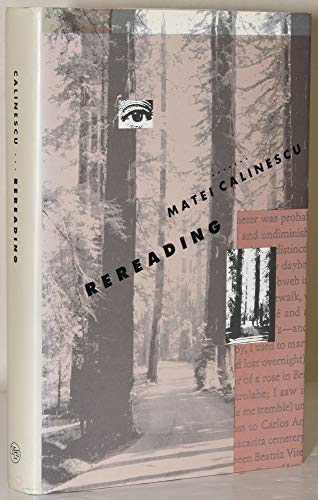
Hardcover. New Haven, Yale University Press, 1st, 1993, Book: Very Good, Dust Jacket: Very Good, Hardcover in a bright, unclipped dust jacket. INSCRIBED BY AUTHOR on the title page. What motivates us to reread literary works? How is our pleasure, interpretation, involvement, and evaluation different when we read a literary work and when we reread it? This fascinating book by Matei Calinescu is the first to focus on the implications of rereading for critical understanding. Drawing on literary theory, cultural anthropology, psychology, philosophy, and previous theories of reading, Calinescu describes the dynamics of rereading and explores the sometimes complementary, sometimes sharply conflicting relationships between reading and rereading. Calinescu analyzes fictional works by Borges, Nabokov, Proust, Robbe-Grillet, and Henry James, among others, explaining how reading texts is related both to symbolic play or make-believe and to games with rules. He reviews the history of reading in modern times, discussing, for example, how the Reformation led to rereadings of Scripture and how the proliferation of books during the Enlightenment led to a shift from "intensive reading" to "extensive reading." Calinescu looks at the distinctions between reading and rereading from the perspectives of the age, situation, and gender of the individual reader. He discusses the problems raised by secret or oblique languages and codes - devised to evade censors, communicate with a select audience of "secret sharers," or play games of hide-and-seek with the reader - and shows that they naturally lead to rereading a text. Calinescu argues persuasively that an understanding of rereading is useful in formulating both analytic strategies of practical criticism and a poetics of reading. Clean, bright copy.
Softcover. Chicago, University Of Chicago Press, 1st pbk, 2005, Book: Very Good, Dust Jacket: None, Softcover, 123 pages, SIGNED BY AUTHOR on title page. Very clean and tight copy.
Hardcover. NY, Knopf, 1st, 1980, Book: Very Good, Dust Jacket: Very Good, Hardcover in a bright dust jacket. 227 pages. Previous owner's signature on front fly leaf, else a clean, tight copy. Naipaul presents here four essays about the "half-made" societies, those still suffering from the profound deprivations of colonialism and prey to corruption." He examines the role of Eva Peron as the catalyst for violence in Argentina, with its yearning for a European culture and the physical, historical, cultural reality of the land in which the native Indians were wiped out and the colonialists took over. He writes of the infamous Michael X in Trinidad whose pretensions to power and destiny led to the man's insanity and execution following two pointless murders. Shorter essays address nihilism in the Congo and Naipaul's take on Joseph Conrad and the Heart of Darkness.
Hardcover. Ann Arbor MI, The University of Michigan Press, 1st, 1999, Book: Very Good, Dust Jacket: Very Good, Hardcover in a bright dust jacket, 354 pages. INSCRIBED BY THE AUTHOR on title page. Light pencil marking to 5 pages, otherwise clean.
Hardcover. Lexington Books , 1st, 2017, Book: Very Good, Dust Jacket: None, Hardcover in glazed boards, 299 pages. John McWilliams has written the first, much needed account of the ways the promise and threat of political revolution have informed masterpieces of the historical novel. McWilliams provides close readings of some twenty historical novels, from Scott and Cooper through Tolstoy, Zola and Hugo, to Pasternak and Lampedusa, and ultimately to Marquez and Hilary Mantel, but with continuing regard to historical contexts past and present. He traces the transformation of the literary conventions established by Scott's Waverley novels, showing both the continuities and the changes needed to meet contemporary times and perspectives. Although the progressive hopes imbedded in Scott's narrative form proved no longer adaptable to twentieth century carnage and the rise of totalitarianism, the meaning of any single novel emerges through comparison to the tradition of its predecessors. A foreword and epilogue explore the indebtedness of McWilliams's perspective to the Marxist scholarly tradition of Georg Lukacs and Frederic Jameson, while defining his differences from them. This is a scholarly work of no small ambition and achievement. Clean copy.
Hardcover. London, Faber & Faber, 1st, 1937, Book: Very Good, Dust Jacket: None, Hardcover, green cloth lettered in gilt at the spine. Illustrated with eight photographic plates. 422 pages. Extended passages from Jefferies' work, with a general introduction in two parts: 'The English Genius' and 'To the Two Types of Jefferies Readers', introductions to each section, notes on the text, and the Epigraph. No dust jacket, clean copy.
Hardcover. NY, Thomas Y. Crowell, 1st, 1972, Book: Very Good, Dust Jacket: Very Good, Hardcover in a bright dust jacket. 166 pages. Lardner was one of the most remarkable satirists in American literature and one of the sharpest cultural historians of his time but is better known to many people as a successful journalist and popular entertainer. Geismar examines the development of this distinguished writer, a biographical and critical account. Clean copy.
Hardcover. NY, Alfred A. Knopf, 1st, 1964, Book: Good, Dust Jacket: Very Good, Hardcover in a lightly worn, chipped dust jacket. A young English novelist's journey through the Soviet Union in the early sixties (author also wrote "The Loneliness of the Long-Distance Runner', "The General", and others. Name on front fly leaf otherwise clean copy.
Hardcover. NY, Henry Holt, 1st, 1995, Book: Very Good, Dust Jacket: Very Good, Hardcover in a bright dust jacket, 524 pages. Robert Graves was astonishingly prolific and worked in many genres. He wrote lyric poetry, scholarly studies of mythology, drama, criticism, and journalism, he translated from Latin, and is probably best known for his potboilers "I, Claudius" and "Claudius the God," works that he considered purely commercial and took little interest in. And, as Miranda Seymour makes clear, he was as odd a duck as ever walked. His life was defined by the women to whom he devoted himself. "Abased himself" would perhaps be the better term. The first and most influential was the American Laura Riding, a second-rate poet who fancied herself some sort of prophetess who would save the world from war and turned Graves into her adoring puppy. Later in life Graves devoted himself to a series of young women, each of whom he claimed embodied "the goddess" in whose service he thought he dwelled. Seymour (a novelist herself) writes beautifully, and with the cooperation of key members of the Graves family she has produced what will surely be the definitive biography of Graves for years to come.
Hardcover. Oxford, Basil Blackwell, 1st, 1926, Book: Very Good, Dust Jacket: None, Hardcover, blue cloth with faded gilt lettering on spine. 191 pages, b&w frontis. of Hawker. Small name stamp on front fly leaf, otherwise clean copy.
Softcover. Hanover NH, Dartmouth College Press, reprint, 2012, Book: Very Good, Dust Jacket: None, Softcover, 277 pages. One of Rousseau?s later and most puzzling works and never before available in English, this neglected autobiographical piece was the product of the philosopher?s old age and sense of persecution. Long viewed simply as evidence of his growing paranoia, it consists of three dialogues between a character named ?Rousseau? and one identified only as ?Frenchman? who discuss the bad reputation and works of an author named ?Jean-Jacques.? Dialogues offers a fascinating retrospective of his literary career. Clean copy.
Hardcover. Brattleboro, VT, Stephen Daye Press, 2nd Printing, 1937, Book: Very Good, Dust Jacket: Fair, Hardcover, 39 pages, dust jacket edge fade and small chunks missing, otherwise, internally very clean and tight.
Hardcover. Bennington VT, Images from the Past, 1st, 1997, Book: Very Good, Dust Jacket: Very Good, Hardcover in a bright dust jacket. Rudyard Kipling in Vermont tells the story of the dynamic years 1892-1896 with Kipling's own letters and memoirs, selected excerpts from his poetry, and the words of those who knew and admired him. More than thirty illustrations illustrate the little-known tale of a time he said "would be blessed to me for all my life." Kipling was born in Bombay, India, and was a prolific writer. He received the Nobel Prize for Literature in 1907. He married an American wife and moved to the village of Brattleboro, VT. He only lived in Vermont for four years. But during that time he wrote his famous "Jungle Book" series. Family troubles forced him to move and the large estate he lived in over looking town fell into disrepair. Clean copy.
Hardcover. NY, John Day/Reynal & Hitchcock, 1st, 1937, Book: Very Good, Dust Jacket: None, Hardcover, light tan cloth, 119 pages. B&w line illustrations by Bernadine Custer. Rudyard Kipling lived with his wife on a small estate in Dummerston, Vermont, in a house they built called Naulakha, from 1892 to 1896. It was while he was here that he wrote both "The Jungle Book" and "Captains Courageous". Kipling would have been content to live out his life there but in 1896, a dispute arose between the Kiplings an a neighbor led to a court case and the Kiplings left Vermont never to return. This volume, written by a Dummerston native and historian, tells the story of that dispute. Lacks dust jacket, otherwise clean, very good.
Hardcover. NY, John Day/Reynal & Hitchcock, 1st, 1937, Hardcover, red cloth. 119 pages, drawings by Bernadine Custer. Told for the first time, 40 years after author Rudyard Kipling and his family hurriedly left their home in Vermont, this story fills some blank pages in Kipling's life story. Author Fredric Van de Water had heard the true account from Kipling's brother-in-law, Beatty Balestier, which followed smoldering tensions and a public trial. The Kiplings left in 1896, never to return. Several of Kipling's writings were put to paper in the Vermont home. First trade edition after a limited edition of 700. Clean.
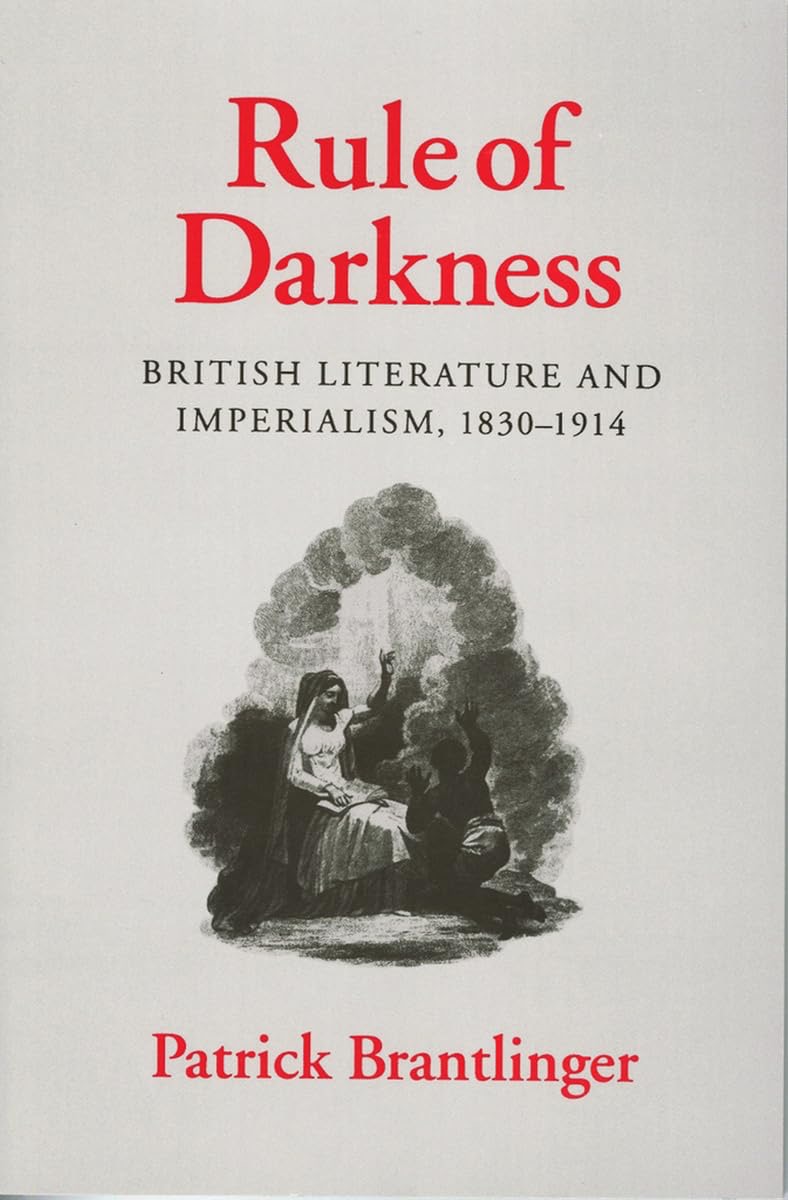
Softcover. Ithaca NY, Cornell University Press, reprint, 1990, Book: Very Good, Dust Jacket: None, Softcover, 309 pages. A major contribution to the cultural and literary history of the Victorian age, Rule of Darkness maps the complex relationship between Victorian literary forms, genres, and theories and imperialist, racist ideology. Critics and cultural historians have usually regarded the Empire as being of marginal importance to early and mid-Victorian writers. Patrick Brantlinger asserts that the Empire was central to British culture as a source of ideological and artistic energy, both supported by and lending support to widespread belief in racial superiority, the need to transform "savagery" into "civilization," and the urgency of promoting emigration. Rule of Darkness brings together material from public records, memoirs, popular culture, and canonical literature. Brantlinger explores the influence of the novels of Captain Frederick Marryat, pioneer of British adolescent adventure fiction, and shows the importance of William Makepeace Thackeray's experience of India to his novels. He treats a number of Victorian best sellers previously ignored by literary historians, including the Anglo-Indian writer Philip Meadows Taylor's Confessions of a Thug and Seeta. Brantlinger situates explorers' narratives and travelogues by such famous author-adventurers as David Livingstone and Sir Richard Burton in relation to other forms of Victorian and Edwardian prose. Through readings of works by Arthur Conan Doyle, Joseph Conrad, H. Rider Haggard, Rudyard Kipling, John Hobson, and many others, he considers representations of Africa, India, and other non-British parts of the world in both fiction and nonfiction. Clean, bright copy.
Hardcover. Chapel Hill, NC, University of North Carolina Press , 1st, 1950, Book: Very Good, Dust Jacket: Good, Hardcover, 292 pages. Light edgewear, rubbing to dust jacket, else a clean, tight copy.
Hardcover. New York, Harcourt, Brace and Company, 1st, 1936, Book: Good, Dust Jacket: None, 148 pages. Black & white illustrations by Rockwell Kent. 1st edition review copy. "Review Copy" with date and price stamped on front endpaper. Previous owners bookplate on inside front cover. Tanning along top edge of pages. Darkening to spine, and top edges of covers. Clean, tight copy.
Hardcover. NY, Random House, 2nd pr., 1969, Book: Very Good, Dust Jacket: Good, Hardcover in a pric-clipped dust jacket that has a bright red cover but fading to spine. 372 pages, clean copy. Describes the influence of Cesar Chavez, leader of the United Farm Workers. The growth of that influence among Mexican-Americans and many other concerned Americans. The years when Chavez called for boycotts, and the greatest agricultural labor strike in U.S. and the greatest agricultural labor strike in U.S. history, the struggle for justice and a means to reverse the order of the system. A book about the man. Cesar Chavez.
Hardcover. NY, Barnes & Noble, reprint, 1981, Book: Very Good, Dust Jacket: Very Good, Hardcover in a bright dust jacket, 194 pages. Includes a bibliography of Bannerman's books and 47 reproductions of the first British and first American editions and her illustrations for them. Phyllis Yuill and Justin Schiller helped with the publishing history and supplied illustrations. Hay shows that it was the illustrations of later artists that provoked the controversy over THE STORY OF LITTLE BLACK SAMBO, not Bannerman's original text or pictures. Bound in the original gilt-stamped red boards. From the dust jacket: "This first biography of Helen Bannerman covers much new ground and is based on the vast collection of letters to the children, usually lovingly illustrated, in the possession of the Bannerman family. As well as telling the story of one of the most popular children's books of all time, Elizabeth Hay's biography offers an intimate picture of the daily life of a British memsahib in the heyday of the Raj." Clean copy.
NY, Simon & Schuster, 1st, 1993, Book: Very Good, Dust Jacket: Very Good, Hardcover in a bright, unclipped dust jacket, 188 pages. SIGNED BY OFFUTT on title-page.
Hardcover. University Park, Penn State University Press, 1st, 1981, Book: Very Good, Dust Jacket: Very Good, Hardcover in a ightly worn dust jacket. 171 pages, INSCRIBED BY BALDWIN on the front fly leaf. The author explores the Christian symbolism throughout a major portion of Beckett;s mature works.
Hardcover. Boston, Ticknor and Fields, 1st Edition, 1860, Book: Very Good, Dust Jacket: None, 267 pages. Hardcover. Black cloth cover boards, Blind-stamped with decoration, gilt title on spine. Very Good condition. Rubs to the corners and spine tips. Gilt top edge (faded). Edges and pages have tanning from age. Dark endpapers. Binding good. Spine straight. Pages unmarked except title page with original owner's name and address in top right corner. 19 tales.
Hardcover. Francestown NH, Marshall Jones Company, 3rd pr., 1967, Book: Very Good, Dust Jacket: Good, Hardcover, blue cloth stamped in gilt. Dust jacket edgeworn, chipped. 295 pages. Revised Edition. Third Printing. INSCRIBED by Rosamond Thaxter ("Rosie") on half title page.
Softcover. Los Angeles, The Augustan Reprint Society , reprint, 1984, Book: Very Good, Dust Jacket: None, Softcover, Introduction by Vincent Carrata plus 52 pages. Facsimile reprints. Clean copy.
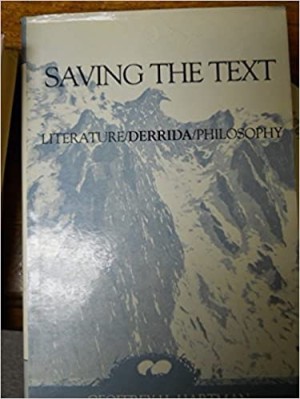
Hardcover. Baltimore, Johns Hopkins, 1st, 1981, Book: Very Good, Dust Jacket: Very Good, Hardcover in a bright dust jacket, 184 pages. Saving the Text cuts through Jacques Derrida's complex blend of philosophy, commentary, and elaborate wordplay to ascertain his place in the history of criticism and the significance of Glas as a literary event. Distinguished critic and scholar Geoffrey Hartman explores the usefulness of Derrida's style of close reading for English and American scholarship and establishes its relevance to the division that has arisen between European and Anglo-American critical approaches.
Hardcover. London, Ashgate, reprint, 2010, Book: Very Good, Dust Jacket: Very Good, 248 pages. Hardcover with dust jacket. Clean, unmarked copy with only minor wear to dust jacket. Silver gilt on spine. 'Like "the ring" itself, this book is viral: it gathers into itself literature and film, disease and survival, cultural studies and aesthetics, Japan and America, technology and the family. We won't read Suzuki's novels or watch the films in the same way again. A thoroughly readable and teachable text!' Steven Bruhm, Robert and Ruth Lumsden Professor of English, The University of Western Ontario, and author of Reflecting Narcissus: A Queer Aesthetic 'Taking as its point of departure the phenomenon of The Ring in all its manifestations"the Japanese novel, the Japanese film, the American film, and the various sequels"The Scary Screen offers an in-depth and sustained speculation about the anxiety created by the development of communication technologies. The collection introduces startling insights into the relationship between changes in media forms and widespread fears of contagion, while also identifying a new universal form of horror that has emerged in recent decades as the status of reproduction"both technological and biological"has undergone a profound transformation. The essays included here represent a powerful theoretical response to this transformation.' Todd McGowan, University of Vermont, and author of The Impossible David Lynch and The Real Gaze '... The Scary Screen is a useful contribution to studies of The Ring, horror film, and cultural anxieties evoked by technology.' Journal of the Fantastic in the Arts.
Hardcover. NY, Bloomsbury Academic, 1st, 2023, Book: Very Good, Dust Jacket: None, Hardcover, glazed pictorial boards, 362 pages. The essays collected in this volume were written to mark the centenary of the birth of Sir Kenneth Dover, one of the twentieth centurys most influential classical scholars. Between them, they explore the two major sides of his career: his groundbreaking scholarship on Greek language, literature and history, and the more public-facing roles he assumed in universities and at the British Academy which brought him into the national spotlight, not without some notoriety, in his later years.The contributors consider the various facets of Dover's life and work from a range of perspectives which reflect the burgeoning field of the history of scholarship. Some contributors were students and colleagues of Dovers at different stages of his career, while others are themselves leading experts in areas of Classics to which he devoted his energies. Chapters on his academic publications and on the controversies he faced in the public realm are not bland celebrations of his legacy but offer critical assessments of his motivations and achievements, cumulatively demonstrating that there is much to be learned not just about Dover himself but also about the fields he helped to shape. Clean copy.
Hardcover. New York, Harcourt Brace, 1st, 1939, Book: Very Good, Dust Jacket: None, 485 pages. Hardcover with red cloth covers.SIGNED BY DOROTHY CANFIELD FISHER on front fly leaf. Light fraying to edges, fading, otherwise tight.

 "Poems of Wilfred Owen with Notes on His Life, The by: Blunden, Edmund")



 "Primitivism and Decadence/ A Study of American Experimental Poetryby: Winters, Yvor")





 "Raymond Carver: A Writer's Lifeby: Sklenicka, Carol")

![Remarks on Clarissa (1749)by: [Fielding, Sarah]](https://www.browsingisarousing.com/shop/images/Remarks-on-Clarissa-1749_by_Fielding-Sarah386961-441314.jpg "Remarks on Clarissa (1749)by: [Fielding, Sarah]")
 "Repression And Recovery: Modern American Poetry & Politics Of Cultural Memory 1910-1945by: Cary Nelson")









 "Rudyard Kipling in New Englandby: Rice, Howard C.")




 "Saga of Gisli - Son of Sour, Theby: Allen (Translator), Ralph B./Rockwell Kent")

 "Sambo Sahib: The Story of Helen Bannerman author of Little Black Sambo by: Elizabeth Hay")



 "Samuel Beckett's Real Silence (INSCRIBED BY AUTHOR)by: Baldwin, Helene L.")
 "Sand-Hills of Jutland, Theby: Andersen, Hans Christian")



 "Scary Screen, The: Media Anxiety in The Ringby: Lacefield (Ed.), Kristin")

 "Seasoned Timber (SIGNED COPY)by: Canfield, Dorothy")

