Hardcover. NY, Charles Scribner's Sons, 1st, 1988, Book: Very Good, Dust Jacket: Very Good, Hardcover in a bright dust jacket, 654 pages. From the more than 4000 letters that have survived, the editors have selected some 400 letters of one of the most important 20th century authors, Edith Wharton. These range from a letter written when Wharton was twelve years old to a letter penned just before her death. The collection shows Wharton at her epistolary best and most characteristic and in all the striking variety of her many voices. Clean copt.
Hardcover. Chicago, University of Chicago Press, 1st, 1970, Book: Very Good, Dust Jacket: Very Good, Hardcover in a bright dust jacket, 696 pages. Name on front fly leaf, otherwise clean.
Hardcover. NY, Columbia University Press, 1st, 1939, Book: Very Good, Dust Jacket: None, Six matching volumes, red cloth bindings with black/gilt titling on spines, gilt initials on front board. Covers Emerson's letters from 1813 to 1881. Ralph Waldo Emerson (1803-1882) was an influential American essayist, philosopher, and poet, known for leading the Transcendentalist movement. His works emphasized individualism, nature, and self-reliance, significantly impacting American literature and thought. NOT ex-lib, clean complete set. Due to weight DOMESTIC SHIPPING ONLY.
Hardcover. NY, Abrams, 1st, 2019, Book: Very Good, Dust Jacket: Very Good, Hardcover in a bright dust jacket, 400 pages. Edith Nesbit (1858-1924) is considered the first modern writer for children and the inventor of the children's adventure story. In The Life and Loves of E. Nesbit, award-winning biographer Eleanor Fitzsimons uncovers the little-known details of her life, introducing readers to the Fabian Society cofounder and fabulous socialite who hosted legendary parties and had admirers by the dozen, including George Bernard Shaw. Through Nesbit's letters and archival research, Fitzsimons reveals "E." to have been a prolific lecturer and writer on socialism and shows how Nesbit incorporated these ideas into her writing, thereby influencing a generation of children--an aspect of her literary legacy never before examined. Fitzsimons's riveting biography brings new light to the life and works of this famed literary icon, a remarkable writer and woman.
Hardcover. NY, Pantheon, 1st, 1970, Book: Very Good, Dust Jacket: Good, Hardcover in an edgeworn, chipped dust jacket. This is the first detailed and balanced biography of one of the most controversial literary figures of the twentieth century. It includes much material - poetry, prose, and letters - which has not previously been published. Ezra Pound, an American who left home for Venice and London at the age of twenty-three, was a leading member of "the modern movement," a friend and helper of Joyce, Eliot, Yeats, and Hemingway, and an early supporter of Lawrence and Frost. Clean copy.
Hardcover. Boston, Kluwer Academic Publishers, 1st, 2000, Book: Very Good, Dust Jacket: Very Good, Hardcover in a bright dust jacket, 408 pages. The only biographical account of More by one of his contemporaries. Ward's almost hagiographical tone is testimony to the high regard in which More was held by his admirers. This account testifies to the continuing impact of More's ideas in the enlightenment. This volume prints the only modern edition of Ward's biography printed in 1710 together with the manuscript account of More's writings published here for the first time. Clean copy.
Hardcover. NY, Oxford University Press, 1st, 1988, Book: Very Good, Dust Jacket: Very Good, Hardcover in a bright, unclipped dust jacket, 512 pages. The second volume in this masterful biography finds Hughes rooting himself in Harlem, receiving stimulation from his rich cultural surroundings. Here he rethought his view of art and radicalism, and cultivated relationships with younger, more militant writers such as Richard Wright, Ralph Ellison, James Baldwin, and Amiri Bakara. Illustrated with black & white photographs, a few by Roy DeCarava with whom Hughes published "The Sweet Flypaper of Life" and a portrait by Henri Cartier-Bresson. Clean copy.
Hardcover. NY, Harcourt Brace Jovanovich, 1st, 1978, Book: Very Good, Dust Jacket: None, Two hardcover volumes in a slipcase, light gray and light green jackets over beige cloth. 258, 277 numbered pages. The Life of the Mind is the final work by the political theorist, philosopher, and feminist thinker. This fascinating book investigates thought itself as it exists in contemplative life. In a shift from Arendt's previous writings, most of which focus on the world outside the mind, this is an exploration of the mind's activities she considered to be the most fundamental. The result is a rich, challenging analysis of human mental activity in terms of thinking, willing, and judging. Stated First Editions with 2 as lowest number. Jacket spines sunned and faded. Light spotting to text block edges. Clean, no markings.
Hardcover. Charlottesville VA, University of Virginia Press, 1st, 2020, Book: Very Good, Dust Jacket: Very Good, Hardcover in a bright dust jacket, 476 pages, b&w illustrations. Rollyson has drawn on an unprecedented amount of material to present the richest rendering of Faulkner yet published. In addition to his own extensive interviews, Rollyson consults the complete and never fully shared research of pioneering Faulkner biographer Joseph Blotner, who discarded from his authorized biography substantial findings in order to protect the Faulkner family. Rollyson also had unrivaled access to the work of Carvel Collins, whose decades-long inquiry produced one of the greatest troves of primary source material in American letters. This first volume follows Faulkner from his formative years through his introduction to Hollywood. Rollyson sheds light on Faulkner's unpromising, even bewildering youth, including a gift for tall tales that blossomed into the greatest of literary creativity. He provides the fullest portrait yet of Faulkner's family life, in particular his enigmatic marriage, and offers invaluable new insight into the ways in which Faulkner's long career as a screenwriter influenced his iconic novels. Clean copy.
Hardcover. London, Jonathan Cape, 1st, 1934, Book: Good, Dust Jacket: None, Hardcover, blue cloth faded on spine and cover edges, gilt lettering on spine. 315 pages, b&w photographic plates. Some fifty essays, reviews, studies and other short pieces, including a section devoted to Williamson's travels in North America and passages from 'The Sun in the Sands' which do not appear in the 1941 book of the same name. No markings.
Hardcover. NY, Harcourt, Brace & World, 1st, 1955, Book: Very Good, Dust Jacket: Fair, Hardcover in a worn, chipped dust jacket, 309 pages. A collection of essays from the famed literary critic. Clean copy.
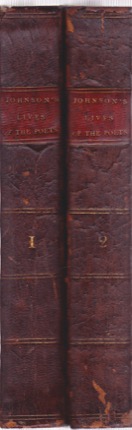
Hardcover. Charlestown MA, Printed and Sold By Samuel Etheridge, Revised Ed., 1810, Book: Very Good, Hardcovers, two volumes complete, 432 and 448 pages. bound in 3/4 calf, with red leather spine labels intact, bindings tight. New corrected edition. A collection of biographical studies on the life of important poets in the cannon of English literature, including: Cowley, Milton, Blackmore, Granville, Somerville, Thomson, Mallet, and Lyttelton. Written by Samuel Johnson, an English writer who made lasting contributions as a poet, playwright, essayist, moralist, critic, biographer, editor, and lexicographer. With the original advertisement to the first edition. originally published in 1779-81. Light edgewear to covers, mild water stain to first 4 pages of Vol. 2, otherwise clean, mild foxing, very good set overall.
Hardcover. NY, HarperCollins, 1st, 2002, Book: Very Good, Dust Jacket: Very Good, Hardcover in a bright, unclipped dust jacket. SIGNED BY PROSE on the title page. In a brilliant, wry, and provocative book, National Book Award finalist Francine Prose explores the complex relationship between the artist and his muse. In so doing, she illuminates with great sensitivity and intelligence the elusive emotional wellsprings of the creative process. Clean copy.
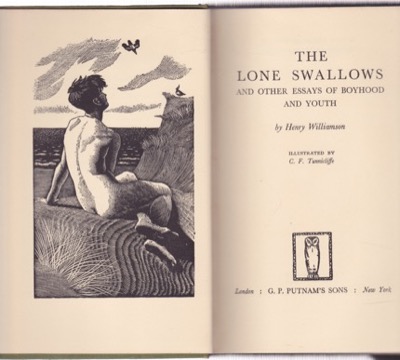
Hardcover. NY/London, G. P. Putnum's Sons, 1st illust. thus, 1933, Book: Very Good, Dust Jacket: None, Hardcover, green cloth with gilt stamping, 242 pages. 24 woodcuts and some decorations by Tunnicliffe. First Illustrated Edition which has been enlarged by the author and contains several new essays. No dust jacket.
Hardcover. NY, Pellegrini & Cudahy, 1st, 1952, Book: Very Good, Dust Jacket: Very Good, Hardcover in a mildly soiled dust jacket with tanning to spine,name on front fly leaf, otherwise clean.
Hardcover. University of Nebraska Press, 1st, 2017, Book: Very Good, Dust Jacket: Very Good, Hardcover, 592 pages. Ring Lardner's influence on American letters is arguably greater than that of any other American writer in the early part of the twentieth century. Lauded by critics and the public for his groundbreaking short stories, Lardner was also the country's best-known journalist in the 1920s and early 1930s, when his voice was all but inescapable in American newspapers and magazines. Lardner's trenchant, observant, sly, and cynical writing style, along with a deep understanding of human foibles, made his articles wonderfully readable and his words resonate to this day. Ron Rapoport has gathered the best of Lardner's journalism from his earliest days at the South Bend Times through his years at the Chicago Tribune and his weekly column for the Bell Syndicate, which appeared in 150 newspapers and reached eight million readers. In these columns Lardner not only covered the great sporting events of the era--from Jack Dempsey's fights to the World Series and even an America's Cup--he also wrote about politics, war, and Prohibition, as well as parodies, poems, and penetrating observations on American life.
Hardcover. NY, Seven Stories Press, 2nd pr., 2021, Book: Very Good, Dust Jacket: None, Hardcover, pictorial boards, illustrated in color by Joanna Concejo. The Lost Soul is a deeply moving reflection on our capacity to live in peace with ourselves, to remain patient, attentive to the world. It is a story that beautifully weaves together the voice of the Nobel Prize-winning Polish novelist Olga Tokarczuk and the finely detailed wash-and-ink drawings of illustrator Joanna Concejo, who together create a parallel narrative universe full of secrets, evocative of another time. Here a man has forgotten what makes his heart feel full. He moves to a house away from all that is familiar to him to wait for his soul to return. Originally published in Poland in 2017. Clean copy.
Lebanon NH, University of New Hampshire Press, 1st, 2005, Book: Very Good, Dust Jacket: Very Good, Hardcover in a bright dust jacket. 294 pages, b&w illustrations. Presents a succinct, articulate examination of the work of the pioneering but controversial archaeologist Roland Wells Robbins (1908-1987) and the development of historical archaelogy in America. In 1945, the self-taught Robbins discovered the remains of Thoreau's cabin at Walden Pond. He excavated the site, documented his findings, and in 1947 published a short book, Discovery at Walden, about the experience. This project launched Robbins's career in archaeology, restoration, and reconstruction, and he went on to excavate at a number of New England iron works and other sites, including the Philipsburg Manor Upper Mills in New York, Stawbery Banke in New Hampshire, and Shadwell, Thomas Jefferson's Virginia birthplace. Although lacking academic training, Robbins quickly developed remarkably sophisticated techniques for the period. However, his "pick and shovel" methods were considered suspect and increasingly frowned upon by the emerging American historical archaeological establishment. Clean copy.
Softcover. The Woodlands,TX, New Century Books, 1st, 2001, Book: Very Good, Dust Jacket: None, Softcover, 210 pages. With a typewritten letter laid in containing an inscription and the author's signature, "Tom". The Man Who Was Dr. Seuss is the first major personal and literary biography of Theodor "Dr. Seuss" Geisel. It describes the origins of the rhyme scheme he used for many of his books; his views of international justice; the morals for children in his books; why parents are seldom seen in Dr. Seuss books and finally, among fabulouse facts and fanciful fables, how and why Dr. Seuss eventually became an American icon. Clean copy.
Hardcover. NY, Viking Press, 1st US, 1977, Book: Very Good, Dust Jacket: Good, Hardcover in a lightly sunned, price-clipped dust jacket, 254 pages. "In this elegant memoir, Quennell turns from biographer of others to creating a self-portrait as well as frank and affectionate pictures of his parents. His father, C.H.B. Quennell, was an architect, a popular historian, and a formidable eccentric. The two men could scarcely have been more dissimilar, yet they shared many tastes and traits, and although they were lifelong adversaries the influence of the father had a determining effect on the education of the son." (from the jacket) Previous owner's inscription on front fly leaf which is tanned from clipping laid in.
Hardcover. London, Jonathan Cape, 1st thus, 1973, Book: Very Good, Dust Jacket: Very Good, Hardcover, 204 pages. With a portrait frontispiece. Original publisher's brown cloth, lettered in gilt, pictorial dustwrapper. Very minor shelf-wear, some spotting to dustwrapper. A 1973 reprint of the unexpurgated edition of T. E Lawrence's The Mint. Two editions were published simultaneously in 1955; an unexpurgated text in a limited edition, and an expurgated version (reprinted once in the same year); the present publication is a reissue of the former. The memoir records his service in the ranks of the R.A.F. Lawrence enlisted in 1922; in an effort to escape public and media attention he assumed the name John Hulme Ross. Upon the discovery of his identity he was discharged, but two and a half years later was permitted to re-enlist, this time using the name of Shaw, under which he had meanwhile served in the Tank Corps.
Hardcover. NY, Free Press, 1st, 1987, Book: Very Good, Dust Jacket: Very Good, Hardcover in a bright dust jacket, 270 pages, b&w illustrations. Light edgewear to dust jacket, else a clean, tight copy. Recounts the life of the English poet who died during World War I, looks at the group of his friends and fellow poets known as the Neo-Pagans, and discusses the influence of homosexuality on his life. His sonnet "The Soldier" and early death in World War I made British poet Rupert Brooke a key figure in the nation's myth of patriotism and youthful valor. Biographer Delaney places him among the Neo-pagans, a small circle of writers, artists, and intellectuals who flourished from 1908 to 1912. The group honored youth, comradeship, and the simple life and aimed to set aside the constraints of Victorianism. Delany shows how the internal dynamics of the group, not shock of war, led to its disintegration.

 "The Letters of Edith Whartonby: Lewis, R. W. B. And Lewis, Nancy, Eds")
 "The Letters of Josiah Royceby: Josiah Royce/John Glendenning")
 "The Letters of Ralph Waldo Emerson (6 Volumes)by: Emerson, Ralph Waldo and Rusk, Ralph L. (Ed.)")
 "The Life and Loves of E. Nesbit : Victorian Iconoclast, Children's Author, and Creator of the Railway Children by: Eleanor Fitzsimons")
 "The Life of Ezra Pound by: Noel Stock")
 "The Life of Henry More: Parts 1 and 2by: Richard Ward / Hutton, Sarah / Courtney, Cecil / Courtney, Michelle/ Crocker, Robert / Hall, Rupert (Editors)")
 "The Life of Langston Hughes Volume 2 1941-1967: I Dream a World by: Rampersad, Arnold")
 "The Life of the Mind (2 vols. Volume I: Thinking, Volume II: Willingby: Hannah Arendt")
 "The Life of William Faulkner: The Past Is Never Dead, 1897-1934by: Carl Rollyson")

 "The Lion and the Honeycomb. Essays in Solicitude and Critiqueby: Blackmur, R.P.")
 "The Lives of the Most Eminent English Poets; with Critical Observations on Their Works (2 Volumes) by: Johnson, Samuel")

 "The Lives of the Muses: Nine Women & the Artists They Inspired (SIGNED COPY)by: Prose, Francine")
 "The Lone Swallows And Other Essays Of Boyhood And Youthby: Henry Williamson")
 "The Lonely Tower: Studies in the Poetry of W. B. Yeatsby: Henn, T. R.")
 "The Lost Journalism of Ring Lardnerby: Ring Lardner, Ron Rapoport , et al.")
 "The Lost Soul by: Olga Tokarczuk / Joanna Concejo")
 "The Making of a Poem by: Spender, Stephen")
 "The Man Who Found Thoreau: Roland W. Robbins and the Rise of Historical Archaeology in America by: Donald W. Linebaugh")
 "The Man Who Was Dr. Seuss: The Life and Work of Theodor Geisel by: Thomas Fensch")
 "The Marble Foot: An Autobiography, 1905-1938by: Quennell, Peter")
 "The Mintby: Lawrence, T. E.")
 "The Moon and Iby: Betsy Byars")
 "The Neo-Pagans: Rupert Brooke and the Ordeal of Youthby: Delany, Paul")