Hardcover. Seattle, WA, Fantagraphics, 1st, 2017, Book: Very Good, Dust Jacket: None, 380 pages. Hardcover with no dust jacket. A very clean, unmarked copy with only minor edgewear to dust jacket. To Laugh That We May Not Weep is a sweeping career retrospective, reprinting -often for the first time in 60 or 70 years- over 800 of Young's timeless, charming, and devastating cartoons and illustrations, many reproduced from original artwork, to create a fresh new portrait of this towering figure in the worlds of cartooning and politics.
Hardcover. Westport CT, Greenwood Press, 1st, 2003, Book: Very Good, Dust Jacket: None, Hardcover, maroon cloth covers stamped in silver, 242 pages. Previous owner's inscription on front fly leaf, otherwise clean. Over the course of the American Occupation of Japan, the U.S. attitude toward the Japanese Communist Party (JCP) gradually shifted from one of friendly cooperation to one of mutual opposition. This new study examines the initial approach toward communism in Japan; internal and external factors that affected American attitudes; the various phases of the relationship; and how Japan ultimately became a democratic nation. Oinas-Kukkonen investigates American information gathering techniques used at the time to determine possible links with the Soviet Union. He also discusses the possibility that Nosaka Sanzo, one of the main leaders of the JCP, was an American spy. Using previously secret records of General MacArthur's intelligence staff and plentiful archival materials on the Occupation, this study explores how the United States originally sought to utilize the JCP to assist in the democratization process. It identifies the perceived threat of a revolution in March 1947 as a key turning point in U.S. attitudes. Involved in a delicate balancing act with multiple Japanese interests, some American officials feared that elements of the extreme left might even evolve into extreme right-wing terrorists. In this comprehensive account, Oinas-Kukkonen includes information on the indirect role of the Europeans in this affair, as well as the roles of outsider groups such as the outcaste burakumin and the Koreans residing in Japan.
Hardcover. Oxford UK, Oxford University Press, 1st, 2016, Book: Very Good, Dust Jacket: Very Good, Hardcover in a bright dust jacket, 175 pages. Despite recent advances in Locke scholarship, philosophers and political theorists have paid little attention to the relations among his three greatest works: An Essay Concerning Human Understanding, Two Treatises of Government, and Epistola de Tolerantia. As a result our picture of Locke's thought is a curiously fragmented one. Toleration and Understanding in Locke argues that these works are unified by a concern to promote the cause of religious toleration. Making extensive use of Locke's neglected replies to Proast, Nicholas Jolley shows how Locke draws on his epistemological principles to criticize religious persecution - for Locke, since revelation is an object of belief, not knowledge, coercion by the state in religious matters is not morally justified. In this volume Jolley also seeks to show how the Two Treatises of Government and the letters for toleration adopt the same contractualist approach to political theory; Locke argues for toleration from the function of the state where this is determined by the decisions of rational contracting parties. Throughout, attention is paid to demonstrating the range of Locke's arguments for toleration and to defending them, where possible, against recent criticisms. The book includes an account of the development of Locke's views about religious toleration from the beginning to the end of his career; it also includes discussions of his individualism about knowledge and belief, his critique of religious enthusiasm, his commitment to the minimal creed, and his teachings about natural law. Locke emerges as a rather systematic thinker whose arguments are highly relevant to modern debates about religious toleration. Light pencil marking to some pages.
Hardcover. London, Cambridge University Press, 1st, 1969, Book: Very Good, Dust Jacket: Very Good, Hardcover in a bright dust jacket, 403 pages, 2 maps. In the belief that intensive study of selected local areas is an important development in scholarship on Africa, the author presents a micropolitical study of an important region of one of East Africa's Rew nations. Sukumaland, an area of Tanzania which contains one tenth of the country's population and its largest tribe, was chosen for the study. Before independence it exhibited the most organized nationalist political activity of any part of the country and developed the largest African-owned co-operative movement in all of Africa. In the final decade of the colonial era Sukumaland was the British administration's principal experimental area for attempts at radical transformation of indigenous political institutions and traditional agricultural techniques. After independence it became a critical testing ground for President Julius Nyerere's concepts of African socialism. Owner's signature on the front fly leaf, otherwise clean.
Hardcover. Cambridge MA, Harvard University Press, 1st, 1967, Book: Very Good, Dust Jacket: Very Good, Hardcover in a lightly worn dust jacket, 336 pages. Discusses the British Acts of Trade and Navigation as enforced in colonial America. Name on front fly leaf, otherwise a clean, tight copy.
Softcover. Richmond, VA, University of Virginia Press, 1st, 1996, Book: Very Good, Dust Jacket: None, 93 pages. Softcover. Very clean, unmarked copy still in publishers shrink-wrap. In an evocative blending of words and images, painter-photographer Carol Burch-Brown and poet David Rigsbee offer a depiction of trailers and their inhabitants. The understated imagery of Burch-Brown's 48 photos implies rather than proclaims the living conditions of these mobile-home dwellers, while Rigsbee's meditative, autobiographical essay parallels and illuminates the subjects and chronicles family histories with trailers.
Hardcover. New York, Farrar Straus Giroux, 1st, 1985, Book: Very Good, Dust Jacket: Very Good, 396 pages. Hardcover with dust jacket. SIGNED BY AUTHOR on half-title page. Clean, tight copy with minor wear to covers and dust jacket.
Hardcover. Baton Rouge LA, Louisiana State University, 1st, 1972, Book: Very Good, Dust Jacket: Very Good, Hardcover in a lightly worn dust jacket, 294 pages. Name on front fly leaf otherwise clean.
Hardcover. London, Oxford University Press, 1st, 1969, Book: Very Good, Dust Jacket: Very Good, Hardcover in a bright dust jacket. Detailed analysis of the events surrounding independence by former British ambassador. 138 pages plus index. Clean copy.
Hardcover. Boston, Kluwer Academic Publishers, 1st, 1989, Book: Very Good, Dust Jacket: None, 315 pages. Light green laminate boards, numerous charts, graphs and diagrams. Previous owner's signature to top right corner of front endpaper, covers very slightly discolored, pages crisp and unmarked; a very neat, tight copy.
Softcover. Chicago, University of Chicago Press, reprint, 2008, Book: Very Good, Dust Jacket: None, Softcover, 370 pages. Democrat and Republican. Meat Eaters and Vegetarians. Black and White. As human beings we sort ourselves into groups. And once we identify ourselves as a member of a particular group--say, Red Sox fans--we tend to feel more comfortable with others of our own kind, rather than, say, Yankees fans. Yet we all belong to multiple groups at the same time--one might be a woman, a mother, an American, a violinist. How do we decide which identities matter and why they matter so much? And what makes us willing to die for, or to kill for, a religion, a nation, or a race? In this award-winning book, David Berreby describes how twenty-first-century science is addressing these age-old questions. Ably linking neuroscience, social psychology, anthropology, and other fields, Us and Them investigates humanity's "tribal mind" and how this alters our thoughts, affects our health, and is manipulated for good and ill. From the medical effects of stress to the rhetoric of politics, our perceptions of group identity affect every part of our lives. Science, Berreby argues, shows how this part of human nature is both unexpectedly important and surprisingly misunderstood. Clean copy.
Hardcover. Cambridge MA, Belknap Press / Harvard University Press, 1st, 1979, Book: Very Good, Dust Jacket: Very Good, Hardcover in a lightly worn dust jacket, 896 pages. This masterly study has a grand sweep. It ranges over centuries, with a long look backward over several millennia. Yet the history it unfolds is primarily the story of individuals: thinkers and dreamers who envisaged an ideal social order and described it persuasively, leaving a mark on their own and later times. The roster of utopians includes men of all stripes in different countries and eras--figures as disparate as More and Fourier, the Marquis de Sade and Edward Bellamy, Rousseau and Marx. Fascinating character studies of the major figures are among the delights of the book. 1980 National Book Award winner. Name on front fly leaf, otherwise clean.
Softcover. Albany, State University of New York , 1st thus, 2000, Book: Very Good, Dust Jacket: None, Softcover, 332 pages. Bayle, arguably the primary intellectual predecessor to the Enlightenment, sought in this text to undermine the influence of "superstition" in politics, particularly the superstition brought about by religious beliefs, and it is here that he first made his suggestion that a decent society of atheists is possible in principle. Translator Robert Bartlett provides extensive notes and an introduction to Bayle, his influence, and the intricacies of his thinking.
Softcover. Lanham MD, Rowman & Littlefield , 1st, 2003, Book: Very Good, Dust Jacket: None, Softcover, 349 pages. In Vergil's Empire, Eve Adler offers an exciting new interpretation of the political thought of Vergil's Aeneid. Adler argues that in this epic poem, Vergil presents the theoretical foundations of a new political order, one that resolves the conflict between scientific enlightenment and ancestral religion that permeated the ancient world. The work concentrates on Vergil's response to the physics, psychology, and political implications of Lucretius' Epicurean doctrine expressed in De Rerum Natura. Proceeding by a close analysis of the Aeneid, Adler examines Vergil's critique of Carthage as a model of universal enlightenment, his positive doctrine of Rome as a model of universal religion, and his criticism of the heroism of Achilles, Odysseus, and Epicurus in favor of the heroism of Aeneas. Beautifully written and clearly argued, Vergil's Empire will be of great value to all interested in the classical world. Clean copy.
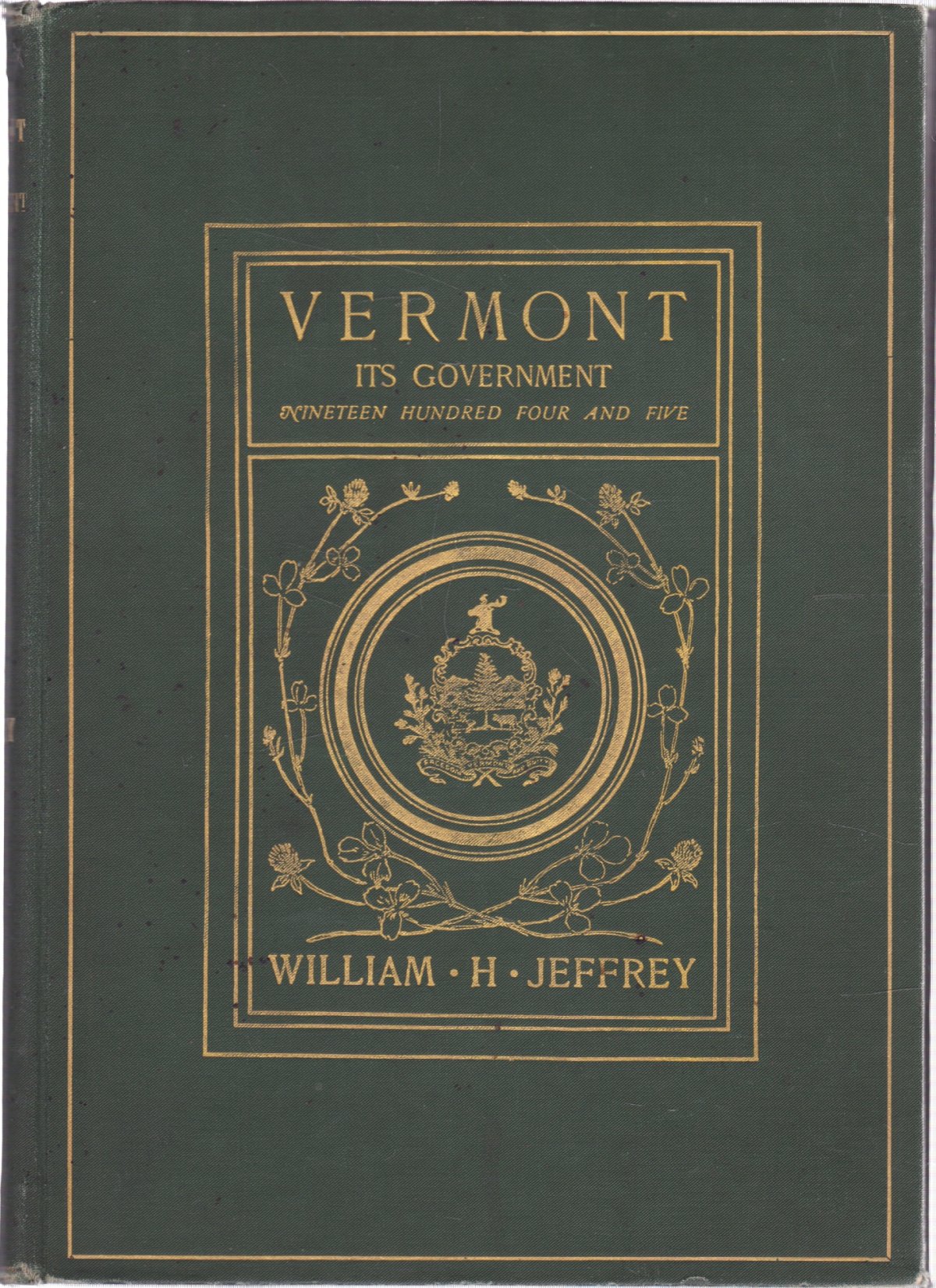
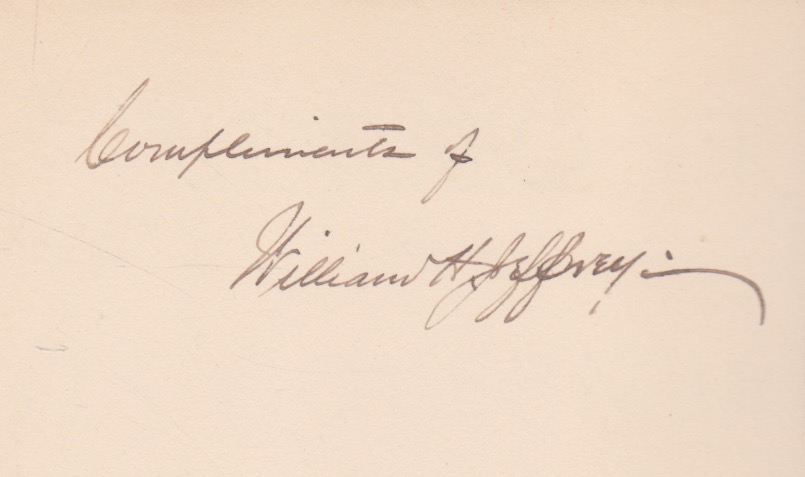
Hardcover. East Burke VT, The Historical Publishing Company, 1st, 1905, Book: Very Good, Dust Jacket: None, Hardcover, green cloth stamped in gilt. 104 pages with b&w photos of government officials. "Compliments of William H. Jeffrey" in his hand on front fly leaf. Valuable historical research book covering all Vermont office holders at the federal, state, and county levels with professional photo-portraits and details. Printed on heavy glossy paper stock. Mild scuffing to spine, otherwise clean.
Hardcover. Berkeley CA, University of California, 1st, 2001, Book: Very Good, Dust Jacket: Very Good, Hardcover, 275 pages, b&w photos. In a bright, unclipped dust jacket. Lawyer, educator, novelist, radio and television scriptwriter, film director and screenwriter, wartime intelligence operative, and full-time radical romantic, Abraham Lincoln Polonsky was blacklisted in Hollywood for refusing to be an informer. This biography helps us understand the relationship between art and politics in American culture.
hardcover. NY, Worker's Library, 1st, 1934, Book: Very Good, Dust Jacket: Very Good, Hardcover. Foreward by John Dos Passos. A study of the Bonus Marches of the Thirties. Light edgewear.
Hardcover. New York, Penguin Press, First Edition, 2014, Book: Very Good, Dust Jacket: Very Good, 642 pages. Hardcover. Grey cloth boards with silver titles to spine. Black & white illustrations throughout. Crisp dust jacket with only minor wear. Very clean & unmarked. Crisp, tight copy.
Softcover. London, Sirius, 1st, 2022, Book: Very Good, Dust Jacket: None, Softcover, 192 pages. Award-winning cartoonist Tony Husband tells the story of World War II through a selection of the era's finest political cartoons. Satire is one of the key weapons of war. Forget 'sticks and stones', each country uses cartoons to hit the enemy where it really hurts and to maintain morale on the home front. Each country brought their own unique style and this collection features work from Britain, the USA, Germany, Russia and Japan and features the work of some of World War II's greatest cartoonists including Bill Mauldin, Fougasse, Emett, David Low and Graham Laidler. Clean, bright copy.
Hardcover. Paris, J. Hetzel, Reprint, 1867, Book: Very Good, Dust Jacket: None, 636 pages. Hardcover. French text only. Previous owners name at top left corner of preliminary page dated 1868. Gilt title and decorations on red leather spine with embossed pebbled cloth covers. Satirical black & white illustrations by Jean-Jacques Grandville. Marbled endpapers. All edges gilt. Light rubbing to cover edges and spine. Small area of discoloration on lower section of front cover. Clean, bright pages.
Hardcover. UK, Cambridge University Press, 1st, 1992, Book: Very Good, Dust Jacket: Very Good, Hardcover in a bright dust jacket, 182 pages. This book offers a detailed study of political argument in early eighteenth-century England, a time in which the politics of virtue were vigorously pursued - and just as vigorously challenged. In tracing the emergence of a privately orientated conception of civic virtue from the period's public discourse, this book not only challenges the received notions of the fortunes of virtue in the early modern era but provides a promising critical perspective on the question of what sort of politics of virtue is possible or desirable today. Clean copy.
Softcover. Canada, Penguin Books, reprint, 1993, Book: Very Good, Dust Jacket: None, Softcover, 640 pages. The Western world is full of paradoxes. We talk endlessly of individual freedom, yet we've never been under more pressure to conform. Our business leaders describe themselves as capitalists, yet most are corporate employees and financial speculators. We call our governments democracies, yet few of us participate in politics. We complain about invasive government, yet our legal, educational, financial, social, cultural and legislative systems are deteriorating. All these problems, John Ralston Saul argues, are largely the result of our blind faith in the value of reason. Over the past 400 years, our "rational elites" have turned the modern West into a vast, incomprehensible, directionless machine, run by process-minded experts--"Voltaire's bastards"--whose cult of scientific management is empty of both sense and morality. Whether in politics, art, business, the military, entertain-ment, science, finance, academia or journalism, these experts share the same outlook and methods. The result, Saul maintains, is a civilization of immense technological power whose ordinary citizens are increasingly excluded from the decision-making process. In this wide-ranging anatomy of modern society and its origins--whose "pages explode with insight, style and intellectual rigor" (Camille Paglia, The Washington Post)--Saul presents a shattering critique of the political, economic and cultural estab-lishments of the West. Clean copy.

 "To Laugh That We May Not Weep: The Life And Art Of Art Youngby: Young, Art")
 "Tolerance, Suspicion, and Hostility: Changing U.S. Attitudes toward the Japanese Communist Movement, 1944-1947by: Oinas-Kukkonen, Henry")
 "Toleration and Understanding in Locke by: Jolley, Nicholas")
 "Toward 'Uhuru' in Tanzania. The Politics of Participation by: Maguire, G. Andrew")
 "Trade and Empire: The British Custom Service in Colonial America 1660-1775 by: Barrow, Thomas C.")
 "Trailersby: Burch-Brown, Carol")
 "Treatise on the Law of Corporations , A - In Two Volumesby: Kyd, Stewart")
 "True Confessions of an Albino Terrorist, The (SIGNED COPY)by: Breytenbach, Breyten")
 "Tudor Men And Institutions; Studies in English Law and Government by: Slavin, Arthur J. (Ed.)")
 "Tumbled House: The Congo at Independence by: Ian Scott")
 "U. S. Trade Deficit: Causes, Consequences and Curesby: Burger (ed.), Albert E.")
 "Unthinkable Swift, The - The Spontaneous Philosophy of a Church of England Manby: Montag, Warren")
 "Us and Them: The Science of Identity by: David Berreby")
 "Utopian Thought in the Western World by: Manuel, Frank E. and Fritzie P. Manuel")
 "Various Thoughts on the Occasion of a Comet by: Bayle, Pierre/ Bartlett, Robert C. (Translator)")
 "Vergil's Empire: Political Thought in the Aeneidby: Eve Adler")
 "Vermont Its Government 1904-1905 (SIGNED COPY)by: Jeffrey, William H.")
 "Very Dangerous Citizen, A: Abraham Lincoln Polonsky and the Hollywood Leftby: Buhle, Paul, and Wagner, Dave")
 "Veterans on the Marchby: Douglas, Jack")
 "Victoria - A Lifeby: Wilson, A. N.")
 "Victory!: Propaganda Cartoons from World War II by: Husband, Tony")
 "Vie Privee et Publique des Animaux Vignettes par Grandville Publiee Sous la Direction de P. J. Stahl - Edition Complete, Revue et Augmentee - 1 Volumeby: Stahl, P. J.")
 "Virtue Transformed: Political Argument in England, 1688-1740by: Burtt, Shelley")
 "Voltaire's Bastards: The Dictatorship of Reason in the Westby: Saul, John Ralston")