Hardcover. Annapolis MD, Dead Reckoning, 1st, 2018, Book: Very Good, Dust Jacket: None, Hardcover in pictorial boards, 221 pages in color. A collection of the best stories from the classic run of Don Winslow of the Navy, one of the most popular comic books running during and after World War II. Edited by Craig Yoe, the selected stories are digitally remastered and contextualized with Yoe's historical research. Preceding the full, colorful tales is a detailed introduction on the creation of the adventurous Don Winslow. The character served to foster recruitment and entertain Navy personnel and the general public alike during World War II and beyond. Winslow fights the Axis and supervillains like The Snake and the attractive, but deadly, Singapore Sal. Clean copy.
Hardcover. NY, Farrar & Rinehart, 1st US, 1939, Book: Good, Hardcover, blue cloth with dark blue lettering, 251 pages. Endpapers tanned and soiled at edges. Name on front fly leaf, otherwise clean.
Hardcover. Boston, Little, Brown and Company, 1st US, 1945, Book: Very Good, Dust Jacket: None, Hardcover, red cloth with front and spine printed in black and gilt, 417 pages. This volume publishes his speeches, broadcasts, messages, statements, and letters made, sent, and issued between 22 February and 31 December 1944. A full and momentous year, 1944 included the Normandy invasion, the largest amphibious operation in history, which re-established the Allied military presence in German-occupied Europe. Light spotting to covers, otherwise clean.
Hardcover. NY, Orion/Crown, 1st, 1989, Book: Very Good, Dust Jacket: Very Good, Hardcover, 272 pages. Recaptures the World War II bombing raid over Tokyo under the command of Lt. Col. "Jimmy" Doolittle and the incredible seek-and-destroy mission that he and other American pilots endured after the bombing.
Hardcover. Boston, Little, Brown and Company, 1st US, 1943, Book: Very Good, Dust Jacket: None, Hardcover, red cloth covers lettered in gold with black letterbox, 322 pages. Contains speeches throughout 1942. This year was a low point of the war, full of setbacks and disappointments across the globe for the British. Throughout the year Churchill's speeches conveyed sober, resolved, and eloquent defiance - with of course an occasional sparkle of Churchillian wit, even in the dark hours of the war. The title of this volume comes from Churchill's 10 November 1942 speech at the Lord Mayor's Day Luncheon in London at a time when fortune finally favored the British with victories in North Africa: "The Germans have received back again that measure of fire and steel which they have so often meted out to others. Now this is not the end. It is not even the beginning of the end. But it is, perhaps, the end of the beginning." Light marking to front endpapers.
Hardcover. Chicago, University of Chicago Press, 1st thus, 2004, Book: Very Good, Dust Jacket: Very Good, Hardcover in a bright, unclipped dust jacket. 87 pages. Foreword, black and white photographs, and colophon. A description of the Allied bombing campaign from the perspective of the German survivors.
Hardcover. NY, Penguin Press, 3rd pr., 2011, Book: Very Good, Dust Jacket: Very Good, Hardcover in a bright, unclipped dust jacket. 564 pages. From the preeminent Hitler biographer, a fascinating and original exploration of how the Third Reich was willing and able to fight to the bitter end of World War II. As Kershaw shows, the structure of Hitler's "charismatic rule" created a powerful negative bond between him and the Nazi leadership- they had no future without him, and so their fates were inextricably tied. Terror also helped the Third Reich maintain its grip on power as the regime began to wage war not only on its ideologically defined enemies but also on the German people themselves. Yet even as each month brought fresh horrors for civilians, popular support for the regime remained linked to a patriotic support of Germany and a terrible fear of the enemy closing in. Based on prodigious new research, Kershaw's The End is a harrowing yet enthralling portrait of the Third Reich in its last desperate gasps. B&w illustrations. Clean copy.
Hardcover. NY, Viking Press, 2nd pr., 2002, Book: Very Good, Dust Jacket: Very Good, Hardcover in a bright, unclipped dust jacket, 430 pages. Immediately after Japan's attack on Pearl Harbor, President Franklin D. Roosevelt sought to restore the honor of the United States with a dramatic act of a retaliatory bombing raid on Tokyo. On April 18, 1942, eighty brave young men, led by the famous daredevil Jimmy Doolittle, took off from a navy carrier in the mid-Pacific on what everyone regarded as a suicide mission but instead became a resounding American victory and helped turn the tide of the war. The First Heroes is the story of that mission. Meticulously researched and based on interviews with twenty of the surviving Tokyo Raiders, this is a true account that almost defies belief, a tremendous human drama of great personal courage, and a powerful reminder that ordinary people, when faced with extraordinary circumstances, can rise to the challenge of history. Clean copy.
Hardcover. Chicago, University of Chicago Press , 1st, 2015, Book: Very Good, Dust Jacket: Very Good, Hardcover in a bright dust jacket. 280 pages. Preface by Geoff Dyer. Essay by David Van Reybrouck. Includes 20 color plates and 80 halftones. Still in publisher's shrinkwrap. The First World War presents a startlingly different perspective, one based on rare glass plate photographs, that reveals the war with previously unseen, even uncanny, clarity. Scanned from the original plates, with scratches and other flaws expertly removed, these oversized reproductions offer a wealth of unusual moments, including scenes of men in training, pictures of African colonial troops on the Western front, landscapes of astonishing destruction, and postmortem portraits of Belgian soldiers killed in action. Readers previously familiar with only black-and-white or sepia-toned prints of the hostilities will be riveted by the book's many authentic color photographs, products of the early autochrome method. From children playing war games to a wrenching deathbed visit, these images are extraordinary not only for their subject matter, but also for the wide range of emotions they evoke.
Hardcover. NY, E. P. Dutton, 1st, 1919, Book: Very Good, Dust Jacket: None, Hardcover, blue cloth covers with gilt lettering, 402 pages. Translated form the Italian by Maria Sermolino. An account of WW1 by an officer in the Italian Army. Clean, tight copy.
Hardcover. NY, Viking, 1st, 2018, Book: Very Good, Dust Jacket: Very Good, Hardcover in a bright, unclipped dust jacket. 294 pages, b&w photos. Sam Kleiner's The Flying Tigers uncovers the hidden story of the group of young American men and women who crossed the Pacific before Pearl Harbor to risk their lives defending China. Led by legendary army pilot Claire Chennault, these men left behind an America still at peace in the summer of 1941 using false identities to travel across the Pacific to a run-down airbase in the jungles of Burma. In the wake of the disaster at Pearl Harbor this motley crew was the first group of Americans to take on the Japanese in combat, shooting down hundreds of Japanese aircraft in the skies over Burma, Thailand, and China. At a time when the Allies were being defeated across the globe, the Flying Tigers' exploits gave hope to Americans and Chinese alike. Clean copy.
Hardcover. NY, New York University Press, 1st, 2002, Book: Very Good, Dust Jacket: Very Good, Hardcover in a bright dust jacket, pages. The GI War Against Japan recounts the harrowing experiences of American soldiers in Asia and the Pacific. Based on countless diaries and letters, it sweeps across the battlefields, from the early desperate stand at Guadalcanal to the tragic sinking of the U.S.S. Indianapolis at war's very end. From the daunting spaces of the China-India theater to the fortress islands of Iwo Jima and Okinawa, Schrijvers brings to life the GIs' struggle with suffocating wilderness, devastating diseases, and Japanese soldiers who preferred death over life. Amidst the frustration and despair of this war, American soldiers abandoned themselves to an escalating rage that presaged Hiroshima and Nagasaki.
Hardcover. NY, W. W. Norton & Company, 1st, 2013, Book: Very Good, Dust Jacket: None, Hardcover, 24-foot-long black-and-white drawing printed on heavyweight accordion-fold paper and packaged in a deluxe hardcover slip-case. From "the heir to R. Crumb and Art Spiegelman" (Economist) comes a monumental, wordless depiction of the most infamous day of World War I. Launched on July 1, 1916, the Battle of the Somme has come to epitomize the madness of the First World War. Almost 20,000 British soldiers were killed and another 40,000 were wounded that first day, and there were more than one million casualties by the time the offensive halted. In The Great War, acclaimed cartoon journalist Joe Sacco depicts the events of that day in an extraordinary, 24-foot- long panorama: from General Douglas Haig and the massive artillery positions behind the trench lines to the legions of soldiers going "over the top" and getting cut down in no-man's-land, to the tens of thousands of wounded soldiers retreating and the dead being buried en masse. Printed on fine accordion-fold paper and packaged in a deluxe slipcase with a 16-page booklet, The Great War is a landmark in Sacco's illustrious career and allows us to see the War to End All Wars as we've never seen it before. Clean copy.
Hardcover. NY, Random House, 1st, 1974, Book: Very Good, Dust Jacket: Good, Hardcover, 373 pages. Color and b&w photographs. Water stain on back cover. Dust jacket has some small tears. A pictorial record, with accompanying text, of German society, culture, and politics, from the Weimar Republic to Hitler's last public appearence, detailing the rise of Nazism and Hitler's public and private lives.
Hardcover. NY, Knopf, 1st, 1997, Book: Very Good, Dust Jacket: Very Good, Hardcover in a bright, unclipped dust jacket. Since 1945 there have been more than one hundred biographies of Hitler, and countless other books on him and the Third Reich. What happens when so many people reinterpret the life of a single individual? Dangerously, the cumulative portrait that begins to emerge can suggest the face of a mythic antihero whose crimes and errors blur behind an aura of power and conquest. By reversing the process, by making Hitler's biographers--rather than Hitler himself--the subject of inquiry, Lukacs reveals the contradictions that take us back to the true Hitler of history. Like an attorney, Lukacs puts the biographies on trial. He gives a masterly account of all the major works and of the personalities, methods, and careers of the biographers (one cannot separate the historian from his history, particularly in this arena); he looks at what is still not known (and probably never will be) about Hitler; he considers various crucial aspects of the real Hitler; and he shows how different biographers have either advanced our understanding or gone off track. By singling out those who have been involved in, or co-opted into, an implicit "rehabilitation of Hitler," Lukacs draws powerful conclusions about Hitler's essential differences from other monsters of history, such as Napoleon, Mussolini, and Stalin, and--equally important--about Hitler's place in the history of this century and of the world.
Softcover. NY, American Italian Historical Association, 1st, 2007, Book: Very Good, Dust Jacket: None, Softcover, 244 pages, 35th Conference of the American Italian Historical Association . "'Italian Americans and World War II, ' explores many facets of the dynamic period of the 1940s and the consequences of war and peace. Scholars within AIHA and outside the academy have been slow to recognize the significance of World War II, now recognized as a seminal event in Italian-American life and culture. . . . "This volume is dedicated to all Italian Americans who lived and died, fought and prayed during World War II." Clean copy.
Hardcover. Boston, Little, Brown and Company, 1st, 1957, Book: Very Good, Dust Jacket: None, Hardcover, blue cloth with gilt lettering on spine. Volume XI in The History of United States Naval Operations in World War II. 360 pages, illustrated with maps (one fold-out) and b&w photos. Gilt on spine with light fading, lacks dust jacket, dj flap copy pasted inside front cover, otherwise clean, tight copy.
Hardcover. NY, Oxford University Press, 1st, 1985, Book: Very Good, Dust Jacket: Very Good, Hardcover in a bright, unclipped dust jacket, 364 pages. The Second World War's Pacific conflict was one of the most complex in history. It embrioled peoples from opposite sides of the globe; it was fought in China, across the expanses of the Pacific, and in the jungles of Southeast Asia; and it was devastating in its consequences for civilians and servicemen alike. It saw the first use of atomic weapons, hastened the end of the Western empires in Asia, and marked America's rise to the position of the most powerful nation in the world. Christopher Thorne, whose previous studies of the war in the Pacific have become landmarks in the field, here weaves together both the entire network of international relations surrounding the war and the impact the war had on all the societies involved--Indian as well as American; Australian and New Zealand as well as Japanese; Korean, Chinese, and Southeast Asian as well as British, French, and Dutch. The Issue of War draws on material gathered over many years in the Far East, Western Europe, and the U.S.--material including wartime films, broadcasts, and newspapers,as well as countless private and offical papers. Representing a synthesis of military, diplomatic, economic, intellectual, and social history, it not only places the war in the context of developments before 1941, but illuminates various patterns that cut across the familiar distinctions between Asia and the West or between Japan and the Allies. Name on front fly leaf, otherwise clean.
Softcover. NY, Oxford University Press, reprint, 1989, Book: Very Good, Dust Jacket: None, Softcover, 310 pages. Jacques Adler (1927-2017) was born in 1927. Jacques brought his experience in the Resistance to the study of history and used it in his pioneering Ph.D. Jacques joined the Jewish underground in Paris and was active throughout the war. During the Liberation, Jacques was involved in the Resistance takeover of the offices of the Union generale des israelites de France (UGIF), the organization which the Vichy regime forced French Jews to create and pay for in order to control the Jewish community. Clean copy.
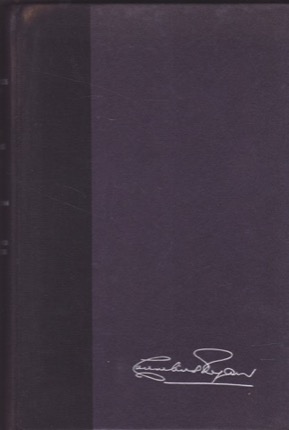
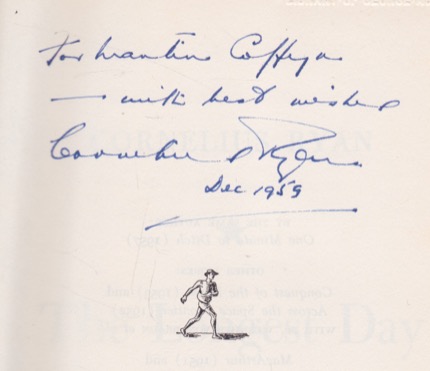
Hardcover. NY, Simon and Schuster, 2nd pr., 1959, Book: Very Good, Dust Jacket: None, Hardcover, dark gray boards with black cloth spine, gilt lettering on spine. 350 pages, b&w illustrations, color endpaper maps. INSCRIBED BY RYAN on half title page and dated Dec 59. In 1956 Ryan began to write The Longest Day,which tells the story of the D-Day Invasion of Normandy, later published in 1959. It was an instant success, and Ryan helped in the writing of the screenplay for the 1962 hit film of the same name. Darryl F. Zanuck paid the author US $175,000 for the screen rights to the book. Lacks dust jacket, a clean, bright copy.
Softcover. Cambridge, Komatik Press, 1st, 2017, Book: Very Good, Dust Jacket: None, Softcover, oblong format. In 1917, while still in art school, Edward Shenton joined Company B, 103rd Engineers of the Pennsylvania National Guard. He stocked up on art materials, including many canvas-bound sketchbooks and a watercolor set, and went off to train and fight. Much of the war he witnessed made their way into his sketchbooks. When Ed returned home, no one wanted to hear about the war, much less see images of the horrors of battle. He went back to art school and his sketches were put away and forgotten. He had a brilliant career as an illustrator. His drawings graced the cover of Scribner's Magazine for ten years and embellished books by, among others, Hemingway, Fitzgerald and Thomas Wolf.Edward Shenton had a long career as an outstanding illustrator, author, and teacher and, after a very full life, died at the age of eighty-two. Nine decades after they were put away, his son came across Ed's sketchbooks and he and I decided that they, along with his father's wartime story, had to be shared with the world.
Hardcover. NY, Harper & Brothers Publishers, 1st, 1918, Book: Very Good, Dust Jacket: None, Hardcover, textured blue cloth covers with gilt lettering and rule on front. B&w frontis. illustration. A story of personality exchange set during World War I. The same German bullet passes through the brain of one French soldier, killing him, but lodges in the head of another (his close friend), causing only a slight injury but transferring the dead man's personality to that second soldier. This produces great psychological consternation in the wounded man, especially when he returns home and courts the widow of the first soldier. Bookplate on front fly, otherwise clean and bright.
Softcover. Washington DC, The Infantry Journal, reprint, 1944, Book: Very Good, Dust Jacket: None, Small softcover, 335 pages. "The primary purpose of this book is to provide a guide to the main forces, institutional and ideological, in the Nazi system." Published for the American servicemen. Name on front cover,mild wear to covers.
Hardcover. NY, The Century Co., 1st, 1917, Book: Good, Dust Jacket: None, Hardcover, green cloth stamped in gilt. 346 pages. Frontis. portrait, illustrated with b&w plates and folding facsimile documents. "Authoritative information as to how the soldiers of the Allies are transported, housed and trained, how a battle is prepared for in advance, etc. " Author observed British Postal Censorship and war, including trench-fighting, during WWI. Eric Fisher Wood, Sr. (1889 1962) was an American civil engineer, architect, author, and officer in the United States Army, retiring with the rank of Brigadier General. Book shows mild shelf wear, name and stamp to front endpapers, otherwise clean. Good plus.

 "The Best of Don Winslow of the Navy: A Collection of High-Seas Stories from Comics' Most Daring Sailorby: Craig Yoe (Ed.)")


 "The British War Blue Book, Miscellaneous No. 9 (1939): Documents Concerning German-Polish Relations and the Outbreak of Hostilities between Great Britain and Germany on September 3, 1939by:")
 "The Dawn of Liberation War Speeches by the Right Hon. Winston S. Churchill CH. MP. C. H. M. P. by: Winston S. Churchill")
 "The Doolittle Raid: America's daring first strike against Japanby: Carroll V. Glines")
 "The End of the Beginning: War Speeches by the Rt. Hon. Winston S. Churchill C. H. M. P. by: Winston S. Churchill / Compiled by Charles Eade")
![The End: Hamburg 1943by: Nossack, Hans Erich; Andres, Erich [Photographer]; Agee, Joel [Translator]](javascript:largeIMTop('https://www.browsingisarousing.com/shop/images/The-End-Hamburg-1943_by_Nossack-Hans-Erich-Andres-Erich-Photographer-Agee-Joel-Translator372848-395803.jpg','https://www.browsingisarousing.com/shop/images/The-End-Hamburg-1943_by_Nossack-Hans-Erich-Andres-Erich-Photographer-Agee-Joel-Translator372848-395803.jpg',0,'372848',0,'') "The End: Hamburg 1943by: Nossack, Hans Erich; Andres, Erich [Photographer]; Agee, Joel [Translator]")
 "The End: The Defiance and Destruction of Hitler's Germany, 1944-1945by: Kershaw, Ian")
 "The First Heroes: The Extraordinary Story of the Doolittle Raid--America's First World War II Victoryby: Craig Nelson")
 "The First World War: Unseen Glass Plate Photographs of the Western Front by Carl De Keyzerby: Carl De Keyzer/David Van Reybrouck")
 "The Flying Spyby: de Carlo, Lieut. Camillo")
 "The Flying Tigers: The Untold Story of the American Pilots Who Waged a Secret War Against Japanby: Sam Kleiner")
 "The GI War Against Japan: American Soldiers in Asia and the Pacific During World War IIby: Peter Schrijvers")
 "The Great War: July 1 1916: The First Day of the Battle of the Somme by: Sacco, Joe/Adam Hochschild (Contributor)")
 "The Hitler File: A Social History of Germany and the Nazis, 1918-45by: Frederic V. Grunfeld")
 "The Hitler of History by: John Lukacs")
 "The Impact of World War II on Italian Americans 1935-Present by: Mormino, Gary R. (Ed.)")
 "The Invasion of France and Germany, 1944-1945: History of United States Naval Operations in World War II, Volume 11 by: Morison, Samuel Eliot")
 "The Issue of War: States, Societies, and the Far Eastern Conflict, 1941-1945 by: Thorne, Christopher")
 "The Jews of Paris and the Final Solution: Communal Response and Internal Conflicts 1940-1944 by: Adler, Jacques")
 "The Longest Day; June 6, 1944by: Ryan, Cornelius")
 "The Lost Sketchbooks: A Young Artist in The Great War by: Passion, Rex")
 "The Man Who Survivedby: Camille Marbo (pseudonym of Marguerite Appell Borel)")
 "The Nazi Stateby: William Ebenstein")
 "The Note-Book of an Intelligence Officerby: Wood, Eric Fisher")