Hardcover. Cambridge MA, Harvard University Press, 3rd pr., 2017, Book: Very Good, Dust Jacket: Very Good, Hardcover in a bright dust jacket, 370 pages with index. Photographs, illustrations, notes, index. "This is the story of how America's first women soldiers helped win World War I, earned the vote, and fought the U.S. Army. In 1918, the U.S. Army Signal Corps sent 223 women to France. They were masters of the latest technology: the telephone switchboard. General John Pershing, commander of the American Expeditionary forces, demanded female 'wire experts' when he discovered that inexperienced doughboys were unable to keep him connected with troops under fire. Without communications for even an hour, the army would collapse". Clean copy.
Hardcover. Munich GDR, Te Neues Publishing Company, 1st, 1996, Book: Very Good, Dust Jacket: None, Hardcover, 144 pages. Photos of Naomi Campbell, Helena Christensen, Cindy Crawford, Linda Evangelista, Kristen McMenamy, Kate Moss, Tatjana Patitz, Claudia Schiffer, Christy Turlington and Amber Valetta. About 10 pages dedicated to each, which comprise amazing shots by Lindbergh in full bleed b&w. Preface by Karl Lagerfeld.
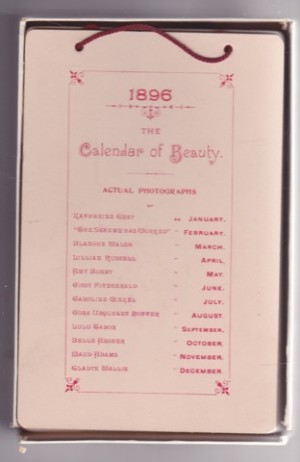
Softcover. NY, Automatic Photograph Co., 1995, Book: Very Good, Unique item: 13 rounded cards, 4 X 6 1/2", hole-punched at the top with a string binding. The top card is the title, listing the women shown in the following cards for the 12 months of the year. Each has a pasted down actual photograph of the female celebrity: Katherine Grey, Lillian Russell, Maud Adams, Lulu Tabor, etc. All in excellent condition in the original white box which is worn at the corners.
Hardcover. College Station, Texas A&M University , 1st, 1994, Book: Very Good, Dust Jacket: Very Good, Hardcover in a bright dust jacket, 318 pages. In their own vivid words, the women members of the Soviet air force recount their dramatic efforts against the German forces in World War II. These brave women, the first ever to fly in combat, proved that women could be among the best of warriors, withstanding the rigors of combat and downing the enemy. B&w illustrations. Clean copy.
Hardcover. London, T. Carnan and F. Newbery, 4th Ed., 1778, Book: Good, Dust Jacket: None, Hardcover, calf binding with covers detached, 262 pages, engraved frontispiece (depicting Millenium Hall). A 1762 novel by Sarah Scott. It was Scott?'s most significant novel, popular enough to go into four editions very early into its publication. Interest has revived in the 21st century among feminist literary scholars. Elizabeth Montague, Sarah Scott?s sisters, had become a leader of the bluestockings, a coterie of reform-minded individuals. Hall is a fictional embodiment of bluestockings ideals. The book was a best seller when it first appeared in 1762, running through four editions by 1778. Frontispiece detached but all text pages still firmly bound and clean. A candidate for rebinding.
Softcover. Hanover NH, Wesleyan University Press, 1st, 1993, Book: Very Good, Dust Jacket: None, Softcover, 542 pages. Now, Voyager, Stella Dallas, Leaver Her to Heaven, Imitation of Life, Mildred Pierce, Gilda ...these are only a few of the hundreds of "women's films" that poured out of Hollywood during the thirties, forties, and fifties. The films were widely disparate in subject, sentiment, and technique, they nonetheless shared one dual to provide the audience (of women, primarily) with temporary liberation into a screen dream--of romance, sexuality, luxury, suffering, or even wickedness--and then send it home reminded of, reassured by, and resigned to the fact that no matter what else she might do, a woman's most important job was...to be a woman. Now, with boundless knowledge and infectious enthusiasm, Jeanine Basinger illuminates the various surprising and subversive ways in which women's films delivered their message. Basinger examines dozens of films, exploring the seemingly intractable contradictions at the convoluted heart of the woman's genre--among them, the dilemma of the strong and glamorous woman who cedes her power when she feels it threatening her personal happiness, and the self-abnegating woman whose selflessness is not always as "noble" as it appears. Basinger looks at the stars who played these women and helps us understand the qualities--the right off-screen personae, the right on-screen attitudes, the right faces--that made them personify the woman's film and equipped them to make believable drama or comedy out of the crackpot plots, the conflicting ideas, and the exaggerations of real behavior that characterize these movies.
Hardcover. NY, Rizzoli, 1st, 2002, Book: Very Good, Dust Jacket: Very Good, Hardcover, 192 pages. This volume surveys over thirty groundbreaking women who were able to negotiate the conventional boundaries of their time in order to forge successful careers and build distinguished bodies of work. Includes works by Dorothea Lange, Berenice Abbott, Margaret Bourke-White, etc.
Hardcover. New Haven CT, Yale University Press, 1st, 2009, Book: Very Good, Dust Jacket: Very Good, Hardcover, 148 pages. This book celebrates the achievements of Alice Guy Blache (1873-1968), the first woman motion picture director and producer. From 1896 to 1907, she created films for Gaumont in Paris. In 1907, she moved to the United States and established her own film company, Solax. From 1914 to 1920, Guy Blache was an independent director for a number of film companies. Despite her immensely productive and creative career, Guy Blache's indispensable contribution to film history has been overlooked. She entered the world of filmmaking at its nascent stage, when films were seen primarily as a medium in the service of science or as an adjunct to selling cameras. Working with Gaumont cameramen and cameras and the new technical advances for the projection of film, she became one of the film pioneers ushering in the new era of motion pictures as a narrative form. Written by cinema history experts and curators, this handsome volume brings to light a critical new mass of Guy Blache's film oeuvre in an effort to restore her to her rightful place in film history.
Hardcover. Philadelphia PA, Philadelphia Museum Of Art, 1st, 2000-06-01, Book: Very Good, Dust Jacket: Good, Hardcover, 198 pages, illustrated throughout in color and b&w. Light edgewear to dust jacket with two faint damp stains to front panel. Clean, tight copy.
Hardcover. NY, Pegasus Books, 1st, 2024, Book: Very Good, Dust Jacket: Very Good, Hardcover in a bright, unclipped dust jacket, 519 pages. At the heart of this history is the female body. The century-span between the crinoline and the bikini witnessed more mutations in the ideal western woman's body shape than at any other period. In this richly detailed account, Virginia Nicholson, described as 'one of the great social historians of our time.' (Amanda Foreman) and a truly brilliant researcher has produced a most remarkable social history revealing the power, the pain and the pleasure involved in adorning the female body. She asks how custom, colour, class and sex fit into the picture, and shrewdly charts how the advances made by feminism collided with the changing shape of desirability. Full of surprising facts - the feminist plastic surgeon, the radioactive corset - alongside stories of the 'New Women' who discovered freedom by bobbing their hair, those who were the early adopters of trousers, and early Black beauty entrepreneurs, this book chronicles the codes, the contradictions, the lies and the highs of beauty.
Hardcover. NY, Pegasus Books, 1st, 2024, Hardcover in a bright, unclipped dust jacket, 519 pages. At the heart of this history is the female body. The century-span between the crinoline and the bikini witnessed more mutations in the ideal western woman's body shape than at any other period. In this richly detailed account, Virginia Nicholson, described as 'one of the great social historians of our time.' (Amanda Foreman) and a truly brilliant researcher has produced a most remarkable social history revealing the power, the pain and the pleasure involved in adorning the female body. She asks how custom, colour, class and sex fit into the picture, and shrewdly charts how the advances made by feminism collided with the changing shape of desirability. Clean copy.
Softcover. Iowa City, University of Iowa Press, 1st, 1993, Book: Very Good, Dust Jacket: None, Softcover, 325 pages with index, b&w illustrations. Sarah Gillespie Huftalen led an unconventional life for a rural midwestern woman of her time. Born in 1865 near Manchester, Iowa, she was a farm girl who became a highly regarded country school and college teacher; she married a man older than either of her parents, received a college degree later in life, and was committed to both family and career. A gifted writer, she crafted essays, teacher-training guides, and poetry while continuing to write lengthy, introspective entries in her diary, which spans the years from 1873 to 1952. In addition, she gathered extensive information about the quietly tragic life of her mother, Emily, and worked to preserve Emily's own detailed diary. Taken together, Emily's and Sarah's extraordinary diaries span nearly a century and thus form a unique mother/daughter chronicle of daily work and thoughts, interactions with neighbors and friends and colleagues, and the destructive family dynamics that dominated the Gillespies. Sarah's consciousness of the abusive relationship between her mother and father haunts her diary, and this dramatic relationship is duplicated in Sarah's relationship with her brother, Henry, Suzanne Bunkers' skillful editing and analysis of Sarah's diary reveal the legacy of a caring, loving mother reflected in her daughter's work as family member, teacher, and citizen. Clean, bright copy.
Hardcover. Giverney, France, Library of Congress/Musee d'Art Giverny, 1st, 2001, Book: Very Good, Dust Jacket: Very Good, Hardcover, 200 pages. Lovely copy. Minor wear to dust jacket, else like new. An exhibition held in Paris a century ago demonstrated the key role American women photographers played in the international pictorialist movement. Each of the 29 artists, including such well-known figures as Gertrude Kaesebier, Amelia van Buren and Zaida Ben-Yusuf, is represented in a selection of approximately 70 breathtaking color plates drawn from the Frances Benjamin Johnston Collection at the Library of Congress and the National Museum of American History. The photographs include landscapes, portraiture, genre scenes, and still-lifes, all of which are evocatively composed and delicately toned using a variety of photographic techniques.
Hardcover. Washington DC, Library of Congress/Musee d'Art Giverny, 1st, 2001, Book: Very Good, Dust Jacket: Very Good, Like new in publishers shrink-wrap. Hardcover exhibition catalog with a dust jacket. 200 pages, 218 bw plates. An exhibition held in Paris a century ago demonstrated the key role American women photographers played in the international pictorialist movement. The accomplishment of these professional and amateur photographers clearly demonstrated a mastery of the medium and made a strong impression on those in attendance. Ambassadors of Progress explores this largely unknown event. Each of the 29 artists, including such well-known figures as Gertrude Kaesebier, Amelia van Buren and Zaida Ben-Yusuf, is represented in a selection of approximately 70 breathtaking color and b&w plates.
Softcover. NY, Dover, reprint, 2012, Book: Very Good, Dust Jacket: None, Softcover, 160 pages. Harrison Fisher's portraits of healthy, poised, active, and confident women set the standard for the concept of American beauty during the early years of the twentieth century. The artist enjoyed enormous popularity from 1905 to 1920, serving as a judge in nationwide beauty contests and maintaining a celebrity status that was unparalleled for an illustrator. This original publication recaptures the images that made Fisher famous, compiling his very best black-and-white and color illustrations for Cosmopolitan, The Saturday Evening Post, and The Ladies Home Journal as well as for books and other publications. The successors to the stylish Gibson Girls created by Charles Dana Gibson, Fisher's idealized women reflect an aspirational degree of wealth and social ease. They ride horses, play tennis, swim, go motoring in newfangled automobiles, and graciously bask in the admiration of attractive young men. These century-old images from a moment in our country's cultural history will appeal to enthusiasts of graphic art and illustration as well as to students of American art and popular culture.
Softcover. Los Angeles, Augustan Reprint Society, reprint, 1980, Book: Very Good, Dust Jacket: None, Softcover, facsimile reprint of a 1673 pamphlet. Introduction by Paula L. Babour, 56 pages. Early feminist tract. Name on front cover, otherwise a clean copy.
Softcover. Hanover NH, University Press of New England, 1st, 2004, Softcover, 222 pages. From 1942 to 1945, Lieutenant Colonel Betty Bandel (retired) served in the Women's Army Auxiliary Corps (WAAC, later WAC, the Women's Army Corps), eventually heading the WAC Division of the Army Air Force. During these years she wrote hundreds of letters to family and friends tracing her growth from an enthusiastic recruit, agog in the presence of public figures such as Eleanor Roosevelt (code named Rover), to a seasoned officer and leader. Bandel was one of the Corps' most influential senior officers. Her letters are rich with detail about the WAC's contribution to the war effort and the inner workings of the first large, non-nurse contingent of American military women. In addition, her letters offer a revealing look at the wartime emergence of professional women. Perhaps for the first time, women oversaw and directed hundreds of thousands of personnel, acquired professional and personal experiences, and built networks that would guide and influence them well past their war years.
Hardcover. NY, Columbia University Press, 1st, 1993, Book: Very Good, Dust Jacket: Very Good, Hardcover in a bright dust jacket, 222 pages. Name on front fly leaf otherwise clean. Applying feminist theory to some lesser-known works by well known authors and painters, Munich (English, SUNY, Stony Brook) explores the psychological and cultural implications of the Victorian (male) treatment of the Perseus and Andromeda myth and its medieval analog, the legend of St. George and the dragon. With 31 photographs of the works discussed. A mild musty odor.
Hardcover. NY, Harper & Brothers, BC Ed., 1956, Book: Very Good, Dust Jacket: Very Good, Hardcover in a bright dust jacket. 305 pages, 16 pages of b&w illustrations. A legend in her own time, Clara Barton, comes to life in these pages. One can almost sense the death and destruction of the battlefields (American Civil War) and disasters to which Barton was the first to bring aid and comfort to the suffering. Barton's life is great testimony as to the powerful influence that one person can have on the outcome of history, and was achieved in an age when women were secondary figures. A diminutive five-foot tall, she rose as a giant among her historical peers (e.g., Susan B. Anthony and Dorothea Dix, et al.) and forever shaped the topography of American society, healthcare, and emergency relief, by founding the American Red Cross [1881] at age 59. Clean copy.
Softcover. New York , Aperture, 1st, 1987, Book: Very Good, Dust Jacket: None, Softcover. Essays by Tillie Olsen, Julie Olsen Edwards, and Estelle Jussim. This issue features the work of Larry Fink, Paul Fusco, Joseph Szabo, Bruce Davidson, Linda Brooks, Barbara Crane, Jill Freedman, Danny Lyon, Harry Callahan, Eve Arnold, Dorothea Lange, Starr Ockenga, and many more. A clean, very good copy.
Hardcover. Penland, NC, Jargon Society, 1st, 1971, Book: Very Good, Dust Jacket: Very Good, 63 pages. Hardcover with dust jacket. Clean, tight copy with only minor wear to edges. Related news clipping laid in.
Hardcover. New York, Skira Rizzoli, 1st, 2015, Book: Very Good, Dust Jacket: Very Good, 192 pages. Hardcover with dust jacket. Remainder mark on bottom of the text block. Clean, unmarked copy with only minor wear to dust jacket. Large black & white and color photographs throughout. Tight copy. Many portraits ranging throughout Audrey's life.
Hardcover. London, Faber & Faber , 3rd pr., 1965, Book: Very Good, Dust Jacket: Good, Hardcover in a bright, rubbed and edgeworn dust jacket. The autobiography of an intelligent, traditional Hausa woman. An excellent piece of ethnography. The author, the wife of social anthropologist, became Baba's friend in Nigeria. After many conversations between the two women, she agreed to dictate the story of her life. Name on inside front cover, otherwise clean.
Hardcover. Urbana IL, University of Illinois Press, 2nd pr., 1995, Book: Very Good, Dust Jacket: Very Good, Hardcover in a bright dust jacket. 327 pages, b&w photos. An extraordinarily gifted athlete, Babe Didrikson Zaharias starred in track and field and won three Olympic medals in 1932. She picked up golf late yet quickly dominated the women's sport. She also competed in baseball, bowling, basketball, and tennis. Interviews with members of Babe's family, peers, and others inform Susan E. Cayleff's story of the athlete and the difficulties she faced as a woman trying to be her own person. The American public was smitten with Babe's wit, frankness, and "unladylike" bravado. But members of the press insinuated that her femininity, even her femaleness, were suspect. Cayleff looks at how Babe used her androgyny and athleticism to promote herself before crafting a more marketable female persona for golf. She also explores Babe's role as a cofounder of the Ladies Professional Golf Association (LPGA); her marriage to George Zaharias and their partnership in shaping her career; her romantic relationship with fellow golfer Betty Dodd; and her courageous public fight against cancer. Clean copy.

 "The Hello Girls: America's First Women Soldiersby: Cobbs, Elizabeth")
 "10 Women by Peter Lindberghby: Lindbergh, Peter")
 "1896 Calendar of Beautyby: N/A")

 "A Dance With Death: Soviet Airwomen in World War II by: Anne Noggle")

 "A Woman's View: How Hollywood Spoke to Women, 1930-1960by: Basinger, Jeanine")
 "Against the Odds: Women Pioneers in the First Hundred Years of Photographyby: Sandler, Martin W.")

 "Alice Guy Blaché: Cinema Pioneerby: Joan Simon, Jane M. Gaines, et al.")
 "Alice Neelby: Temkin, Ann")
 "All the Rage: Stories from the Frontline of Beauty: A History of Pain, Pleasure, and Power: 1860-1960 by: Virginia Nicholson")
 "All the Rage: Stories from the Frontline of Beauty: A History of Pain, Pleasure, and Power: 1860-1960 by: Nicholson, Virginia")
 "All Will Yet Be Well: The Diary of Sarah Gillespie Huftalen, 1873-1952by: Bunkers, Suzanne L.")
 "Ambassadors of Progress: American Women Photographers in Paris, 1900-1901by: Griffith, Bronwyn (Contributor)")
 "Ambassadors of Progress: American Women Photographers in Paris, 1900-1901by: Griffith, Bronwyn")
 "American Beauties: The Artwork of Harrison Fisherby: Harrison Fisher")
 "An Essay to Revive the Antient Education of Gentlewomen (1673)by: Bathsua Makin")
 "An Officer and a Lady: The World War II Letters of Lt. Col. Betty Bandel, Women's Army Corps by: Sylvia J. Bugbee (Ed.)")
 "Andromeda's Chains: Gender and Interpretation in Victorian Literature and Artby: Adrienne Auslander Munich")
 "Angel of the Battlefield: The Life of Clara Barton by: Ross, Ishbel")
 "Aperture: Mothers & Daughters, That Special Quality/No 107by: Olsen, Tillie")
 "Appalachian Photographs of Doris Ulman, Theby: Niles, John Jacob (Intro by)")
 "Audrey Hepburn: Portraits of an Iconby: Pepper, Terence/Helen Trompeteler")
 "Baba of Karo: A Woman of the Muslim Hausa by: Smith, Mary")
 "Babe: The Life and Legend of Babe Didrikson Zaharias by: Cayleff, Susan E.")