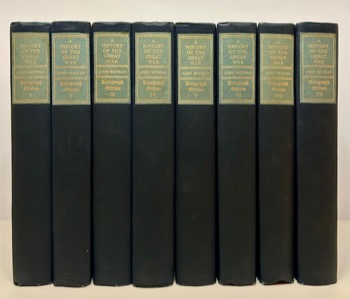
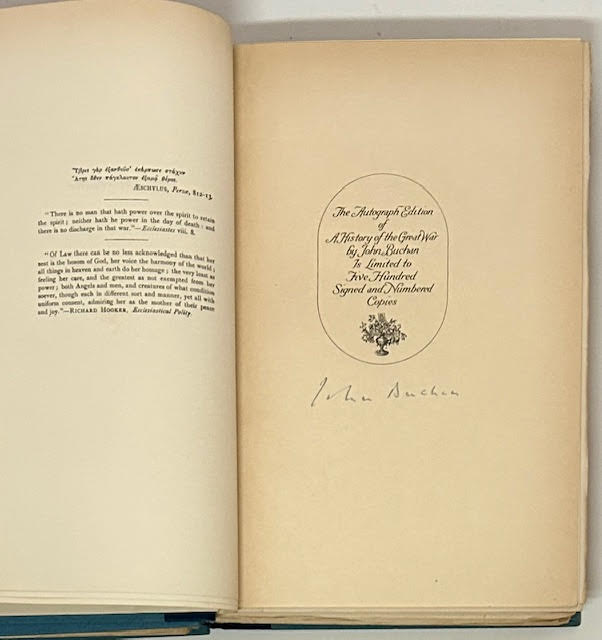
Hardcover. Boston, MA, Houghton Mifflin Company, 1st, 1922, Book: Very Good, Dust Jacket: None, Domestic shipping only. 8 Volumes. Hardcovers. Autograph edition is limited to five hundred signed and numbered copies printed at the Riverside Press, Cambridge, U.S.A. Number 187. SIGNED BY BUCHAN in volume 1, reverse of title page. 2268 total pages within 8 volumes: Color frontispieces in each volume and b/w illustrations throughout with tissue page guards and fold-out maps. Blue cover boards, navy blue quarter cloths with gilt title on blue paste downs on spines. Covers show very light shelf wear with some slight tanning and a touch of rubbing to bottom of spines (Vol. 3 has small spot on front cover board). Pages offset, some tanning to pages and edges from age. Binding very good. Spines straight. Pages and edges have a touch of tanning from age. Beautiful, historical set perfect for the WWI enthusiast.
Softcover. Minneapolis MN, University Of Minnesota Press, 1st, 1998, Softcover, 303 pages. The Subaltern Studies Collective, founded in 1982, was begun with the goal of developing a new critique of both colonialist and nationalist perspectives in the historiography of colonized countries. Its most famous members - Gayatri Spivak, Partha Chatterjee, and others - were instrumental in establishing the discipline best known as postcolonial studies. A selection of the definitive and most influential work from the collective's eponymous journal, these essays chart the course of subaltern history from an early concentration on peasant revolts and popular insurgency to an engagement with the more complex processes of domination and subordination in a variety of the changing institutions and practices of evolving modernity. Clean copy.
Hardcover. Gloucester MA, Peter Smith, reprint, 1985, Book: Very Good, Dust Jacket: None, Hardcover, green cloth covers, 569 pages. Two decades after Darwin, intellectuals were writing about the evolution of everything. In England Edward Taylor focused on material culture such as fire making, cooking, or tool making. In America, Lewis Henry Morgan, concentrated on social evolution combined with subsistence techniques. His thinking was influenced by his Iroquois neighbors in New York. Like many others he posited three stages of evolution: savagery, barbarism and civilization, but he refined the three periods with three subperiods. In Lower savagery, for example, he saw humans subsisting on fruits and roots in tropical climes, using gesture language and marrying siblings in a consanguine family. Middle savagery saw fish subsistence, monosyllabic language, and marriage of cousins. Bows and arrows appeared in Upper Savagery along with syllabic language, clans, and tribal organization. Obviously Morgan was speculating on most of the developments, but he had found arguments for his positions from the reports of explorers and missionaries around the world. As a result, Morgan inspired an era of inquisitive thought that led to the development of American anthropology. Name on front fly leaf, otherwise clean.
Hardcover. Boston, Little, Brown & Company, 1st, 1961, Book: Very Good, Dust Jacket: None, Hardcover, light mauve cloth with white lettering on spine, 311 pages with index. B&w illustrations, maps. Spine with light fading, book is clean, tight copy. Stated First Edition.
Hardcover. New York, Macmillan Company, 1st, 1947, Book: Good, Dust Jacket: None, Hardcover. 361 pages. Some light scratching to front cover. Rubbing to corners, spine. Spine slightly faded.
Hardcover. Boston, Roberts Brothers, 1st, 1895, Book: Good, Dust Jacket: None, Two volumes complete. 811 pages, many b&w illustrations. Green cloth with black rule, gilt design and lettering, top edge gilt. Volume one with fraying to cloth at top of spine, previous owner's sticker inside front covers. Otherwise clean, very good set.
Hardcover. UK, Cambridge University Press, 1st, 2013, Book: Very Good, Dust Jacket: Very Good, Hardcover in a bright dust jacket, 407 pages. Color and b&w illustrations. Details the history of cotton and how it has impacted the textile and garment trade. Today's world textile and garment trade is valued at a staggering $425 billion. We are told that under the pressure of increasing globalisation, it is India and China that are the new world manufacturing powerhouses. However, this is not a new phenomenon: until the industrial revolution, Asia manufactured great quantities of colorful printed cottons that were sold to places as far afield as Japan, West Africa and Europe. Cotton explores this earlier globalized economy and its transformation after 1750 as cotton led the way in the industrialization of Europe. By the early nineteenth century, India, China and the Ottoman Empire switched from world producers to buyers of European cotton textiles, a position that they retained for over two hundred years. This is a fascinating and insightful story which ranges from Asian and European technologies and African slavery to cotton plantations in the Americas and consumer desires across the globe. Clean copy.
Hardcover. Groningen, Wolters, 1st, 1955, Book: Very Good, Dust Jacket: None, Hardcover, red cloth with gilt lettering, 241 pages. Name on front fly leaf, otherwise clean. Everyone who wonders what history is or how it should be written will derive enjoyment and profit from the book. Ranke, Carlyle, Michelet, Macaulay and Toynbee are among the historians whom the author engages in debate.
Softcover. New York, Jill Newhouse, 1st, 1983, Book: Good, Dust Jacket: None, Unpaginated, staple-bound pamphlet, with 47 black-and-white illustrations. Price list for works laid in. Light soiling, edge-wear, and shelf-wear to covers. A little foxing to top edge. Otherwise, clean, tight copy.
Hardcover. Seattle, WA, University of Washington Press, 1st, 2016, Book: Very Good, Dust Jacket: None, 224 pages. Hardcover with no dust jacket. A very clean, unmarked copy with only minor edgewear. A tight copy. Contemporary portraits of key personalities aboard the ship, scale models and plans of the ship itself, scientific instruments taken on the voyage, commemorative medals and sketches, the objects (over 140) featured in this book tell the story of the Endeavour voyage and its impact ahead of the 250th anniversary in 2018 of the launch of this seminal mission. Artwork made both during and after the voyage will be seen alongside actual specimens. By comparing the voyage originals with the often stylized engravings later produced in London for the official account, Endeavouring Banks investigates how knowledge gained on the mission was gathered, revised, and later received in Europe. Items that had been separated in some cases for more than two centuries are brought together to reveal their fascinating history not only during but since that mission. Original voyage specimens are featured together with illustrations and descriptions of them, showing a rich diversity of newly discovered species and how Banks organized this material, planning but ultimately failing to publish it. In fact, many of the objects in the book have never been published before.
Hardcover. New York, Picador, 1st Edition, 2015, Book: Very Good, Dust Jacket: Very Good, 566 pages. Hardcover. Full page, full color and b/w illustrations throughout. Dust jacket with graphic illustration in very good condition. Clean, unmarked copy.
Hardcover. New York , Arno Press, reprint, 1976, Book: Very Good, Dust Jacket: None, 295 pages, green cloth covers with gilt lettering. Previous owner's stamp on front fly leaf, otherwise clean, very good. Facsimile reprint of the 1933 edition. Scarce in hardcover.
Hardcover. Paris, Corbet Aine Libraire, 1st Thus, 1836, Book: Good, Dust Jacket: None, 2 leather bound volumes. FRENCH TEXT. Black & white illustrations, each volume with fold-out map in rear. Volume 1 with rubbing, chipping to leather covers. 1" piece of leather missing at bottom of spine. Marbled endpapers. Light foxing throughout. Volume 2 with rubbing, chipping to leather covers. Marbled endpapers. Light to moderate foxing throughout. Both volumes with clean, unmarked texts.
Hardcover. Boston/New York, Bedford/ St. Martin's, 4th pr., 2005, Book: Very Good, Dust Jacket: None, 1224 pages plus appendix, color illustrations. Pictorial boards, very heavy textbook. Clean, tight copy. Light bump to cover corner otherwise very good. DOMESTIC SHIPPING ONLY.
Hardcover. New York, Harry N. Abrams, 1st, 1980, Book: Very Good, Dust Jacket: Very Good, Hardcover, 239 pages. Illustrated with full color photographs. Foxing to endpapers, with faint darkening to page edges. Dust jacket shows light wear. Clean, tight copy.
Hardcover. Washington DC, National Geographic Society, 1913, Book: Very Good, Dust Jacket: None, Hardcover, six bound editions from the first 6 months of 1913. Nice folding map of Central America/ Caribbean (pg. 166), fold-out b&w photo of Machu Picchu (pg. 434), poster-size fold-out of Titkana Peak (pg. 600, Color porfolio of 50 birds of Farm and Orchard (pgs. 669-697) with paintings by Louis Agassiz Fuertes. Interior pages and fold-outs pristine, rear upper spine label rubbed, faded. DOMESTIC SHIPPING ONLY.
Hardcover. New Haven, S. Converse, 4th Ed., 1823, Book: Good, Dust Jacket: None, 856 pages, the Fourth Edition, revised and corrected of this classic work. Bound in worn calf with an inch and a half tear to top of spine. Previous owners signatures on front fly leaf. Very good with light, scattered foxing. Issued with an separate atlas of maps which is missing.
Hardcover. NY, Zone Books, 1st, 2022, Book: Very Good, Dust Jacket: Very Good, Hardcover in a bright dust jacket, 214 pages. The philosopher and literary and cultural critic Samuel Weber returns to past narratives of plagues and pandemics to reproduce the myriad ways individual and collective, historical and actual, intentional and unintentional forces converge to reveal how cultures and societies deal with their vulnerability and mortality. The "preexisting conditions"-a phrase taken from the American healthcare industry-of these very cultures converge and collide with the urgent situations of individuals confronting the plague. Texts drawn from the Bible, Sophocles, Thucydides, Boccaccio, Luther, Defoe, Kleist, Holderlin, Artaud, and Camus demonstrate how in the process of narration individuals come to reconsider their relationship to others, to themselves, and to the collectives to which they belong and on which they depend. Clean copy.
Softcover. Washington DC, National Museum of American Art and National Portrait Gallery, Smithsonian Institution, 1st, 1993, Book: Very Good, Dust Jacket: None, Softcover, 408 pages, illustrated throughout in color and b&w. Light edgewear and rubbing to wrappers, else a clean, tight copy.
Hardcover. Cambridge, Cambridge University Press, 1st, 2000, Book: Very Good, Dust Jacket: None, 328 pages with bibliography and index. A revised and abridged version of Watkins earlier work on Soane (1753-1837), concentrating on the twelve lectures the eminent architect gave to the Royal Academy between 1810 and 1820, dealing with the huge scope of the lessons to be gained from world architecture.
Hardcover. NY, Knopf, 1st, 2012, Book: Very Good, Dust Jacket: Very Good, Hardcover in a bright, unclipped dust jacket. 418 pages, b&w illustrations. From the author of the best-selling One Minute to Midnight, a riveting account of the pivotal six-month period spanning the end of World War II, the dawn of the nuclear age, and the beginning of the Cold War. When Roosevelt, Stalin, and Churchill met in Yalta in February 1945, Hitler's armies were on the run and victory was imminent. The Big Three wanted to draft a blueprint for a lasting peace--but instead set the stage for a forty-four-year division of Europe into Soviet and western spheres of influence. After fighting side by side for nearly four years, their political alliance was rapidly fracturing. By the time the leaders met again in Potsdam in July 1945, Russians and Americans were squabbling over the future of Germany and Churchill was warning about an "iron curtain" being drawn down over the Continent. These six months witnessed some of the most dramatic moments of the twentieth century: the cataclysmic battle for Berlin, the death of Franklin Roosevelt, the discovery of the Nazi concentration camps, Churchill's electoral defeat, and the dropping of atomic bombs on Japan. While their armies linked up in the heart of Europe, the political leaders maneuvered for leverage: Stalin using his nation's wartime sacrifices to claim spoils, Churchill doing his best to halt Britain's waning influence, FDR trying to charm Stalin, Truman determined to stand up to an increasingly assertive Soviet superpower.
Hardcover. NY, Alfred A. Knopf, 1st, 1935, Book: Very Good, Dust Jacket: None, Hardcover, maroon cloth with gilt lettering on spine, pages 415-797, plus index. Volume 2 ONLY. No dust jacket. Name on front fly leaf otherwise a clean, bright copy.
Hardcover. NY, Alfred A. Knopf, 1st, 1935, Book: Very Good, Dust Jacket: None, Hardcover, maroon cloth with gilt lettering on spine, 414 pages. Volume 1 ONLY. No dust jacket. Name on front fly leaf otherwise a clean, bright copy.

 "A History of the Great War (SIGNED)by: Buchan, John")
 "A Subaltern Studies Reader, 1986-1995by: Ranajit Guha (Ed.)")
 "Ancient Society Or Researches in the Lines of Human Progress from Savagery Through Barbarism to Civilizationby: Morgan, Lewis Henry")
 "Black Mother: The Years of the African Slave Tradeby: Basil Davidson")
 "Concise History of Law of Nations, Aby: Nussbaum, Arthur")
 "Constantinople (2 Volumes)by: Grosvenor, Edwin A.")
 "Cotton: The Fabric that Made the Modern World by: Riello, Giorgio")
 "Debates with Historians by: Geyl, Pieter")
 "Drawings of Frederick A. Bridgman, Theby: Fort (introduction and chronology), Ilene Susan")
 "Endeavouring Banks: Exploring Collections from the Endeavour Voyage 1768-1771by: Chambers, Neil")
 "Fallen Glory - The Lives and Deaths of History's Greatest Buildingsby: Crawford, James")
 "Foreign Bonds; An Autopsy - A Study of Defaults and Repudiations of Government Obligationsby: Winkler, Max")
 "Histoire de la decouverte de l'Amerique - traduite de l'allemand de Campe - 2 Volumesby: Piton, E. C.")
 "Making of the West, The: Peoples and Cultures - Second Editionby: Hunt, Lynn and others")
 "Masterpieces of Glass - A World History from the Corning Museum of Glassby: Charleston, Robert J.")
 "National Geographic January -June 1913 vol. XXIV No.1 includes Beacons of the Sea: Lighing of the coasts of America by George Putnam by: N/A")
 "New Universal Gazetteer or Geographical Dictionary/ Containing a Description of the Various Countries, Provinces,by: Morse, Jedidiah and Richard")
 "Picture History of the Reformation and Protestantism by: Haverstick, John")
 "Preexisting Conditions: Recounting the Plagueby: Samuel Weber")
 "Revisiting the White City: American Art at the 1893 World's Fairby: Art, National Museum of American (U.S.)")
 "Sir John Soane: The Royal Academy Lecturesby: Watkin, David (Editor)")
 "Six Months in 1945: FDR, Stalin, Churchill, and Truman--from World War to Cold Warby: Michael Dobbs")
 "The Diplomacy of Imperialism, 1890-1902: Volume 2 by: William L. Langer")
 "The Diplomacy of Imperialism, 1890-1902: Volume I by: William L. Langer")