Hardcover. NY, Grosset & Dunlap, 1st, 1978, Book: Very Good, Dust Jacket: None, Hardcover First Edition SIGNED BY THE AUTHOR RICHARD NIXON. First printing (per publisher's statement upon copyright page). Blue cloth slipcase, Richard Nixon's blue ink signature appears on special leaf bound-in immediately between front free endpaper and half-title. A very good copy in a very good slipcase. No dust jacket. Please note that this thick book has an approximate shipping weight of 5.25 pounds and will require additional postage and insurance for any postal class other than domestic Media Mail.
Hardcover. London, Jonathan Cape, 1st thus, 1973, Book: Very Good, Dust Jacket: Very Good, Hardcover, 204 pages. With a portrait frontispiece. Original publisher's brown cloth, lettered in gilt, pictorial dustwrapper. Very minor shelf-wear, some spotting to dustwrapper. A 1973 reprint of the unexpurgated edition of T. E Lawrence's The Mint. Two editions were published simultaneously in 1955; an unexpurgated text in a limited edition, and an expurgated version (reprinted once in the same year); the present publication is a reissue of the former. The memoir records his service in the ranks of the R.A.F. Lawrence enlisted in 1922; in an effort to escape public and media attention he assumed the name John Hulme Ross. Upon the discovery of his identity he was discharged, but two and a half years later was permitted to re-enlist, this time using the name of Shaw, under which he had meanwhile served in the Tank Corps.
Hardcover. University of Nebraska Press, 1st, 2016, Book: Very Good, Dust Jacket: Very Good, Hardcover, 512 pages. Historians, biographers, and scholars of John James Audubon and natural history have long been mystified by Audubon's 1843 Missouri River expedition, for his journals of the trip were thought to have been destroyed by his granddaughter Maria Rebecca Audubon. Daniel Patterson is the first scholar to locate and assemble three important fragments of the 1843 Missouri River journals, and here he offers a stunning transcription and critical edition of Audubon's last journey through the American West. Patterson's new edition of the journals--unknown to Audubon scholars and fans--offers a significantly different understanding of the very core of Audubon's life and work. Readers will be introduced to a more authentic Audubon, one who was concerned about the disappearance of America's wild animal species and yet also loved to hunt and display his prowess in the wilderness. This edition reveals that Audubon's famous late conversion to conservationism on this expedition was, in fact, a literary fiction. Maria Rebecca Audubon created this myth when she rewrote her grandfather's journals for publication to make him into a visionary conservationist. In reality the journals detail almost gratuitous hunting predations throughout the course of Audubon's last expedition.
Hardcover. Cambridge MA, Harvard University Press, 1st, 1956, Book: Very Good, Dust Jacket: Fair, Hardcover in a worn, chipped dust jacket, 408 pages, index. Black and white frontis photo portrait of author. "Moffat served for a protracted period and with notable distinction in the key position of what was then termed Chief of the Division of European affairs; he accompanied me as my chief assistant when FDR sent me to Europe as his personal representative in the spring of 1940; and I was in the closest touch with him during the time he served as American Minister to Canada, a service so tragically terminated by his untimely death in 1943. I know of no man who came up through the ranks of the Foreign Service with whose work I am personally familiar who impressed me as having in his latter years greater knowledge, a wiser and more balanced judgement, or a greater devotion to the highest interests of this country." - Sumner Welles.
Hardcover. Berkeley CA, University of California Press, 1st, 1984, Book: Very Good, Dust Jacket: Good, Hardcover in dust jacket with some fading to edges, spine. 421 pages, b&w illustrations. ."This story of an outstandingly strange and interesting man is a triumph of modern biography. Nikolai Miklouho-Maclay (1846-1888) was one of the most extraordinary of all the nineteenth-century savant-adventurers. a brilliant student of Ernst Haeckel, he embraced the natural sciences at a time when the genius of Darwin was revolutionizing Western cosmology. In his short lifetime he made the whole world his laboratory: sponges in the Red Sea, and the ancestry of sharks, head measurements in New Guinea; Negrito races in Malay jungles; marine life in Sydney Harbor -- all these and a hundred other topics and places engaged his curiosity. Name on front fly leaf, otherwise clean.
Hardcover. NY, Doubleday, 3rd pr., 2006, Book: Very Good, Dust Jacket: Very Good, Hardcover in a bright, unclipped dust jacket. 527 pages, b&w illustrations. No one predicted success for Henry Ward Beecher at his birth in 1813. The blithe, boisterous son of the last great Puritan minister, he seemed destined to be overshadowed by his brilliant siblings--especially his sister, Harriet Beecher Stowe, who penned the century's bestselling book Uncle Tom's Cabin. But when pushed into the ministry, the charismatic Beecher found international fame by shedding his father Lyman's Old Testament-style fire-and-brimstone theology and instead preaching a New Testament-based gospel of unconditional love and healing, becoming one of the founding fathers of modern American Christianity. By the 1850s, his spectacular sermons at Plymouth Church in Brooklyn Heights had made him New York's number one tourist attraction, so wildly popular that the ferries from Manhattan to Brooklyn were dubbed "Beecher Boats." SIGNED BY APPLEGATE on the half-title page. Clean copy.
Softcover. Greenwich CT, Fairview Printers, 1st, 1977, Book: Very Good, Dust Jacket: None, Softcover, glossy pictorial stiff wraps, softcover; 187 pages plus index; black and white illustrations and photographic illustrations; very good.
Hardcover. Chapel Hill , University of North Carolina, 1st, 1949, Book: Very Good, Dust Jacket: None, Hardcover, dark green cloth, gilt lettering, design on spine, 280 pages. "The story of a Confederate childhood, a Reconstruction boyhood, and the education of a medical pioneer in the new South." This book is first of all a personal narrative that is alternately dramatic, thoughtful, and hilariously funny. It is also a vivid picture of plantation life before and during the Civil War and the beginnings of the building of a New South. Clean copy, spine a bit darkened.
Hardcover. NY, Free Press, 1st, 1987, Book: Very Good, Dust Jacket: Very Good, Hardcover in a bright dust jacket, 270 pages, b&w illustrations. Light edgewear to dust jacket, else a clean, tight copy. Recounts the life of the English poet who died during World War I, looks at the group of his friends and fellow poets known as the Neo-Pagans, and discusses the influence of homosexuality on his life. His sonnet "The Soldier" and early death in World War I made British poet Rupert Brooke a key figure in the nation's myth of patriotism and youthful valor. Biographer Delaney places him among the Neo-pagans, a small circle of writers, artists, and intellectuals who flourished from 1908 to 1912. The group honored youth, comradeship, and the simple life and aimed to set aside the constraints of Victorianism. Delany shows how the internal dynamics of the group, not shock of war, led to its disintegration.
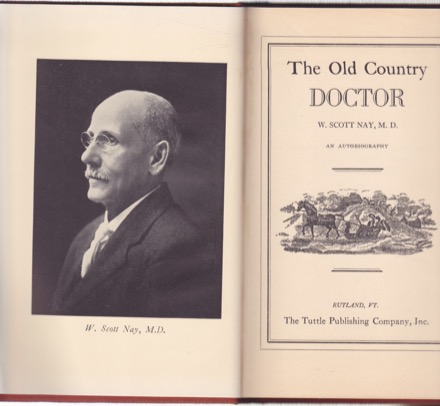
Hardcover. Rutland VT, Tuttle Publishing Co,, 1st, 1937, Book: Very Good, Dust Jacket: None, Hardcover, terra-cotta cloth, 87 pages, limited to 500 copies. SIGNED BY NAY on the half-title page. "This is the real authentic story of an old Vermont country doctor written not as fiction but as the life of one of Vermont's oldest physicians....that beloved figure, the old-fashioned country doctor..." Name on front fly leaf otherwise clean.
Hardcover. Boston, David R. Godine, 3rd pr., 2008, Book: Very Good, Dust Jacket: Very Good, Hardcover in a bright, unclipped dust jacket. Tojiro, a nine-year-old orphan, sells rice cakes on the streets of 19th-century Edo, the bustling city we now call Tokyo. One of his customers is the grumpy, eccentric octogenarian Hokusai. The old man takes a liking to Tojiro, and soon employs him as his assistant. The boy's ignorance provides a convenient vehicle for introducing the artist's life and work. Much of the dialogue and action is written for the purpose of conveying information about Hokusai, as well as the technique of woodblock printing and the social customs of Edo. The book's greatest strength is not the text, but the art that enlivens every page. A combination of the author's watercolors and reproductions of Hokusai's drawings and woodblock prints, the illustrations are arranged in enticing and varied page designs.
Hardcover. NY, Gotham Books, 1st, 2012, Book: Very Good, Dust Jacket: Very Good, Hardcover in a bright, unclipped dust jacket. 455 pages, b&w photos. The definitive biography of James Brown, the Godfather of Soul, with fascinating findings on his life as a Civil Rights activist, an entrepreneur, and the most innovative musician of our time. Playing 350 shows a year at his peak, with more than forty Billboard hits, James Brown was a dazzling showman who transformed American music. His life offstage was just as vibrant, and until now no biographer has delivered a complete profile. The One draws on interviews with more than 100 people who knew Brown personally or played with him professionally. Using these sources, award-winning writer RJ Smith draws a portrait of a man whose twisted and amazing life helps us to understand the music he made. The One delves deeply into the story of a man who was raised in abject-almost medieval-poverty in the segregated South but grew up to earn (and lose) several fortunes. Covering everything from Brown's unconventional childhood (his aunt ran a bordello), to his role in the Black Power movement, which used "Say It Loud (I'm Black and Proud)" as its anthem, to his high-profile friendships, to his complicated family life, Smith's meticulous research and sparkling prose blend biography with a cultural history of a pivotal era. Clean, bright copy.
Hampshire UK, Drift Books, 1st, 1993, Book: Very Good, Dust Jacket: None, Softcover, green wrappers, 170 pages, b&w illustrations, map. The author went to the Falklands as a young man to work on a sheep farm. His memoir offers a personal glimpse of the harsh but rewarding life of the Islands in the 1950s. Previous owner's inscription on inside cover, otherwise clean.
Hardcover. Wiley, 1st, 2010, Book: Very Good, Dust Jacket: Very Good, Hardcover in a bright, unclipped dust jacket, 320 pages. Having signed the most lucrative contract in NHL history with the Washington Capitals, Alexander Ovechkin, at 24, is an undisputed hockey legend. In the mold more of a rock star than hockey player, Ovechkin courts the limelight, is never shy with his opinions, and, in a sport that thrives on the collective culture of the team-Ovechkin is an iconoclast who flouts convention, while loving the game. In The Ovechkin Project, veteran hockey writers Damien Cox and Gare Joyce trace his elite sports pedigree, his role representing Russia in the World Juniors, and how since entering the NHL, he's taken his team from worst to first in their division, and the hockey world by storm. Clean copy.
Hardcover. Baltimore, Johns Hopkins University Press, 1st, 2007, Book: Very Good, Dust Jacket: Very Good, Hardcover in a bright dust jacket. The seventh volume of the Papers of Frederick Law Olmsted presents the record of his last years of residence in New York City. It includes reports on the design of Riverside and Morningside parks and Tompkins Square in Manhattan, as well as his comprehensive plan for the street system and rapid transit routes of the Bronx. It records his continuing work on Central Park and presents his final retrospective statement, The Spoils of the Park. In addition, volume seven contains an annotated version of the journal in which Olmsted recorded instances of political maneuvering and patronage politics in the years before his dismissal from the New York parks department in 1878. Later documents chronicle the early stages of his planning of the Boston park system--the Back Bay Fens, Arnold Arboretum, and Riverway. Other major commissions, each with its own political complications, were the grounds of the U.S. Capitol, the completion of the new state capitol in Albany, the designing of a park on Mount Royal in Montreal, and construction of the park system of Buffalo, New York. The volume also presents Olmsted's commentary on issues of the times including federal Reconstruction policy and civil-service reform.
Hardcover. New Haven CT, Yale University Press, 1st, 1997, Book: Very Good, Dust Jacket: Very Good, Hardcover in a bright dust jacket, 354 pages, b&w illustrations. An illustrated study brings to life the atmosphere and personalities of pre-revolutionary Paris, traces their influence on the American envoy, and recounts his participation in the life of the city and its intrigues at court. Clean copy.
Hardcover. NY, Knopf, 1st, 2012, Book: Very Good, Dust Jacket: Very Good, Hardcover in a bright, unclipped dust jacket. Book Four of Robert A. Caro's monumental The Years of Lyndon Johnson displays all the narrative energy and illuminating insight that led the Times of London to acclaim it as "one of the truly great political biographies of the modem age. A masterpiece." This volume follows Johnson through both the most frustrating and the most triumphant periods of his career. It tells the story of his volatile relationship with John Kennedy and Robert Kennedy during the fight they waged for the 1960 Democratic nomination for president and through Johnson's unhappy vice presidency. It gives us for the first time the story of the assassination from the viewpoint of Lyndon Johnson himself. And with the depth of insight, the profound grasp of both the life and times of his subject that Robert Caro has consistently brought to this mesmerizing biography, it reveals what it was like to suddenly become president in a time of great crisis.
Hardcover. NY, Knopf, 1st, 2012, Book: Very Good, Dust Jacket: Very Good, Hardcover in a bright, unclipped dust jacket. Book Four of Robert A. Caro's monumental The Years of Lyndon Johnson displays all the narrative energy and illuminating insight that led the Times of London to acclaim it as "one of the truly great political biographies of the modem age. A masterpiece." This volume follows Johnson through both the most frustrating and the most triumphant periods of his career. It tells the story of his volatile relationship with John Kennedy and Robert Kennedy during the fight they waged for the 1960 Democratic nomination for president and through Johnson's unhappy vice presidency. It gives us for the first time the story of the assassination from the viewpoint of Lyndon Johnson himself. And with the depth of insight, the profound grasp of both the life and times of his subject that Robert Caro has consistently brought to this mesmerizing biography, it reveals what it was like to suddenly become president in a time of great crisis.
Hardcover. NY, The Monacelli Press, 1st, 2008, Book: Very Good, Dust Jacket: None, Hardcover, 208 pages. Debate and banter between the irascible Philip Johnson and the equally articulate and opinionated Robert A. M. Stern generates a provocative combination of astute commentary and personal observation on the state of architecture in the twentieth century. Philip Johnson's multifaceted career as an architect, curator, and collector extended from the early 1920s to his death in 2005. Captivated by the work of the European modernists Gropius, Le Corbusier, and Mies van der Rohe, Johnson assembled the seminal exhibition "Modern Architecture--International Exhibition" at the Museum of Modern Art in 1932. Among his most notable achievements are the famous Glass House in Connecticut, designed for his own use, and the Seagram Building in New York, in association with Mies van der Rohe. Recognized as the dean of American architecture, Johnson had a profound influence on the next generation of architects, including Robert A. M. Stern. Stern has conducted a series of ten interviews with Johnson, each covering a decade of his life, that provide an illuminating assessment of a significant period of American architecture. No dj issued.
Softcover. Rochester NY, George Eastman House, 1st, 2000, Book: Very Good, Dust Jacket: None, Softcover, 127 page book with 40 black & white and color images by Stieglitz. Essays by Eugenia Parry, Laura Downey and Therese Mulligan. A complete illustrated catalog in rear of the collection O'Keeffe left to George Eastman House in 1951.
Hardcover. Milwaukie OR, M Press, 1st, 2006, Book: Very Good, Dust Jacket: Very Good, Hardcover in a bright, unclipped dust jacket. The third installment of Playboy interviews gives their claim some validity (although probably not enough). The first two collections were grouped under the topics of sports figures and film directors, while the latest simply has the designation "Larger Than Life," and indeed those interviewed were awfully big for their britches. The interviewees include Frank Sinatra, Marlon Brando, Bette Davis, Bob Dylan, Mae West, and Muhammad Ali, among others. The interviews--in true Playboy fashion--are revealing, but also fascinating to realize are the periods in which they occurred. Sinatra was interviewed in 1963, and the cold war was definitely on his mind. Bette Davis, in 1982, had a long career of ups and downs to sound off about. But Muhammad Ali is the perfect example of how honest these personalities could become when allowed to digress; asked why he flunked the army's preinduction test, he replied, "I have said I am the greatest. Ain't nobody ever heard me say I was the smartest." 398 pages, clean copy.
Hardcover. London, Strathearn, 1st, 2001, Book: Very Good, Dust Jacket: Very Good, Hardcover, 188 pages, b&w photos. A personal and business biography by the founder of the Polly Peck clothing line, a successful company that boomed in postwar Britain. SIGNED BY ZELKER on half-title page. Clean copy.
Hardcover. University Press of Kansas, 1st, 2000, Book: Very Good, Dust Jacket: Very Good, Hardcover in a bright dust jacket, 355 pages. Elected in hard times and serving throughout a catastrophic global war, Franklin Delano Roosevelt confronted crises of epic proportions during his record twelve-year tenure as our nation's chief executive. George McJimsey now provides a fresh account of his much-debated presidency, describing the successes and failures of FDR's landmark administration and offering a new perspective on the New Deal. A welcome synthesis of the best modern scholarship on the Roosevelt administration, McJimsey's study portrays Roosevelt as a pluralist leader whose various New Deal programs empowered the American people to combat America's Great Depression at the grass roots by participating in programs for agriculture, industry, labor, the unemployed, and "underdeveloped" regions. During the depression, Roosevelt hoped to create a "cooperative commonwealth" that would create a strong America at home, as later during World War II he sought to create an international order based on allied cooperation and American leadership.

 "The Memoirs of Richard Nixon (SIGNED COPY)by: Nixon, Richard")
 "The Mintby: Lawrence, T. E.")
 "The Missouri River Journals of John James Audubonby: John James Audubon and Daniel Patterson")
 "The Moffat Papers; Selections From the Diplomatic Journals of Jay Pierrepont Moffat, 1919-1943 by: Moffat, Jay Pierrepont; Nancy Harvison Hooker (Ed.)")
 "The Moon and Iby: Betsy Byars")
 "The Moon Man: A Biography of Miklouho-Maclayby: E. M. Webster")
 "The Most Famous Man in America: The Biography of Henry Ward Beecher (SIGNED COPY)by: Debby Applegate")
 "The National Cartoonists Society Album 1972-77 Editionby: Walker (compiled by), Mort")
 "The Natural Bent:The Memoirs of Dr. Paul B. Barringer by: Barringer, Paul B.")
 "The Neo-Pagans: Rupert Brooke and the Ordeal of Youthby: Delany, Paul")
 "The Old Country Doctor (SIGNED COPY)by: Winfield Scott Nay")

 "The Old Man Mad about Drawing: A Tale of Hokusaiby: Place, Francois")
 "The One: The Life and Music of James Brownby: Smith, R. J.")
 "The Other Side of the Falklands: The Lion and the Lamb by: Edwards, Roger M.")
 "The Ovechkin Project: A Behind-the-Scenes Look at Hockey's Most Dangerous Playerby: Damien Cox/Gare Joyce")
 "The Papers of Frederick Law Olmsted: Parks, Politics, and Patronage, 1874?1882 (Volume 7) by: Frederick Law Olmsted; Editor-Charles E. Beveridge")
 "The Paris Years of Thomas Jeffersonby: William Howard Adams")
 "The Passage of Power: The Years of Lyndon Johnsonby: Robert A. Caro")
 "The Passage of Power: The Years of Lyndon Johnsonby: Robert A. Caro")
 "The Philip Johnson Tapes: Interviews by Robert A. M. Sternby: Robert A.M. Stern")
 "The Photography of Alfred Stieglitz: Georgia O'Keeffe's Enduring Legacyby: Mulligan, Therese (Ed.)")
 "The Playboy Interviews: Larger Than Life by: Stephen Randall (Editor)")
 "The Polly Peck Story: A Memoir (SIGNED COPY)by: Raymond Zelker")
 "The Presidency of Franklin Delano Rooseveltby: George McJimsey")