Hardcover. London, Lutterworth, 1st UK, 1955, Book: Very Good, Dust Jacket: None, Hardcover, blue cloth with faded gilt lettering on spine, 115 pages. A fascinating glimpse into the debate in Scandinavia concerning a number of inter-related Biblical themes focused on the concept of the Messiah, a debate associated with scholars such as Mowinckel, Pedersen, Widengren, and Bentzen himself. The argument traces the development of the Messianic figure from its Old Testament roots, starting with the Messiah of many of the Psalms, which represents a demythologised form of the Oriental conception of kingship, through the eschatologised Messiah of the prophetic thought of Isaiah and Micah, and then to the prophet-Messiah of Second Isaiah, which although still a present and entirely human figure, embodies the insight that the saviour of Israel must suffer and be cast in the role of a Moses Redivivus as leader of a new Exodus. The Son of Man of Daniel 7 carries this eschatologising process even further, until the Christology of the New Testament emerges as a creative synthesis of these Old Testament types. In this synthesis, Jesus is a new Adam, the Messiah present in the flesh and present still in His body the Church, the suffering Prophet playing the part of the new Moses and the once and future Divine King. Bentzen argues that ultimately this figure of Christ the Messiah transcends not only the Old Testament types on which it is based, but also the subsequent historical development of the Christian Messianic tradition.
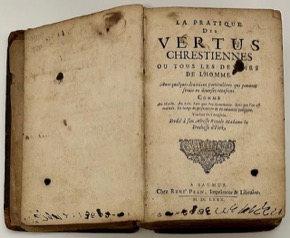
Hardcover. Chez Rene' Pean, 1st thus, 1680, Book: Good, Dust Jacket: None, 648 pages. Hardcover. Brown leather bound cover boards (age wear-see images) with faded gilt title on spine and raised bands. Front cover board completely separated from spine with front flyleaf. Previous owner's notes on preliminary page, dated "1694 16 November". Dark brown dyed edges. Tanning to pages (some partially detached from spine) from age. A few stray ink marks on pages. Christian devotions in French text.
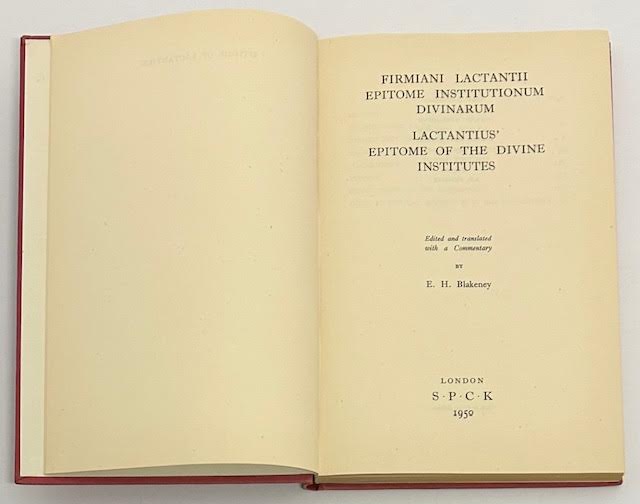
Hardcover. London, England, SPCK, 1st Edition, 1950, Book: Very Good, Dust Jacket: None, 175 pages. Hardcover. Red cover boards, fading to spine and edges, gilt title on spine. Pages unmarked. Binding tight. Spine straight. The Epitome covers a wide range of topics, including the nature of God, the creation of the world, the fall of man, the life and teachings of Jesus Christ, and the end of the world. It also discusses various aspects of Christian morality.
Hardcover. New York , Nelson & Phillips, 1st, 1873, Book: Very Good, Dust Jacket: None, Hardcover, 309 pages. Terracota cloth with gilt titles and decor to front and spine. Light edgewear and rubbing to covers, previous owner's bookplate on front end paper, else a clean, tight copy.
Hardcover. Princeton, N.J., Princeton University Press, 1st, 1992, Book: Very Good, Dust Jacket: Very Good, Hardcover, 287 pages. Clean, unmarked copy with only minor wear to dust jacket.
Hardcover. NY, powerHouse Books, 1st, 2006, Book: Very Good, Dust Jacket: Very Good, Hardcover, 127 pages. Lili Almog's color photos taken at three Carmelite monasteries (of nuns) are revealing of their faith.. The sisters showing their distinctive profession crucifixes (normally worn hidden under their scapulars, and pinned to their beds when they go to sleep) are revealing their personal symbols of "perfect intimacy." And the statues and/or holy cards of our holy mother St. Teresa, our holy father St. John of the Cross, St. Therese, and St. Joseph make Carmelites feel right at home. The monasteries are also significant: they are on Mt. Carmel (Haifa) and in Bethlehem--founded by Sister Miriam, "the little Arab"; and in Port Tobacco, Maryland, whose community is the oldest and first Discalced Carmelite convent founded in the US. The spartan surroundings emphasize the importance of the nuns' relationship with God. The photos of the sisters revealing their profession crucifixes, which they wear near their hearts and pin to their beds when going to sleep, I found especially moving. Almog's photos are neither stilted nor rigid, but reminiscent of the photos that St. Therese's sister Celine took of her! The quotations from Blessed Teresa of the Andes are very apt comments on the photos.
Hardcover. NY, Arno Press, reprint, 1977, Book: Very Good, Dust Jacket: None, Hardcover, green cloth with silver lettering on spine and front cover, A facsimile reprint of the corrected 1716 4th edition published in London. Sixteen sermons with notes and observations. Name on front fly leaf otherwise a clean, bright copy.
Hardcover. Edinburch and London, William Blackwood and Sons, 2nd revised edition, 1874, Book: Very Good, Dust Jacket: None, Vol. 1: 463 pages. Vol. 2: 500 pages. Scarce. Hardcovers. Colored endpapers (black). Light pencil notes/marks in margins. Red cloth cover boards, gilt title on spine, light age wear to covers. Front endpapers' gutters are split, binding is good. Spines straight. Edges untrimmed, pages and edges have some tanning from age. Some foxing to preliminary pages. DOMESTIC SHIPPING ONLY.
Hardcover. Berkeley, CA , University of California Press, 1st, 2002, Book: Very Good, Dust Jacket: Very Good, 283 pages. Hardcover with dust jacket. A very clean, unmarked copy with only minor wear to dust jacket edges. A tight copy. Black and white illustrations throughout. This richly detailed study reconceptualizes a striking but enigmatic moment in Rembrandt's art from the 1650s--one of the artist's most prolific and creative periods. Michael Zell identifies a significant theological shift in Rembrandt's use of religious imagery and interprets this shift in light of the unique religious and social conditions of seventeenth-century Amsterdam. Rembrandt's biblical art has generally been regarded as the embodiment of a Protestant aesthetic. By looking closely at the artist's relationship with his patron Rabbi Menasseh ben Israel and the ideas of a group of "philosemitic" Protestants with whom the rabbi was engaged in an apologetic dialogue, Zell deepens and complicates our understanding of Rembrandt's sacred art from this period.
Hardcover. Princeton, N.J., Kingston Press, Incorporated, The, 1st, 1984, Book: Very Good, Dust Jacket: Very Good, SIGNED BY AUTHOR. 227 pages. Light foxing to top and fore-edge. Minor wear to dust jacket; spine slightly faded. Else a very clean, tight copy.
Hardcover. UK, Oxford University Press, 2nd pr., 2002, Book: Very Good, Dust Jacket: Very Good, Hardcover in a bright dust jacket, 327 pages. John Damascene, a monk near Jerusalem in the early 700s, never set foot in the Byzantine Empire, yet he had a great influence on Byzantine theology. This book, the first to present an overall account of John's life and work, sets him in the context of the early synods of the Church that took place in the Palestinian monasteries during the first century of Arab rule.
Softcover. UK, Faber & Faber, reprint, 1988, Book: Very Good, Dust Jacket: None, Softcover, 271 pages. In the twelfth century, Languedoc, in the far south, was among the most beautiful parts of France, far away from the world of the feudal north. However, it was in this rich region that a heresy of Eastern origin took hold, forcing the Catholic Church to confront a rival whose teachings questioned the foundations of Christian thought. These heretics, called Cathars, held a profoundly pessimistic view of the world that was based on the duality of all things, including good and evil: according to one heretic, "The one, the good God, made the invisible world, while the other, the evil God, made the visible one." Jonathan Sumption's acclaimed history examines the roots of this heresy as well as of the crusade the Church undertook in 1208 to stamp out the infidels, who ultimately were conquered by the Catholic armies. But this book does more than simply describe this terrible war; it reconstructs a lost world of great cultural richness, one that saw the creation in Languedoc of the troubadour tradition as well as the magnificent castles at Cabaret and Carcassonne. Clean copy.
Hardcover. Cambridge MA, Harvard University Press, 1st, 1982, Book: Very Good, Dust Jacket: None, Hardcover, blue cloth with gilt lettering and design to spine and front cover. 274 pages. Clean, bright copy.
Hardcover. Cambridge MA, Harvard University Press, 1st, 1977, Book: Very Good, Dust Jacket: None, Hardcover, blue cloth with gilt lettering and design to spine and front cover. 552 pages. Clean, bright copy.
Hardcover. Oxford UK, Clarendon Press, 1st, 1993, Book: Very Good, Dust Jacket: Very Good, Hardcover in a bright dust jacket, Maurice Wiles was Regius Professor of Divinity at the University of Oxford from 1970-1991. To celebrate his seventieth birthday, a group of distinguished friends and colleagues have written this important series of original and perceptive essays on the twin themes of making and remaking Christian doctrine. The topics covered in this thought-provoking collection range from the notion of divine action in Hebrew Wisdom literature to reflections on the nature of the ministry, from the concept of God and the doctrines of Christology and of the Trinity to the character of theological reflection, and from revelation and tradition to the "lex orandi," the nature of interpretation in religion and the historical basis of theological understanding. Clean copy.
Hardcover. NY, Doubleday and Company, 1st, 1983, Book: Very Good, Dust Jacket: Very Good, Hardcover in a lightly chipped dust jacket. The writers of the Bible, like any other authors, were dependent on a vast array of literary sources from their time-the ancient world. Many of these documents are tragically lost, but what remains provides insight into the voluminous, fascinating, complex, and dynamic literary world that shaped the expressions of faith found in the Old and New Testaments. Part of these extant sources are known as the Pseudepigrapha. This collection of Jewish and Christian writings shed light on early Judaism and Christianity and their doctrines. Volume 1 only (of a 2-volume set). 995 pages. Clean copy.
Hardcover. NY, Doubleday and Company, 1st, 1985, Book: Very Good, Dust Jacket: Very Good, Hardcover in a lightly chipped dust jacket. The writers of the Bible, like any other authors, were dependent on a vast array of literary sources from their time-the ancient world. Many of these documents are tragically lost, but what remains provides insight into the voluminous, fascinating, complex, and dynamic literary world that shaped the expressions of faith found in the Old and New Testaments. Part of these extant sources are known as the Pseudepigrapha. This collection of Jewish and Christian writings shed light on early Judaism and Christianity and their doctrines. Volume 2 only (of a 2-volume set). 1006 pages. Clean copy.
Hardcover. NY, Alfred A. Knopf, 1st, 2001, Book: Very Good, Dust Jacket: Very Good, Hardcover in a bright, unclipped dust jacket, 355 pages. In this meticulously researched, unflinching, and reasoned study, National Book Award finalist David I. Kertzer presents shocking revelations about the role played by the Vatican in the development of modern anti-Semitism. Working in long-sealed Vatican archives, Kertzer unearths startling evidence to undermine the Church's argument that it played no direct role in the spread of modern anti-Semitism. In doing so, he challenges the Vatican's recent official statement on the subject, We Remember. Kertzer tells an unsettling story that has stirred up controversy around the world and sheds a much-needed light on the past. Newspaper review laid in. Clean copy.
Hardcover. Omohundro Institute/University of North Carolina Press, 1st, 2004, Book: Very Good, Dust Jacket: Very Good, Hardcover in a bright dust jacket, 349 pages. In an examination of transatlantic Puritanism from 1570 to 1638, Theodore Dwight Bozeman analyzes the quest for purity through sanctification. The word "Puritan," he says, accurately depicts a major and often obsessive trait of the English late Reformation. He argues forcefully for the various movements in England and New England termed 'antinomianism' to be seen as sustained protests against and deliberate alternatives to this great and defining Puritan achievement in practical divinity.
Hardcover. Boston, Benjamin H. Greene, 1st, 1837, Book: Good, Scarce. 168 pages. Dark brown cloth covers w/ gilt lettering. Light edge wear, soiling to covers. Foxing to edges, end papers and pages. Pages slightly warped. Else in good condition.
Hardcover. Carbondale IL, Southern Illinois University, 1st, 1975, Book: Very Good, Dust Jacket: Very Good, Hardcover in a bright, lightly worn dust jacket. 219 pages, b&w illustrations.Prostitute, saint, penitent, woman taken in adultery, the Magdalen--a Venus in sackcloth----has evolved through two thou-sand years of iconography and literature little understood, this original and pro-vocative study shows. The complex intermingling of the Mag-dalen myth in religion and culture pro-vides a fascinating chapter in the history of ideas. This important new book there-fore not only fills a gap in religious and humanistic studies but also deepens our understanding of how the ideas implanted in the Magdalen figure were sustained over the years--from her origins in Scrip-ture and Apocrypha to rock opera in our time.
Softcover. Oxford UK, Clarendon Press, reprint, 2016, Book: Very Good, Dust Jacket: None, Softcover, 400 pages. Clean, bright copy. This volume makes available for the first time critical editions of John Locke's A Vindication and A Second Vindication of the Reasonableness of Christianity, in which Locke defends his interpretation of the New Testament and of the Christian Religion against charges of heterodoxy. These works contribute greatly to our understanding of Locke's Christian commitments, which it is now recognized played an important role in shaping his philosophical opinions; they also demonstrate his sophistication as a biblical scholar, and the breadth of his theological learning. The texts are accompanied by a historical introduction explaining the origin of the works and setting them in context. In addition to a textual introduction and critical apparatus, editorial notes help to clarify the text. The volume also includes a French translation and abridgment by Pierre Coste, a Huguenot scholar, who was patronized by Locke and worked on his translations while residing in Locke's household. This definitive edition is an important contribution to an understanding of the development of modern enlightened Christian attitudes.

 "King and Messiahby: Aage Bentzen")


 "La Pratique Des Vertus Chrestiennes Ou Tous Les Devoirs De L'Homme (FRENCH TEXT)by: n/a")

 "Lactantius' Epitome of the Divine Institutesby: Blakeney, E.H. (Editor and translation with commentary)")

 "Methodism Forty Years Ago and Now: Embracing Many Interesting Reminiscences and Incidentsby: Culver, Rev. Newell")
 "Origenist Controversy, The by: Clark, Elizabeth A.")
 "Perfect Intimacyby: Lili Almog")
 "Physico-Theology: Or, A Demonstration of the Being and Attributes of God, From His Works of Creationby: William Derham")
 "Rational Theology and Christian Philosophy in England in the Seventeenth Century (Two volumes)by: Tullich, John")


 "Reframing Rembrandt: Jews and the Christian Image in Seventeenth-Century Amsterdamby: Zell, Michael")
 "Religious Revolt in the Seventeenth Century: The Schism of the Russian Church (SIGNED COPY)by: Lupinin, Nickolas B.")
 "Saint Paul's Epistles to the Galatians: A Revised Textby: Lightfoot, J. B.")
 "St John Damascene: Tradition and Originality in Byzantine Theology (Oxford Early Christian Studies) by: Louth, Andrew")
 "The Albigensian Crusade by: Jonathan Sumption")
![The Folger Library Edition of the Works of Richard Hooker: Of the Lawes of Ecclesiastical Polity: Attack and Response - Volume Four ] by: Richard Hooker/ John E. Boot](javascript:largeIMTop('https://www.browsingisarousing.com/shop/images/The-Folger-Library-Edition-of-the-Works-of-Richard-Hooker-Of-the-Lawes-of-Ecclesiastical-Polity-Atta386149-437874.jpg','https://www.browsingisarousing.com/shop/images/The-Folger-Library-Edition-of-the-Works-of-Richard-Hooker-Of-the-Lawes-of-Ecclesiastical-Polity-Atta386149-437874.jpg',0,'386149',0,'') "The Folger Library Edition of the Works of Richard Hooker: Of the Lawes of Ecclesiastical Polity: Attack and Response - Volume Four ] by: Richard Hooker/ John E. Boot")
 "The Folger Library Edition of the Works of Richard Hooker: Of the Lawes of Ecclesiastical Polity: Book V- Volume Two by: Richard Hooker/ W. Speed Hill")
 "The Making and Remaking of Christian Doctrine: Essays in Honour of Maurice Wilesby: Coakley, Sarah, /Pailin, David A. (Editors)")
 "The Old Testament Pseudepigrapha Vol. 1: Apocalyptic Literature and Testaments by: Charlesworth, James H.(Ed.)")
 "The Old Testament Pseudepigrapha Vol. 2: Expansions of the Old Testament and Legends, Wisdom and Philosophical Literature, Prayers, Psalms, and Odes, Fragments of Lost Judeo-Hellenistic works by:")
 "The Popes Against the Jewsby: David I. Kertzer")
 "The Precisianist Strain Disciplinary Religion & Antinomian Backlash in Puritanism to 1638 by: Bozeman, Theodore Dwight")
 "True Believer's Defence Against Charges Preferred by Trinitarians, for Not Believing in the Divinity of Christ, the Deity of Christ, the Trinity, etc., Theby: Morgrid")
 "Venus in Sackcloth: The Magdelen's Origins and Metamorphosesby: Malvern, Marjorie M.")
 "Village Sermons; or, Short and Plain discourses, for he Use of Families, Schools, and Religious Societies.by: Burder, George")
 "Vindications of the reasonableness of Christianity. Edited with introductions, notes, and critical apparatus by Victor Nuovoby: John Locke")