Hardcover. US, Museum of Photographic Arts, 1st, 2008, Book: Very Good, Dust Jacket: Very Good, 240 pages. Hardcover with dust jacket. Clean, tight copy. Black and white photographs throughout. This publication is the first comprehensive survey of Nancy Newhall, a prolific writer and major contributor to the history of photography. During the first half of the twentieth century, Newhall helped define photography and was one of the first to write about visual literacy- the importance of reading images and how text can change their meaning. Using her skills as designer, editor and collaborator, Nancy Newhall helped shape the concept of the modern photographic book. A Literacy of Images celebrates the 100th anniversary of her birth, exhibiting her photographs (many for the first time) and the work of her circle of friends, including well-known photographers such as Ansel Adams, Paul Strand, Helen Levitt and Edward Weston.
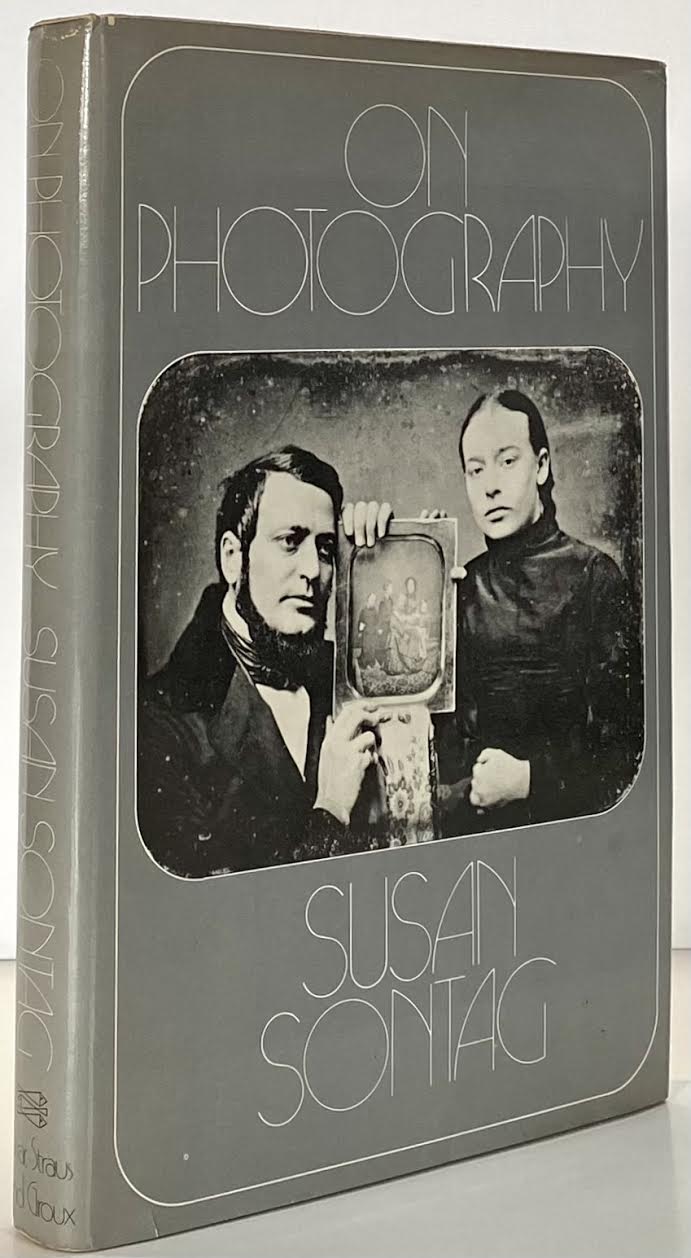
Hardcover. New York, Farrar, Straus and Giroux, 1st Edition, 1977, Book: Very Good, Dust Jacket: Very Good, 207 pages. Hardcover. Cover boards bound in dark gray cloth, gilt title on spine. Some light fading to covers at top and bottom of spine (shelfwear). Gray endpapers. Dust jacket price-clipped, some light tanning and chipping to edges of dj (see image). Pages clean and unmarked. Foreedge has some light spots of soil and a touch of tanning (see image). Binding tight. Spine straight. Sontag examines a wide range of problems, both aesthetic and moral, raised by the presence and authority of the photographed image in the lives of everyone today. Appendix "A Brief Anthology of Quotations" included.
Softcover. Bristol UK, Intellect, 1st, 2012, Book: Very Good, Dust Jacket: None, Softcover, 255 pages. With a focus on the settler societies of the United States and Australia, Photography and Landscape is a new critical account of landscape photography created through a unique collaboration between a photography writer and a landscape photographer. Beginning with the frontier days of the American West, the subsequent century-long popularity of landscape photography is exemplified by images from Carleton Watkins to Ansel Adams, the New Topographics to Richard Misrach, all of whose works are considered here. Along with discussions of other contemporary photographers, this extensively illustrated volume demonstrates the influence of settler societies on landscape photography, in which skilled photographers captured the fascination with and the appeal of the land and its expanse. Clean copy.
Hardcover. Boston, J. Paul Getty Museum, 1st, 2012, Book: Very Good, Dust Jacket: Very Good, 112 pages. Hardcover with dust jacket. Very clean, unmarked copy with only minor edgewear. Featuring eighty-seven photographs, all drawn from the collection of the J. Paul Getty Museum, that span nearly 150 years of image making.
Softcover. Duke University Press, 1st, 2017, Book: Very Good, Dust Jacket: None, Softcover, 381 pages, color and b&w illustrations. Photography is one of the principal filters through which we engage the world. The contributors to this volume focus on Walter Benjamin's concept of the optical unconscious to investigate how photography has shaped history, modernity, perception, lived experience, politics, race, and human agency. In essays that range from examinations of Benjamin's and Sigmund Freud's writings to the work of Kara Walker and Roland Barthes's famous Winter Garden photograph, the contributors explore what photography can teach us about the nature of the unconscious. They attend to side perceptions, develop latent images, discover things hidden in plain sight, focus on the disavowed, and perceive the slow. Of particular note are the ways race and colonialism have informed photography from its beginning. The volume also contains photographic portfolios by Zoe Leonard, Kelly Wood, and Kristan Horton, whose work speaks to the optical unconscious while demonstrating how photographs communicate on their own terms. The essays and portfolios in Photography and the Optical Unconscious create a collective and sustained assessment of Benjamin's influential concept, opening up new avenues for thinking about photography and the human psyche. Clean, bright copy.
Hardcover. Boston, J. Paul Getty Museum, 1st, 2011, Book: Very Good, Dust Jacket: Very Good, 112 pages. Hardcover with dust jacket. Very clean, unmarked copy still in publishers shrink-wrap. Photography as Fiction includes seventy-six color plates illustrating works from the J. Paul Getty Museum's collection that embrace theatricality and are unconcerned with documenting the world as it exists.
Softcover. NY/London, Routledge, reprint, 2007, Book: Very Good, Dust Jacket: None, Softcover, 470 pages. Forty of the world's most active art historians and theorists, including Victor Burgin, Joel Snyder, Rosalind Krauss, Alan Trachtenberg, Geoffrey Batchen, Carol Squiers, Margaret Iversen and Abigail Solomon-Godeau in animated debate on the nature of photography. Photography has been around for nearly two centuries, but we are no closer to understanding what it is. For some people, a photograph is an optically accurate impression of the world, for others, it is mainly a way of remembering people and places. Some view it as a sign of bourgeois life, a kind of addiction of the middle class, whilst others see it as a troublesome interloper that has confused people's ideas of reality and fine art to the point that they have difficulty even defining what a photograph is. For some, the whole question of finding photography's nature is itself misguided from the beginning. This provocative second volume in the Routledge The Art Seminar series presents not one but many answers to the question what makes a photograph a photograph? Clean copy.
Hardcover. NY, Rizzoli, 1st, 1996, Book: Very Good, Dust Jacket: Very Good, Hardcover, 208 pages. Pictorial photography is noted for its artistic expressiveness, careful design and composition, and muted focus. In 1914 Clarence White (1871-1925) left Alfred Stieglitz's Photo-Secession group, abandoned his ambitions to be a photographic illustrator, and opened the Manhatten-based Clarence H. White School of Photography. Lecturers at his school included Stieglitz, Paul Strand, and Edward Steichen. White's unique teaching skills, especially his encouragement of women students, nurtured the careers of such talented photographers as Margaret Bourke-White, Laura Gilpin, and Dorothea Lange. Presented by the Detroit Institute of Arts and the George Eastman House, this companion volume for a traveling exhibition contains the elegant photographic imagery of White and his students. The clear text by two photography curators imparts how the revered teacher's romantic pictorialism became the foundation for the student's avant-garde modernism. By far the most substantial review of White's work and influence in print.
Hardcover. US, Univ of New Mexico Press, 1st, 1995-10-01, Book: Very Good, Dust Jacket: Very Good, 227 pages. Minor edgewear to dust jacket, else a clean, tight copy. A in depth study of the exhibition held at the Museum of Modern Art in 1955, and its influence, with a final chapter on "Edward Steichen, Robert Frank and American Modernism".
Softcover. London/NY, I. B. Tauris & Company, 1st, 2003, Book: Very Good, Dust Jacket: None, Softcover, 354 pages, b&w illustrations. The advent of photography opened new worlds to 19th-century viewers, who became able to visualize themselves, their immediate surroundings, their communities, and the world beyond. The geographical imagination--the ability to know the world and situate oneself in space and time--fostered the expectations and applications of photographic technologies, and photographic technologies expresses the form and reach of the geographical imagination. This dialectic is the basis of this collection of intriguing essays, which explore the diverse ways in which the relationship manifested.
Hardcover. New York, Abbeville Press, 1st, 1991, Book: Very Good, Dust Jacket: Very Good, 279 pages, hardcover with dust jacket. B&w illustrations throughout. SIGNED BY AUTHOR on title page. Mild wear to dust jacket top edge. Light fading to top boards. Foxing and faint soiling to text block. A bright and tight copy.
Softcover. Germany, Steidl, 1st, 2015, Book: Very Good, Dust Jacket: None, 224 pages. Softcover. Very clean, unmarked copy still in publishers shrink-wrap. Adieu Saigon covers a varied range of imagery from Saigon, where Depardon photographed two wars and, on visits as recent as 2014, the unrecognizable, globalized city now called Ho Chi Minh. Depardon's work bears witness to a city in transition.
Softcover. Germany, Steidl, 1st, 2015, Book: Very Good, Dust Jacket: None, 224 pages. Softcover. Very clean, unmarked copy still in publishers shrink-wrap. Adieu Saigon covers a varied range of imagery from Saigon, where Depardon photographed two wars and, on visits as recent as 2014, the unrecognizable, globalized city now called Ho Chi Minh. Depardon's work bears witness to a city in transition.
Hardcover. New York, Thames and Hudson, 3rd Revised, 1988, Book: Very Good, Dust Jacket: Very Good, 285 pages. Hardcover with dust jacket. Minor yellowing to dust jacket edges and spine. Previous owners inscription in pen to top edge of front flyleaf. An otherwise very clean, unmarked copy with only minor edgewear. 206 photographs, 16 in color. Follows the developments in the art and science of photography from the invention of the wet-collodion process through the evolution of dry plates.
Hardcover. Germany, Steidl, 1st, 2010, Book: Very Good, Dust Jacket: None, 160 pages. Hardcover with no dust jacket. Very clean, unmarked copy still in publishers shrink-wrap. Over 100 black and white photographs. Tight copy.
Hardcover. Germany, Steidl, 1st, 2010, Book: Very Good, Dust Jacket: None, 160 pages. Hardcover with no dust jacket. Very clean, unmarked copy still in publishers shrink-wrap. Over 100 black and white photographs. Tight copy.
Hardcover. New York, Cambridge University Press, 1st US, 1989, Book: Very Good, Dust Jacket: Very Good, Hardcover in a bright dust jacket, 190 pages. Illustrated with black & white photographs. Clean, tight copy. The documentary style that dominates American photography had its origins in the social reform publicity campaigns of the turn of the century. This book traces the history of this genre and its main participants, including Jacob Riis, Lewis Hine, Walker Evans, Dorothea Lange, Ben Shahn, and Russell Lee. Clean copy.
Hardcover. Chicago, University of Chicago Press, 1st, 2010, Book: Very Good, Dust Jacket: Very Good, Hardcover in a bright dust jacket, 321 pages, b&w illustrations. In The Cruel Radiance, Susie Linfield challenges the idea that photographs of political violence exploit their subjects and pander to the voyeuristic tendencies of their viewers. Instead she argues passionately that looking at such images--and learning to see the people in them--is an ethically and politically necessary act that connects us to our modern history of violence and probes the human capacity for cruelty. Grappling with critics from Walter Benjamin and Bertolt Brecht to Susan Sontag and the postmoderns--and analyzing photographs from such events as the Holocaust, China's Cultural Revolution, and recent terrorist acts--Linfield explores the complex connection between photojournalism and the rise of human rights ideals. In the book's concluding section, she examines the indispensable work of Robert Capa, James Nachtwey, and Gilles Peress and asks how photography should respond to the increasingly nihilistic trajectory of modern warfare. Clean copy.
Hardcover. NY, Abrams, 1st, 2008, Book: Very Good, Dust Jacket: Very Good, Hardcover, 300 pages. In this lavishly produced volume, journalist Gaudriault accompanies photographer Rancinan to Africa, Asia, Europe and the United States to interview 23 masters of contemporary photography, paying homage to fashion photographers and photojournalists, traditional chroniclers of their times and conceptual artists. Rancinan's photographs record each encounter in portraits that encapsulate each subject's relationship with his shared discipline. Readers follow paparazzo Ron Galella fending off the camera; Martin Parr, the sardonic chronicler of middle-class British life, having tea in a cafe; Rankin, the creator of the hip magazine Dazed and Confused, hopping into a trashcan filled with his own cast-off images. Gaudriault's short essays quote liberally from her interviews and provide both biographical information and incisive commentary. Several of the older photographers strike an elegiac tone and confess to finding themselves at the end of the eras that gave birth to their visions, but optimism reigns among younger practitioners: David LaChapelle is reinventing himself in Hawaii; Rankin is bearing witness to an age that is still young; and Oliviero Toscani, the radical combination of journalist and marketer behind the Benetton campaigns, describes billboards as the church frescoes of today.
Softcover. NY, Museum of Modern Art, reprint, 2007, Book: Very Good, Dust Jacket: None, Softcover, 156 pages. A guide to the mediums visual language through works by such early masters as Atget, Cartier-Bresson, Evans, Strand and Weston. It contains 172 illustrations that reveal the range of the photograph from the early days of the mediums development to the mid-1960s.
Softcover. Albuquerque, University Of New Mexico Press, 1st pbk, 1987, Book: Very Good, Dust Jacket: None, Softcover, 285 pages, b&w and color illustrations. Nineteen essays on various issues in photography; includes essays about Photographers at War, Robert Doisneau, Helen Levitt, William Klein, Atget, and more. Clean copy.
Hardcover. Philadelphia, PA, Philadelphia Museum of Art, 1st, 2001, Book: Very Good, Dust Jacket: Very Good, 488 pages. Hardcover with dust jacket. Very clean, unmarked copy still in publishers shrink-wrap. Lavishly illustrated with more than 250 of Eakins's most significant paintings, watercolors, drawings, photographs, and sculpture, the book features essays by prominent scholars who place his art in the context of the history and culture of late nineteenth-century Philadelphia, where he lived.
Hardcover. New Haven, CT, Yale University Press, 1st, 2014, Book: Very Good, Dust Jacket: Very Good, 232 pages. Hardcover with dust jacket. Very clean, unmarked copy still in shrink wrap. Black & white and color photographs throughout. City scenes have been chronicled in photographs since the early 1800s, but street photography as traditionally defined has captured a relatively narrow field of these images. Revolutionizing the history of street photography, Unfamiliar Streets explores the work of Richard Avedon (1923-2004), Charles Moore (1931-2010), Martha Rosler (b. 1943), and Philip-Lorca diCorcia (b. 1951), four American photographers whose careers in fashion, photojournalism, conceptual art, and contemporary art are not usually associated with the genre. Bussard's lively and engaging text, a timely response to a growing interest in urban photography, challenges the traditional understanding of street photography and makes original and important connections among urban culture, social history, and the visual arts, constructing a new historical model for understanding street photography. Illustrated with more than one hundred images, this book provides an interpretation of a compelling genre that is as fresh as its consideration of the city streets themselves, sites of commerce, dispossession, desire, demonstration, power, and spectacle.
Softcover. London, Afterall Books, 1st, 2019, Book: Very Good, Dust Jacket: None, Softcover, 88 pages. Illustrated with b&w and color plates. Kitchen Corner, Tenant Farmhouse, Hale County, Alabama shows a painstakingly clean-swept corner in the house of an Alabama sharecropper. Taken in 1936 by Walker Evans as part of his work for the Farm Security Administration, Kitchen Corner was not published until 1960, when it was included in a new edition of Walker Evans and James Agee's classic Let Us Now Praise Famous Men. The 1960 reissue of Evans and Agee's book had an enormous impact on Americans' perceptions of the Depression, creating a memory-image retrospectively through Walker's iconic photographs and Agee's text. In this latest addition to the Afterall One Work series, photographer Olivier Richon examines Kitchen Corner. The photograph is particularly significant, he argues, because it uses a documentary form that privileges detachment, calling attention to overlooked objects and to the architecture of the dispossessed.

 "Nancy Newhall A Literacy of Imagesby: Klochko, Deborah")
 "On Photographyby: Sontag, Susan")
 "Photography and Landscapeby: Rod Giblett, Juha Tolonen")
 "Photography and Playby: Garcia, Erin C.")
 "Photography and the Optical Unconscious by: Smith, Shawn Michelle, Sliwinski, Sharon (Editors)")
 "Photography as Fictionby: Garcia, Erin C.")
 "Photography Theoryby: James Elkins")
 "Pictorialism into Modernism: The Clarence H. White School of Photographyby: Marianne Fulton")
 "Picturing an Exhibition: The Family of Man and 1950s Americaby: Sandeen, Eric J.")
 "Picturing Place: Photography and the Geographical Imagination by: Joan M. Schwartz / James R. Ryan")
 "Power of Photography, The: How Photographs Changed Our Lives (SIGNED COPY)by: Goldberg, Vicki")
 "Raymond Depardon: Adieu Saigonby: Depardon, Raymond")
 "Raymond Depardon: Adieu Saigonby: Depardon, Raymond")
 "Rise of Photography, The: 1850-1880 by: Gernsheim, Helmut")
 "Robert Doisneau: From Craft to Artby: ChEvrier, Jean-FranAois")
 "Robert Doisneau: From Craft to Artby: ChEvrier, Jean-FranAois")
 "Symbols of Ideal Life - Social Documentary Photography in America 1890 - 1950by: Stange, Maren")
 "The Cruel Radiance: Photography and Political Violenceby: Linfield, Susie")
 "The Photographer by: Gerard Rancinan and Caroline Gaudriault")
 "The Photographer's Eyeby: John Szarkowski")
 "The Privileged Eye: Essays on Photographyby: Kozloff, Max")
 "Thomas Eakinsby: Eakins, Thomas")
 "Unfamiliar Streets: The Photographs of Richard Avedon, Charles Moore, Martha Rosler, and Philip-Lorca DiCorciaby: Bussard, Katherine A.")
 "Walker Evans: Kitchen Corner by: Olivier Richon")