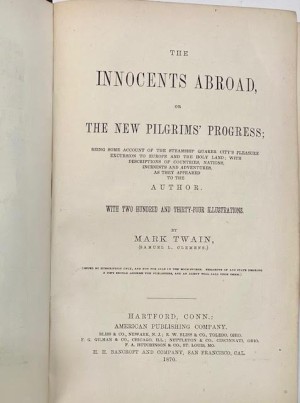
Hardcover. Hartford, CT, American Publishing Company, 1st Edition, 1870, Book: Good, Dust Jacket: None, 651 pages plus publisher's ads. Hardcover. Front and back hinges cracked, binding tight otherwise. Frontispieces with tissue guard. Tanning to edges. Pages clean with just a touch of tanning. Spine straight. Cover boards bound in black cloth, gilt title on spine and design on front cover board. Borders and decoration blind-stamped to front and back cover boards. Some agewear to boards: fraying/chipping at top and bottom of spine and corners, rubbing. "Being some account of the steamship Quaker City's pleasure excursion to Europe and the Holy Land; with descriptions of countries, nations, incidents and adventures, as they appeared to the author." Perfect for any collector's bookshelf.
Hardcover. US, Taschen, 1st, 2011, Book: Very Good, Dust Jacket: Very Good, Like new in publishers shrink-wrap. Hardcover, 239 pages, color illustrations. A pictorial journey through Havana with author Julio Perez Hernandez, a professor of Architecture in Havana, & lavish photographs by Gianni Basso.
Softcover. Durham NC, Duke University Press, 5th pr., 1999, Book: Very Good, Dust Jacket: None, Softcover, 250 pages, b&w illustrations. This entertaining and playful book views Disney World as much more than the site of an ideal family vacation. Blending personal meditations, interviews, photographs, and cultural analysis, Inside the Mouse looks at Disney World's architecture and design, its consumer practices, and its use of Disney characters and themes. This book takes the reader on an alternative ride through "the happiest place on earth" while asking "What makes this forty-three-square-mile theme park the quintessential embodiment of American leisure?" Turning away from the programmed entertainment that Disney presents, the authors take a peek behind the scenes of everyday experience at Disney World. In their consideration of the park as both private corporate enterprise and public urban environment, the authors focus on questions concerning the production and consumption of leisure. Featuring over fifty photographs and interviews with workers that strip "cast members" of their cartoon costumes, this captivating work illustrates the high-pressure dynamics of the typical family vacation as well as a tour of Disney World that looks beyond the controlled facade of themed attractions. Clean copy.
Hardcover. New York, Riverside Book Company, Inc., 1st Edition, 2008, Book: Very Good, Dust Jacket: Very Good, 111 pages. Hardcover. INSCRIBED BY AUTHOR. Dust jacket unclipped, has two small tears at fop of front cover (see image). Gray cover boards, gilt title on spine. Pages clean and bright. Binding tight. Spine straight.
Hardcover. Chapel Hill NC, University of North Carolina Press, 1st, 2001, Book: Very Good, Dust Jacket: Very Good, Hardcover in a bright dust jacket. 277 pages, illustrated in b&w and color. The putto (often portrayed as a mischievous baby) appears frequently in the art and literature of Renaissance Italy. The "spiritelli" embody a minor species of demon, neither good nor bad. This book discusses the manifestations of the putto-spiritello in 15th-century art and literature. It offers parallel interpretations of two works: Botticelli's "Mars and Venus", a painting in which infant Satyr-putti appear as the panic-inducing spirits of the nightmare, and Politian's "Stanze", a poem in which masked cupids appear to the hero in a deceiving dream. The text concludes with an examination of the functions of such masks in the poetry and public masquerades sponsored by Lorenzo de'Medici and in Michelangelo's scheme for the decoration of the Medici Chapel. Clean copy.
Hardcover. NY, Knopf, 1st, 1976, Book: Very Good, Dust Jacket: Very Good, Hardcover in a bright dust jacket, 360 pages. Published in association with the American Heritage Publishing Co. Text by Bernard Lewis, Richard Ettinghausen, Oleg Grabar, Fritz Meier, Charles Pellat, A. Shiloah, A.I. Sabra, Edmund Bosworth, Emilio Garcia Gomex, Roger M. Savory, Norman Itzkowitz, S.A.A. Rizvi, Elie Kedourie. Illustrated with 495 reproductions, photographs, drawings, and maps, 160 of them in full color.
Hardcover. London, Faber and Faber, Reprint, 1967, Book: Very Good, Dust Jacket: None, Hardcover. Orange cloth covers with gilt titles to spine. 93 pages of text followed by 613 monochrome plates, non-paginated. Frontis illustration, Tabriz, Tilework in the Courtyard of the So-called Blue Mosque, A. D. 1465, in full page, full color. Toning to edges. Clean, unmarked. A nice copy.
Hardcover. London, England, Oxford University Press, Reprint, 1953, Book: Very Good, Dust Jacket: None, 788 pages. Hardcover. Vol. III & IV only. Previous owner's name stamped on contents page and front endpapers. Green cloth cover boards, gilt title on spine, spine very faded (see image). Pages and edges have a touch of tanning. Edges have a specked design. v. 3. Holiness and its upholders -- v. 4. The renewal and the source of holiness. DOMESTIC SHIPPING ONLY.
Hardcover. Atglen PA, Schiffer, 1st, 2012, Book: Very Good, Dust Jacket: Very Good, Hardcover, 216 pages, color photographs by Janes. What is burlesque? Who better to ask than burlesque performers themselves? With this question in mind, the author traveled over 14,000 miles across the United States visiting today's burlesque performers, photographing them in their homes, and asking them: "What does burlesque mean to you?" Their answers and 104 accompanying portraits may surprise you. For these performers, burlesque is so many things, including fun and empowerment on stage, an escape from life's doldrums, a fantasy, a career. This book also presents a study in contrasts between the public persona of each performer and that performer's private life.
Hardcover. New York , Watson Guptill, 1st, 1974, Book: Very Good, Dust Jacket: Very Good, Hardcover, 208 pages illustrated throughout with 175 b&w illustrations and 70 plates in full color. Clean, unmarked copy with only minor edgewear to dust jacket.
Hardcover. New York , Watson Guptill, 1st, 1974, Book: Very Good, Dust Jacket: Good, Hardcover, 208 pages illustrated throughout with 175 b&w illustrations and 70 plates in full color. Clean, unmarked copy with minor closed tears to dust jacket.
Hardcover. New York , Watson Guptill, 1st, 1974, Book: Very Good, Dust Jacket: Very Good, Hardcover, 208 pages illustrated throughout with 175 b&w illustrations and 70 plates in full color. Clean, unmarked copy with only minor edgewear to dust jacket.
Hardcover. Boston, American Unitarian Association, 1st, nd, Book: Very Good, Dust Jacket: None, 225 pages. Hardcover. No date of publication. Ex-library copy with bookplate on inside front cover and label at bottom of spine. Top edge gilt. Black & white photographs. Light wear. Clean, unmarked text.
Hardcover. Cambridge UK, Cambridge University Press, 1st, 2006, Book: Very Good, Dust Jacket: Very Good, Hardcover in a bright dust jacket, 767 pages. 'This book is a major new intellectual and cultural history of intolerance and toleration in early modern and early Enlightenment Europe. John Marshall offers an extensive study of late seventeenth-century practices of religious intolerance and toleration in England, Ireland, France, Piedmont and the Netherlands and of the arguments which John Locke and his associates made in defence of 'universal religious toleration'. He analyses early modern and early Enlightenment discussions of toleration; debates over toleration for Jews and Muslims as well as for Christians; the limits of toleration for the intolerant, atheists, 'libertines' and 'sodomites'; and the complex relationships between intolerance and resistance theories including Locke's own Treatises. This study is a significant contribution to the history of the 'republic of letters' of the 1680s and the development of early Enlightenment culture and will be essential reading for scholars of early modern European history, religion, political science, and philosophy.' Clean copy.
Hardcover. London, Oxford University Press, reprint, 2011, Book: Very Good, Dust Jacket: None, Two volume set complete, glossy boards, 977 pages in total. Professor Toomer's two-volume set is not only an indispensable reference work but also provides the first thorough treatment of the scholarship of John Selden, acknowledged as the most learned man of 17th-century England. All of his numerous published works, especially in the fields of history, law, and Hebraica, are critically examined and described in detail. The narrative also relates his writings to contemporary events, in the Civil War and the parliaments (including the Long Parliament) in which he played a prominent part, and to the work of other scholars in Europe (notably Scaliger and Grotius) and in Britain (including Camden and Ussher). Selden's involvement with the Universities, the support of libraries, and the promotion of scholarship is discussed. The work will be an essential resource, not only for the life of a major figure of his time, but also for the intellectual history of 17th-century England in general. No djs as issued, like new.
Softcover. Bowling Green OH, Journal of Popular Culture, 1st, 1977, Book: Very Good, Dust Jacket: None, Softcover, pages 701-909. Articles include: Philip Gordon on Ayn Rand. Louis F. Helbig on Struwwelpeter: an inquiry into the effects of violence in children's literature. French folk songs. D. L. Ashliman on the American Indian in German Travel Narratives and Literature. Clean.
Softcover. Bowling Green OH, Journal of Popular Culture, 1st, 1976, Book: Very Good, Dust Jacket: None, Softcover, pages 1-258. Articles include: The tragedy of Bert Williams, mystery writer John D. MacDonald, Edward R. Murrow's WW2 radio broadcasts, the dance marathon craze, Spider-Man - Superhero in the Liberal Tradition, others. Clean.
Softcover. Canberra AU, Australian Institute of Aboriginal Studies, 1st, 1984, Book: Very Good, Dust Jacket: None, Softcover, oblong, 160 pages. Details an Australian film made in 1976 and released in 1979. The traditional, extremely complex mortuary rites for a young child at an Aboriginal homeland settlement on the Gulf of Carpentaria. Foreword by Ian Dunlop. Previous owner's name opposite half-title page, otherwise clean.
Hardcover. Israel, Yeshivat Kol Yehuda, Reprint, 1970, Book: Very Good, Dust Jacket: Very Good, 264 pages. Hardcover. Black & white illustrations. Dust jacket with light wear along edges. Clean, unmarked pages.
Hardcover. San Francisco, Fraenkel Gallery, 1st, 2014, Book: Very Good, Dust Jacket: None, 160 pages. Two volumes in slipcase. Very clean, like new in publishers shrink-wrap. The result of three years of work in California's Central Valley, Katy Grannan's new series The 99 features large-scale color portraits and black-and-white photographs. Grannan's recent photographs are set in the parched landscape and forgotten towns along Highway 99, including Modesto, Fresno and Bakersfield. In her intensely vivid color portraits, the artist works at midday when the sun is direct and the heat is unrelenting, presenting each individual, often simultaneously heroic and vulnerable, against stark, white backgrounds. In the black-and-white photographs, many of her subjects re-appear on Modesto's South 9th Street and along the banks of the Tuolumne River. Everyday rituals, small interactions and moments of beauty on the fringes of society are depicted in detail, conferring significance to what is often overlooked. This large-format, two-volume, slipcased monograph gathers this series for the first time.
Hardcover. San Francisco, Fraenkel Gallery, 1st, 2014, Book: Very Good, Dust Jacket: None, 160 pages. Two volumes in slipcase. Both very clean, unmarked copies. Only minor edgwear to slipcase. The result of three years of work in California's Central Valley, Katy Grannan's new series The 99 features large-scale color portraits and black-and-white photographs. Grannan's recent photographs are set in the parched landscape and forgotten towns along Highway 99, including Modesto, Fresno and Bakersfield. In her intensely vivid color portraits, the artist works at midday when the sun is direct and the heat is unrelenting, presenting each individual, often simultaneously heroic and vulnerable, against stark, white backgrounds. In the black-and-white photographs, many of her subjects re-appear on Modesto's South 9th Street and along the banks of the Tuolumne River. Everyday rituals, small interactions and moments of beauty on the fringes of society are depicted in detail, conferring significance to what is often overlooked. This large-format, two-volume, slipcased monograph gathers this series for the first time.
Hardcover. Princeton NJ, Princeton University Press, 1st, 1992, Book: Very Good, Dust Jacket: Very Good, Hardcover in a bright dust jacket, 281 pages, b&w illustrations. "For, Lo! We live in an Iron Age--In the age of Steam and Fire!" wrote a poet mesmerized by the engines that were transforming American transportation, agriculture, and industry during his lifetime. Indeed, by the nineteenth century fire had become America's leitmotif--for good and for ill. "Keeping the flame" was deadly serious: even the slightest lapse of attention could convert a fire from friendly ally to ravaging destroyer. To examine the cultural context of fire in "combustible America," Margaret Hazen and Robert Hazen gather more than a hundred illustrations, most never before published, together with anecdotes and information from hundreds of original sources, including newspapers, diaries, company records, popular fiction, art, and music. What results is an immensely entertaining and encyclopedic history that ranges from stories of the tragic "great fires" of the century to fire imagery in folktales and popular literature. Dealing more with technology than with fire in nature, the book provides a vast amount of information on fire manipulation and prevention in urban life. Hazen and Hazen discuss the people who worked with fire--or against it. Founders, gaffers, blacksmiths, boilers at saltworks, and housewives knew how to "read" a fire and employ it for their purposes. A few dedicated investigators inquired about the scientific nature of heat and flame. And firefighters gradually progressed from "bucket brigades" to "using fire to fight fire" with the newly invented steam engine. The colorful stories of these Americans--the risks they took and the rewards they received--will fascinate not only social historians but also a broad audience of general readers. Clean copy.
Hardcover. New York, Random House, 1st US, 1998, Book: Very Good, Dust Jacket: Very Good, 638 pages. Hardcover. Illustrated with black & white photographs. Minor rubbing to surface of dust jacket. Clean, tight copy.

 "Innocents Abroad, The: or the New Pilgrims' Progressby: Twain, Mark (Samuel Clemens)")

 "Inside Havanaby: Hernandez, Julio Caesar Perez")
 "Inside The Mouse: Work and Play at Disney World by: The Project on Disney")
 "Intimate Eye, The: Portraits by Bernard Godfryd (INSCRIBED BY AUTHOR)by: Gotfryd, Bernard")


 "Inventing the Renaissance Puttoby: Dempsey, Charles")
 "Islam and the Arab World: Faith, People, Culture by: Bernard Lewis (Ed.)")
 "Islamic Architecture and its Decoration - A. D. 800 - 1500by: Hill, Derek")


 "Israel: Its Life and Culture Vol III - IVby: Pedersen, Johs.")


 "It's All That Glitters: Portraits of Burlesque Performers in Their Homesby: Janes, Brian C.")
 "James Montgomery Flaggby: Meyer, Susan E.")
 "James Montgomery Flaggby: Meyer, Susan E.")
 "James Montgomery Flaggby: Meyer, Susan E.")
 "Jasper Douthit's Story - The Autobiography of a Pioneerby: Douthit's, Jasper")


 "John Locke, Toleration and Early Enlightenment Culture (Cambridge Studies in Early Modern British History)by: Marshall, John")
 "John Selden: A Life in Scholarship (Two Volumes)by: Toomer, G. J.")
 "JOURNAL OF POPULAR CULTURE Volume X Spring 1977 No. 4by: Ray B. Browne (Ed.)")
 "JOURNAL OF POPULAR CULTURE: Volume X Summer 1976 No. 1 by: Ray B. Browne (Ed.)")
 "Journey to the Crocodile's Nest. an Accompanying Monograph to the Film Madarrpa Funeral at Gurka'Wuyby: Morphy, Howard")
 "Juxtapoz Magazine: Spring 2018, # 205: Featuring Ines Longevial; Julian Schnabel; Theresa Chromatiby: N/A")
 "Kabbalah - The Light of Redemptionby: Krakovsky, Rabbi Levi Isaac")
 "Katy Grannan: The Ninety Nine and The Nineby: Grannan, Katy (Photographer)")
 "Katy Grannan: The Ninety Nine and The Nineby: Grannan, Katy (Photographer)")
 "Keepers of the Flame: The Role of Fire in American Culture, 1775-1925by: Margaret Hindle and Robert M Hazen")
 "Kenneth Tynan - Lettersby: Tynan, Kenneth/Kathleen Tynan (Editor)")