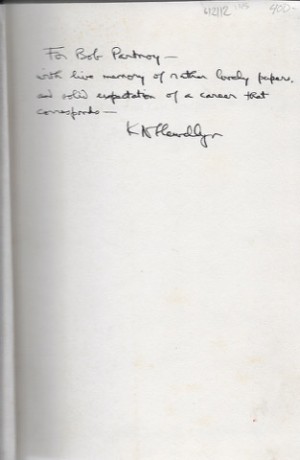
Hardcover. Boston, Little, Brown and Company, 1st, 1960, Book: Very Good, Dust Jacket: Good, 565 pages. Hardcover. INSCRIBED BY KARL LLEWELLYN ON FRONT ENDPAPER. Light foxing to edges, endpapers. Dust jacket with moderate wear, now protected with clear plastic cover. Clean, unmarked text.
Softcover. Stanford CA, Stanford University Press, 3rd pr., 1999, Book: Very Good, Dust Jacket: None, Softcover, 493 pages. This book is about ending guerrilla conflicts in Latin America through political means. It is about peace processes, aimed at securing an end to military hostilities in the context of agreements that touch on some of the principal political, economic, social, and ethnic imbalances that led to conflict in the first place. The book presents a carefully structured comparative analysis of six Latin American countries--Nicaragua, El Salvador, Guatemala, Mexico, Colombia, and Peru--which experienced guerrilla warfare that outlasted the end of the Cold War. The book explores in detail the unique constellation of national and international events that allowed some wars to end in negotiated settlement, one to end in virtual defeat of the insurgents, and the others to rage on. The aim of the book is to identify the variables that contribute to the success or failure of a peace dialogue. Clean copy.
Hardcover. New York, Dodd, Mead and Company, 1st Edition, 1920, Book: Good, Dust Jacket: None, 370 pages. Hardcover. Green cloth covers with gilt titles to cover & spine. Fraying, scuffing to edges. Light sunfade to spine. As is, with light pencil marking throughout. Cracked rear hinge.
Hardcover. NY, Museum of Modern Art, 1st, 1966, Book: Very Good, Dust Jacket: Good, Hardcover in a lightly soiled, edgeworn dust jacket with $4.95 on flap, 135 pages. Translated into 16 languages, this remarkable book has become an essential document of architectural literature. A "gentle manifesto for a nonstraightforward architecture," Venturi's Complexity and Contradiction in Architecture expresses in the most compelling and original terms the postmodern rebellion against the purism of modernism. Three hundred and fifty architectural illustrations serve as historical comparisons and illuminate the author's ideas on creating and experiencing architecture. Complexity and Contradiction in Architecture was the winner of the Classic Book Award at the AIA's Seventh Annual International Architecture Book Awards. Robert Charles Venturi Jr. (June 25, 1925-September 18, 2018) was an American architect, founding principal of the firm Venturi, Scott Brown and Associates. Together with his wife and partner, Denise Scott Brown, he helped shape the way that architects, planners and students experience and think about architecture and the built environment. Foreword by Arthur Drexler. Introduction by Vincent Scully. No markings.
Hardcover. Atglen, PA, Schiffer Publishing Ltd., 1st, 2011, Book: Very Good, Dust Jacket: Very Good, 239 pages. Hardcover with dust jacket. A very clean, unmarked copy with only minor wear to dust jacket edges. Black and white photographs throughout.
Hardcover. Kent, OH, The Kent State University Press, 1st, 1998, Book: Very Good, Dust Jacket: Very Good, 348 pages. Hardcover with dust jacket. Very clean, unmarked copy still in publishers shrink-wrap. Conrad Wise Chapman (1842-1910) is unique among Civil War artists: he painted and sketched while on duty as a Confederate soldier who served in three theaters of the war. Chapman's first-hand knowledge is evident in his work. Ben Bassham has written both a critical study of Chapman's art and a biography, incorporating Chapman's correspondence and Civil War memoirs.
Hardcover. NY, Da Capo Press, reprint, 1969, Book: Very Good, Dust Jacket: None, Maroon boards, [vi] 270 pages, no illustrations. Series: Library of American Art. This is the 1969 Da Capo reprint of the 1895 original; made possible by the Kennedy Galleries. This version is an unabridged republication of the first edition. No dust jacket, as issued. Light wear to lower edges and spine, overall a very clean, tight copy.
Softcover. NY, Basic Books, reprint, 2007, Book: Very Good, Dust Jacket: None, Softcover, 359 pages. Stanley Crouch-MacArthur "genius" award recipient, co-founder of Jazz at Lincoln Center, National Book Award nominee, and perennial bull in the china shop of black intelligentsia- has been writing about jazz and jazz artists for over thirty years. His reputation for controversy is exceeded only by a universal respect for his intellect and passion. As Gary Giddons notes: "Stanley may be the only jazz writer out there with the kind of rhinoceros hide necessary to provoke and outrage and then withstand the fulminations that come back." Now, in a long-awaited collection, Crouch collects fifteen of his most influential, and most controversial pieces (published in Jazz Times, The New Yorker, the Village Voice, and elsewhere), and includes two new essays as well. The pieces range from the introspective "Jazz Criticism and its Effect on the Art Form" to a rollicking debate with Amiri Baraka, to vivid, intimate portraits of the legendary performers Crouch has known. The first, autobiographical essay reflects on his life in jazz as a drummer, a promoter, a critic, and most of all a lover of this quintessentially American art form. And the closing essay, about a young Italian saxophonist, expresses undaunted optimism for the worldwide vibrancy of jazz.Throughout, Crouch's work reminds us not only of why he is one of the world's most important living jazz critics, but also of why jazz itself remains, against all odds, an elemental component of our cultural identity. Clean, bright copy.
Hardcover. NY, Alfred A. Knopf, 1st, 1985, Book: Very Good, Dust Jacket: Very Good, Hardcover in a lightly worn, price-clipped dust jacket with short closed tears. 14 original and thoughtful interviews - Burroughs discusses Paris in the 50s, the Olympia Press and the issue of obscenity, Norman Mailer on the Jack Abbott issue, Paul Theroux on Americans abroad, Scott Spencer on the experience of having a movie made from his book 'Endless Love' and more. Biographical information and photographs of each author. 324 pages. Clean copy.
Hardcover. Jackson MS, University of Mississippi, 1st, 1987, Hardcover in a bright dust jacket, 178 pages. Gathers interviews with the Tennessee short story writer in which he discusses his career, writing, character development themes, settings, and growing older. Clean copy.
Softcover. University Press of Mississippi, 1st, 1995, Book: Very Good, Dust Jacket: None, Softcover, 320 pages. Here is a collection of interviews that cover the period from 1967 through 1993. Many are translations of interviews that originally appeared in French, German, Italian, Polish, Spanish, or Swedish periodicals. Several are published here for the first time in any language. Giving attention to Sontag's education and the development of her aesthetic and moral temperament, they cover Sontag's rich career as a distinguished writer, filmmaker, dramatist, and cultural critic. Clean, bright copy.
Hardcover. NY, Rodale Books , 1st, Book: Very Good, Dust Jacket: Very Good, Hardcover in a bright, unclipped dust jacket. Robert Hilburn's storied career as a rock critic has allowed him a behind-the-scenes look at the lives of some of the most iconic figures of our time. He was the only music critic to visit Folsom Prison with Johnny Cash. He met John Lennon during his lost weekend period in Los Angeles and they became friends. Bob Dylan granted him his only interviews during his "born-again" period and the occasion of his 50th birthday. Michael Jackson invited Hilburn to watch cartoons with him in his bedroom. When Springsteen took to playing only old hits, Hilburn scolded him for turning his legendary concerts into oldies revues, and Springsteen changed his set list. In this totally unique account of the symbiotic relationship between critic and musical artist, Hilburn reflects on the ways in which he has changed and been changed by the subjects he's covered; Bono weighs in with an introduction about how Hilburn's criticism influenced and altered his own development as a musician.
Hardcover. NY, Harper & Bros., 1st US, 1940, Book: Very Good, Dust Jacket: None, Hardcover. Black & white photos by Bryan & Norman Westwood. Previous owner's signature on front end paper.
Hardcover. NY, Harcourt, Brace & Co., 1st, 1920, Book: Very Good, Dust Jacket: None, Hardcover. 302 pages. Previous owner's signature on front endpaper. Light pencil marginalia to last page. Browning to front endpapers. Red cloth binding with black lettering.
Hardcover. NY, Farrar, Straus and Giroux, 1st, 1996, Book: Very Good, Dust Jacket: Very Good, Hardcover in a bright dust jacket, 54 pages. Seamus Heaney's Nobel Lecture, captured here in Crediting Poetry, is a powerful defense of poetry as "the ship and the anchor" of our spirit within an ocean of violent, divisive politics and "world-sorrow." Beginning with the "creaturely existence" of his childhood in a thatched farmstead in rural County Derry, Heaney traces his path in "the wideness of language." It is a way forged by listening: to the "burbles and squeaks" of BBC and Radio Eireann from a wireless speaker, to the triple-rhyme in a line of Yeats', but also to the sound of gunfire in Ulster and the keening desolation of all the "wounded spots on the face of the earth." Out of all these sounds Heaney discovers the necessity of poetic order: "an order where we can at last grow up to that which we stored up as we grew." Clean copy.
Hardcover. NY, Horn Book, 1st, 1977, Book: Very Good, Dust Jacket: Very Good, Hardcover in a lightly worn dust jacket, 359 pages. Using as a framework his two essays "Out on a Limb with the Critics" and "Coming to Terms with Criticism," Paul Heins has selected contributions which expand and elucidate "the invariable questions that beset the criticism of children's books: the classification, defense, and evaluation of children's literature." Included is the controversial exchange between Eleanor Cameron and Roald Dahl on the validity of the child as critic; Jane Langton's perceptive and original discussion of the fine distinction between fantasy and reality in literature; Alvin Schwartz's remarks on folklore and humor; Mary Orvig's consideration of Swedish books in translation; and treatments of individual titles such as Watership Down, Tom Sawyer, and A Wizard of Earthsea. Name and stamp on front fly leaf, otherwise clean.
Softcover. Durham NC, Duke University Press, 1st, 1993, Book: Very Good, Dust Jacket: None, Softcover, 672 pages. Pointing to a glaring blind spot in the basic premises of the study of American culture, leading critics and theorists in cultural studies, history, anthropology, and literature reveal the "denial of empire" at the heart of American Studies. Challenging traditional definitions and periodizations of imperialism, this volume shows how international relations reciprocally shape a dominant imperial culture at home and how imperial relations are enacted and contested within the United States.Drawing on a broad range of interpretive practices, these essays range across American history, from European representations of the New World to the mass media spectacle of the Persian Gulf War. The volume breaks down the boundary between the study of foreign relations and American culture to examine imperialism as an internal process of cultural appropriation and as an external struggle over international power. Clean copy.
Softcover. Durham NC, Duke University Press, 1st, 1993, Book: Very Good, Dust Jacket: None, Softcover, pages. Cultures of United States Imperialism represents a major paradigm shift that will remap the field of American Studies. Pointing to a glaring blind spot in the basic premises of the study of American culture, leading critics and theorists in cultural studies, history, anthropology, and literature reveal the "denial of empire" at the heart of American Studies. Challenging traditional definitions and periodizations of imperialism, this volume shows how international relations reciprocally shape a dominant imperial culture at home and how imperial relations are enacted and contested within the United States. Light shelf wear.
Softcover. Minneapolis, MN, Zenith Press, 1st, 2004, Book: Very Good, Dust Jacket: None, 144 pages. Softcover. Very clean, unmarked copy still in publishers shrink-wrap. The Marines of Operation Iraqi Freedom highlights the human side of war, the day-in-the-life of U.S. Marines stationed in that volatile region. Dramatic, harrowing, and simply unbelievable images of the marines of Operation Iraqi Freedom, personal letters, and stories of coping with the pain of separation from their families and the horrors of war. Russ Bryant's photography chronicles every aspect of the daily lives of these marines: lazy camels amble by a cargo drop; blinding sandstorms threaten to blow away tents, supplies, and marines alike; Scud missile attack sirens send marines scuttling to their bunkers; sniper fire crisscrosses marine convoys moving into Iraq; tanks and bombs topple the portraits of Saddam that seem to loom over every Iraqi village; shelled-out tanks, armored vehicles, and even busses litter the road on the way to Baghdad; medical personnel attend to fallen marines and prisoners alike; the occasional silent interlude allows time for prayer and remembrance.
Hardcover. Los Angeles, Rare Bird Books, 1st, 2022, Book: Very Good, Dust Jacket: Very Good, Hardcover in a bright, unclipped dust jacket, 312 pages. The highlight of Desolation Peak is the journal Kerouac kept, starkly revealing the depth of his poverty, the extremity of his mood swings, and the ongoing arguments with himself over the future direction of his life, his writing, and faith. Along with the journal, he worked on a series of projects, including "Ozone Park," another installment of the Duluoz Legend beginning in 1943, after his discharge from the Navy; "The Martin Family," an intended sequel to The Town and the City, and "Desolation Adventure," a series of sketches that became part 1 of Desolation Angels. In writing it, Kerouac was re-committing himself to his more experimental, then-unpublishable style, declaring in the journal that "the form of the future is no-form." Also included in Collected Writings is "The Diamondcutter of Perfect Knowing," Kerouac's "transliteration" of the Diamond Sutra, his "Desolation Blues" and "Desolation Pops" poems, and assorted prose sketches and dreams. Clean copy.
Hardcover. New York, Metropolitan Museum of Art, 1st, 2016, Book: Very Good, Dust Jacket: None, 272 pages. Hardcover with no dust jacket. Very clean, unmarked copy still in shrink wrap. Over 100 of Diane Arbus' early photographs in black and white. Tight copy. Diane Arbus (1923-1971) is one of the most distinctive and provocative artists of the twentieth century. Her photographs of children and eccentrics, couples and circus performers, female impersonators and nudists, are among the most recognizable images of our time. This book is the definitive study of the artist's first seven years of work, from 1956 to 1962. Drawn primarily from the rich holdings of the Metropolitan Museum's Diane Arbus Archive--a remarkable treasury of photographs, negatives, appointment books, notebooks, and correspondence--it is an essential contribution to our understanding of Arbus and her oeuvre.

 "Common Law Tradition: Deciding Appeals (SIGNED COPY)by: Llewellyn, Karl N.")

 "Comparative Peace Processes in Latin America by: Arnson Cynthia J. (Ed.)")
 "Complex Vision, The by: Powys, John Cowper")


 "Complexity and Contradiction in Architecture by: Robert Venturi")
 "Coney Island: 40 Yearsby: Stein, Harvey")
 "Conrad Wise Chapman: Artist and Solider of the Confederacyby: Bassham, Ben")
 "Considerations on Painting by: John La Farge")
 "Considering Genius: Writings on Jazzby: Stanley Crouch")
![Contexts and Levels: Anthropological Essays on Hierarchyby: Barnes, R.H., Daniel De Coppet, R.J. Parkin [Editors]](javascript:largeIMTop('https://www.browsingisarousing.com/shop/images/Contexts-and-Levels-Anthropological-Essays-on-Hierarchy_by_Barnes-R.H.-Daniel-De-Coppet-R.J.-Parkin-380866-422703.jpg','https://www.browsingisarousing.com/shop/images/Contexts-and-Levels-Anthropological-Essays-on-Hierarchy_by_Barnes-R.H.-Daniel-De-Coppet-R.J.-Parkin-380866-422703.jpg',0,'380866',0,'') "Contexts and Levels: Anthropological Essays on Hierarchyby: Barnes, R.H., Daniel De Coppet, R.J. Parkin [Editors]")
 "Conversations With American Writers by: Ruas, Charles")
 "Conversations with Architects: Philip Johnson, Kevin Roche, Paul Rudolph, Bertrand Goldberg, Morris Lapidus, Louis Kahn, Charles Moore, Robert Venturi & Denise Scott Brown! by:")
 "Conversations with Peter Taylorby: McAlexander, Hubert H. (Ed.)")
 "Conversations with Susan Sontag (Literary Conversations Series)by: Leland Poague (Editor)")
 "Corn Flakes with John Lennon: And Other Tales from a Rock 'n' Roll Life by: Hilburn, Robert")
 "Country Notesby: Sackville-West, V.")
 "Cradle of God, Theby: Powys, Llewelyn")
 "Crediting Poetry: The Nobel Lecture by: Seamus Heaney")
 "Crosscurrents of Criticism: Horn Book Essays, 1968-1977by: Heins, Paul")
 "Cultures of United States Imperialism by: Kaplan, Amy and Donald E Pease (Editors)")
 "Cultures of United States Imperialismby: Editors: Amy Kaplan; Donald E. Pease")
 "Curiosities of Olden Timesby: Baring-Gould, S.")
 "Desert Dogs: The Marines of Operation Iraqi Freedomby: Strebe, Amy Goodpaster")
 "Desolation Peak: Collected Writingsby: Jack Kerouac /Charles Shuttleworth (Editor)")
 "Diane Arbus: In the Beginningby: Rosenheim, Jeff L.")