Softcover. Albany NY, State University of New York Press, 1st, 2003, Book: Very Good, Dust Jacket: None, Engaging the Philosophical Contributions of Calvin O. Schrag. Softcover, 214 pages. Providing developments and advancements concerning the thought of Calvin O. Schrag, this book includes the first full-length interview with the American continental philosopher and covers his long and illustrative philosophical contribution to thinking about the consequences of communication. The influence of Schrag's work is significant and broad, and these nine thought-provoking pieces by leading scholars whose work has been influenced by his philosophy presents the best contemporary thought on communicative praxis. Encompassing questions of democracy, the public and private spheres, and relations inside organizational structures, to questions of giving and ethics, rhetoric and narrative, suffering and love, this is a wellspring of insight and provocation for both those already familiar with Schrag's work and those seeking a keen invitation to his many critical reflections. Clean, bright copy.
Softcover. London, Methuen & Co, Ltd, 1st, 1973, Book: Very Good, Dust Jacket: None, Softcover, 405 pages. Black stiff wrappers. Light wear to edges and slight bump to upper edge of spine. Small crease to lower front corner. Clean, tight copy.
Softcover. Berkeley CA, University of California Press, 1st, 2001, Book: Very Good, Dust Jacket: None, Still wrapped in plastic. Accompanied the exhibition "Expressionist Utopias" at the Los Angeles County Museum in 1993. In great condition. Color illustrations throughout. A nice, tight copy.
Softcover. Berkeley CA, University of California Press, 1st, 2001, Book: Near Fine, Dust Jacket: Near Fine, Still wrapped in plastic. Accompanied the exhibition "Expressionist Utopias" at the Los Angeles County Museum in 1993. In great condition. Color illustrations throughout. A nice, tight copy.The notion of utopia exists in every culture, capturing shared dreams and common goals. This book--prepared to accompany the exhibition Expressionist Utopias mounted at the Los Angeles County Museum in 1993--explores how the optimistic themes of utopia and fantasy sustained faith among artists and architects in the power of art to shape a better world during the tumultuous World War I era in Germany. The exhibition's curator, Timothy O. Benson along with David Frisby, Reinhold Heller, Anton Kaes, Wolf Prix, and Iain Boyd White present the diverse manifestations of the utopia metaphor in its progression throughout Expressionism from Arcadian to manmade utopias.
Softcover. London/NY, Bloomsbury, 1st, 2016, Book: Very Good, Dust Jacket: None, Softcover, 346 pages. This volume makes the key essays of 19th century French philosopher Felix Ravaisson available in English for the first time. In recent years, Ravaisson has emerged as an extremely important and influential figure in the history of modern European philosophy. The volume contains the classic 1838 dissertation Of Habit, studies of Pascal, Stoicism and the wider history of philosophy together with the Philosophical Testament that he left unfinished when he died in 1900. The volume also features Ravaisson's work in archaeology, the history of religions and art-theory, and his essay on the Venus de Milo, which occupied him over a period of twenty years after he noticed, when hiding the statue behind a false wall in a dingy Parisian basement during the Franco-Prussian war, that it had previously been presented in a way that deformed its original bearing and meaning. Clean copy.
Hardcover. New York, PowerHouse Books, 1st, 2005, Book: Very Good, Dust Jacket: Very Good, 128 pages. Hardcover with dust jacket. Very clean, unmarked copy still in publishers shrink-wrap. With sumptuous black-and-white photographs that recall the religious fervor of El Greco and the anguish of Francis Bacon, The Face of Forgiveness: Salvation and Redemption takes us inside evangelical meetings across the world and bears witness to the driving emotional faith of Christian revival, where emotion and love pours from the eyes and mouths of the faithful, praying and thanking the Lord.
Hardcover. NY, Oxford University Press;, 1st, 1992, Book: Very Good, Dust Jacket: Very Good, Hardcover in a bright, unclipped dust jacket, 288 pages. As an essayist and Village Voice columnist, Gary Giddins is widely known as a preeminent jazz writer. Walter Clemons, writing in Newsweek, hailed him as "the best jazz critic now at work," praising his "elegant prose" and "encyclopedic knowledge." Yet he has won a devoted audience for his reflections on popular culture, books, and movies as well--including a marvelous essay on Jack Benny that Gay Talese selected for Best American Essays of 1987. In Faces in the Crowd, Giddins once again demonstrates his graceful style and sharp wit in a brilliant collection of critiques, assessments, and profiles of major figures in the culture of our century.
Hardcover. NY, Basic Books, 1st, 2006, Book: Very Good, Dust Jacket: Very Good, Hardcover, 337 pages, in a bright, unclipped dust jacket. Essays by the New York City cultural critic; examines the work of artists, filmmakers and writers ranging from Anton Chekov to J. K. Rowling, including Stanley Kubrick, The Sopranos, Sex in the City, John Updike, Norman Mailer, and Barbara Kingsolver. Clean copy.
Hardcover. Norfolk UK, Black Dog Books, 1st, 2007, Book: Very Good, Dust Jacket: Very Good, 310 pages. Hardcover. Author signed. B/w illustrations throughout. Dust jacket front flap price clipped. Clean inside and out. From the dust jacket front flap: "These essays, written over a 30-year period and published to celebrate the Benson Medal for Literature awarded to Ronald Blythe in 2006, offer Blythe's lingering comment on his life as a writer."
Softcover. Philadelphia, University of Pennsylvania Press, reprint, 2003, Book: Very Good, Dust Jacket: None, Softcover, 338 pages. In North America industrial agriculture has now virtually displaced diversified family farming. The prevailing system depends heavily on labor supplied by migrants and immigrants, and its reliance on monoculture raises environmental concerns. In this book Jane Adams and contributors--anthropologists and political scientists among them--analyze the political dynamics that have transformed agriculture in the United States and Canada since the 1920s. The contributors demonstrate that people become politically active in arenas that range from the state to public discourse to relations between growers and their contractors or laborers, and that politics is a process that is intimately local as well as global. The farm financial crisis of the 1980s precipitated rapid consolidation of farms and a sharp decline in rural populations. It brought new actors into the political process, including organic farmers and environmentalists. Fighting for the Farm: Rural America Transformed considers the politics of farm policy and the consequences of the increasing alignment of agricultural interests with the global economy. The first section of the book places North American agriculture in the context of the world system; the second, a series of case studies, examines the foundations of current U.S. policy; subsequent sections deal with the political implications for daily life and the politics of the environment.
Hardcover. Staten Island NY, Center Migration Studies , 1st, 2000, Book: Very Good, Dust Jacket: Very Good, Hardcover in a bright dust jacket, 359 pages. Clean copy.
Hardcover. New Haven, CT, Yale University Press, 1st, 2015, Book: Very Good, Dust Jacket: Very Good, 224 pages. Hardcover with dust jacket. Very clean, like new copy still in publishers shrink wrap. Over 200 duotone images throughout. Tight copy. Born in Cork, Ireland, Frank Browne (1880-1960) was both a distinguished Jesuit and an accomplished photographer. At age 17, before commencing his studies for the priesthood, he embarked on a tour of Europe armed with a camera. Browne quickly discovered a strong affinity for photography, and continued to take photographs throughout his life. It was not until 1985, however-when Father Edward O'Donnell SJ discovered a large trunk in the Irish Jesuit Provincial's House and found it packed with negatives and photographs-that Browne was catapulted to international fame. Father Browne's remarkable life is recorded in the superb selection of images presented in this book. With wit and a sharp eye, he observed 20th-century Ireland; life as a Jesuit priest; his experience as a passenger on the first leg of the voyage of the Titanic in 1912; and his later travels throughout Europe, Egypt, Yemen, Ceylon, and Australia. This handsome, copiously illustrated volume offers a complete survey of the photographic work of an exceptional man.
Hardcover. NY, Duell, Sloan And Pearce, 1st, 1941, Book: Very Good, Dust Jacket: None, Hardcover, 8.5 inch square hardback in brick red cloth, 275 pages including bibliography and index. Contains speeches and lectures as well as articles from the Architectural Record, Architectural Forum, and Architect's Journal. Clean copy.
Hardcover. NY, Knopf, 1st US, 1983, Book: Very Good, Dust Jacket: Very Good, Hardcover, 112 pages. Tanning to rear endpapers otherwise clean, very good in an unclipped dust jacket.
Softcover. NY, Aperture, 1st, 1999, Book: Very Good, Dust Jacket: None, Softcover, 172 pages. Nancy Newhall wrote some of the most incisive work ever published on the inner lives of the photographers who shaped the medium. Her friendship with photographers such as Paul Strand, Alfred Stieglitz, Edward Weston, Ansel Adams, and Helen Levitt, to name a few, lends her writing a vibrancy rarely found in essays on photography. Newhall was one of the few people to gain access to the inner circle--and thoughts--of the imposing Alfred Stieglitz, and her intimate portrait of him, previously unpublished, reveals a man of genius, humor, and kindness. Clean copy.
Hardcover. NY, Library Press, 2nd pr., 1971, Hardcover in a lightly worn dust jacket, 335 pages. Described by Melvin Lasky as "one of the great journalists of our time," Luigi Barzini was also one of the great cultural historians of modern Italy. From Caesar to the Mafia brings together his finest essays, roughly half of them never before published in the English language. Whether discussing the deep Italian roots of Julius Caesar, Casanova's contribution to the art of living big, or Camillo Cavour's contribution to a democratic as well as integrated nation, Barzini makes Italian culture come alive. Whether he is dealing with heroes or villains, he never loses sight of how Italy became a distinct nation. From Caesar to the Mafia is not only about people, but also focuses on places and problems. When Barzini discusses the Sicilians, the Isle of Capri, or his birthplace of Milan, he has the distinct capacity to capture what is universal as well as what is intimate in each place. Clean copy.
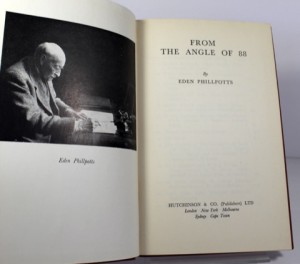
Hardcover. London, Hutchinson & Co, 1st, 1951, Book: Very Good, Dust Jacket: None, 128 pages. Hardcover with no dust jacket. Brick cloth covered boards with gilt titles to spine. Light foxing to endpapers. Frontis illustration, Eden Phillpotts, in black & white. Toning throughout, tight binding with clean pages throughout.
Hardcover. Athens OH, Ohio University Press, 2nd pr., 1996, Book: Very Good, Dust Jacket: Very Good, Hardcover in a bright dust jacket, 373 pages. Editors Groth and Castronovo have chosen from Wilson's previously uncollected works to present materials illuminating his growth as a literary critic and writer. The works are arranged chronologically, beginning with essays published in the High School Record in 1911 proceeding to works penned for the Nation, New Republic, and the New Yorker in the Thirties, Forties, and Fifties, and winding up with an acceptance speech delivered by Wilson in 1966. Among the subjects of the essays are underrated pleasures (including Edith Wharton, satin breeches, and the human body), overrated experiences (such as afternoon tea, youth, summer, and weddings), and literary critiques, both admiring and scathing. Many libraries already own the source periodicals, but this collection includes a few items that would be difficult to obtain.
Hardcover. New Haven CT, Yale University Press, 1st, 2012, Book: Very Good, Dust Jacket: Very Good, Hardcover in a bright dust jacket. Published on the occasion of the exhibition held at the Philadelphia Museum of Art, 20 June-3 September 2012]/edited by Joseph J Rishel; with essays by Stephanie D'Allessandro.[et al.] A trio of masterpieces by Gauguin, Cezanne, and Matisse are joined by works by other major artists in this exploration of the enduring vitality of the theme of Arcadia. Paul Gauguin's Where Do We Come From? What Are We? Where Are We Going? (1897-98), Paul Cezanne's The Large Bathers (1906), and Henri Matisse's Bathers by a River (1909-10, 1913, and 1916-17). Other masterpieces by Jean-Baptiste-Camille Corot, Nicolas Poussin, and Pierre Puvis de Chavannes establish the high value given to Arcadia in the history of French painting. Still in publisher's shrinkwrap.
Hardcover. NY, Teachers College Press, 1st, 1968, Book: Very Good, Dust Jacket: Good, Hardcover in a lightly worn, unclipped dust jacket, 140 pages. A collection of essays by the German sociologist and philosopher concerning man's relationship to culture. Clean copy, minor wear to dust jacket.
Hardcover. Peacham VT, The Perpetua Press, 1st, 2002, Hardcover in the publisher's cream-colored linen over boards with spine and upper board gilt-stamped black leather labels. No dust jacket, as issued. 88 pages, only 500 copies printed. A collection of interviews done with Shaw from 1924 - 1945. Bright and clean copy.

 "Experiences between Philosophy and Communicationby: Ramsey, Ramsey E. / Miller, David James (Editors)")
 "Experimental Study of Freudian Theories, Theby: Eysenck, Hans J. & Glenn D. Wilson")
 "Expressionist Utopias: Paradise, Metropolis, Architectural Fantasyby: Benson, Timothy O.")
 "Expressionist Utopias: Paradise, Metropolis, Architectural Fantasyby: Benson, Timothy O.")
 "F?©lix Ravaisson: Selected Essays by: Sinclair, Mark (Ed.)")
 "Face of Forgiveness, The: Salvation and Redemptionby: Coleman, A.D. (Foreword)")
 "Faces in the Crowd: Players and Writersby: Gary Giddins")
 "Falling Upwards: Essays in Defense of the Imaginationby: Siegel, Lee")
 "Field Work (Author signed)by: Blythe, Ronald")
 "Fighting for the Farm: Rural America Transformedby: Jane Adams (Ed.)")
 "FILMS AND FILMING. DECEMBER 1962. Jackboot cinem: Was Hitler wrong?. How the west was lost. Oh! Oh! Antonioni! Ten Years of Italian films. Marlon Brandon as Fletcher Christian and Trevos Howard as Catain Bligh in Lewis Milestone's Mu")
 "For the Love of Immigrants: Migration Writings and Letters of Bishop John Baptist Scalabrini 1839-1905 by: Scalabrini, Giovanni Battista, Editor: Tomasi, Silvano M.")
 "Frank Browne: A Life through the Lensby: Davison, Edwin (Editor)")
 "Frank Lloyd Wright On Architecture-Selected Writing 1894-1940 by: Wright, Frank Lloyd. Edited & Introduction by Frederick Gutheim")
 "Freud and Man's Soulby: Bettelheim, Bruno")
 "From Adams to Steiglitz: Pioneers of Modern Photographyby: Nancy Newhall")
 "From Caesar to the Mafia: Sketches of Italian Lifeby: Luigi Barzini, Jr.")
 "From Rousseau to Ritschl being the translation of eleven chapters of Die Protestantische Theologie im 19. Jahrhundertby: Barth, Karl")
 "From the Angle of 88by: Philpotts, Eden")

 "From the Uncollected Edmund Wilson by: Edmund Wilson /Janet Groth (Editor), David Castronovo (Contributor)")
 "Garland Series: On the Freedom of Printing and of Speech - Charles Blount - A Just Vindication of Learning - Daniel Defoe - An Essay on the Regulation of the Press - Jeremy Bentham - On the Liberty of the Press.")
 "Gauguin, Cezanne, Matisse: Visions of Arcadia by: Rishel, Joseph J.")
 "Georg Simmel: The Conflict in Modern Culture and Other Essaysby: K. Peter Etzkorn")
 "George Bernard Shaw: Eight Interviews By Hayden Churchby: Bernard Shaw, Editor: Edward Connery Lathem")