Hardcover. New Haven CT, Yale University Press, 1st, 2018, Book: Very Good, Dust Jacket: None, Hardcover, 156 pages, no dj issued. An insightful new look at two renowned photographers, their interconnected legacies, and the vital documents of urban transformation that they created. In this comprehensive study, Kevin Moore examines the relationship between Eugene Atget (1857-1927) and Berenice Abbott (1898-1991) and the nuances of their individual photographic projects. Abbott and Atget met in Man Ray's Paris studio in the early 1920s. Atget, then in his sixties, was obsessively recording the streets, gardens, and courtyards of the 19th-century city--old Paris--as modernization transformed it. Abbott acquired much of Atget's work after his death and was a tireless advocate for its value. She later relocated to New York and emulated Atget in her systematic documentation of that city, culminating in the publication of the project Changing New York.
Hardcover. New Haven CT, Yale University Press, 1st, 2018, Book: Very Good, Dust Jacket: None, Hardcover, 156 pages, no dj issued. An insightful new look at two renowned photographers, their interconnected legacies, and the vital documents of urban transformation that they created. In this comprehensive study, Kevin Moore examines the relationship between Eugene Atget (1857-1927) and Berenice Abbott (1898-1991) and the nuances of their individual photographic projects. Abbott and Atget met in Man Ray's Paris studio in the early 1920s. Atget, then in his sixties, was obsessively recording the streets, gardens, and courtyards of the 19th-century city--old Paris--as modernization transformed it. Abbott acquired much of Atget's work after his death and was a tireless advocate for its value. She later relocated to New York and emulated Atget in her systematic documentation of that city, culminating in the publication of the project Changing New York.
Hardcover. St. Augustine FL, E.H. Reynolds, 5th Ed., 1893, Hardcover, Original tan decorative boards, maroon cloth spine. 161 pages, Index. B&w photos, maps. Gilt spine title. Previous owners bookplate on front flyleaf. Gilt title on spine. Mild wear to cover edges. Clean, unmarked copy.
Hardcover. NY, Harper & Brothers, 1st, 1881, Book: Very Good, Dust Jacket: None, Hardcover, expertly rebound green cloth with original gilt and black design inlaid on front cover. New color pattern endpapers, 460 pages, plus publisher's ads. Frontis w/ tissue guard many b/w engravings throughout. Various artists. illustrated tale of the triumphs and tragedies of the formation of the English colonies through the French & Indian War. Light shelf wear, no marking.
Hardcover. London, T. Werner Laurie Ltd, Book: Very Good, Dust Jacket: Good, Hardcover red cloth covers in a worn, chipped dust jacket. 264 pages, b&w plates. No date, appears to be circa 1920s. Subjects include: old stone crosses, sanctuaries, English bells, holy wells, misericords, the holy grail, etc. Cloth has
Hardcover. New York, Norton, 1st, 2007, Book: Very Good, Dust Jacket: Very Good, Hardcover, 160 pages. Like new in publisher's shrink-wrap. For over twenty-five years Tim Barnwell has explored the southern Appalachian region, documenting the farm culture, visiting with and photographing the people of its isolated mountain enclaves. The photographs in this collection provide a window onto a world that is quickly fading. Barnwell honors the richness and rhythms of everyday life-people in their homes and at work in the fields-and captures the beauty of the North Carolina mountains. These intimate portraits are complemented by oral histories, derived from conversations between the author and his subjects, through which individual stories unfold, rich in humor, joy, loss, and wisdom. 100 duotone photographs
Hardcover. Boston, Houghton Mifflin , 1st, 1889, Book: Good, Dust Jacket: None, Hardcover, green cloth stamped in dark green with drawing of two riders on horseback. Gilt title on spine. Bookseller's sticker on inside front cover, previous owner's signature on front fly leaf otherwise clean.
Hardcover. Yokyo Japan, Tokyo Lawn Tennis Club, 1st, 2001, Book: Very Good, Dust Jacket: None, 168 pages. Hardcover. Color and b/w illustrations throughout. Signed letter by Chairman of the Board presenting book to previous owner inserted. Very clean inside and out. Covered by plastic bookcover/sleeve.
Softcover. Hanover NH, Wesleyan University Press, 3rd pr., 1987, Book: Very Good, Dust Jacket: None, Softcover in pictorial wraps, 343 pages. The focus of this book is the secular cultures of pagan Greece and imperial Rome, and the religious cultures of Judaism and Christianity which, in turn, grew from and influenced them and the modern world. For Momigliano, religion, secular ideology, and politics live in and illuminate the present. Brings together nineteen essays written over five years from sources such as The New York Review of Books, The American Scholar, and the Annali della Scuola Normale Superiore di Pisa. Clean copy.
Softcover. US, Turner, 1st, 2008, Book: Very Good, Dust Jacket: None, Softcover, 270 pages, illustrated throughout in color and b&w. Text in English and Spanish. Light edgewear to wrappers, else a clean, tight copy. Featuring work by Cecil Beaton, Brassai, Henri Cartier-Bresson, Robert Frank, Raoul Hausmann, Richard Avedon, Man Ray, El Lissitzky, Aleksandr Rodchenko and dozens more of the most outstanding photographers of the twentieth century. Analyzes photography as an artistic medium from 1900 to 2000-paying particular attention to the myriad ways that human beings have been portrayed across the years.
Softcover. US, Turner, 1st, 2008-08-01, Book: Very Good, Dust Jacket: None, Softcover, 270 pages, illustrated throughout in color and b&w. Text in English and Spanish. Light edgewear to wrappers, else a clean, tight copy. Featuring work by Cecil Beaton, Brassai, Henri Cartier-Bresson, Robert Frank, Raoul Hausmann, Richard Avedon, Man Ray, El Lissitzky, Aleksandr Rodchenko and dozens more of the most outstanding photographers of the twentieth century. Analyzes photography as an artistic medium from 1900 to 2000-paying particular attention to the myriad ways that human beings have been portrayed across the years.
Hardcover. Moscow, Progress Publishers, 1st, 1971, Book: Very Good, Dust Jacket: Very Good, Hardcover in a bright dust jacket, 357 pages. "On March 18, 1871, the workers of Paris expelled the bourgeois rulers of the city and took power into their own hands , a shining achievement never to be forgotten. Ten days later, on March 28, they set up the Paris Commune, the world's first proletarian state. It was of an entirely new type, being governed by the people and for the people, with all its social and political measures taken in the interest of the working people, the working class above all." -from the Preface. First printing of this selection, published for the centenary of the Commune. With ribbon bookmark. Clean copy.
Hardcover. Cambridge, Mass., The Belknap Press of Harvard University Press, 1st, 1997, Book: Very Good, Dust Jacket: Very Good, Hardcover in a bright, unclipped dust jacket, 442 pages, b&w illustrations. In the beginning, they rallied behind Hitler in the national interest of Germany; in the end, they sacrificed their lives to assassinate him. A history of German resistance to Hitler in high places, this book offers a glimpse into one of the most intractable mysteries. Why did high-ranking army officers, civil servants, and religious leaders support Hitler? Why did they ultimately turn against him? What transformed these unlikely men, most of them elitist, militaristic, and fiercely nationalistic, into martyrs to a universal ideal?
Hardcover. NY, Rizzoli , 1st, 2007, Book: Very Good, Dust Jacket: Very Good, Hardcover in a bright dust jacket, 453 pages, color illustrations throughout. In the mold of his acclaimed History of Beauty, renowned cultural critic Umberto Eco's On Ugliness is an exploration of the monstrous and the repellant in visual culture and the arts. What is the voyeuristic impulse behind our attraction to the gruesome and the horrible? Where does the magnetic appeal of the sordid and the scandalous come from? Is ugliness also in the eye of the beholder? Eco's encyclopedic knowledge and captivating storytelling skills combine in this ingenious study of the Ugly, revealing that what we often shield ourselves from and shun in everyday life is what we're most attracted to subliminally. Topics range from Milton's Satan to Goethe's Mephistopheles; from witchcraft and medieval torture tactics to martyrs, hermits, and penitents; from lunar births and disemboweled corpses to mythic monsters and sideshow freaks; and from Decadentism and picturesque ugliness to the tacky, kitsch, and camp, and the aesthetics of excess and vice. With abundant examples of painting and sculpture ranging from ancient Greek amphorae to Bosch, Brueghel, and Goya among others, and with quotations from the most celebrated writers and philosophers of each age, this provocative discussion explores in-depth the concepts of evil, depravity, and darkness in art and literature. Clean copy.
Hardcover. New York, Burns Archive Press, 1st Edition, 2004, Book: Very Good, Dust Jacket: None, 4 Volumes: (SIGNED). In slipcase. DOMESTIC SHIPPING ONLY. Slipcase still has original mylar wrap (See image). 1916-1945 The Radium Era. 1845-1875 The Anesthesia Era. 1876-1900 The Antiseptic Era. 1901-1915 The X-Ray Era. Limited to 6,500 copies including a special edition of 500 copies. Color, b/w and sepia illustrations throughout. Black, decorated cover boards in like new condition. Pages clean, binding tight, spines straight. Slipcase fine.
Softcover. Canyonville OR, self-published, 1st, 1958, Book: Very Good, Dust Jacket: None, Softcover, 36 page stapled booklet, b&w historical photos. A pictorial history of a small Oregon town. INSCRIBED BY THE AUTHOR on the title page.
Softcover. Duke University Press, 1st, 2012, Book: Very Good, Dust Jacket: None, Softcover, 424 pages, 29 illustrations. Elvis Presley's television debut in January 1956 is often cited as the moment when popular music and television came together. Murray Forman challenges that contention, revealing popular music as crucial to television years before Presley's sensational small-screen performances. Drawing on trade and popular journalism, internal television and music industry documents, and records of audience feedback, Forman provides a detailed history of the incorporation of musical performances into TV programming during the medium's formative years, from 1948 to 1955. He examines how executives in the music and television industries understood and responded to the convergence of the two media; how celebrity musicians such as Vaughn Monroe, Frank Sinatra, and Fred Waring struggled to adjust to television; and how relative unknowns with an intuitive feel for the medium were sometimes catapulted to stardom. Forman argues that early television production influenced the aesthetics of musical performance in the 1940s and 1950s, particularly those of emerging musical styles such as rock and roll. At the same time, popular music helped to shape the nascent medium of television--its technologies, program formats, and industry structures. Popular music performances were essential to the allure and success of TV in its early years. Like new in publisher's shrinkwrap.
Hardcover. Jackson MS, University Press of Mississippi, reprint, 1996, Book: Very Good, Dust Jacket: Very Good, Hardcover, 115 pages illustrated throughout in b&w. Light edgewear to dust jacket, else a clean, tight copy. An Anniversary Edition of a book first published in 1971. New introduction by William Maxwell. Photodocumentation of the noted author's personal selection of images made in her native Mississippi soon after her return from college and as publicity agent for the state's Works Progress Administration office.
Hardcover. Boston, Little, Brown and Company, 1st US, 1944, Book: Very Good, Dust Jacket: None, Hardcover, bound in publisher's red cloth, lettered in gold with black letterbox. First printing of Churchill's fourth war speeches volume, containing Churchill's speeches from 1943. Here the oratory takes a more positive tone as Churchill and the Allies begin to anticipate victory. A little before mid-year, on 19 May 1943 Churchill gave his second address to the U.S. Congress. Seventeen long months of war had passed since his first, just after Pearl Harbor. Dust jacket flap copy pasted to inside front cover. Mild spotting to covers. Otherwise clean.
Hardcover. NY, Zone Books, 1st, 2011, Book: Very Good, Dust Jacket: Very Good, Hardcover in a bright, unclipped dust jacket. An examination of the ultimate power opera grants to singing: the reversal of death. In Operatic Afterlives, Michal Grover-Friedlander examines the implications of opera's founding myth-the story of Orpheus and Eurydice: Orpheus's attempt to revive the dead Eurydice with the power of singing. Grover-Friedlander examines instances in which opera portrays an existence beyond death, a revival of the dead, or a simultaneous presence of life and death. These portrayals-in operas by Puccini and other composers and performances by Maria Callas-are made possible, she argues, by the unique treatment of voice in the operas in question: the occurrence of a breach in which singing itself takes on an afterlife in the face of the singer's death. Clean copy, 252 pages.
Hardcover. Boston, Little, Brown and Company, 1st, 1947, Book: Very Good, Dust Jacket: None, Hardcover, blue cloth with gilt lettering on spine. Volume VI in The History of United States Naval Operations in World War II. 297 pages, illustrated with maps (one fold-out) and b&w photos. This volume covers the operations of the United States Navy in North African waters, both on the Atlantic coast and in the Mediterranean, from the beginning of World War II through the capture of Pantelleria in June 1943. More than half the volume is devoted to the capture of bases in French Morocco, which was an all-American operation and in many respects one of the most remarkable of the war. Gilt on spine with light fading, lacks dust jacket, otherwise clean, tight copy.
Softcover. Belgium, Brepols Publishers, 1st, 1994, Book: Very Good, Dust Jacket: None, Softcover, 76 pages. INSCRIBED BY RICHTER on front fly leaf. Light pencil marks to several pages.
Hardcover. Windsor VT, Washington Benevolent Society, 1st, 1812, Book: Very Good, Dust Jacket: None, 24 pages. Bound in brown leather covers. Stamp on cover with handwritten title. Related clippings mounted to inside front cover. Standard rubbing to leather. Clean, tight copy.
Hardcover. NY, Doubleday, 1st, 1970, Book: Very Good, Dust Jacket: Very Good, Hardcover in a bright dust jacket, 445 pages. Story of the struggle among Jefferson, Hamilton and Burr for power and influence during the early days of the nation. Name on front fly leaf, otherwise clean.
Hardcover. New York, John Wiley & Sons, Inc., Reprint, 1915, Book: Very Good, Dust Jacket: None, Hardcover, brick-red cloth, 604 pages. Stated: First Edition - Third Thousand. Illustrated with black & white photographs and drawings. Previous owners name on front endpaper. Minor fade to spine. Clean, tight copy.
Hardcover. Tokyo, Hokuseido Press, Reprint, 1968, Book: Very Good, Dust Jacket: Very Good, 382 pages. Hardcover with dust jacket & slipcase. Mustard cloth boards with black printed titles to spine. Full page, full color illustrations protected with tissue guards throughout. Frontis illustration, Man Playing the Samisen, in full color & protected with a tissue guard. Chronological chart of Japanese Humor tipped-in. Dust jacket with light wear to edges, lightly price-clipped to corners. Plain slipcase with creases, light wear to edges. Clean, unmarked copy.
Hardcover. Paris, Flammarion, 1st, 2009, Book: Very Good, Dust Jacket: Very Good, Hardcover, 202 pages. Like new in publisher's shrink-wrap. Pays homage to the ultimate travel dream of that era. This collection of over 100 autochrome, sepia, and black and white photographs captures delicate, lost details: the dusty, labyrinthine walls of the casbah; the dappled sunlight on the market stall of a souk; the intricate metal work of traditional jewelry. Each image is accompanied by an informative text that situates the photograph in its historical reality.
Softcover. Philadelphia, Temple University Press, 1st, 1999, Book: Very Good, Dust Jacket: None, Softcover, 271 pages. Confronting the cultural stereotypes that have been attached to Asian-Americans over the last 150 years, this title seizes the label Oriental and asks where it came from. It shows how the bewildering array of racialized images first proffered by music hall songsters and social commentators have evolved and become generalized to Asian-Americans. Clean copy.
Cleveland OH, Rauch & Lang Carriage Co., 1913, Book: Very Good, Dust Jacket: None, Art "The car that sets the fashion", color illustration, not credited. 9" X 10 1/2", very good. PLEASE NOTE: The image shown is a scan of the actual product you are purchasing. What you see is what you get. The sheet may have some imperfections beyond the cropped area shown. You are buying THIS PAGE ONLY- not the entire magazine. Your order will be placed carefully between stiff paper and an acetate overlay, then packed in a rigid cardboard sleeve to prevent bending.
NY, Harper & Brothers, 1911, Book: Very Good, Dust Jacket: None, Decorative cover featuring Revolutionary War scene. PLEASE NOTE The image shown is a scan of the actual product you are purchasing. What you see is what you get. The sheet may have some imperfections beyond the cropped area shown. You are buying THIS PAGE ONLY- not the entire magazine. Your order will be placed carefully between stiff paper and an acetate overlay, then packed in a rigid cardboard sleeve to prevent bending.
NY, Harper & Brothers, 1902, Book: Very Good, Dust Jacket: None, B&w illustration of an indignant woman whose baggage is being searched by customs officers. Art by J.E. Jackson. Approx. 10 X 13". PLEASE NOTE The image shown is a scan of the actual product you are purchasing. What you see is what you get. The sheet may have some imperfections beyond the cropped area shown. You are buying THIS PAGE ONLY- not the entire magazine. Your order will be placed carefully between stiff paper and an acetate overlay, then packed in a rigid cardboard sleeve to prevent bending.
NY, Harper and Brothers, 1913, Book: Very Good, Dust Jacket: None, Two-color art of Uncle Sam greeting Woodrow Wilson by C. Budd. Approx. 10 X 12". PLEASE NOTE: The image shown is a scan of the actual product you are purchasing. What you see is what you get. The sheet may have some imperfections beyond the cropped area shown. You are buying THIS PAGE ONLY- not the entire magazine. Your order will be placed carefully between stiff paper and an acetate overlay, then packed in a rigid cardboard sleeve to prevent bending.
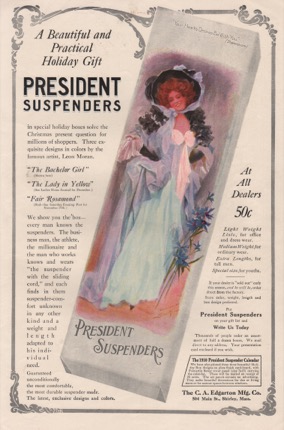
Shirley MA, C.A. Edgarton Co., 1909, Book: Very Good, Holiday Boxes featuring "The Bachelor Girl" and two others. 11 X 14". PLEASE NOTE: The image shown is a scan of the actual product you are purchasing. What you see is what you get. The sheet may have some imperfections beyond the cropped area shown. You are buying THIS PAGE ONLY- not the entire magazine. Your order will be placed carefully between stiff paper and an acetate overlay, then packed in a rigid cardboard sleeve to prevent bending.
NY, P F Collier & Son, Book: Very Good, Illustration in 2-colors of Benjamin Franklin selling books door-to-door by Edward Penfield.. Colliers, 8/22/1925. "Franklin learned the secret for himself-" 10 X 13". PLEASE NOTE: The image shown is a scan of the actual product you are purchasing. What you see is what you get. The sheet may have some imperfections beyond the cropped area shown. You are buying THIS PAGE ONLY- not the entire magazine. Your order will be placed carefully between stiff paper and an acetate overlay, then packed in a rigid cardboard sleeve to prevent bending.
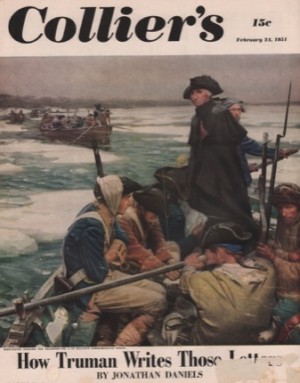
1951, Book: Very Good, Color art of Washington in his boat crossing the Delaware River. Painting by Tom Lovell. 10 X 13", label shadoe not affecting art. PLEASE NOTE: The image shown is a scan of the actual product you are purchasing. What you see is what you get. The sheet may have some imperfections beyond the cropped area shown. You are buying THIS PAGE ONLY- not the entire magazine. Your order will be placed carefully between stiff paper and an acetate overlay, then packed in a rigid cardboard sleeve to prevent bending.
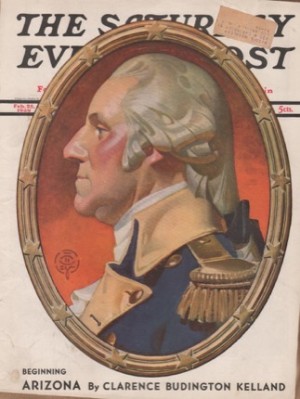
1939, Book: Very Good, Color portrait of George Washington in profile, art by J. C. Leyendecker. 10 X 13", small label. PLEASE NOTE: The image shown is a scan of the actual product you are purchasing. What you see is what you get. The sheet may have some imperfections beyond the cropped area shown. You are buying THIS PAGE ONLY- not the entire magazine. Your order will be placed carefully between stiff paper and an acetate overlay, then packed in a rigid cardboard sleeve to prevent bending.
Hardcover. New York, Academic Press, 1st, 1982, Book: Very Good, Dust Jacket: Very Good, 366 pages, b&w illustrations. Gray cloth with silver lettering on spine, in a bright dust jacket. Previous owner's signature on inside front cover, otherwise clean and tight.
Hardcover. Jackson MS, University Press of Mississippi, 1st, 2014, Book: Very Good, Dust Jacket: None, Like new in publisher's shrink-wrap. Hardcover, 168 pages. In The Origins of Comics: From William Hogarth to Winsor McCay, Thierry Smolderen presents a cultural landscape whose narrative differs in many ways from those presented by other historians of the comic strip. Rather than beginning his inquiry with the popularly accepted "sequential art" definition of the comic strip, Smolderen instead wishes to engage with the historical dimensions that inform that definition. His goal is to understand the processes that led to the twentieth-century comic strip, the highly recognizable species of picture stories that he sees crystallizing around 1900 in the United States. Featuring close readings of the picture stories, caricatures, and humoristic illustrations of William Hogarth, Rodolphe Topffer, Gustave Dore, and their many contemporaries, Smolderen establishes how these artists were immersed in a very old visual culture in which images--satirical images in particular--were deciphered in a way that was often described as hieroglyphical. Across eight chapters, he acutely points out how the effect of the printing press and the mass advent of audiovisual technologies (photography, audio recording, and cinema) at the end of the nineteenth century led to a new twentieth-century visual culture. In tracing this evolution, Smolderen distinguishes himself from other comics historians by following a methodology that explains the present state of the form of comics on the basis of its history, rather than presenting the history of the form on the basis of its present state. This study remaps the history of this influential art form.
Hardcover. New York, Thames and Hudson, 1st, 1982, Book: Very Good, Dust Jacket: Very Good, 280 pages. Black cloth covers with silver titles to spine, silver pictorial to front, silver dust jacket and slipcase with color illustration, 191 illustrations throughout. 1"x3" strip missing from upper right corner from front endpaper, slight rubbing to dust jacket and slipcase, clean covers, pages crisp and unmarked, stiff binding; overall, a very clean, tight copy in great condition.
Softcover. Louisiana State University, reprint, 1974, Book: Very Good, Dust Jacket: None, Softcover, 654 pages with index. After more than half a century, Origins of the New South is still recognized both as a classic in regional historiography and as the most perceptive account yet written on the period which spawned the New South. Historian Sheldon Hackney recently summed it up this way: "The pyramid still stands. Origins of the New South has survived relatively untarnished through twenty years of productive scholarship, including the eras of consensus and of the new radicalism. . . . Woodward recognizes both the likelihood of failure and the necessity of struggle. It is this profound ambiguity which makes his work so interesting. Like the myth of Sisyphus, Origins of the New South still speaks to our condition." Light rubbing to wrappers, clean copy.
Softcover. NY, McGraw-Hill , 3rd pr., 1992, Book: Very Good, Dust Jacket: None, Softcover, 205 pages. 191 b&w figures. An in-depth look at the history of ornamental ironwork and ironworkers in American architecture. Well illustrated with many photos. Clean copy.
Hardcover. Boston, David R. Godine, 1st, 1978, Book: Very Good, Dust Jacket: Very Good, Hardcover, 202 pages, b&w photographs by Charles C. Withers. Very good copy in a clean, bright, unclipped dust jacket.
Hardcover. New Haven, Yale University Press, 1st, 1998, Book: Very Good, Dust Jacket: Very Good, Hardcover, 302 pages, illustrated throughout in b&w. SIGNED BY AUTHOR on title page. Light sun-fade along dust jacket spine. Clean, tight copy. Touring America as the "Apostle of Aestheticism" in 1882, Oscar Wilde brought a witty and controversial message of regeneration through art and beauty to a nation still shaken by the trauma of the Civil War. In this book, the first cultural history of the aesthetic movement in the United States, Mary W. Blanchard shows that it was a wide-ranging popular movement resisted by the moral guardians of Victorianism but advanced by visionary women.
Hardcover. Cambridge MA, Harvard University Press, 1st, 2018, Book: Very Good, Dust Jacket: Very Good, Hardcover in a bright dust jacket, 404 pages. The Napoleonic wars did not end with Waterloo. That famous battle was just the beginning of a long, complex transition to peace. After a massive invasion of France by more than a million soldiers from across Europe, the Allied powers insisted on a long-term occupation of the country to guarantee that the defeated nation rebuild itself and pay substantial reparations to its conquerors. Our Friends the Enemies provides the first comprehensive history of the post-Napoleonic occupation of France and its innovative approach to peacemaking. From 1815 to 1818, a multinational force of 150,000 men under the command of the Duke of Wellington occupied northeastern France. From military, political, and cultural perspectives, Christine Haynes reconstructs the experience of the occupiers and the occupied in Paris and across the French countryside. The occupation involved some violence, but it also promoted considerable exchange and reconciliation between the French and their former enemies. Clean copy.








 "On the Human Being 1900-1950by: Ebner, Florian (Ed.)")
 "On the Human Being 1900-1950by: Ebner, Florian")

 "On the Road to the Wolf's Lair: German Resistance to Hitlerby: Hamerow, Theodore S.")

 "Oncology Tumors & Treatment: A Photographic History 1845-1945 (SIGNED)by: Burns, MD, FACS, Stanley B.")


 "One Time, One Place: Mississippi in the Depressionby: Welty, Eudora")



 "Ophthalmology: A Photographic History 1845-1945 (SIGNED)by: Burns MD, FACS, Stanley B.")


 "Oration, in Commemoration of the Birth of our Illustrious Washington, Pronounced at Windsor, February 24, 1812, Before the Washington Benevolent Societyby: Dunham, Jo")


 "Oriental Humour by: Blyth, R. H.")


 "Orientalist Photographs: 1870-1950by: Milet, Eric")
 "Orientalist Photographs: 1870-1950by: Milet, Eric")


 "ORIG VINTAGE MAGAZINE COVER: Harper's Weekly -Connecticut Numberby:")
 "ORIG VINTAGE MAGAZINE COVER: Harper's Weekly June 28 1902 - Customs Searchby: John Edwin Jackson")