Softcover. Philadelphia, University of Pennsylvania Press, 1st pbk, 1998, Book: Very Good, Softcover, 330 pages. Twelve literary scholars and historians investigate the ways in which space and place are politically, religiously, and culturally inflected. Exploring medieval texts as diverse as Icelandic sagas, Ptolemy's Geography, and Mandeville's Travels, the contributors illustrate the intimate connection between geographical conceptions and the mastery of land, the assertion of doctrine, and the performance of sexuality. Clean copy.
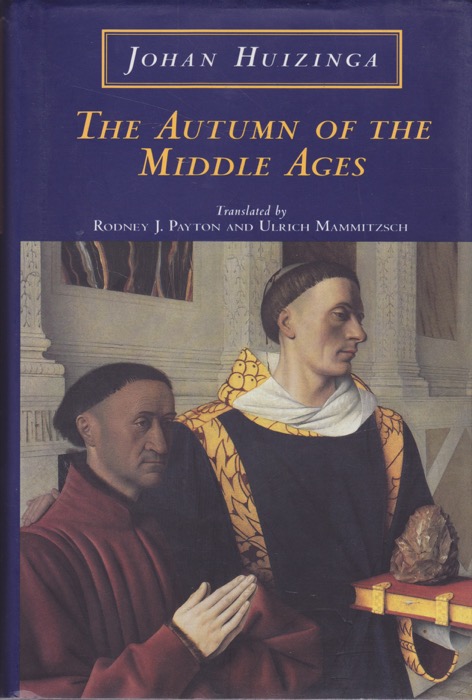
Hardcover. Chicago, University of Chicago Press, 1st, 1996, Book: Very Good, Dust Jacket: Very Good, Hardcover in a bright dust jacket. Clean, bright copy, 467 pages. Illustrated with 36 pages of historic Plates, b/w, on coated paper. One of the most famous works of history, Johan Huizinga presents a brilliant portrait of life, thought, and art in 14th and 15th century France and the Netherlands.
Hardcover. Chicago, University of Chicago Press, 1st, 1996, Book: Very Good, Dust Jacket: Very Good, Hardcover in a bright dust jacket. Clean, bright copy, 467 pages. Illustrated with 36 pages of historic Plates, b/w, on coated paper. One of the most famous works of history, Johan Huizinga presents a brilliant portrait of life, thought, and art in 14th and 15th century France and the Netherlands.
Hardcover. Leiden/Boston, Brill, 1st, 2002, Book: Very Good, Dust Jacket: None, Hardcover, decorated cloth, 482 pages. This book explores the dynamics of the commentary and textbook traditions in Aristotelian natural philosophy under the headings of doctrine, method, and scientific and social status. It inquires what the evolution of the Aristotelian commentary tradition can tell us about the character of natural philosophy as a pedagogical tool, as a scientific enterprise, and as a background to modern scientific thought. In a unique attempt to cut old-fashioned historiographic divisions, it brings together scholars of ancient, medieval, Renaissance and seventeenth-century philosophy. The book covers a remarkably broad range of topics: it starts with the first Greek commentators and ends with Leibniz. Small ink stamp on front fly leaf, otherwise clean.
Lawrence, KS, Spencer Museum of Art, 1st, 1984, Book: Very Good, Dust Jacket: None, Hardcover, 158 pages. Black & white illustrations throughout. No dust jacket.
Hardcover. London, J. M. Dent & Sons, 1976, Book: Very Good, Dust Jacket: Very Good, Hardcover in a bright, unclipped dust jacket. B&w illustrations by Jeff Thomas. A collection of classic Welsh stories. Clean copy.
Hardcover. NY, Walker & Company, 1st, 2000, Book: Very Good, Dust Jacket: Very Good, Hardcover in a bright, unclipped dust jacket. chronicles the Roman Catholic Church's crusade against--and ultimate annihilation of--the Albigenses, or Cathars, a group of heretical Christians who thrived in what is now the Languedoc region of Southern France. The Cathars held revolutionary beliefs that threatened the authority of the church. The world, they maintained, was not created by a benevolent God. Rather, it was the creation of a force of darkness, immanent in all things. They considered worldly authority a fraud, and authority based on some divine sanction, such as claimed by the church, outright hypocrisy. Innocent III, resolved to eradicate the Cathar threat to church authority, recruited the military powers of France, eager to expand their territory to the south. Together, they systematically exterminated the Cathars and their supporters in a series of crusades between 1209 and 1229. The Dominican-led Inquisition that ensued built upon this momentum of intolerance and tormented Europe for centuries to come. 333 pages, endpapers map.
Hardcover. NY, George Braziller, 1st, 1973, Book: Very Good, Dust Jacket: None, Hardcover, red cloth covers stamped in gilt, in a black cardboard slipcase. Color illustrations throughout. This powerful and breathtakingly beautiful Book of Hours was designed in the fifteenth century by one of the greatest masters of expressionism in France at the time, and executed by him (together with members of his workshop) for a royal patron. A relatively unknown masterpiece, it emerged from artistic obscurity in 1904 to widespread acclaim and critical appreciation. As Millard Meiss points out in his Introduction: "The Rohan Master cared less about what people do than what they feel. . . .Whereas his great predecessors, the Boucicaut Master and the Limbourgs, excelled in the description of novel aspects of the natural world, he explored the realm of human feeling." Clean copy.
Hardcover. Columbus OH, Ohio State University Press, 1st, 1980, Book: Good, Dust Jacket: None, Hardcover, dark blue cloth, giltlettering on spine.861 pages including index. Pencil underling to a few pages. Name on front fly leaf.
Softcover. Kila MT, Kessinger, reprint, Book: Very Good, Dust Jacket: None, Softcover, blue pictorial wrappers. This is an unchanged, high-quality reprint of the original edition of 1895, originally published by Swan Sonnenschein & Co., London, 13 illustrations, 2 maps. Clean copy.
Hardcover. NY, Henry Z. Walck, Inc., 1st, 1960, Book: Very Good, Dust Jacket: Very Good, Hardcover, black & white illustrations by Ezra Jack Keats. Light edgewear to dust jacket, short tears at bottom. Ex-library stamp on both end papers, otherwise clean. Dust jacket price clipped .
Hardcover. NY, Henry Holt & Co., 1st, 1926, Book: Very Good, Dust Jacket: None, Hardcover, light gray boards with a black cloth spine with gilt lettering. Name and ownership stamp on front fly leaf, otherwise clean copy.
Softcover. New York, Metropolitan Museum of Art, 1st, 1998, Book: Very Good, Dust Jacket: None, 128 pages. Softcover. A very clean, unmarked copy with only minor edgewear. Color illustrations throughout.



![The Dynamics of Aristotelian Natural Philosophy from Antiquity to the Seventeenth Centuryby: Herausgeber: Leijenhorst, C., Herausgeber: L]thy, C., Herausgeber: Thijss](http://www.browsingisarousing.com/images-books/383974.jpg "The Dynamics of Aristotelian Natural Philosophy from Antiquity to the Seventeenth Centuryby: Herausgeber: Leijenhorst, C., Herausgeber: L]thy, C., Herausgeber: Thijss")
 "The Franklin D. Murphy Lectures V - Programs of Medieval Illuminationby: Calkins, Robert G.")


![The Rohan Master:A Book of Hoursby: Marcel Thomas [Editor]; Millard Meiss [Introduction];](https://www.browsingisarousing.com/shop/images/The-Rohan-MasterA-Book-of-Hours_by_Marcel-Thomas-Editor-Millard-Meiss-Introduction382074-428042.jpg "The Rohan Master:A Book of Hoursby: Marcel Thomas [Editor]; Millard Meiss [Introduction];")


 "Tournaments of the Lions, Theby: Williams/Ezra Jack Keats, Jay")

