Hardcover. New York, Harry N. Abrams, Inc., 1st English, 1972, Book: Very Good, Dust Jacket: Very Good, 527 pages. Hardcover. Previous owners name and brief inscription on front endpaper. Illustrated with black & white photographs. Dust jacket with light wear. Clean, tight copy.
Hardcover. Amsterdam, Ludion Ghent/Abrams, 1st, 2001, Book: Very Good, Dust Jacket: None, 208 pages with 282 color plates, 53 in b&w. No dust jacket. Published to coincide with a major exhibition of the artist's work in Europe, this loving tribute to one of the greatest, and most bizarre, of the medieval painters introduces readers to the often grotesque vision expressed in his work.
Hardcover. New York, Harper & Brothers, 1st, 1880, Book: Good, Dust Jacket: None, 331 pages, with gilt top edge and titles. Minor corner and edge wear, light crack along spine but no loose pages, overall, clean and tight copy.
Hardcover. Geneva, Edito-Service, 1st English Ed., 1968, Book: Very Good, Dust Jacket: None, Hardcover, pebbled red cloth with gilt decoration and color label on front cover. Good general overview of painting in Western Europe during the later Medieval period. Illustrated in color and b&w. Clean copy.
Hardcover. London, Oxford University Press, 1st, 1957, Book: Very Good, Dust Jacket: Good, 257 pages. Hardcover. Previous owner's name on front endpaper. Inside front hinge cracked. Minor dust jacket edge wear - jacket now protected with clear plastic cover. Clean, unmarked text.
Softcover. UK, Sutton, Revised Ed., 1999, Book: Very Good, Dust Jacket: None, Softcover, 216 pages. Joachim of Fiore has been described as the most singular and fascinating figure of mediaeval Christendom. This title explores his unique understanding of history and looks at the powerful influence of his ideas.
Hardcover. Leiden/Boston, Brill, 1st, 2001, Book: Very Good, Dust Jacket: None, Hardcover, decorated cloth covers, 610 pages. This book on medieval and early modern corpuscular matter theories presents the research results of nineteen scholars, who show that his modern model of matter has some of its roots in physical, medical, mathematical, alchemical, and theological conceptions developed in the Middle Ages. Clean, bright copy.
Hardcover. Philadelphia, University of Pennsylvania Press, 1st, 1977, Book: Very Good, Dust Jacket: Good, Hardcover ina worn, rubbed dust jacket. 340 pages. Essays exploring the impact of Church law on medieval legal theory. Clean copy.
Softcover. NY, Cambridge University Press, reprint, 1960, Book: Very Good, Dust Jacket: None, Softcover, 364 pages. A picture of the daily and yearly round of the English peasant in the Middle Ages. Bennett explains the feudal system which linked the poor man to the soil and to the service of his lord and the church. Since all of the inhabitants of England at that time were countrymen, except for a few large towns, this book is really an introduction to life in Medieval England as a whole. Clean and unmarked wraps in reddish-brown with a woodcut illustration. Name on front fly leaf, otherwise clean.
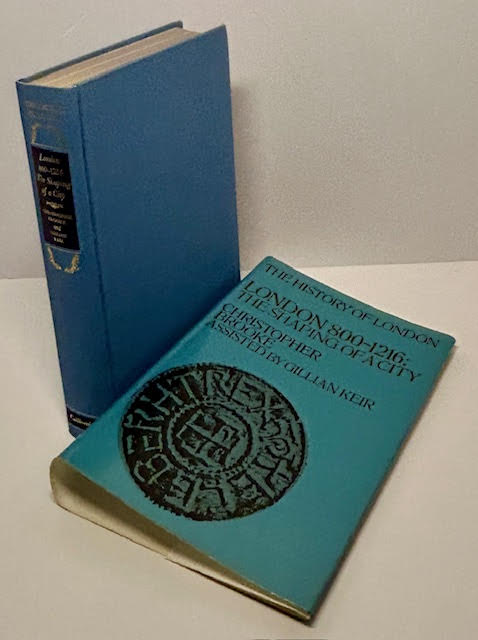
Hardcover. Berkeley, CA, University of California Press, 1st Edition, 1975, Book: Very Good, Dust Jacket: Very Good, 424 pages. Hardcover. B/w illustrations throughout. Blue cloth cover boards, gilt title on black on spine. Light tanning to pages. Spine straight. Binding tight. Takes its place in the eight-volume History of London series, but it is a self-contained enquiry into the place of ninth- to twelfth-century London in the history of the City and of the urban renaissance.
Hardcover. New Haven CT, Yale University Press, 1st, 2001, Book: Very Good, Dust Jacket: Very Good, Hardcover in a bright dust jacket, 387 pages. Color and b&w illustrations. Leading medieval historian Nicholas Orme draws together a vast range of sources and disciplines-history, literature, religion, and art-to create a picture of medieval childhood more comprehensive than ever before. Beginning with pregnancy and childbirth, Orme explores the succeeding stages of a child's growth to adulthood. He discusses baptism, the significance of birthdays and ages, and family life, including upbringing, food, clothes, sleep, and the plight of the poor. He also chronicles the misfortunes of childhood, from disablement, abuse, and accidents to illness and death. In a fascinating review of the special culture of children, the author describes their rhymes, toys, and games; their religion and relationship to the Church; and their learning to read the literature for children. The final chapter of the book explains how adolescents grew up and entered the adult world. Mild fade to spine, front fly leaf with two small scars to black paper, otherwise a clean, bright copy.
Hardcover. Limpsfield UK, Paper Tiger, 1st, 1981, Book: Very Good, Dust Jacket: Very Good, Hardcover in a bright, price-clipped dust jacket, 70 pages. 30 fables collected by the mysterious Marie de France, lavishly illustrated by Jason Carter and with new translations from original manuscripts. Carter's ancient-look, colorful artwork adds to the appeal. (The publisher has added `pre-foxed' pages.) Three of the tales are : The Bitch and Her Litter, The King of the Frogs, and The Crow Who Found Peacock Feathers. Each has an attached moral. Previous owner's inscription on front fly leaf, otherwise clean.
Softcover. London, The Hambledon Press, 1st, 1982, Book: Very Good, Dust Jacket: None, Softcover, 288 pages. The inner workings of early medieval societies cannot be understood without also studying their links - religious, cultural, economic and political - with their neighbours. In this collection Karl Leyser shows how Ottonian and Salian Germany both influenced and was influenced by the societies with which it came into contact. While the author's central interest is in Germany, his work is of value for the study of medieval European society as a whole. Clean copy.
Hardcover. Gloucester, MA, Peter Smith, Reprint, 1959, Book: Very Good, Dust Jacket: None, 321 pages. Hardcover with no dust jacket. Green cloth covered boards with light wear to edges & black titles to spine. Faint soil to top edge. Otherwise clean inside and out. Tight copy.
Hardcover. Folkestone UK, Winterdown Books, reprint, 1987, Book: Very Good, Dust Jacket: Very Good, Hardcover in a bright dust jacket, 248 pages. Sydenham's first book on the treatment of fevers, has been reprinted since the 2nd edition of 1668 and has never been translated as a whole until this book. Text is in both Latin and English. The Latin text of the 1666 and 1668 editions with English translation from R.G. Latham (1848). Introduction, notes and index by G.G. Meynell. Limited to 275 copies. Name on front fly leaf, otherwise clean.
Hardcover. NY, Scholastic Press, 1st, 2003, Book: Very Good, Dust Jacket: None, Hardcover in glazed pictorial boards, 40 pages. Brilliant, vibrantly colored pictures by Bruce Degen illustrate this story. 'With her reluctant student, Arnold, the Friz slips through a mysterious trap door and ends up in the Middle Ages. There, they explore a medieval castle, meeting the people who live there and learning about everyday life within the castle walls.' Sicker residue on rear cover, crease to front fly leaf. Otherwise clean.
Softcover. Ithaca NY, Cornell University Press, reprint, 1991, Book: Very Good, Dust Jacket: None, Softcover, 204 pages. "Not of woman born," "the Fortunate," "the Unborn" - the terms designating those born by Caesarean section in medieval and Renaissance Europe were mysterious and ambiguous. In antiquity, children fortunate enough to have survived a Caesarean birth were believed to be marked for a special destiny. Vividly tracing the evolution of Caesarean birth from the early 1300s (when the operation was performed almost exclusively by midwives) through the Renaissance period (when midwives were considered witches and male surgeons took control), Blumenfeld-Kosinski . . . does more than provide [an] engrossingly accessible, historical account of the now-commonplace procedure--she unveils the roots of a medical misogyny that still prevails today. A richly cross-disciplined study utilizing depictions of Caesarean delivery in art, literature, and medical texts and illuminations (illustrations), [this book] is a captivating and revealing work that will be relished by readers of medical and cultural history, as well as by those who are interested in the subject of male dominance over women. Clean copy.
Softcover. Belgium, Brepols Publishers, 1st, 1994, Book: Very Good, Dust Jacket: None, Softcover, 76 pages. INSCRIBED BY RICHTER on front fly leaf. Light pencil marks to several pages.
Hardcover. Princeton NJ, Princeton University Press, 1st, 2015, Book: Very Good, Dust Jacket: Very Good, Hardcover in a bright dust jacket, 354 pages. From the turn of the fifth century to the beginning of the eighteenth, Christian writers were fascinated and troubled by the "Problem of Paganism," which this book identifies and examines for the first time. How could the wisdom and virtue of the great thinkers of antiquity be reconciled with the fact that they were pagans and, many thought, damned? Related questions were raised by encounters with contemporary pagans in northern Europe, Mongolia, and, later, America and China. Pagans and Philosophers explores how writers-philosophers and theologians, but also poets such as Dante, Chaucer, and Langland, and travelers such as Las Casas and Ricci-tackled the Problem of Paganism. Augustine and Boethius set its terms, while Peter Abelard and John of Salisbury were important early advocates of pagan wisdom and virtue. University theologians such as Aquinas, Scotus, Ockham, and Bradwardine, and later thinkers such as Ficino, Valla, More, Bayle, and Leibniz, explored the difficulty in depth. Meanwhile, Albert the Great inspired Boethius of Dacia and others to create a relativist conception of scientific knowledge that allowed Christian teachers to remain faithful Aristotelians. At the same time, early anthropologists such as John of Piano Carpini, John Mandeville, and Montaigne developed other sorts of relativism in response to the issue. Clean copy.
Hardcover. Oxford UK, Clarendon Press, 2nd Ed., 1970, Book: Very Good, Dust Jacket: Very Good, Hardcover in a bright dust jacket with light edgewear. Based on the 1958 edition, this printing has extensive changes and additional material. Fold-out map, 136 pages. No marking.
Softcover. Los Angeles, University of California Press , 1st, 1982, Book: Very Good, Dust Jacket: Very Good, Large softcover, 100 pages; many illustrations. Clean and tight; fairly unblemished. Stiff card wraps with wraparound jacket. Following the publication of the 3-volume Plan of St. Gall an exhibition was mounted which used selected text, drawings, models, etc. that were used to produce the large work This shorter volume grew out of that exhibition.
Hardcover. Paris, Zodiaque, 1st, 1982, Book: Very Good, Dust Jacket: Very Good, Hardcover, 407 pages plus index. Color and b&w gravure plates, plans of medieval churches of France. French text. A clean, tight copy in a bright dust jacket.
Softcover. Princeton NJ, Princeton University Press, reprint, 1996, Book: Very Good, Dust Jacket: None, Softcover, pictorial wraps, 490 pages. By explaining how to sire multicolored horses, produce nuts without shells, and create an egg the size of a human head, Giambattista Della Porta's Natural Magic (1559) conveys a fascination with tricks and illusions that makes it a work difficult for historians of science to take seriously. Yet, according to William Eamon, it is in the "how-to" books written by medieval alchemists, magicians, and artisans that modern science has its roots. These compilations of recipes on everything from parlor tricks through medical remedies to wool-dyeing fascinated medieval intellectuals because they promised access to esoteric "secrets of nature." In closely examining this rich but little-known source of literature, Eamon reveals that printing technology and popular culture had as great, if not stronger, an impact on early modern science as did the traditional academic disciplines. Clean copy.

 "Gothic Sculpture in France 1140-1270by: Sauerlander, Willibald/Max Hirmer")
 "Hieronymus Bosch: The Complete Paintings and Drawingsby: Koldeweij, Jos, Paul Vandenbroeck and Bernard Vermet")
 "Historical Studies of Church-Building in the Middle Ages: Venice, Siena, Florenceby: Norton, Charles Eliot")
 "History of Art: Gothic Painting IIby: H?©rubel, Michel")
 "Hoysalas - A Medieval Indian Royal Family, Theby: Derrett, J. Duncan M.")
 "Joachim of Fiore and the Prophetic Futureby: Reeves, Marjorie")
 "Late Medieval and Early Modern Corpuscular Matter Theoriesby: Christoph Luthy, John E. Murdoch, William R.Newman")
 "Law Church and Society: Essays in Honor of Stephan Kuttner (The Middle Ages Series)by: Somerville Robert; Pennington Kenneth/Editors")
 "Life on the English Manor: A Study of Peasant Conditions 1150-1400by: Bennett, H. S.")
 "London 800-1216: The Shaping of a Cityby: Brooke, Christopher, Gillian Kerr (assisted)")

 "Malice Defeated and The Matchless Rogue (1680 )by: Elizabeth Cellier")
 "Medieval Childrenby: Nicholas Orme")

 "Medieval Germany and its Neighbours: 900-1250by: Leyser, K. J.")
 "Medieval Rhetoric and Poetic to 1400 - Interpreted from Representative Worksby: Baldwin, Charles Sears")
 "Methodus Curandi Febres Propriis Observationibus Superstructuraby: Sydenham, Thomae / Latham, R.G. (trans.) / Meynell, G.G. (intro.)")
 "Ms. Frizzle's Adventures Medieval Castleby: Cole, Joanna and Degen, Bruce")
 "Not of Woman Born: Representations of Caesarean Birth in Medieval and Renaissance Cultureby: Renate Blumenfeld-Kosinski")
 "Oral Tradition in the Early Middle Ages (SIGNED COPY)by: Richter, Michael")
 "Pagans and Philosophers: The Problem of Paganism from Augustine to Leibniz by: Marenbon, John")
 "Peterborough Chronicle, 1070-1154 by: Clark, Cecily (Ed.)")
 "Plan of St. Gall, The: In Brief by: Price, Lorna")
 "Routes Romanes: 1- La Route aux Saintsby: Oursel, Raymond")
 "Science and the Secrets of Nature: Books of Secrets in Medieval and Early Modern Cultureby: William Eamon")