Hardcover. Cambridge UK, Cambridge University Press, 1st, 2006, Book: Very Good, Dust Jacket: Very Good, Hardcover in a bright dust jacket, 767 pages. 'This book is a major new intellectual and cultural history of intolerance and toleration in early modern and early Enlightenment Europe. John Marshall offers an extensive study of late seventeenth-century practices of religious intolerance and toleration in England, Ireland, France, Piedmont and the Netherlands and of the arguments which John Locke and his associates made in defence of 'universal religious toleration'. He analyses early modern and early Enlightenment discussions of toleration; debates over toleration for Jews and Muslims as well as for Christians; the limits of toleration for the intolerant, atheists, 'libertines' and 'sodomites'; and the complex relationships between intolerance and resistance theories including Locke's own Treatises. This study is a significant contribution to the history of the 'republic of letters' of the 1680s and the development of early Enlightenment culture and will be essential reading for scholars of early modern European history, religion, political science, and philosophy.' Clean copy.
Softcover. Princeton NJ, Princeton University Press, 1st, November 1989, Book: Very Good, Dust Jacket: None, Softcover, 325 pages. Clean, unmarked copy with only minor edgewear to wrappers.
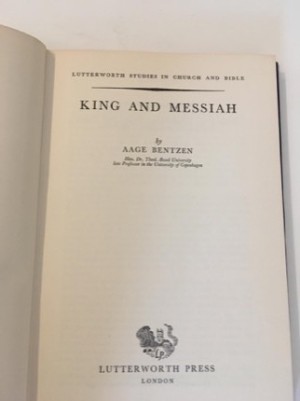
Hardcover. London, Lutterworth, 1st UK, 1955, Book: Very Good, Dust Jacket: None, Hardcover, blue cloth with faded gilt lettering on spine, 115 pages. A fascinating glimpse into the debate in Scandinavia concerning a number of inter-related Biblical themes focused on the concept of the Messiah, a debate associated with scholars such as Mowinckel, Pedersen, Widengren, and Bentzen himself. The argument traces the development of the Messianic figure from its Old Testament roots, starting with the Messiah of many of the Psalms, which represents a demythologised form of the Oriental conception of kingship, through the eschatologised Messiah of the prophetic thought of Isaiah and Micah, and then to the prophet-Messiah of Second Isaiah, which although still a present and entirely human figure, embodies the insight that the saviour of Israel must suffer and be cast in the role of a Moses Redivivus as leader of a new Exodus. The Son of Man of Daniel 7 carries this eschatologising process even further, until the Christology of the New Testament emerges as a creative synthesis of these Old Testament types. In this synthesis, Jesus is a new Adam, the Messiah present in the flesh and present still in His body the Church, the suffering Prophet playing the part of the new Moses and the once and future Divine King. Bentzen argues that ultimately this figure of Christ the Messiah transcends not only the Old Testament types on which it is based, but also the subsequent historical development of the Christian Messianic tradition.
Softcover. Berkeley CA, University of California Press, reprint, 1990, Book: Very Good, Dust Jacket: None, Softcover, 218 pages. Students and teachers of Chinese history and philosophy will not want to miss Daniel Gardner's accessible translation of the teachings of Chu Hsi (1130-1200)-a luminary of the Confucian tradition who dominated Chinese intellectual life for centuries. Homing in on a primary concern of our own time, Gardner focuses on Chu Hsi's passionate interest in education and its importance to individual development. For hundreds of years, every literate person in China was familiar with Chu Hsi's teachings. They informed the curricula of private academies and public schools and became the basis of the state's prestigious civil service examinations. Nor was Chu's influence limited to China. In Korea and Japan as well, his teachings defined the terms of scholarly debate and served as the foundation for state ideology. Clean copy.
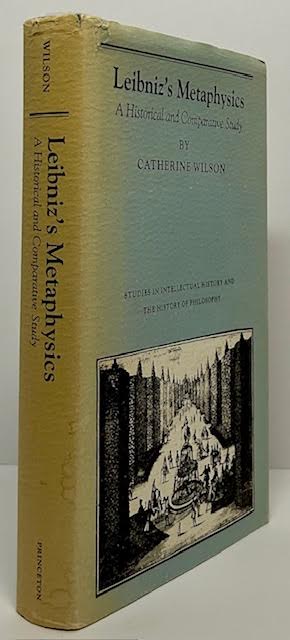
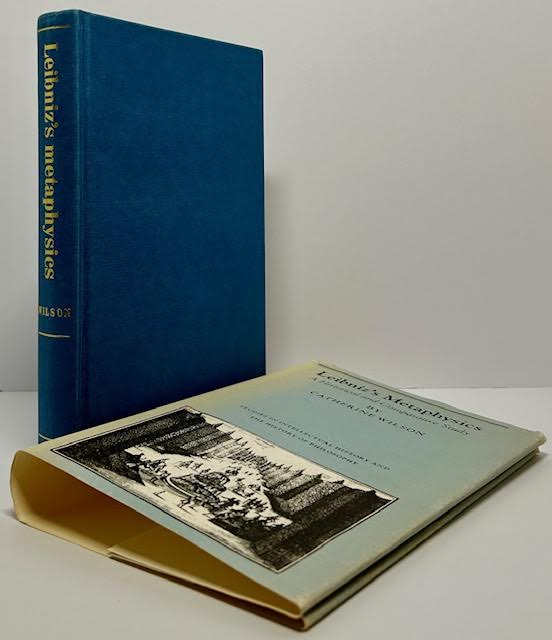
Hardcover. Princeton, NJ, Princeton University Press, 1st Edition, 1989, Book: Very Good, Dust Jacket: Very Good, 350 pages. Hardcover. Previous owner's name on front flyleaf. Blue cover boards, gilt title on spine. Dust jacket unclipped, some fading and agewear to spine of dj. This study of the metaphysics of G.W. Leibniz gives a clear picture of his philosophical development within the general scheme of seventeenth-century natural pholosophy.
Hardcover. Cambridge, Harvard University Press, First Edition, 1968, Book: Very Good, Dust Jacket: Very Good, 335 pages. Hardcover. Ivory boards with black printed titles to mustard cloth spine. Dust jacket with moderate toning & light wear to edges. Previous owner's signature to front flyleaf. Illustrations in bw throughout. Clean & unmarked copy.
Hardcover. Boston, Houghton Mifflin, reprint, 1882, Book: Very Good, Dust Jacket: None, Hardcovers, two-volume set complete. Matching dark brown cloth covers stamped in black and gilt, top edge gilt. 639; vi, 653 pages; index, bibliography, frontispiece portrait in each volume - one a quite formal portrait of Voltaire in his prime, the other a sketch of him in old age. Covers show light wear, name on title pages. This is the second printing, the first published a year earlier. A comprehensive life of the great Enlightenment writer. PLEASE NOTE: DUE TO WEIGHT, DOMESTIC SHIPPING ONLY.
Hardcover. Oxford UK, Clarendon Press, 1st, 1991, Book: Very Good, Dust Jacket: Very Good, Hardcover set, complete in two volumes, both with bright dust jackets. Locke on Money presents for the first time the entire body of the philosopher's writings on this important subject (other than Two Treatises of Government). Accurate texts, together with an apparatus listing variant readings and significant manuscript changes, record the evolution of Locke's ideas from the original 1668-74 paper on interest to the three pamphlets on interest and coinage published in the 1690s. The introduction by Patrick Hyde Kelly establishes the wider context of Locke's writings in terms of contemporary debates on these subjects, the economic conditions of the time, and the circumstances of writing and publication. It shows, notably, that Locke's supposed responsibility for the 1696 recoinage is a myth. The account of what Locke derived from Mercantilist writings and of how he reformulated these in accordance with his philosophy illuminates his contribution to the evolution of economics, and will aid reappraisal of Two Treatises. The picture that emerges confirms Locke's status as major economic thinker, contrary to the prevalent view of recent decades. There are two volumes in the edition. The first contains the introductory matter, and the texts of the Early Writings on Interest, 1688-74, and Some Considerations. The second comprises Short Observations, Further Considerations, and the Appendices, Bibliography, and Index. 664 total pages. Name on front fly leaf in Vol. 1, otherwise clean.
Hardcover. London, Bucknell University Press, 1st, 2003, Book: Very Good, Dust Jacket: Very Good, Hardcover in a bright dust jacket, 199 pages. This book shows how, in his enormously influential Essay Concerning Human Understanding (1689), John Locke embraces the new rhetoric of seventeenth-century natural philosophy, adopting the strategies of his scientific contemporaries to create a highly original natural history of the human mind. With the help of Locke's notebooks, letters, and journals, Peter Walmsley reconstructs Locke's scientific career, including his early work with the chemist Robert Boyle and the physician Thomas Sydenham. He demonstrates too how the Essay embodies in its form and language many of the preoccupations of the science of its day, from the emerging discourses of experimentation and empirical taxonomy to developments in embryology and the history of trades. Widely research and lucidly and engagingly written, Locke's Essay and the Rhetoric of Science constitutes an important new reading of Locke, on that shows both his brilliance as a writer and his originality in turning to science to effect a radical re-invention of the study of the mind. Pencil marking to front fly leaf, otherwise clean.
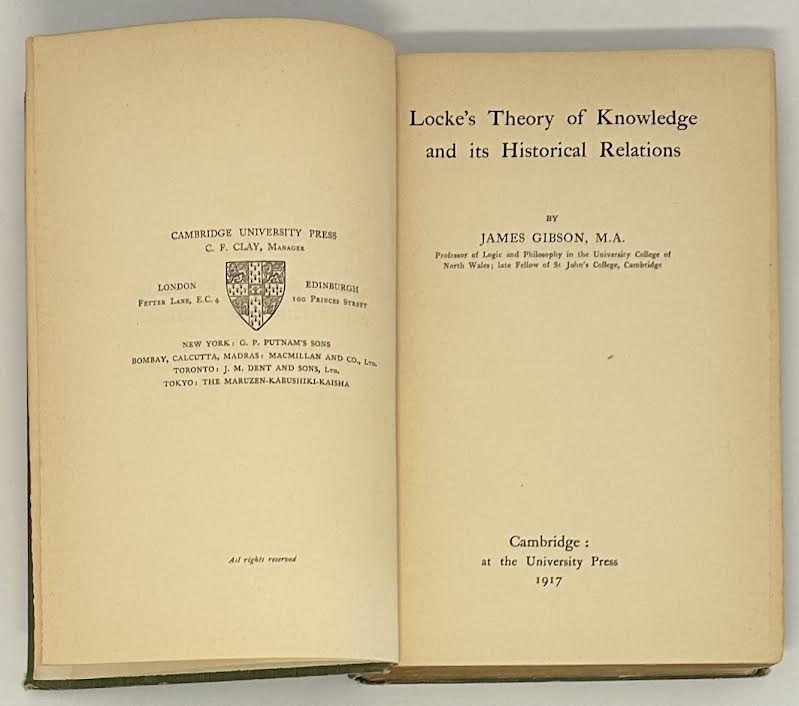
Hardcover. London, England, Cambirdge at the University Press, 1st Edition, 1917, Book: Good, Dust Jacket: None, 338 pages. Hardcover. Green cloth cover boards, gilt title on spine and front cover board, gilt faded on cover, some agewear. Some light pencil within. Previous owner's name on front flyleaf. Some tanning to pages and edges.
Hardcover. Cambridge UK, Cambridge University Press, 1st, 1953, Book: Very Good, Dust Jacket: Good, Hardcover in a worn dust jacket with a chunk gone from rear panel, 309 pages. This book gives a complete account of all that Locke saw, did and heard during his four years in France. The entries vary from laconic jottings to detailed accounts - full of colour and wit - of life in Paris and the provinces. Locke's variety of interests presents a vivid and thorough account of France at that time. He observed and recorded the absolutism of Louis XIV and the poverty of the peasants, the growing persecution of the Protestants and the external manifestations of Catholicism, recent developments in science and technology - even agricultural methods and the system of taxes. So that this is a book for the general reader as well as for the student of Locke, the social historian and the historian of science. Three b&w plates including a map of his travels. Name on front fly leaf, rubber withdrawn stamp on copyright page, otherwise clean.
Softcover. NY, W. W. Norton , reprint, 1984, Book: Very Good, Dust Jacket: None, Softcover, 339 pages. In Felix Gilbert's skilled analysis, the figures of Niccolo Machiavelli, whose writing changed the way people think about politics, and Francesco Guicciardini, whose History of Italy is one of the first classics of modern historical writing, provide important clues to interpreting the Renaissance. "Instead of treating these two great figures in isolation, Professor Gilbert puts them into the context of their times, into the stream of political thinking and historical writing of which they were a part. . . .His book is the fruit of years of writing of which they were a part. . . .His book is the fruit of years of original research among Florentine archives and of careful thought about the problems of Renaissance politics and historiography." Clean, bight copy.
Hardcover. Cambridge MA, Harvard University Press, 1st, 1977, Book: Very Good, Dust Jacket: Good, Hardcover in an edgeworn dust jacket, 500 pages. "The Ecclesiastical History of New England from the First Planting in the Year 1620, unto the Year of Our Lord 1698." With reproductions of the title-pages from the 1702 edition. Edited by Kenneth B. Murdock, with the assistance of Elizabeth W. Miller. Clean copy.
Softcover. Cambridge UK, Cambridge University Press, 1st, 1997, Book: Very Good, Dust Jacket: None, Softcover, 775 pages. Malebranche is now recognized as a major figure in the history of philosophy, occupying a crucial place in the Rationalist tradition of Descartes, Spinoza and Leibniz. The Search after Truth is his first, longest and most important work; this volume also presents the Elucidations that accompanied its third edition, the result of comments that Malebranche solicited on the original work and an important repository of his theories of ideas and causation. Together, the two texts constitute the complete expression of his mature thought, and are written in his subtle, argumentative and thoroughly readable style. Bright, clean copy.
Hardcover. London, Routledge, 1st, 2003, Book: Very Good, Dust Jacket: Very Good, Hardcover in a bright dust jacket, 289 pages. Nicolas Malebranche (1638-1715) is one of the most important philosophers of the seventeenth century after Descartes. A pioneer of rationalism, he was one of the first to champion and to further Cartesian ideas. Andrew Pyle places Malebranche's work in the context of Descartes and other philosophers, and also in its relation to ideas about faith and reason. He examines the entirety of Malebranche's writings, including the famous The Search After Truth, which was admired and criticized by both Leibniz and Locke. Pyle presents an integrated account of Malebranche's central theses, occasionalism and 'vision in God', before exploring and assessing Malebranche's contribution to debates on physics and biology, and his views on the soul, self-knowledge, grace and the freedom of the will. This penetrating and wide-ranging study will be of interest to not only philosophers, but also to historians of science and philosophy, theologians, and students of the Enlightenment or seventeenth century thought.
Hardcover. Evanston IL, Northwestern University Press, 1st, 1966, Book: Very Good, Dust Jacket: Good, Hardcover in a lightly worn dust jacket with mild tanning, 220 pages. Lowith is probably most known for his two books From Hegel to Nietzsche, which describes the decline of German classical philosophy, and Meaning in History, which discusses the problematic relationship between theology and history.
Hardcover. NY, Cambridge University Press, 1st, 1994, Book: Very Good, Dust Jacket: Very Good, Hardcover in a bright dust jacket. This pioneering study documents the extent and diversity of the impact of Nietzschean ideas on Soviet literature and culture. It shows for the first time how these ideas, unacknowledged and reworked, entered and shaped that culture and stimulated the imagination of both supporters and detractors of the regime. 421 pages, a bright, clean copy.
Softcover. Cambridge University Press, reprint, 1992, Book: Very Good, Dust Jacket: None, Softcover, 314 pages. Essays on language, action and interpretation. This is a collection in translation of essays by Paul Ricoeur which presents a comprehensive view of his philosophical hermeneutics, its relation to the views of his predecessors in the tradition and its consequences for the social sciences. The major theme that unites his writings is that of a philosophical anthropology. This anthropology, which Ricoeur came to call an anthropology of the "capable human being," aims to give an account of the fundamental capabilities and vulnerabilities that human beings display in the activities that make up their lives.
Hardcover. New Haven CT, Yale University Press, 1st, 2000, Book: Very Good, Dust Jacket: Very Good, Hardcover in a bright dust jacket, 234 pages, b&w illustrations. Nicolas-Claude Fabri de Peiresc (1580-1637) was, during his lifetime, one of Europe's most famous men. A friend of Pope Urban VIII and Galileo, of Peter-Paul Rubens and Hugo Grotius, of Tommaso Campanella and Marin Mersenne, Peiresc played an important role in the intellectual culture of his time. This book is the first study in English of this extraordinary man, as well as a vivid portrait of his whole circle. Looking through the lens of Peiresc's life, Peter N. Miller brings into focus the early-seventeenth-century world of learning-its people, places, and ideas. Drawing on the extensive Peiresc archive (more than 50,000 pieces of paper), Miller brilliantly evokes the lives of antiquaries, philosophers, theologians, and politicians of Peiresc's day, only some of whom remain known today. He explores the age in which Peiresc's toleration and sociability, his political action and cosmopolitanism, and his serious scholarship without dogmatism were identified as a set of virtues and practices by which to live. Peiresc's notion of scholarship as a moral exercise, the sweep of his interests, and the cross-Continental reach of his intellectual life show with new clarity what it meant to be a man of learning during the decades around 1600. Name on front fly leaf, otherwise clean copy.
Hardcover. NY, Greenwood Press, reprint, 1969, Book: Very Good, Dust Jacket: None, Hardcover, blue cloth covers with gilt lettering on spine, 477 pages, two b&w plates. A reprint of the 1913 revised Second Edition. A selection from his correspondence with Boccaccio and other friends, designed to illustrate the beginnings of the Renaissance. Name on front fly leaf, otherwise clean
Hardcover. Oxford, Clarendon Press, 1st , 1982, Book: Good, Dust Jacket: Good, Hardcover, 284 pages. Previous owner's signature on front fly leaf. Slight foxing to top edge. Dust jacket has price clipped from front flap. Dust jacket also shows minor shelf wear and fading to spine. Otherwise, tight clean copy.
Hardcover. Hillsdale NJ, Lawrence Erlbaum, 1st, 1982, Book: Very Good, Dust Jacket: None, Hardcover, green cloth covers with light blue stamping, 422 pages. This highly readable translation of the major works of the 18th- century philosopher Etienne Bonnot, Abbe de Condillac, a disciple of Locke and a contemporary of Rousseau, Voltaire, and Diderot, shows his influence on psychiatric diagnosis as well as on the education of the deaf, the retarded, and the preschool child. Published two hundred years after Condillac's death, this translation contains treatises which were, until now, virtually unavailable in English: A Treatise on Systems, A Treatise of the Sensations, Logic. Name on front fly leaf, light bumps to cover corners.
Softcover. Rochester NY, University of Rochester Press, reprint, 1994, Book: Very Good, Dust Jacket: None, Softcover, 539 pages. The essays in this collection illustrate the interdisciplinary approach to the history of ideas fostered by the Journal of the History of Ideas. Science, philosophy and religion were closely connected in the 17th and 18th centuries, and common threads run through all the articles. A number of essays revolve around Locke: the implications of his doctrines for religion, and their relation to and support of the new science; several of these articles refer to Descartes, Leibniz andHume. There are essays on optics and vision in the work of Berkeley, Reid and Newton, and on the relation between biology and physiology, especially as these disciplines contribute to the science of man. The authors include HENRY GUERLAC, MARGARET C. JACOB, SHIRLEY ROE, L. LAUDAN, NICHOLAS JOLLEY, JAMES FORCE, G. A. J. ROGERS and CATHERINE WILSON. Name on front fly leaf, otherwise clean.
Hardcover. Oxford UK, Cambridge University Press, 1st, 1992, Book: Good, Dust Jacket: Very Good, Hardcover in a bright dust jacket, 287 pages. This collection of essays looks at the distinctively English intellectual, social and political phenomenon of Latitudinarianism, which emerged during the Civil War and Interregnum and came into its own after the Restoration, becoming a virtual orthodoxy after 1688. Dividing into two parts, it first examines the importance of the Cambridge Platonists, who sought to embrace the newest philosophical and scientific movements within Church of England orthodoxy, and then moves into the later seventeenth century, from the Restoration onwards, culminating in essays on the philosopher John Locke. These contributions establish a firmly interdisciplinary basis for the subject, while collectively gravitating towards the importance of discourse and language as the medium for cultural exchange. The variety of approaches serves to illuminate the cultural indeterminacy of the period, in which inherited models and vocabularies were forced to undergo revisions, coinciding with the formation of many cultural institutions still governing English society. Name on front fly, pencil marking to about 20 pages.

 "John Locke, Toleration and Early Enlightenment Culture (Cambridge Studies in Early Modern British History)by: Marshall, John")
 "Kant and the Philosophy of Historyby: Yovel, Yirmiyahu")
 "King and Messiahby: Aage Bentzen")

 "Learning to Be A Sage: Selections from the \"Conversations of Master Chu,\" Arranged Topicallyby: Hsi Chu and Daniel K. Gardner")
 "Leibniz's Metaphysics: A Historical and Comparative Studyby: Wilson, Catherine")
 "Leonardo da Vinciby: Zubov, V. P.")
 "Life of Voltaire: 2 Volume Setby: James Parton")
 "Locke on Money. Edited together with Ancillary Manuscripts, an Introduction, Critical Apparatus, and Notes by Patrick Hyde Kelly.(2 Volumes)by: Locke, John and Kelly,")
 "Locke's Essay and the Rhetoric of Science by: Walmsley, Peter")
 "Locke's Theory of Knowledge and its Historical Relationsby: Gibson, James")

 "Machiavelli and Guicciardini: Politics and History in Sixteenth Century Florence by: Felix Gilbert")
 "Magnalia Christi Americana: Books I and IIby: Mather, Cotton With Kenneth B. Murdock (Ed) With Elizabeth Miller")
 "Malebranche: The Search after Truth: With Elucidations of The Search after Truthby: Malebranche, Nicolas/ Lennon, Thomas M./ Olscamp, Paul J.")
 "Malebrancheby: Pyle, Andrew")
![Nature, History, and Existentialismby: Karl Lowith; Arnold Levison [Editor]](javascript:largeIMTop('https://www.browsingisarousing.com/shop/images/Nature-History-and-Existentialism_by_Karl-Lowith-Arnold-Levison-Editor400196-457823.jpg','https://www.browsingisarousing.com/shop/images/Nature-History-and-Existentialism_by_Karl-Lowith-Arnold-Levison-Editor400196-457823.jpg',0,'400196',0,'') "Nature, History, and Existentialismby: Karl Lowith; Arnold Levison [Editor]")
 "Nietzsche and Soviet Culture: Ally and Adversaryby: Bernice Glatzer Rosenthal (Ed.)")
 "Paul Ricoeur: Hermeneutics & the Human Sciencesby: John B. Thompson (Ed.)/Paul Ricoeur")
 "Peiresc's Europe: Learning and Virtue in the Seventeenth Century by: Peter N. Miller")
 "Petrarch: The First Modern Scholar and Man of Lettersby: James Harvey Robinson")
 "Philosophes and Post-Revolutionary France, Theby: Lough, John")
 "Philosophical Writings of Etienne Bonnot, Abbe De Condillac:by: Franklin Philip/ Harlan Lane")
 "Philosophy, Religion and Science in the 17th and 18th Centuries by: Yolton, John. W. / Editor")
 "Philosophy, Science, and Religion in England 1640-1700 by: Kroll, Richard, Richard Ashcraft and Perez Zagorin")