Hardcover. New York, Flammarion, 1st, 2005, Book: Very Good, Dust Jacket: Very Good, Hardcover, 560 b&w photographs of Doisneau's beloved Paris, many published for the first time, accompanied by anecdotes from Doisneau's personal notebooks. Sections include Paris by Surprise: Parks and Gardens, Pedestrian Ballet, Urban Flirtation, Bistros; Paris for Parisians: Les Halles, Everyday Parisians, A Home for Tenants, A few Tenants More, Paris-by-the-Seine; Paris at Play: Fairs, Cabarets and Nightclubs; Society, Fashion; and Paris in Concrete. As the photographer said, "There are days when the technique of an aimless stroll - without timetable or destination - works like a charm, flushing out pictures from the non-stop urban spectacle."
Hardcover. New Haven, Yale University Press, 1st, March 1, 2002, Book: Very Good, Dust Jacket: Very Good, Hardcover, 245 pages, illustrated throughout. Clean, bright pages and tight binding. Pierre Puvis de Chavannes (1824-1898) was a towering figure in late nineteenth-century France. The country's greatest public painter, he created murals that decorated museums in Amiens, Rouen, and Lyons as well as major buildings in Paris-most notably the Pantheon, the Sorbonne, and the city hall. Critics from the political right, left, and center, the avant-garde, the Academy, and the state all agreed on the importance of Puvis's murals. Avant-garde artists greatly admired and drew from his work. There was much controversy, however, over the meaning of these murals. This handsomely illustrated book is the first full-length examination of Puvis's murals and their critical reception during the artist's lifetime. Jennifer L. Shaw explains that Puvis's paintings were imagined to embody a vision of France. Although his regional images, allegories of the French heritage, and evocations of the nation as an embracing motherland were all part of a grand tradition of public art, Puvis's painting style was more closely aligned with the avant-garde. Rather than providing a specific narrative or allegory of France, Puvis's murals provoked viewers to experience their own fantasies of Frenchness; rather than using the close brushwork favored by most of his contemporaries, Puvis used large flat areas of color to render his subjects. Shaw persuasively argues that Puvis was the only painter of the period to unite the traditions of public art and modernist form. Her original analysis of Puvis's art underlines his importance to the history of modernism; her examination of the public response to his art illuminates debates about art, subjectivity, and national identity in fin de siecle France.
Hardcover. NY, Metropolitan Books, 1st, 2010, Book: Very Good, Dust Jacket: Very Good, Hardcover in a bright, unclipped dust jacket, 542 pages with index. In 1894, Alfred Dreyfus, a Jewish officer in the French army, was wrongfully convicted of being a spy for Germany and imprisoned on Devil's Island. Over the following years, attempts to correct this injustice tore France apart, inflicting wounds on the society which have never fully healed. But how did a fairly obscure miscarriage of justice come to break up families in bitterness, set off anti-Semitic riots across the French empire, and nearly trigger a coup d'etat? Drawing upon thousands of previously unread and unconsidered sources, prizewinning historian Ruth Harris goes beyond the conventional narrative of truth loving democrats uniting against proto-fascists. Instead, she offers the first in-depth history of both sides in the Affair, showing how complex interlocking influences--tensions within the military, the clashing demands of justice and nationalism, and a tangled web of friendships and family connections--shaped both the coalition working to free Dreyfus and the formidable alliances seeking to protect the reputation of the army that had convicted him. Clean copy.
Hardcover. Associated Publishing Company, 1st, 1899, Book: Good, Dust Jacket: None, Hardcover, blue pictorial cloth illustrated on upper cover with gilt, red, blue and black illustration and embossed gilt title. Gilt title on spine faded. 406 pages, frontispiece illustrated with b/w plate of Captain Dreyfus. Profusely illustrated with b/w portraits of the principal actors, and photographic reproductions of the places and scenes of Dreyfus trial and exile. Name and embossed stamp on front fly leaf, cover with light edge wear, interior clean.
Hardcover. Oxford UK, Oxford University Press, 1st, 2016, Book: Very Good, Dust Jacket: Very Good, Hardcover in a bright dust jacket, 382 pages. This study addresses the need for a more current understanding of Cartesian philosophy by considering the different constructions of Descartes's thought that emerged in the Calvinist United Provinces (Netherlands) and Catholic France, the two main centers for early modern Cartesianism, during the period dating from the last decades of his life to the century or so following his death in 1650. It turns out that we must speak not of a single early modern Cartesianism rigidly defined in terms of Descartes's own authorial intentions, but rather of a loose collection of early modern Cartesianisms that involve a range of different positions on various sets of issues. Though more or less rooted in Descartes's somewhat open-ended views, these Cartesianisms evolved in different ways over time in response to different intellectual and social pressures. Chapters of this study are devoted to: the early modern Catholic and Calvinist condemnations of Descartes and the incompatible Cartesian responses to these; conflicting attitudes among early modern Cartesians toward ancient thought and modernity; competing early modern attempts to combine Descartes's views with those of Augustine; the different occasionalist accounts of causation within early modern Cartesianism; and the impact of various forms of early modern Cartesianism on both Dutch medicine and French physics. Name on front fly leaf, otherwise clean.
Softcover. NY, Rosenberg & Stiebel, Inc., 1st, 1984, Book: Very Good, Dust Jacket: None, Softcover, 68 pages, illustrated throughout with photos in b&w. Pictorial stiff wrappers. Light wear and rubbing to edges and slightly foxed spine, else a very nice, tight copy. Good scope to text and examples: Mounts and corner mounts on all manner of furniture and decorative arts.
Hardcover. Chicago, University of Chicago Library, 1st, 2014, Book: Very Good, Dust Jacket: None, Hardcover, 144 pages. Like new in publisher's shrink-wrap. With 2014 marking the one-hundredth anniversary of the commencement of World War I, En Guerre offers a fresh, thought-provoking exploration of the impact of the Great War as viewed through the lens of French graphic illustration of the period. Published in conjunction with an exhibition of these illustrations at the University of Chicago Library's Special Collections Research Center, this catalog draws from illustrated books, magazines, and prints to present a wide range of perspectives on themes essential to a deeper understanding of the war in France: patriotism, nationalism, propaganda, and the soldier's experience, as well as the mobilization of the French national home front as seen through fashion, music, humor, and children's literature. With a text by noted historians Neil Harris and Teri J. Edelstein and featuring more than one hundred reproductions of the vivid and colorful work of French illustrators, En Guerre reaffirms the persuasive role that art can play in the service of political and military power.
Hardcover. NY, Scribners, 1st, 1961, Book: Very Good, Dust Jacket: Very Good, 64 pages. Hardcover with dust jacket. FRENCH TEXT. Illustrated in color by Kahl. Light edgewear to cover boards.
Paris, Honore Champion, 1st thus, Book: Very Good, Dust Jacket: None, Hardcover, pale blue boards stamped in black and blue, 1086 pages. Translated to French by Pierre Coste, edited by Georges Moyal. Name on front fly leaf, otherwise clean.
Hardcover. NY, Te Neues, 1st, 1998, Book: Very Good, Dust Jacket: Very Good, Hardcover in a bright dust jacket, 109 pages. This is a high-quality publication with printing on heavy stock paper with incredible depth to its black and white plates of Atget's iconic images of Paris; and some less common ones too. Clean, like new.
Softcover. NY, The New Press, 1st, 2003, Book: Very Good, Dust Jacket: None, Softcover, 199 pages. For thirty years, Eugene Atget photographed the historic core of Paris, its buildings and monuments, its ancient streets and civic spaces, its public parks and gardens. With the exception of his earliest photographs, he chose not to represent a particular site by a single, definitive photograph but produced sequences of interrelated images that create a cumulative portrait. A collection of case studies of archetypal urban settings, this book examines Atget's approach to photography. It features 240 of his photographs-nearly all of which have never been published-assembled to display the integral relationship between the photographer's working method and his subject matter, revealing the character of Le Vieux Paris itself. Clean copy.
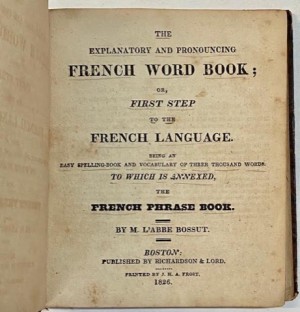
Hardcover. Boston, MA, Richardson & Lord, 1st edition, 1826, Book: Fair, Dust Jacket: None, 125 pages plus publisher ads. Hardcover. Small: 4.5" W x 5.5" L. Previous owners' names on front endpapers. Brown, marbled cover boards, brown quarter cloth, rubbing and chipping to cover boards (see image). Tanning and some foxing to pages from age (see image), doesn't affect text. Binding tight. Spine straight. Charming old, tiny textbook.
Hardcover. NY, Simon & Schuster, 1st, 2000, Book: Very Good, Dust Jacket: Very Good, Hardcover in a bright, unclipped dust jacket, 512 pages. B&w illustrations. With this handsome book, David Sweetman, a biographer of Vincent van Gogh and Paul Gauguin, brings together the dissolute lives of various artists who came to represent decadent fin-de-siecle Paris: Oscar Wilde, Felix Feneon, Alfred Jarry, and, of course, Henri de Toulouse-Lautrec. As the author reminds us, imitations of the latter's work adorn the walls of French-themed bars worldwide and have become a shorthand for sanitized debauchery. Toulouse-Lautrec--absinthe drinker and brothel frequenter--was instrumental in the development of the poster, but what is his artistic legacy? Although Toulouse-Lautrec dominates the book's subtitle, Sweetman's sweep is much grander. In much the same way as his main subject was, Sweetman proves a sympathetic host to the women of Montmartre, tragic figures such as La Goulue, Jane Avril, and Suzanne Valadon, and he is particularly insightful on the singer Aristide Bruant's influence on the fledgling artist. Clean copy.
Hardcover. Paris, Librairie d'Art, 1st, 1889, Book: Good, Dust Jacket: None, Hardcover, 348 pages, half leather with decorated cloth, raised bands on spine, red leather label with gilt title. Profusely illustrated throughout in b&w with FRENCH TEXT. Minor corner and edge wear and fade, otherwise, very clean and tight copy.
Hardcover. NY, Franklin Watts, 1st, 1959, Book: Very Good, Dust Jacket: Very Good, Hardcover in a bright, colorful wraparound dust jacket, price-clipped. 192 pages illustrated in color and b&w by Charles Mozley.
Hardcover. Boston , MFA Publications, 1st, 2006, Book: Very Good, Dust Jacket: Very Good, Hardcover, 223 pages, Like new in publisher's shrink-wrap. 145 illustrations. Both a historical overview and an up-to-the-minute spectacular, "Fashion Show" explores the ever-fascinating world of Paris couture-the history of the Paris fashion industry from its beginnings through the mid-twentieth century.
Hardcover. Paris, Editions Jafont, 1st, 1982, Book: Very Good, Dust Jacket: Very Good, Hardcover, French text. 185 pages, illustrated throughout in color and b&w. Grey cloth. Light shelf-wear to dust jacket. Overall, a tight clean copy.
Hardcover. New York, Crown, 1st, 1999, Book: Very Good, Dust Jacket: Good, Hardcover, 132 pages, illustrated throughout in b&w. INSCRIBED BY AUTHOR on title page. Previous owner's bookplate on front end paper, light shelf-wear and rubbing to dust jacket. Clean, tight copy. As a serviceman in Paris after World War II, Peter Miller served as a US Army Signal Corps photographer. By day, he would snap one-star generals greeting four-star generals, and the innumerable grip and grins of Congressmen visiting soldiers. By night, Miller traversed the city of light, capturing the resilient spirit of Parisians in the wake of the devastating war. Miller's photographs reflect the vision of a sparkling city while his recollections document the wonder and enchantment felt by a young man from Vermont. From pictures of the Latin Quarter brimming with American jazz and blues to alluring models on the runways of Christian Dior; from romantic courtships in the streets to hobos along the River Seine, Miller captures these sights and impressions in dynamic compositions and sensitive recollections that are striking, compassionate, and a joy to all lovers of the city of light.
Hardcover. NY, Crown, 1st, 1999-12-08, Book: Very Good, Dust Jacket: Very Good, 132 pages, illustrated throughout in b&w. Light edgewear and rubbing to dust jacket, else a clean, tight copy. SIGNED BY MILLER.
Hardcover. NY, Viking, 1st, 1992, Book: Very Good, Dust Jacket: Very Good, Hardcover in a bright, price-clipped dust jacket, 374 pages.Translated by Joan Pinkham, notes, bibliography, index, b/w photo plates, white boards/black cloth. Originally published Librairie Flammarion, Paris, 1988. First American Edition.
Hardcover. NY, E.P. Dutton, 1st, 1955, Book: Very Good, Dust Jacket: Good, Hardcover, 219 pages, b&w photos. The author was the owner/manager of famous girl revue for 40 years and gives us this history. Preface by Maurice Chevalier. Dust jacket shoes wear, chipping.
Hardcover. San Francisco, Harper & Row, 1st, 1987, Book: Very Good, Dust Jacket: Very Good, 363 pages. Hardcover with dust jacket. A very clean, unmarked copy with only minor wear to dust jacket edges. A tight copy. Recounts the life of the prolific author, inveterate explorer, pioneer feminist, and world authority on Tibetan Buddhist tantric rites.
Hardcover. New York, Frederick A Stokes, 1st, 1914, Book: Very Good, Dust Jacket: None, Hardcover, 215 pages. Red cloth, gilt lettering. Very minor wear to spine. Full illustrated plates by Edwards, some with tissue guard. Frontispiece illustration. Illustrated end papers. Top edge gilt. Some pages uncut.
Hardcover. Chicago, Rand McNally & Co , reprint, Book: Very Good, Dust Jacket: None, Hardcover, glossy pictorial boards, The squirrel family leaves their home in the woods, which is threatened by woodsmen, and seek refuge in a nearby garden. 64 pages with eight color plates and additional b&w drawings by Frances Beem. Several of the drawings have been colored by a child.

 "Doisneau: Parisby: Doisneau/Francine Deroudille, Robert")
 "Dream States: Puvis de Chavannes, Modernism, and the Fantasy of Franceby: Shaw, Professor Jennifer L.")
 "Dreyfus: Politics, Emotion, and the Scandal of the Century by: Ruth Harris")
 "Dreyfus: The Prisoner of Devil's Island. A Full Story of the Most Remarkable Military Trial and Scandal of the Age by: William Harding")
 "Early Modern Cartesianisms: Dutch and French Constructionsby: Schmaltz, Tad M.")
 "Elements of Style: The Art of the Bronze Mount in 18th and 19th Century Franceby: Penelope Hunter-Stiebel")
 "En Guerre: French Illustrators and World War Iby: Harris, Neil and Teri J. Edelstein")
 "Encore Henri !by: Kahl, Virginia & Edith Vacheron")
 "Essai philosophique concernant l'entendement humain (FRENCH TEXT)by: Locke, John")
 "Eugene Atget: Paris (Masters of the Camera)by: Eugene Atget")
 "Eugene Atget: Unknown Parisby: David Harris/Atget")
 "Explanatory and Pronouncing French Word Book; or, First Step to the French Languageby: Bossut, M. L'Abbe")

 "Explosive Acts: Toulouse Lautrec Oscar Wilde Felix Feneon and the Art & Anarchy of the Fin De Siecle by: Sweetman, David")
 "Exposition Des Beaux-Arts - Salon de 1889: Catalogue Illustre Peinture & Sculptureby: Baschet (Editor), Ludovic")
 "Famous French Fairy Tales Collected and Adapted from the Original Perrault by: Perrault, Charles & Stone, David")
 "Fashion Show: Paris Styleby: Ward, Susan")
 "Felix Buhot, peintre-graveur, 1847-1898by: Fontaine, Andre")
 "First Time I Saw Paris, The : Photographs and Memories from the City of Light (SIGNED COPY)by: Miller, Peter")
 "First Time I Saw Paris, The : Photographs and Memories from the City of Light (SIGNED COPY)by: Miller, Peter")
 "Flaubert by: Henri Troyat")
 "Folies-Bergere by: Durval, Paul")
 "Forbidden Journey: The Life of Alexandra David-Neelby: Foster, Barbara and Michael")
 "Forest of Arden, The by: Edwards, George Wharton")
 "Foxy Squirrel in the Gardenby: Clara Ingram Judson /Frances Beem")