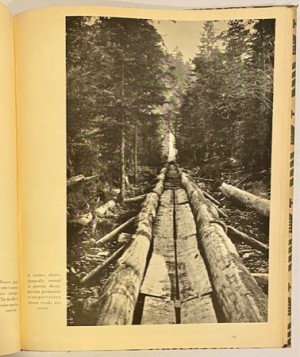
Hardcover. New York, German Library of Information, 1st, 1940, Book: Good, Dust Jacket: None, 127 pages. Hardcover. B/w illustrations throughout. Former library book with labels/stamps/attachments expected. Photographs by the author. Decorated cover boards. Pages and covers have some tanning from age. This volume, intended for American students, interprets the social, economic, hygenic, aesthetic and ethical significance of the German forest, presenting not merely facts but also the philosophy of German Forestry.
Hardcover. New York , George H. Doran, unknown, ND, Book: Very Good, Dust Jacket: None, Hardcover, red cloth, 249 pages. Faint foxing to edges, Previous owner's inscription on front end paper, else a clean, tight copy.
Hardcover. London, Chatto and Windus, reprint, 1892, Book: Very Good, Dust Jacket: None, 335 pages. Introduction by John Ruskin. Green cloth covers, gilt titles to spine and front, all edges gilt, slip-on plastic protective covering to boards, numerous b&w illustrations by George Cruikshank. Slight foxing to endpapers, previous owner's inscription in pencil to half title page, pages crisp and unmarked, stiff binding, clean covers; a very clean, tight copy in great condition.
Hardcover. London, George Allen & Unwin, reprint, 1965, Book: Very Good, Dust Jacket: None, Hardcover, dark blue cloth, gilt lettering on spine. 184 pages, clean, bright copy. No dust jacket.
Hardcover. NY, Liveright, 1st, 2023, Book: Very Good, Dust Jacket: Very Good, Hardcover in a bright, unclipped dust jacket, 432 pages, b&w illustrations. As the great Austrian writer Stefan Zweig confided in his autobiography, written in exile, "I have a pretty thorough knowledge of history, but never, to my recollection, has it produced such madness in such gigantic proportions." He was referring to the situation in Germany in 1923. It was a "year of lunacy," defined by hyperinflation, a political system on the verge of collapse, and separatist movements that threatened Germany's territorial integrity. Most significantly, Adolf Hitler launched his infamous Beer Hall Putsch in Munich-a failed coup that nonetheless drew international attention and demonstrated the Nazis' ruthless determination to seize power. In Germany 1923, award-winning historian Volker Ullrich draws on letters, memoirs, newspaper articles, and other sources from the time to present a captivating new history of those explosive twelve months. Clean copy.
Hardcover. NY, Abrams, 1st, 1981, Book: Very Good, Dust Jacket: Very Good, Hardcover, 96 pages, in a bright dust jacket. Photographs taken by Alfred Eisenstaedt in Germany in the 1920s and 1930s and on a return trip to Germany in 1979.
Softcover. Princeton NJ, Princeton University Press, 2nd pr., 1997, Book: Very Good, Dust Jacket: None, Softcover in pictorial wrappers, 255 pages. Color and black and white illustrations throughout. Second paperback printing. Bright and clean. Hans Holbein the Younger (1497/8-1543), one of the most versatile and admired painters of the Northern Renaissance, trained under his father in Augsburg and then worked for leading patrons in Switzerland before settling in England as Court Painter to Henry VIII. To commemorate the five-hundredth anniversary of the artist's birth, Oskar Batschmann and Pascal Griener offer this richly illustrated book the first comprehensive monograph on the artist to appear in more than forty years which is a major advance in our understanding of Holbein's contribution to European art.
Hardcover. New York, State University of New York Press, 1st, 1991, Book: Very Good, Dust Jacket: Very Good, 233 pages. Hardcover. Dust jacket with light wear. Clean unmarked text.
Hardcover. Woodstock NY, Overlook Press, 1st US, 2003, Book: Very Good, Dust Jacket: Very Good, Hardcover in a bright dust jacket, 456 pages with b&w and color illustrations. In Hitler and the Power of Aesthetics, acclaimed historian Frederic Spotts presents a startling reassessment of Hitler's aims and motivations. Spotts dismisses the traditional biographical view that Hitler was an "unperson," who had no life outside of politics, Spotts shows that Hitler's interest in the arts was as intense as his racism and his argument is punctuated with photographs and illustrations, including reproductions of Hitler's watercolors and drawings from his 1925 sketchbook. The book offers the first full analysis of Hitler's own work as a painter, as well as of his art collection. It also treats the entire range of his personal interests: from architecture, painting, symphony, opera, and sculpture, to the German autobahn system and the development of the Volkswagen. A riveting and highly original work, Hitler and the Power of Aesthetics provides a key to an understanding of the Third Reich which has, until now, been missing from biographies and studies of the arts in the Third Reich, as well as from political and military studies of Hitler. Clean copy.
Hardcover. Wilby UK, Michael Russell Publishing, 1st UK, 1997, Book: Very Good, Dust Jacket: Very Good, Hardcover in a bright dust jacket. 391 pages, b&w illustrations, translated from the German by G.T. Waddington. An insider's account of the turbulent rise and fall of Hitler's "Thousand Year Reich". Clean copy.
Hardcover. Chiselbury, 1st, 2024, Book: Very Good, Dust Jacket: None, Hardcover in glossy pictorial boards, 356 pages. An amazing real-life story of espionage, of courage and resistance, and of friendship and love. It pulls back the veil on the hidden history of the struggle for the identity of the Resistance in France. The life of 'André' Joseph Scheinmann is more intriguing and compelling than any work of fiction. His true-life story of derring-do starts as a Jewish youth in Munich, whose family moves to France in 1933 to escape the Nazi tide. He joins the French army at the outbreak of WW2 and escapes from a prisoner-of war camp after the bitterly brief fight for France in the summer of 1940. André becomes a spy and saboteur for the British and Free French whilst working undercover as translator and liaison with the German high command at the Brittany headquarters of the French National Railroads. Summoned by the British, he clandestinely crosses the Channel for initiation and training as an MI6 agent in England. His network betrayed during his absence, he is arrested on his return to France. André then begins an even more perilous journey with interrogation in Gestapo prisons and the little-known Natzweiler concentration camp in Alsace, before being transferred to Dachau and Allach, ahead of the advancing Allies. Illustrated with over 120 vintage and color photographs and letters. Clean copy.
Hardcover. Chicago, Henry Regnery Company, 1st, 1950, Book: Very Good, Dust Jacket: Fair, Hardcover in a worn, chipped dust jacket. Map endpapers, 176 pages, b&w photos. The first book by a German general published in America after the war, a German account of the D-Day & Normandy 'invasion' by Allied forces; the author was Rommel's Chief-of-Staff and therefore had an inside view of Rommel's efforts to get Hitler to negotiate a peace in the face of overwhelming Allied superiority. Speidel was a career military officer and trained historian; a German nationalist, he disagreed with racist Nazi policies, was involved in the 20 July plot to kill Hitler, and was important in rebuilding Germany's army after the war. Clean copy.
Softcover. Cambridge MA, Harvard University Press, reprint, 2008, Book: Very Good, Dust Jacket: None, Softcover, 776 pages. "Iron Kingdom, Christopher Clark's stately, authoritative history of Prussia from its humble beginnings to its ignominious end, presents a much more complicated and compelling picture of the German state, which is too often reduced to a caricature of spiked helmets and polished boots. Prussia and its army were inseparable, but Prussia was also renowned for its efficient, incorruptible civil service; its innovative system of social services; its religious tolerance; and its unrivaled education system, a model for the rest of Germany and the world. This too was Prussia-a tormented kingdom that, like a tragic hero, was brought down by the very qualities that raised it up. Mr. Clark, a senior lecturer in modern European history at Cambridge University, does an exemplary job. A lively writer, he organizes masses of material in orderly fashion, clearly establishing his main themes and pausing at crucial junctures to recapitulate and reconsider. Prussia, a self-invented artifact right down to its name, demands the kind of careful demythologizing that it receives from Mr. Clark, who gently but insistently exposes the flaws in most of the received wisdom about his subject. A result is an illuminating, profoundly satisfying work of history, brightened by vivid character sketches of the principals in his drama." Clean copy.
Softcover. San Francisco, Chronicle Books, 1st, 1993, Book: Very Good, Dust Jacket: None, Softcover, 133 pages illustrated in color. This lavishly illustrated volume offers a unique survey of Italian commercial graphic design during a period of both creative artistic vitality and extreme political turmoil. The first English-language book to showcase the bold typography and streamlined imagery of modern Italian design motifs on commercial products of the day, this fascinating and important resource for designers, history buffs, and collectors includes a discussion of the Futurist influence on the Italian Art Deco style and the success of such individualized expression despite a ruthless Fascist regime. Clean copy.
Hardcover. Chapel Hill, University of North Carolina Press., 1st, 1981, Book: Very Good, Dust Jacket: Very Good, Hardcover in a lightly worn dust jacket, 364 pages, b&w illustrations. As the most learned and eminent public lawyer in Germany, a busy administrator, and a prolific writer, Moser (1701-85) lived and breathed the political order. His correspondence, memoranda, and manuscript autobiography reflect the intricate day-to-day operations of the empire, and his fascinating life is a microcosm of the life and style of the empire itself. The biography provided a comprehensive picture of the empire between the Thirty Years War and the revolutionary era. Dust jacket spine faded otherwise very good, clean.
Hardcover. Ostfildern GR, Hatje Cantz, 1st, 2008, Book: Very Good, Dust Jacket: Very Good, Hardcover, 288 pages 231 illustrations 60 in color with 274 plans and drawings. Biography. Like new in publisher's shrink-wrap. Josef Paul Kleihues (1933-2004) was one of the most prolific architects of postwar Germany, famous both as the Director of the International Building Exhibition Berlin in 1987 and for his design for the Museum of Contemporary Art in Chicago. He was also known for his sensitive interventions into older buildings, an instance of which is the former Hamburger Bahnhof--now the Museum fur Gegenwart--in Berlin, where Kleihues intermixed glass walls and light installations by the American Minimalist Dan Flavin with the building's original nineteenth-century Neoclassical design. (His reconstruction was widely deemed to rival or even surpass Gae Aulenti's overhaul of the interior of the Musee d'Orsay in Paris.) This first volume of a three-part monograph presents projects up to 1980, including the highly acclaimed Berlin Sanitation Department and the Neukolln Hospital. Even in these early works, Kleihues' practical, problem-solving approach is already evident, indicating his readiness to reflect on the traditional approaches of Modern architecture and his capacity to expand them in interesting ways. This very generously illustrated volume was designed by Kleihues himself, just before his death in 2004.
Hardcover. Munich/NJ, Prestel, 1st, 2021, Book: Very Good, Dust Jacket: Very Good, Hardcover in a bright dust jacket, 256 pages. One of the most important German postwar artists, Joseph Beuys is known for his drawings, performance art, activism, and teaching, influencing a generation of younger artists and expanding the concept of what art is. He had an ambitious goal for his art: to transform western culture into a more peaceful, democratic, and creative place. He also considered everyone to be an artist and that art and life should not be viewed separately. This book pulls together all of the avant-garde artist's posters from his entire oeuvre. His earliest posters often announced exhibitions of his own performance art, while later posters expressed his philosophical and political opinions, such as those for Germany's Green Party, which he was a founding member of. This book includes full page illustrations of Beuys' most important posters, essays about Beuys' influence, an extensive biography of the artist and a complete catalogue of all posters created under his guidance. Text in English and German. Still in publisher's shrinkwrap.
Hardcover. Leipzig, Germany, Kurt Wolff Verlag, 1st, 1915, Book: Very Good, Dust Jacket: None, Hardcover, 338 pages, plus postscript in rear, GERMAN TEXT. Purple cloth cover with Art Deco motif. Light edge wear, otherwise, very clean and tight copy.
Softcover. Old Westbury NY, The Feminist Press, 1st, 1976, Book: Very Good, Dust Jacket: None, Softcover, 237 pages, b&w illustrations. A generation after her death, German artist Kathe Kollwitz won a reputation as one of the great graphic artists of the 20th Century. Concentrating on the more 'democratic' media--especially etchings, lithographs, posters, and woodcuts, as well as sculpture and bronze reliefs--Kollwitz always created for the people, rather than for the upper class collector. This original paperback is generously illustrated with many striking, seldom-seen reproductions from private collections, assembled in one volume for the first time. Name on front fly leaf, inscription on title page. Otherwise clean.
Hardcover. Koln GR, Taschen, 1st, 2001, Book: Very Good, Dust Jacket: Very Good, Hardcover, 336 pages. One remarkable woman, five remarkable careers: Leni Riefenstahl is the exception to the rule. From dancer to actress to film-maker to photographer to diver, she has excelled in each field and is one of the most important and controversial artists of the 20th century. Her contributions to the art and technique of film-making were vast, most notably in her epochal film "Olympia" (1938). Critically acclaimed during the 1930's for her work under the Hitler administration and harshly criticized after the war, Riefenstahl surged on, completing the famous "Tiefland" in 1954. In the 1960s and 70s she traveled to Africa and extensively photographed East Africa and the Nuba tribes in Sudan, publishing three books. Ready for yet another change, she took up deep-sea diving at the age of 71, beginning a new chapter as an underwater photographer. Though she has attracted much attention throughout her life and has been the subject of many books, articles, and films, Leni Riefenstahl Five Lives is the first book to showcase her entire career in pictures. Produced in collaboration with Riefenstahl herself, the book includes her most famous images as well as many previously unpublished pictures from her private archives.
Hardcover. NY, Knopf, 1st, 2007, Book: Very Good, Dust Jacket: Very Good, Hardcover, 400 pages. The definitive biography of Leni Riefenstahl, the woman best known as "Hitler's filmmaker," one of the most fascinating and controversial personalities of the twentieth century. It is the story of huge talent and huger ambition, one that probes the sometimes blurred borders dividing art and beauty from truth and humanity. Relying on new sources--including interviews with her colleagues and intimate friends, as well as on previously unknown recordings of Riefenstahl herself--Bach gives us an exceptional work of historical investigation that untangles the past and is also an objective but unsparing appraisal of a woman of spectacular gifts corrupted by ruthless personal ambition.
Hardcover. London, The Cresset Press, 1st, 1966, Book: Very Good, Dust Jacket: Very Good, Hardcover in a bright dust jacket with light edgewear. 297 pages + 26 b&w plates. English language edition. Translated from the German and with an introduction by Innes and and Gustav Herdan. Contains very clever and funny remarks on Hogarth's engravings by an 18th century German professor of physics. Small owner's stamp on front fly leaf, otherwise clean.
Softcover. Zenith Press, reprint, 2004, Book: Very Good, Dust Jacket: None, Softcover, 574 pages, b&w illustrations. Originally published in Germany in 1955, and in England and the United States in 1958, this classic memoir of WWII by a man who was an acknowledged military genius and probably Germany's top WWII general, is now made available again. Field Marshal Erich von Manstein described his book as a personal narrative of a soldier, discussing only those matters that had direct bearing on events in the military field. The essential thing, as he wrote, is to "know how the main personalities thought and reacted to events." This is what he tells us in this book. His account is detailed, yet dispassionate and objective. Clean copy.

 "German Forests: Treasures of a Nationby: Ebner, Dr. Adalbert")

 "German Fury in Belgium, Theby: Mokveld, L.")
 "German Popular Storiesby: Ruskin (ed.), John")


 "Germany 1923: Hyperinflation, Hitler's Putsch, and Democracy in Crisisby: Volker Ullrich / Jefferson Chase (Translator)")
 "Germanyby: Eisenstaedt, Alfred")
 "Hans Holbein by: Batschmann, Oskar and Pascal Griener")
 "Heidegger and the Project of Fundamental Ontologyby: Taminiaux, Jacques")
 "Hitler and the Power of Aestheticsby: Spotts, Frederic")
 "How We Squandered the Reichby: Spitzy, Reinhard")
 "I Am André: German Jew, French Resistance Fighter, British Spyby: Diana Mara Henry")
 "Invasion 1944: Rommel and the Normandy Campaign by: Hans Speidel")
 "Iron Kingdom: The Rise and Downfall of Prussia, 1600–1947by: Christopher Clark")
 "Italian Art Deco: Graphic Design between the Warsby: Heller, Steven / Fili, Louise")
 "Johann Jakob Moser and the Holy Roman Empire of the German Nation by: Walker, Mack")
 "Josef Paul Kleihuesby: Kleihues, Josef Paul, Andrea Mesecke and Thorsten Scheer")
 "Joseph Beuys: Life and Worksby: Beuys, Joseph")
 "Joseph Beuys: Plakate Postersby: Rene Spiegelberger /Claus Von Der Osten")


 "Judinnen (GERMAN ED.)by: Brod, Max")
 "Kathe Kollwitz: Woman and Artistby: Martha Kearns")
 "Leni Riefenstahl-Five Lives: A Biography in Picturesby: Walk Ines; Leni Riefenstahl")
 "Leni: The Life and Work of Leni Riefenstahlby: Bach, Steven")
 "Lichtenberg's Commentaries on Hogarth's Engravings by: Herdan, Innes & Gustav (translated by)")
 "Lost Victories: War Memoirs of Hitlers Most Brilliant General by: Von Manstein, Field Marshal Erich")