Hardcover. NY, The Free Press, 1st, 1965, Book: Very Good, Dust Jacket: Very Good, Hardcover in a lightly worn dust jacket, 330 pages. This book traces the central developments in American literature between and 1919. It opens with an account of the consolidation of realism as the dominant standard of critical value and brings the reader forward to the moment, at the end of World War I, when American writers began to take a recognized place among the masters of literary modernism. The ascendancy of the novel as the principal genre of the realists is presented against a broader cultural and historical background. Professor Berthoff reviews and evaluates American fiction from the time when Howells, Twain, and Henry James were still under attack by old-school idealizers, to the emergence of a new critical and testamentary realism with Crane, Dreiser, and Gertrude Stein. Clean copy.
Softcover. Cambridge MA, Harvard University Press, 1st, 1995, Book: Very Good, Dust Jacket: None, Softcover, 139 pages. How does a poet repeatedly make art over a lifetime out of an arbitrary assignment of fate? By asking this question of the work of four American poets--two men of the postwar generation, two young women writing today--Helen Vendler suggests a fruitful way of looking at a poet's career and a new way of understanding poetic strategies as both mastery of forms and forms of mastery. Fate hands every poet certain unavoidable "givens." Of the poets Vendler studies, Robert Lowell sprang from a family famous in American and especially New England history; John Berryman found himself an alcoholic manic-depressive; Rita Dove was born black; Jorie Graham grew up trilingual, with three words for every object. In Vendler's readings, we see how these poets return again and again to the problems set out by their givens, and how each invents complex ways, both thematic and formal, of making poetry out of fate. Clean copy.
Softcover. Berkeley, University of California Press, 1st, 1987, Book: Very Good, Dust Jacket: None, Softcover, 248 pages. Name on front fly leaf whited out, otherwise clean.
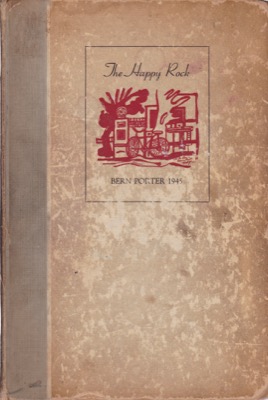
Hardcover. Berkeley CA, Bern Porter, 1st, 1945, Book: Fair, Dust Jacket: None, Hardcover. No. 260 out of 750 copies bound for distribution. 157 pages. Tan boards with wear and soiling, gray cloth spine. Shelving information on spine. Front hinge cracked. Ex-library. Printed on various colored paper, with contributions by a lot of well known authors, including Williams, Patchen, Durrell, Lamantia, many others. Edges soiled. Interior very good.
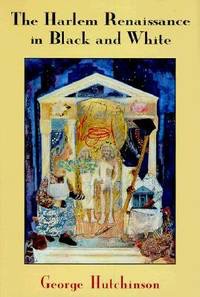
Softcover. Cambridge MA, Harvard University Press, 3rd pr., 1997, Book: Very Good, Dust Jacket: None, Softcover, 541 pages. It wasn't all black or white. It wasn't a vogue. It wasn't a failure. By restoring interracial dimensions left out of accounts of the Harlem Renaissance--or blamed for corrupting it--George Hutchinson transforms our understanding of black (and white) literary modernism, interracial literary relations, and twentieth-century cultural nationalism in the United States. What has been missing from literary histories of the time is a broader sense of the intellectual context of the Harlem Renaissance, and Hutchinson supplies that here: Boas's anthropology, Park's sociology, various strands of pragmatism and cultural nationalism--ideas that shaped the New Negro movement and the literary field, where the movement flourished. Hutchinson tracks the resulting transformation of literary institutions and organizations in the 1920s, offering a detailed account of the journals and presses, black and white, that published the work of the "New Negroes." This cultural excavation discredits bedrock assumptions about the motives of white interest in the renaissance, and about black relationships to white intellectuals of the period. Clean copy.
Hardcover. Pinceton NJ, Princeton University Press, 1st, 1979, Book: Very Good, Dust Jacket: Very Good, Hardcover in a bright dust jacket, 315 pages. The Western ideal of individualism had a pervasive influence on the culture of the Meiji period in Japan (1868-1912). Janet Walker argues that this ideal also had an important influence on the development of the modern Japanese novel. Focusing on the work of four late Meiji writers, she analyzes their contribution to the development of a type of novel whose aim was the depiction of the modern Japanese individual. Professor Walker suggests that Meiji novels of the individual provided their readers with mirrors in which to confront their new-found sense of individuality. Her treatment of these novels as confessions allows her to discuss the development of modern Japanese literature and "the modern literary self" both in themselves and as they compare their prototypes and analogues in European literature. The author begins by examining the evolution of a literary concept of the inner self in Futabatei Shimei's novel Ukigumo (The Floating Clouds), Kitamura Tokoku's essays on the inner life, and Tayama Katai's I-novel Futon (The Quilt). She devotes the second half of her book to Shimazaki Toson, the Meiji novelist who was most influenced by the ideal of individualism. Here she traces Toson's development of a personal ideal of selfhood and analyzes in detail two examples of the lengthy confessional novel form that he created as a vehicle for its expression.
Hardcover. NY, Harcourt, Brace & World, 1st, 1955, Book: Very Good, Dust Jacket: Fair, Hardcover in a worn, chipped dust jacket, 309 pages. A collection of essays from the famed literary critic. Clean copy.
Hardcover. Charlestown MA, Printed and Sold By Samuel Etheridge, Revised Ed., 1810, Book: Very Good, Hardcovers, two volumes complete, 432 and 448 pages. bound in 3/4 calf, with red leather spine labels intact, bindings tight. New corrected edition. A collection of biographical studies on the life of important poets in the cannon of English literature, including: Cowley, Milton, Blackmore, Granville, Somerville, Thomson, Mallet, and Lyttelton. Written by Samuel Johnson, an English writer who made lasting contributions as a poet, playwright, essayist, moralist, critic, biographer, editor, and lexicographer. With the original advertisement to the first edition. originally published in 1779-81. Light edgewear to covers, mild water stain to first 4 pages of Vol. 2, otherwise clean, mild foxing, very good set overall.
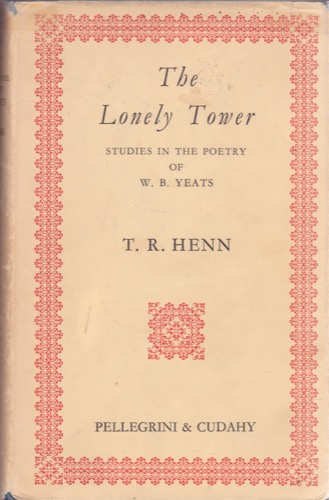
Hardcover. NY, Pellegrini & Cudahy, 1st, 1952, Book: Very Good, Dust Jacket: Very Good, Hardcover in a mildly soiled dust jacket with tanning to spine,name on front fly leaf, otherwise clean.
Hardcover. NY, Free Press, 1st, 1987, Book: Very Good, Dust Jacket: Very Good, Hardcover in a bright dust jacket, 270 pages, b&w illustrations. Light edgewear to dust jacket, else a clean, tight copy. Recounts the life of the English poet who died during World War I, looks at the group of his friends and fellow poets known as the Neo-Pagans, and discusses the influence of homosexuality on his life. His sonnet "The Soldier" and early death in World War I made British poet Rupert Brooke a key figure in the nation's myth of patriotism and youthful valor. Biographer Delaney places him among the Neo-pagans, a small circle of writers, artists, and intellectuals who flourished from 1908 to 1912. The group honored youth, comradeship, and the simple life and aimed to set aside the constraints of Victorianism. Delany shows how the internal dynamics of the group, not shock of war, led to its disintegration.
Hardcover. Athens GA, University of Georgia Press, 1st, 1986, Book: Very Good, Dust Jacket: Very Good, Hardcover in a bright dust jacket. 176 pages. INSCRIBED BY AUTHOR on front end paper. In the 1960s, as the underpinnings of society weakened, the traditional novel form seemed less suited to describe American reality. Theorists groped towards non-mimetic fiction as the tools that had sustained the novel since its birth-coherent characterization, linear plot, symbolism-became tools of New Journalism. The New American Novel of Manners explores the virtual reinvention of the novel of manners in America out of the same subjectivity that charged the works of New Journalism. In place of the rigid social structures that never seemed to depict America, novelists such as Richard Yates, Dan Wakefield, and Thomas McGuane located America's modern-day manners in its semiotics, in the system of signs that envelops us-the blue jeans people wear, the fast food they eat, the decor of the bars they drink in and the rock-and-roll lyrics that play through memories. The new generation of mannerists describe lifestyles that are determined by words and images, by actions that are dictated by what has been read and seen, and patterns of behavior in which life is edited and fictionalized. Klinkowitz reveals a fiction that is once again capable of reflecting the way people live. Clean copy.
Softcover. Seattle, Wave Books, 1st, 2023, Book: Very Good, Dust Jacket: None, Softcover, 219 pages. A collection of essay/talks that the poet Rachel Zucker, expanded from lectures presented for the Bagley Wright Lecture Series in 2016. Devastating in their revelations, yet hopeful in their endurance, these are lectures of protest and reckoning. Zucker declares 'I write against. My poetics is a poetics of opposition and provocation that I never outgrew. Against the status quo or the powers that be, writing out of and into wrongness.' Thus, Zucker deftly dismantles the outdated paradigms of motherhood, aesthetics, feminism, poetics, and politics. Bringing Bernadette Mayer, Marina Abramovic, Alice Notley, Adrienne Rich, Audre Lorde-among many others-into the conversation, Zucker questions the categories that have been imposed on poetry, as well as a poet's need to speak, and the resulting responsibilities. Clean copy.
Softcover. NY, Oxford University Press, repriny, 1989, Book: Very Good, Dust Jacket: None, Softcover, 290 pages. Henry Louis Gates, Jr.'s original, groundbreaking study explores the relationship between the African and African-American vernacular traditions and black literature, elaborating a new critical approach located within this tradition that allows the black voice to speak for itself. Examining the ancient poetry and myths found in African, Latin American, and Caribbean culture, and particularly the Yoruba trickster figure of Esu-Elegbara and the Signifying Monkey whose myths help articulate the black tradition's theory of its literature, Gates uncovers a unique system for interpretation and a powerful vernacular tradition that black slaves brought with them to the New World. His critical approach relies heavily on the Signifying Monkey--perhaps the most popular figure in African-American folklore--and signification and Signifyin(g). Exploring signification in black American life and literature by analyzing the transmission and revision of various signifying figures, Gates provides an extended analysis of what he calls the "Talking Book," a central trope in early slave narratives that virtually defines the tradition of black American letters. Gates uses this critical framework to examine several major works of African-American literature--including Zora Neale Hurston's Their Eyes Were Watching God, Ralph Ellison's Invisible Man, and Ishmael Reed's Mumbo Jumbo--revealing how these works signify on the black tradition and on each other. Clean copy.
Hardcover. Albuquerque NM, University of New Mexico Press, 1st, 1989, Book: Very Good, Dust Jacket: Very Good, Hardcover in a bright dust jacket, 217 pages. Includes essays on William Everson, Robert Duncan, Gary Snyder, Kenneth Rexroth, Michael McClure, Nathaniel Tarn, Thom Gunn and more. Notes, bibliography. Clean copy.
Hardcover. San Francisco, Sierra Club Books, 1st, 1986, Book: Very Good, Dust Jacket: Very Good, Hardcover in a lightly worn dust jacket. 51 pages, illustrated with wood engravings by Michael McCurdy. Bly's commentary sheds important new light on the intellectual and spiritual development of a major American literary figure. Mild fade to dj spine. Clean copy.
Hardcover. New York, Doubleday, 1t, 2017, Book: Very Good, Dust Jacket: Very Good, 256 pages. Hardcover with dust jacket. Very clean, unmarked copy with only minor wear to dust jacket edges. A tight copy. Color illustrations throughout.
Hardcover. New York, Doubleday, 1t, 2017, Book: Very Good, Dust Jacket: Very Good, 256 pages. Hardcover with dust jacket. Very clean, unmarked copy with only minor wear to dust jacket edges. A tight copy. Color illustrations throughout.
Hardcover. Concord MA, Albert Lane/Erudite Press, 2nd Ed., 1903, Book: Very Good, Dust Jacket: None, Hardcover, gray-green boards over green cloth spine, 35 pages, frontis. portrait plus 3 halftone plates. First published in 1890, "It is a pious duty to his memory to correct the errors of fact that were ... reported in the first edition of the Glimpse 1890." Jones was part of the rehabilitation of Thoreau's reputation and appreciation. Previous owner's bookmark on inside front cover, Paper label on spine mostly gone, otherwise clean, very good.
Hardcover. Cambridge, Cambridge University Press, 1st ed., 1982, Book: Good, Dust Jacket: Good, 220 pages. Purple cloth boards with gilt lettering along spine. Few pages of light pencil underlining. Dust jacket has some foxing, mainly on flaps, and discoloring. Tight copy. The idea of man as an essentially irrational being has preoccupied some of the most influential of Russian thinkers, including the three important Soviet writers considered by Dr Edwards in this book. Since the 1917 Revolution the polemic between rationalists and irrationalists has become directly relevant to the way life is lived in the Soviet Union, and a knowledge of the irrationalist point of view is essential for an understanding of much of Soviet literature and of the foundations of Soviet dissidence. As with other titles in this series, this book is not intended simply for the specialist. The broad speculations arising from the subject will fascinate all those who take a serious interest in the Russian literary tradition; a tradition whose principal figures have been concerned to reject philosophical and political creeds that, in seeking to produce a perfect human being in a perfect society, point in fact towards a vision of hell.
San Marino, Huntington Library, 1st, 1974, Book: Very Good, Dust Jacket: None, 446 pages. Hardcover. Black covers with title and decoration in silver. Black & white illustrations. Some light pencil marking scattered throughout. Clean, tight copy.
Hardcover. NY, Random House, 1st US, 1978, Book: Very Good, Dust Jacket: Very Good, Hardcover in a bright, unclipped dust jacket, 382 pages. A biography of Ivan Turgenev, 19th-century Russian writer. The book is not a critical examination of Turgenev's literary output, but, of the man himself - enigmatic and unknown - and the world in which he lived, and the people he knew and associated with. Clean copy.
Hardcover. Princton NJ, Princeton University Press, 1st, 2001, Book: Very Good, Dust Jacket: Very Good, Hardcover in a bright dust jacket. Fairy tales, often said to be ''timeless'' and fundamentally ''oral,'' have a long written history. However, argues Elizabeth Wanning Harries in this provocative book, a vital part of this history has fallen by the wayside. The short, subtly didactic fairy tales of Charles Perrault and the Grimms have determined our notions about what fairy tales should be like. Harries argues that alongside these ''compact'' tales there exists another, ''complex'' tradition: tales written in France by the conteuses (storytelling women) in the 1690s and the late-twentieth-century tales by women writers that derive in part from this centuries-old tradition. Grounded firmly in social history and set in lucid prose, Twice upon a Time refocuses the lens through which we look at fairy tales.
Hardcover. NY, Henry Holt & Co., 1st, 1926, Book: Very Good, Dust Jacket: None, Hardcover, light gray boards with a black cloth spine with gilt lettering. Name and ownership stamp on front fly leaf, otherwise clean copy.
Softcover. UK, Cambridge University Press, 8th pr., 2008, Book: Very Good, Dust Jacket: None, Softcover, 751 pages. -In this wide-ranging book, based on her Gifford Lectures, philosopher Nussbaum draws on philosophy, psychology, anthropology, music and literature to illuminate the role emotions play in thoughts about important goals. Clean, bright copy.
Softcover. Amherst, University of Massachusetts Press, 1st, 1988, Book: Very Good, Dust Jacket: None, Softcover, 287 pages. Because Naipaul's work occupies such an important place in English literature today, it is necessary to understand the forces that shape his work and the issues with which he is concerned. If this study raises some of the more important questions about Naipaul's work and demonstrates that is cannot be seen as an unproblematic guide to post colonial "reality," then it would have gone a long way toward opening up the terrain in which the most meaningful discussion of his work can take place. Like it or not, Naipaul's work represents an important postcolonial impulse/response that begs to be understood and interpreted. Clean, bright copy.
Softcover. Cambridge UK/US, Cambridge University Press, reprint, 2006, Book: Very Good, Dust Jacket: None, Softcover, 321 pages. Virgil's agricultural poem, the Georgics, forms part of a long tradition of didactic epic going back to the archaic poet Hesiod. This book explores the relationship between the Georgics and earlier works in the didactic tradition, particularly Lucretius' De Rerum Natura ("On the Nature of Things"). It is the first comprehensive study of Virgil's use of Lucretian themes, imagery, ideas and language; it also proposes a new reading of the poem as a whole, as a confrontation between the Epicurean philosophy of Lucretius and the opposing world views of his predecessors. Clean copy.
Hardcover. Burlington VT, Ashgate , 1st, 2011, Book: Very Good, Dust Jacket: Very Good, Hardcover in a bright dust jacket. 259 pages. Despite the growing critical relevance of Shakespeare's two Venetian plays and a burgeoning bibliography on both The Merchant of Venice and Othello, few books have dealt extensively with the relationship between Shakespeare and Venice. Setting out to offer new perspectives to a traditional topic, this timely collection fills a gap.
NY, The Macmillan Company, 1st, 1958, Book: Very Good, Dust Jacket: Very Good, Hardcover in a nice dust jacket with light tanning to spine. A study and interpretation of Yeats' five plays and related lyrics. Includes notes, bibliography & index.
Softcover. Berkeley CA, University of California Press, 1st, 1994, Book: Very Good, Dust Jacket: None, Softcover, 316 pages. Few twentieth-century thinkers have proven as influential as Walter Benjamin, the German-Jewish philosopher and cultural and literary critic. Richard Wolin's book remains among the clearest and most insightful introductions to Benjamin's writings, offering a philosophically rich exposition of his complex relationship to Adorno, Brecht, Jewish Messianism, and Western Marxism. Wolin provides nuanced interpretations of Benjamin's widely studied writings on Baudelaire, historiography, and art in the age of mechanical reproduction. In a new Introduction written especially for this edition, Wolin discusses the unfinished Arcades Project, as well as recent tendencies in the reception of Benjamin's work and the relevance of his ideas to contemporary debates about modernity and postmodernity. Clean, bright copy.
Hardcover. Amherst, University of Massachusetts, 1st, 1972, Book: Very Good, Dust Jacket: Very Good, Hardcover, 217 pages. Previous owners inscription at top right corner of front endpaper. Dust jacket shows light wear. Clean, tight copy.
Hardcover. NY, Norton, 1st, 2020, Book: Very Good, Dust Jacket: Very Good, Hardcover in a bright, unclipped dust jacket. Effortlessly blending biography, criticism, and memoir, National Book Award-winning poet and best-selling memoirist Mark Doty explores his personal quest for Walt Whitman. Mark Doty has always felt haunted by Walt Whitman's bold, perennially new American voice, and by his equally radical claims about body and soul and what it means to be a self. In What Is the Grass, Doty--a poet, a New Yorker, and an American--keeps company with Whitman and his Leaves of Grass, tracing the resonances between his own experience and the legendary poet's life and work. What is it then between us? Whitman asks. In search of an answer, Doty explores spaces--both external and internal--where he finds the poet's ghost. He meditates on desire, love, and the mysterious wellsprings of the poet's enduring work: a radical experience of transformation and enlightenment, queer sexuality, and an obsession with death, as well as unabashed love for a great city and for the fresh, rowdy character of American speech. In riveting close readings threaded with personal memoir and illuminated by awe, Doty reveals the power of Whitman's persistent presence in his life and in the American imagination at large. Clean copy.
Hardcover. NY, Harcourt Brace Jovanovich, 1st, 1973, Book: Good, Dust Jacket: Good, Hardcover in a lightly worn and chipped dust jacket. 401 pages with index. Ex-lib copy with stamp to front fly leaf, envelope on rear endpaper, sticker on dust jacket spine, interior clean.
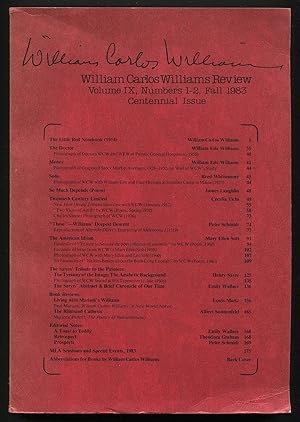
Softcover. Middletown PA, Pennsylvania State University, 1st, 1983, Book: Good, Dust Jacket: None, Softcover. Red perfect bound wrappers, 176 pages. Covers with a few faint creases, spine slightly faded, mild wave to book. Prints Williams' 80-page 1914 little red notebook in exact-size facsimiles with a transcription and two additional essays from his son William Eric Williams; additional contributions by Reed Whittemore, James Laughlin, Cecelia Tichi, Peter Schmidt, Mary Ellen Solt, Henry Sayre, Emily Wallace, Louis Martz and Albert Sonnenfeld. The journal showcases scholarly essays on any aspect of the life and work of William Carlos Williams.
Hardcover. Boston, Twayne Publishers, 1st, 1982, Book: Good, Dust Jacket: None, 191 pages, green cloth covers. A scarce study of the Caribbean writer which has been heavily annotated and underlined by Joyce Adler, the previous owner. Adler was a literary scholar and published two books on Harris herself.
Hardcover. Burlington, VT, Ashgate , 1st, 2014, Book: Very Good, Dust Jacket: None, 232 pages. Hardcover with no dust jacket. Clean, unmarked copy with only minor wear to wrappers.
Hardcover. Lewiston NY, Edwin Mellen Press, 1st, 1990, Book: Very Good, Dust Jacket: None, Hardcover, green cloth with gilt lettering, 424 pages plus appendix. This study provides an examination of the Spanish novelist Perez Galdos' turn to the stage in 1892 and his simultaneous shift in approach towards the roles of women in society. Faint pencil marking to about 25 pages in front of volume. Otherwise a tight, clean copy.
Hardcover. New York, Viking Press, 1st, 1967, Book: Very Good, Dust Jacket: Good, 368 pages. Hardcover. Features: Louis-Ferdinand Celine, Norman Mailer, William S. Burroughs, Allen Ginsberg, Jean Cocteau, Harold Pinter, and more. Price clipped dust jacket with short closed tears along edges - jacket now protected with clear plastic cover. Clean, tight copy.
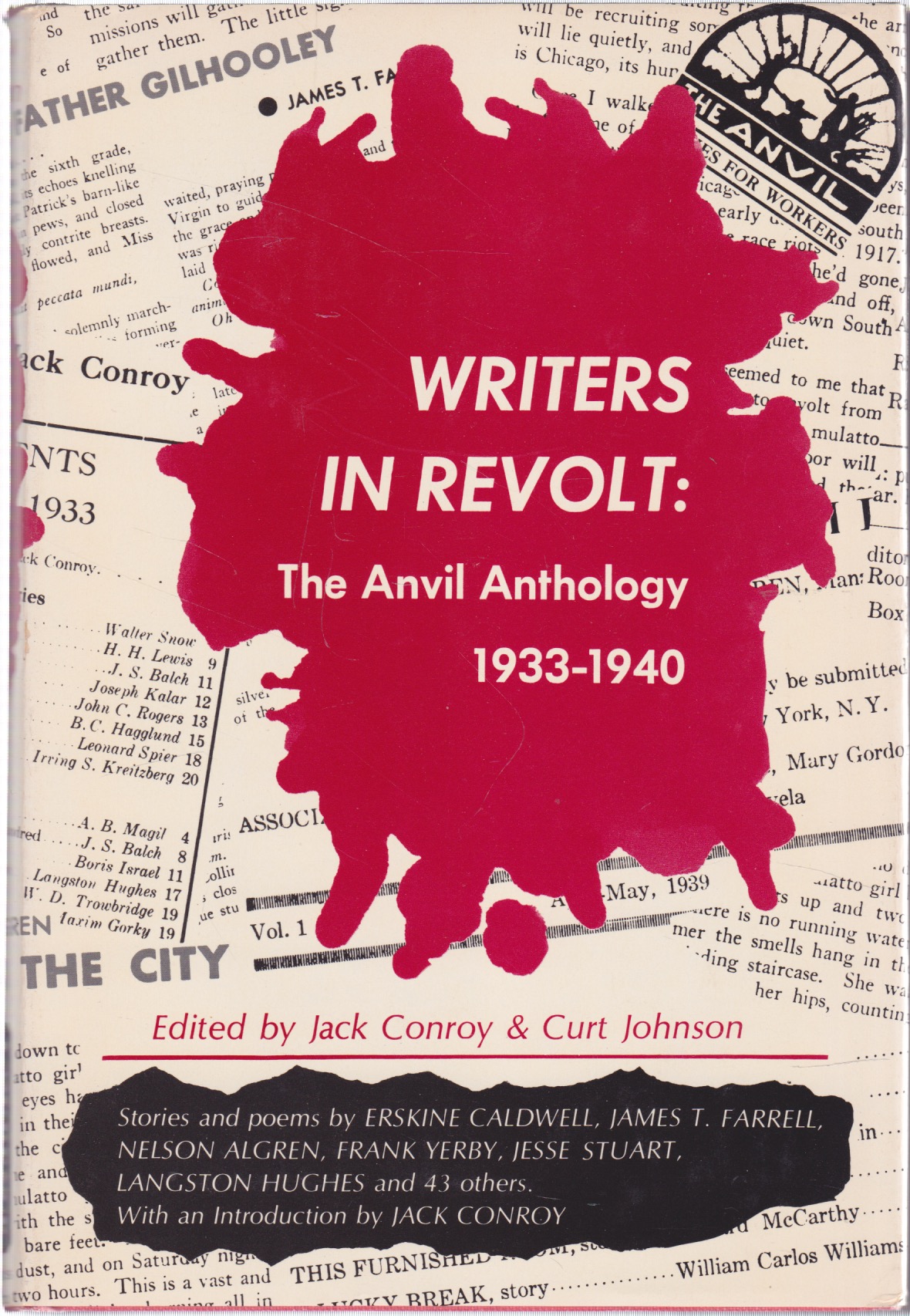
Hardcover. NY, Lawrence Hill and Company, 1st, 1973, Book: Very Good, Dust Jacket: Very Good, Hardcover in a bright, unclipped dust jacket. 234 pages.Introduction by Jack Conroy. Other contributors include Nelson Algren, Langston Hughes, Erskine Caldwell, James T. Farrell, William Carlos Williams, Michael Gold, Kenneth Patchen and Karl Shapiro. Clean, tight copy. Cheap paper tanning.
Hardcover. Cambridge MA, Harvard University Press, 1st, 1995, Book: Very Good, Dust Jacket: Very Good, Hardcover in a bright dust jacket, 145 pages. Gordimer examines the tension for a writer between life's experiences and narrative creations. She tries to unravel the mysterious process that breathes "real" life into fiction by exploring the writings of revolutionaries in South Africa and the works of Naguib Mahfouz, Chinua Achebe and Amos Oz. Ending on a personal note, Gordimer reveals her own experience of "writing her way out of" the confines of a dying colonialism.





 "The Lives of the Most Eminent English Poets; with Critical Observations on Their Works (2 Volumes) by: Johnson, Samuel")











 "Thoreau: A Glimpseby: Jones, Samuel Arthur")


 "Toward the Poetics of Surrealismby: Matthews, J. H.")








 "What the Woman Lived: Selected Letters of Louise Bogan, 1920-1970 by: Bogan, Louise; Edited by Ruth Limmer")


 "Writers at Work: The Paris Review Interviewsby: Cowley, Malcolm (Ed.)")
 "Writing and Being: The Charles Eliot Norton Lectures 1994 by: Nadine Gordimer")
)