Hardcover. Baltimore, Johns Hopkins Press, 1st, 1906, Book: Good, Dust Jacket: None, Hardcover, brown cloth covers with gilt lettering on spine, 95 pages. Ex-lib with residue, stamping to endpapers. Interior clean, probably a rebound softcover published in 1906.
Paperback. NY, Random House, 1st wraps, 1952, Book: Good, Dust Jacket: None, Softcover, 128 pgs. A collection of political speeches with a four page intro by Steinbeck. Fading to color on wraps with some shallow creases.
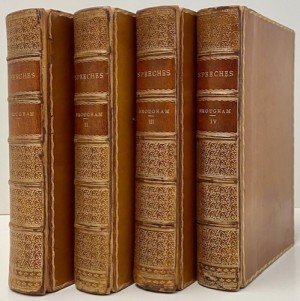
Hardcover. Edinburgh, Adam & Charles Black, 1st, 1838, Book: Very Good, Dust Jacket: None, Four volumes complete, [x], 676p, [1]; [iv], 632p; [iv], 626p; 571p+Index. Full calf binding, marbled edges, spine ribbed with 6 sections, 2 with leather labels and gilt titles. Gilt edge design on all edges, ornate gilt design on spine. Bookplate of Herbert John Gladstone on inside covers. He was a British Liberal politician. The youngest son of Prime Minister William Ewart Gladstone, he was Home Secretary from 1905 to 1910 and Governor-General of the Union of South Africa from 1910 to 1914. All volumes are bright and clean. Some minor wear to spine edges.
Hardcover. Birmingham AL, The Legal Classics Library , reprint, 1984, Book: Very Good, Dust Jacket: None, Hardcover, frontispiece. Burgundy calf, gilt spine with raised bands, all edges gilt, marbled endpapers, ribbon marker. Facsimile reprint of the 1876 edition published by Callaghan & Company, Chicago. Erskine was "probably the greatest advocate who ever practiced at the English bar," who "at once made his way by his eloquence." Previous owner's bookplate inside front covers, otherwise a clean, bright set.
Softcover. Indianapolis, Liberty Fund, reprint, 2001, Book: Very Good, Dust Jacket: None, Softcover, 325 pages. John Adams and Benjamin Rush were two remarkably different men who shared a devotion to liberty. Their dialogues on the implications of fame for their generation prove remarkably timely--even for the twenty-first century. Adams and Rush championed very different views on the nature of the American Revolution and of the republic established with the United States Constitution; yet they shared one of the most important correspondences of their time. John Adams and Benjamin Rush met in 1774 as members of the Continental Congress--Adams from Massachusetts, Rush from Pennsylvania. In 1805, after Adams was defeated in his quest of a second term as the new republic's second President, the two men self-consciously commenced an exchange of letters. Their recurring subject was fame. This emphasis on fame was crucial, Adams and Rush believed, because on the fame attached to individual leaders of the Revolutionary generation would depend the view of the Revolution and of the Constitution and republican government that would be embraced by generations to come, including our own. The Liberty Fund edition of The Spur of Fame reproduces a text originally published by the Huntington Library.
Hardcover. NY, Harcourt Brace Jovanovich, 1st, 1987, Book: Very Good, Dust Jacket: Very Good, Hardcover in a bright, unclipped dust jacket, 326 pages, b&w photos. Rosenblum, a journalist, and Williamson, a scientist, explore Africa in the 1980s and report ubiquitous disaster and tragedy. It weaves a backdrop of misguided charity, of bloated egos amid corruption and waste, and of our State Department consistently backing the wrong horse. It is a hard look at a depressing future. Pages tanning slightly, no markings.
Hardcover. NY, Oxford University Press, 1973, Book: Very Good, Dust Jacket: Very Good, Hardcover in a bright, lightly worn dust jacket, 993 pages. A biography of the "Little Giant from Illinois", Lincoln's highly influential opponent for the Presidency in 1860. Name on front fly leaf, otherwise clean.
Hardcover. London, Reaktion Books, 2013, 2013, Book: Very Good, Dust Jacket: Very Good, 336 pages. Hardcover with dust jacket. Profusely illustrated in full color & black & white throughout. Clean, tight copy.
Softcover. London/NY, Verso, reprint, 2005, Book: Very Good, Dust Jacket: None, Softcover, 403 pages, b&w illustrations. In this new edition of his memoirs, Tariq Ali revisits his formative years as a young radical. It is a story that takes us from Paris and Prague to Hanoi and Bolivia, encountering along the way Malcolm X, Bertrand Russell, Marlon Brando, Henry Kissinger, and Mick Jagger. Ali captures the mood and energy of those years as he tracks the growing significance of the nascent protest movement. This edition includes a new introduction, as well as the famous interview conducted by Tariq Ali and Robin Blackburn with John Lennon and Yoko Ono in 1971. Clean.
Hardcover. NY, John Day Co., 1st, 1946, Book: Very Good, Dust Jacket: Good, Hardcover in a worn, chipped dust jacket. A biography of Sun Yat-Sen, founder of the short-lived Chinese Republic. Dust jacket spine faded, bookplate inside front cover.
Hardcover. Berkeley, University of California Press, 2nd pr., 1970, Book: Good, Dust Jacket: None, Hardcover, black cloth with gilt lettering on spine, 412 pages with index. Frontis. map. Ex-lib with stamping to edges and endpapers, name on front fly leaf.
Hardcover. New York, Thames & Hudson, 1st, 2005, Book: Very Good, Dust Jacket: Very Good, 240 pages. Hardcover with dust jacket. Very clean, unmarked copy still in publishers shrink-wrap. This intellectual tour de force draws on interviews with such key artists as Jean-Jacques Lebel, Mimi Parent, and Jean Benoit, and uses primary sources to advance our knowledge of the work of the better-known Surrealists, from Hans Bellmer to Meret Oppenheim. The Second World War, the Algerian War, and May 1968 are related in new ways to surrealism as a major countercultural force throughout this critical period in French history. By documenting the ways in which the Surrealists used sound, lighting, special effects, and performance art to create a living, theatrical environment, Dr. Mahon sheds new light on topics central to understanding art in our time.
Softcover. London/NY, Palgrave Macmillan, 2nd pr., 2004, Book: Very Good, Dust Jacket: None, Softcover, 233 pages. China's role in world history has been controversial, especially as seen through an economic lens. This book presents an alternative interpretation of that role, less exclusively economic, more broadly based, and focused on the T'ang period, one of China's acknowledged golden ages. It shows how a different China, Buddhist or Taoist rather than Confucian, aristocratic as much as meritocratic, achieved, through openness to the outside world and partnership with its elites, a multiple preeminence in politics, economics, society and the intellect, not unlike that enjoyed by the United States today. Within a looser web of globalization, the T'ang period and its dynamics offers a distant mirror of our own time, casting a new light on issues in contemporary politics. Clean copy.
Hardcover. London, Oxford University Press, 1st, 1944, Book: Good, Dust Jacket: None, Hardcover, tan cloth with gilt lettering on the spine, 212 pages, fold-out map in rear. Previous owners signature at top of front endpaper. Cover shows wear and sun fading.
Softcover. NY, International Publishers, 1st, 1944, Book: Good, Dust Jacket: None, Softcover, 128 pages. Author was leader of the American communist party, and the Teheran he refers to, is the meeting between Stalin, Churchill and Roosevelt in Teheran in 1943, and Brewstewr's wish to maintain the colalition post war. Clean, light shelf wear.
Hardcover. NY, Viking Press, 1st US, 1975, Book: Very Good, Dust Jacket: Good, Hardcover in a worn dust jacket, 398 pages, b&w illustrations, maps. About the Boer War and the rescue of the garrison at Ladysmith, Natal, under siege by 5,000 Boer farmers. One map with bottom corner torn, affecting several words on caption, otherwise very good, clean copy.
Softcover. NY, Vintage, 1st pbk, 2008, Book: Very Good, Dust Jacket: None, Softcover, pages. That Sweet Enemy brings both British wit (Robert Tombs is a British historian) and French panache (Isabelle Tombs is a French historian) to bear on three centuries of the history of Britain and France. From Waterloo to Chirac's slandering of British cooking, the authors chart this cross-channel entanglement and the unparalleled breadth of cultural, economic, and political influence it has wrought on both sides, illuminating the complex and sometimes contradictory aspects of this relationship--rivalry, enmity, and misapprehension mixed with envy, admiration, and genuine affection--and the myriad ways it has shaped the modern world. Clean copy.
Hardcover. Lawrence KS, University Press of Kansas, 1st, 2009, Book: Very Good, Dust Jacket: Very Good, Hardcover in bright dust jacket, 375 pages. The debate over the federal budget-and the deficit spending it tends to produce-has assumed a renewed urgency for reasons that are painfully clear to all of us. Over the past thirty-two years-from the presidency of Jimmy Carter through that of George W. Bush-the U.S. government has in fact balanced its budget in only four of them, while the fiscal challenges confronting President Obama make a balanced budget anytime soon a remote possibility. Iwan Morgan's book provides a much-needed historical perspective on this perennially troubling issue. Clean copy.
Hardcover. Princeton NJ, Princeton University Press, 1st, 2011, Book: Very Good, Dust Jacket: Very Good, Hardcover in a bright, unclipped dust jacket, 543 pages. This is the history of how two countries on the northern edge of Europe built societies in the twentieth century that became objects of inspiration and envy around the world. Francis Sejersted, one of Scandinavia's leading historians, tells how Norway and Sweden achieved a rare feat by realizing grand visions of societies that combine stability, prosperity, and social welfare. It is a history that holds many valuable lessons today, at a time of renewed interest in the Scandinavian model. The book tells the story of social democracy from the separation of Norway and Sweden in 1905 through the end of the century, tracing its development from revolutionary beginnings through postwar triumph, as it became a hegemonic social order that left its stamp on every sector of society, the economy, welfare, culture, education, and family. The book also tells how in the 1980s, partly in reaction to the strong state, a freedom and rights revolution led to a partial erosion of social democracy. Yet despite the fracturing of consensus and the many economic and social challenges facing Norway and Sweden today, the achievement of their welfare states remains largely intact.
Softcover. Atlantic Highlands NJ, Humanities Press, 1st, 1981, Book: Very Good, Dust Jacket: None, Softcover, 329 pages. A Marxian perspective on anthropology. Sections are pre-capitalist societies with hunter-gatherers, pastoralists, lineage-based societies and the Asiatic mode of production; and recent Marxian studies, rethinking traditional aspects of anthropology, including phenomenological anthropology, the history of the social sciences, world-systems theory, the nature of peripheral societies, and feminist perspectives.
Hardcover. NY, MacMillan Company, 1st US, 1971, Book: Very Good, Dust Jacket: Very Good, Hardcover in a bright, unclipped dust jacket, 312 pages. Includes footnotes, bibliography, and index. Foreword by Stephen Spender. A narrative study of the troubling phenomenon why many European intellectuals and artists were drawn to and embraced Fascism during the period between the world wars. This conundrum may find expression today. Clean copy.
Softcover. London/NY, Verso Books, reprint, 2002, Book: Very Good, Dust Jacket: None, Softcover, 226 pages, b&w illustrations. Unravels the appalling mass of lies, hypocrisy and betrayals that have surrounded accounts of the 1961 assassination of Patrice Lumumba-the first prime minister of the Republic of Congo and a pioneer of African unity-since it perpetration. Making use of a huge array of official sources as well as personal testimony from many of those in the Congo at the time, Ludo De Witte reveals a network of complicity ranging from the Belgian government to the CIA. Patrice Lumumba's personal strength and his quest for African unity emerges in stark contrast with one of the murkiest episodes in twentieth-century politics.
Hardcover. Princeton NJ, Princeton University Press, 1st, 1999, Book: Very Good, Dust Jacket: Very Good, Hardcover in a bright dust jacket, 335 pages with b&w illustrations. Re-creates the story of Europe's indigenous people who were nearly stricken from historical memory even as they adopted and transformed aspects of Roman culture. The Celts and Germans inhabiting temperate Europe before the arrival of the Romans left no written record of their lives and were often dismissed as "barbarians" by the Romans who conquered them. Accounts by Julius Caesar and a handful of other Roman and Greek writers would lead us to think that prior to contact with the Romans, European natives had much simpler political systems, smaller settlements, no evolving social identities, and that they practiced human sacrifice. A more accurate, sophisticated picture of the indigenous people emerges, however, from the archaeological remains of the Iron Age. Here Peter Wells brings together information that has belonged to the realm of specialists and enables the general reader to share in the excitement of rediscovering a "lost people." Clean copy.
Hardcover. NY/London, Verso, 1st, 2003, Book: Very Good, Dust Jacket: Very Good, Hardcover in a bright, unclipped dustjacket. The violence that has ravaged Algeria has often defied explanation. Regularly invoked in debates about political Islam, transitions to democracy, globalization, and the right of humanitarian interference, Algeria's tragedy has been reduced to a clash of stereotypes: Islamists vs.a secular state, terrorists vs. innocent civilians, or generals vs. a defenseless society. The prevalence of such simplistic representations has disabled public opinion inside as well as outside the country and contributed to the intractability of the conflict. This collection of essays offers a radical corrective to Western misconceptions. Rejecting essentialist and determinist approaches, Hugh Roberts explores the outlook and evolution of the various internal forces as they emerged--the Islamists, the Berberists, the factions within the army, and the regime in general--and he looks at external interests and actors. Clean copy.

 "SPANISH-AMERICAN DIPLOMATIC RELATIONS PRECEDING THE WAR OF 1898 by: Horace Edgar Flack")
 "Speeches of Adlai Stevensonby: Steinbeck, John")
 "Speeches of Henry Lord Brougham, upon questions relating to Public Rights, Duties and Interests; with Historical Introductions, and A Critical Dissertation upon the Eloquence of the Ancients. (Volumes 1, 2, 3, 4)")
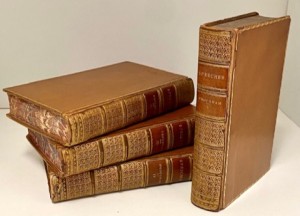
 "Speeches of Lord Erskine. 4 Vols. in 2 books. Completeby: Erskine Thomas Henry Lord; High James (Editor)")
 "Spur of Fame: Dialogues of John Adams and Benjamin Rush, 1805-1813 by: Schutz, John A / Douglass Adair")
 "Squandering Eden: Africa at the Edgeby: Mort Rosenblum, Doug Williamson")
 "Stephen A. Douglas by: Johannsen, Robert W.")
 "Story of Black, Theby: Harvey, John")
 "Street Fighting Years: An Autobiography of the Sixtiesby: Tariq Ali")
 "Sun Yat Sen: A Portraitby: Stephen Chen; Robert Payne")

 "Surrealism and the Politics of Eros, 1938-1968by: Mahon, Alyce")
 "T'ang China: The Rise of the East in World Historyby: S. A. M. Adshead")
 "Tanganyika Territory; A Study of Economic Policy Under Mandate by: Leubuscher, Charlotte")
 "Teheran: Our Path in War and Peace by: Browder, Earl")
 "Thank God We Kept the Flag Flying: The Siege and Relief of Ladysmith, 1899-1900 by: Griffith, Kenneth")
 "That Sweet Enemy: Britain and France: The History of a Love-Hate Relationshipby: Tombs, Robert; Tombs, Isabelle")
 "The Age of Deficits: Presidents and Unbalanced Budgets from Jimmy Carter to George W. Bushby: Iwan Morgan")
 "The Age of Social Democracy: Norway and Sweden in the Twentieth Centuryby: Francis Sejersted")
 "The Anthropology of Pre-Capitalist Societiesby: Joel S. Kahn/Josep R. Llobera")
 "The Appeal of Fascism: A Study of Intellectuals and Fascism 1919-1945 by: Hamilton, Alastair")
 "The Assassination of Lumumba by: De Witte, Ludo/ Fenby, Renee (Transl.)/ Wright, Ann (Transl.)")
 "The Barbarians Speak: How the Conquered Peoples Shaped Roman Europeby: Wells, Peter S.")
 "The Battlefield: Algeria 1988 2002 Studies in a Broken Polity by: Roberts, Hugh")