Hardcover. Cambridge MA, Harvard University Press, 1st, 2016, Book: Very Good, Dust Jacket: Very Good, Hardcover in a bright dust jacket, 592 pages. Alexander Herzen-philosopher, novelist, essayist, political agitator, and one of the leading Russian intellectuals of the nineteenth century-was as famous in his day as Tolstoy and Dostoevsky. While he is remembered for his masterpiece My Past and Thoughts and as the father of Russian socialism, his contributions to the history of ideas defy easy categorization because they are so numerous. Aileen Kelly presents the first fully rounded study of the farsighted genius whom Isaiah Berlin called "the forerunner of much twentieth-century thought." In an era dominated by ideologies of human progress, Herzen resisted them because they conflicted with his sense of reality, a sense honed by his unusually comprehensive understanding of history, philosophy, and the natural sciences. Following his unconventional decision to study science at university, he came to recognize the implications of early evolutionary theory, not just for the natural world but for human history. In this respect, he was a Darwinian even before Darwin. Clean, bright copy.
Hardcover. Boston, Little, Brown & Company., 3rd pr., 2001, Book: Very Good, Dust Jacket: Very Good, Hardcover in a bright, unclipped dust jacket. A young huntsman named Alexi is helped by a golden mare when he tries to perform the seemingly impossible feats commanded by the Tsar, in a story based on a classic Russian folktale. Illustrated with gorgeous paintings by Sanderson. Clean copy.
Hardcover. Greenwich CT, New York Graphic Society, 1st, 1960, Book: Very Good, Dust Jacket: None, Hardcover, pebbles white cloth stamped in gilt. 170 pages. 83 tipped in color plates throughout. This enormous volume features full-color photography of art rarely seen in the West. From one of the most extensive - yet hidden - collections in Europe comes this treasury of works of art, statuary, tapestry, jewelry, and much, much more. Comprehensively annotated by one of the foremost art historians specializing in Russian artworks. Hairline crack to cover at spine, overall clean with tight binding. No dust jacket.
Softcover. Bloomington IN, Indiana University Press, 2nd Ed., 1994, Book: Very Good, Dust Jacket: None, Softcover, 418 pages. Like the other republics floating free after the demise of the Soviet empire, the independent republic of Georgia is reinventing its past, recovering what had been forgotten or distorted during the long years of Russian and Soviet rule. Whether Georgia can successfully be transformed from a society rent by conflict into a pluralistic democratic nation will depend on Georgians rethinking their history. This is the first comprehensive treatment of Georgian history, from the ethnogenesis of the Georgians in the first millennium B.C., through the period of Russian and Soviet rule in the nineteenth and twentieth centuries, to the emergence of an independent republic in 1991, the ethnic and civil warfare that has ensued, and perspectives for Georgia's future.
Hardcover. London, Macgibbon & Kee, 1st, 1966, Book: Very Good, Dust Jacket: Fair, Hardcover in a worn, chipped dust jacket, 204 pages. "A valuable well-researched study of brinkmanship and of people under pressure presented fully for the first time." Name on front fly leaf, otherwise clean.
Hardcover. London, Macgibbon & Kee, 1st, 1966, Book: Very Good, Dust Jacket: Fair, Hardcover in a worn, chipped dust jacket, 204 pages. "A valuable well-researched study of brinkmanship and of people under pressure presented fully for the first time." Name on front fly leaf, otherwise clean.
Hardcover. NY, Norton, 1st US, 1985, Book: Very Good, Dust Jacket: Very Good, Hardcover in a bright dust jacket, 192 pages. The photos are breathtaking not necessarily for their quality - many are washed out and most of the subject matter is routine day to day military stuff - but for their rarity. While the Germans seem to have been at least as far advanced in the use of color photography as the Americans, there is still a paucity of color photography in the public record. That is being addressed by the various nations who took large amounts of color film in an official capacity, including the US, UK, Germany and Canada. The book's captions are adequate to the task, and there are good historical sections, as well as an introduction by Max Hastings as well as commentary by an actual German war correspondent. The strength of the book is in its ability to bring the participants of the subject campaign - the German invasion of Russia up to and including Stalingrad - to life. The use of a large format allows one to note small details of the photos, and relate to the subject matter on a personal level. Despite the lack of "action" shots, there is much to see in facial expressions, uniform details, and especially geography as the Russian steppe is shown in summer and winter, as well as the famous Russian mud (Rasputitsa) about which so much has been written.
Hardcover. NY, Farrar Straus Giroux, 1st, 1994, Book: Very Good, Dust Jacket: Very Good, Hardcover in a bright dust jacket, 181 pages. "In the 1960's and 1970's, American professor Norton Dodge forayed on his own in the Soviet Union, bought the work of underground 'unofficial' artists, and brought it out himself or arranged to have it shipped illegally to the United States. John McPhee investigates Dodge's clandestine activities in the service of dissident Soviet art, his motives for his work, and the fates of several of the artists whose lives he touched. The Ransom of Russian Art is a suspenseful, chilling, and fascinating report on a covert operation like no other". Clean copy.
Hardcover. NY , Norton, 1st, 1979, Book: Very Good, Dust Jacket: Very Good, Hardcover in an unclipped dust jacket with fading to spine, 253 pages. This series of sketches captures Stalin with irony, humor and pathos. The author calls his fictionalized version of Stalin "artistic documentation" in the spirit of reality based on research, personal experience and conversations with others. Yuri Krotkov, a Soviet Georgian, as was Stalin, was a prominent dramatist and screenwriter in the Soviet Union before his defection. As a member of the Russian intelligentsia, he was in the confidence of top-ranking Soviet and party officials in Moscow. Review slip laid in. Foxing to top edge otherwise clean copy.
Hardcover. NY, Museum of Modern Art, 1st, 2002, Book: Very Good, Dust Jacket: None, Hardcover in pictorial boards, 304 pages, illustrated in color. Russian avant-garde books made between 1910 and 1934 reflect a vivid and tumultuous period in that nation's history that had ramifications for art, society, and politics. The early books, with their variously sized pages of coarse paper, illustrations entwined with printed, hand-written, and stamped texts, and provocative covers, were intended to shock academic conventions and bourgeois sensibilities. After the 1917 Revolution, books appeared with optimistic designs and photomontage meant to reach the masses and symbolize a rational, machine-led future. Later books showcased modern Soviet architecture and industry in the service of the government's agenda. Major artists adopted the book format during these two decades. They include Natalia Goncharova, El Lissitzky, Kazimir Malevich, Aleksandr Rodchenko, Olga Rozanova, the Stenberg brothers, Varvara Stepanova, and others. These artists often collaborated with poets, who created their own transrational language to accompany the imaginative illustrations. Three major artistic movements, Futurism, Suprematism, and Constructivism, that developed during this period in painting and sculpture also found their echo in the book format. The more than 600 color illustrations are accompanied by incisive essays, a bibliography, and a checklist of the 1,200 items in the full collection. Expect additional shipping charges especially if sent overseas.
Hardcover. Washington DC, Brookings Institution Press, 1st, 2003, Book: Very Good, Dust Jacket: Very Good, Hardcover in a bright dust jacket, 303 pages. The author analyzes why it is uneconomical to develop Siberia as the Russians have historically envisioned. Clean copy.
Softcover. Princeton NJ, Princeton University Press, 3rd pr., 2008, Book: Very Good, Dust Jacket: None, Softcover in pictorial wraps, 375 pages, maps. A decade after the Soviet Union and the People's Republic of China established their formidable alliance in 1950, escalating public disagreements between them broke the international communist movement apart. In The Sino-Soviet Split, Lorenz Luthi tells the story of this rupture, which became one of the defining events of the Cold War. Identifying the primary role of disputes over Marxist-Leninist ideology, Luthi traces their devastating impact in sowing conflict between the two nations in the areas of economic development, party relations, and foreign policy. The source of this estrangement was Mao Zedong's ideological radicalization at a time when Soviet leaders, mainly Nikita Khrushchev, became committed to more pragmatic domestic and foreign policies. Using a wide array of archival and documentary sources from three continents, Luthi presents a richly detailed account of Sino-Soviet political relations in the 1950s and 1960s. He explores how Sino-Soviet relations were linked to Chinese domestic politics and to Mao's struggles with internal political rivals. Furthermore, Luthi argues, the Sino-Soviet split had far-reaching consequences for the socialist camp and its connections to the nonaligned movement, the global Cold War, and the Vietnam War. Clean copy.
Hardcover. London, George Allen & Unwin Ltd, 2nd Ed., 1955, Book: Very Good, Dust Jacket: Good, Hardcover in a worn, chipped dust jacket. 664 pages with index. Volume 2 ONLY. Masaryk was the president of Czechoslovakia after World War I. Long a student of Russia this book was first published in 1913. Clean copy.
Hardcover. Princeton NJ, Princeton University Press, 1st, 1974, Book: Very Good, Dust Jacket: None, Hardcover, brick-red cloth covers, 448 pages with index. The attempted modernization of Central Asia by the central Soviet government in the 1920's was a dramatic confrontation between radical, determined, authoritarian communists and a cluster of traditional Moslem societies based on kinship, custom, and religion. The Soviet authorities were determined to undermine the traditional social order through the destruction of existing family structures and worked to achieve this aspect of revolution through the mobilization of women. Gregory J. Massell's study of the interaction between central power and local traditions concentrates on the development of female roles in revolutionary modernization. Women in Moslem societies were segregated, exploited, and degraded; they were, therefore, a structural weak point in the traditional order-a surrogate proletariat. Through this potentially subversive group, it was believed, intense conflicts could be generated within society which would lead to its disintegration and subsequent reconstitution. Marginal notes to about 15 pages, otherwise clean, solid copy.
Hardcover. NY, Random House, 1st, 1985, Book: Very Good, Dust Jacket: Very Good, Hardcover in a bright dust jacket, 487 pages, b&w illustrations. Napoleon's colorful but disastrous Russian campaign has been strangely neglected by American publishers. Bridging the gap between popular and scholarly history, historian Cate has written a thoroughly detailed and researched account that should also appeal to the lay reader. His writing is deliberately paced but dramatic and does far more justice to the extremely complex political and military situation of 1812 than Philippe de Segur's Napoleon's Russian Campaign (1965), the only other work available in the United States. Clean copy.
Softcover. Princeton NJ, Princeton University Press, reprint, 1978, Book: Very Good, Dust Jacket: None, Softcover, 464 pages. Richard Stites views the struggle for liberation of Russian women in the context of both nineteenth-century European feminism and twentieth-century communism. The central personalities, their vigorous exchange of ideas, the social and political events that marked the emerging ideal of emancipation--all come to life in this absorbing and dramatic account. The author's history begins with the feminist, nihilist, and populist impulses of the 1860s and 1870s, and leads to the social mobilization campaigns of the early Soviet period. Spine with light fading, otherwise a clean, tight copy.
Hardcover. London, George Allen and Unwin Ltd., 1st ed., 1967, Book: Very Good, Dust Jacket: Good, Hardcover, 331 pages. Blue cloth boards with gilt lettering along spine. Dust jacket has sticker on front flap. Dust jacket is also faded along spine with over all shelf wear. Otherwise, tight clean copy.
Hardcover. Cambridge, Cambridge University Press, 1st ed., 1982, Book: Good, Dust Jacket: Good, 220 pages. Purple cloth boards with gilt lettering along spine. Few pages of light pencil underlining. Dust jacket has some foxing, mainly on flaps, and discoloring. Tight copy. The idea of man as an essentially irrational being has preoccupied some of the most influential of Russian thinkers, including the three important Soviet writers considered by Dr Edwards in this book. Since the 1917 Revolution the polemic between rationalists and irrationalists has become directly relevant to the way life is lived in the Soviet Union, and a knowledge of the irrationalist point of view is essential for an understanding of much of Soviet literature and of the foundations of Soviet dissidence. As with other titles in this series, this book is not intended simply for the specialist. The broad speculations arising from the subject will fascinate all those who take a serious interest in the Russian literary tradition; a tradition whose principal figures have been concerned to reject philosophical and political creeds that, in seeking to produce a perfect human being in a perfect society, point in fact towards a vision of hell.
Hardcover. Moscow, Raduga, reprint, Book: Very Good, Dust Jacket: None, Hardcover, illustrated glossy boards. Color illustrations by Kirill Ovchinnikov. Three old Egyptian tales: Jedi The Magician, The Seafarer and The Snake, How the Thief Outwitted the Pharaoh. Clean copy.
Hardcover. NY, Charles Scribner's Sons, 1st US, 1985, Book: Very Good, Dust Jacket: Very Good, Two hardcover volumes with dust jackets in a cardboard slip case. Volume 1: 1847-1894, 396 pages. Vol. 2: 1895-1910, 397-755 pages. All bright and clean except for fading to dj spines. DOMESTIC SHIPPING ONLY.
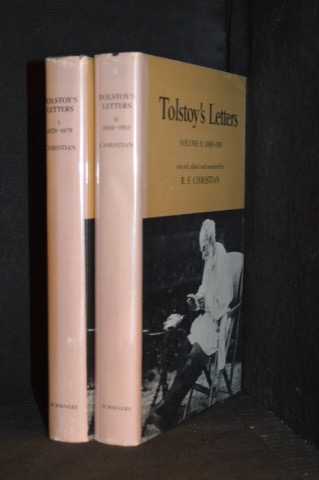
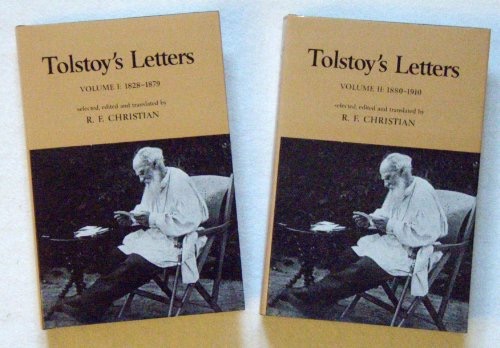
Hardcover. NY, Charles Scribner's Sons, 1st, 1978, Book: Very Good, Dust Jacket: Very Good, Two hardcovers in dust jackets. 737 pages. Index. The dust jackets are faded on the spine. Edited by R.F. Christian. Vol. 1 1828-1879. Vol. 2 1880-1910. In a cardboard slipcase. Clean, bright set.
Hardcover. New York, William Morrow, 1st, 2002, Book: Very Good, Dust Jacket: Very Good, 295 pages. Hardcover. Dust jacket unclipped. Gilt title on spine. Deckled edges. Binding tight. In great shape, clean inside and out.
Hardcover. New York, Viking Press, Reprint, 1967, Book: Very Good, Dust Jacket: Very Good, Hardcover, 80 pages. Color illustrations by Feodor Rojankovsky. Ex-library copy with minimal stamping on endpapers. Library tape strip at bottom of dust jacket. Clean, bright copy. A modern European story with the flavor of folk tale, wonderfully illustrated. Set in a Russian country village where peasants still live by habits and traditions. Two orphans, 12-year-old Anna and younger brother Peterkin live on their own. One day they look for cranberries in Wandering Swamp, and they argue about which trail to take. Their one day becomes a tapestry of experiences past the Blind Break Quagmire.

 "The Discovery of Chance: The Life and Thought of Alexander Herzenby: Kelly, Aileen M.")
 "The Golden Mare, the Firebird, and the Magic Ringby: Ruth Sanderson")
 "The Kremlin : A Portrait of Russiaby: David Douglas Duncan")
 "The Making of the Georgian Nationby: Suny, Ronald Grigor")
 "The Missiles of October: The Story of the Cuban Missile Crisis 1962 by: Abel, Elie")
 "The Missiles of October: The Story of the Cuban Missile Crisis 1962 by: Abel, Elie")
 "The Onslaught: The German Drive to Stalingrad : Documented in 150 Unpublished Colour Photographs by: Heinrich Von Einsiedel")
 "The Ransom of Russian Artby: John McPhee")
 "The Red Monarch: Scenes from the Life of Stalinby: Yuri Krotkov")
 "The Russian Avant-Garde Book: 1910-1934by: Nina Gurianova, Gerald Janecek, Margit Rowell, Deborah Wye")
 "The Siberian Curse: How Communist Planners Left Russia Out in the Cold by: Fiona Hill / Clifford G. Gaddy")
 "The Sino-Soviet Split: Cold War in the Communist Worldby: Lorenz M. Luthi")
 "The Spirit of Russia: Studies in History Literature and Philosophy - Volume 2 by: Masaryk Thomas Garrigue ; Slavik Jan ; Paul Eden and Cedar translators ; Lee W. R. &")
 "The Surrogate Proletariat: Moslem Women and Revolutionary Strategies in Soviet Central Asia, 1919-1929by: Gregory J. Massell")
 "The Unpublished Dostoevsky: Diaries and Notebooks, Volume III (1860-81) by: Dostoevsky, Fyodor/Proffer, Carl R. (Editor)")
 "The War of the Two Emperors: The Duel between Napoleon and Alexander: Russia 1812by: Cate, Curtis")
 "The Women's Liberation Movement in Russia: Feminism, Nihilism, and Bolshevism, 1860-1930by: Richard Stites")
 "Thomas Garrigue Masaryk: The Spirit of Russiaby: Gibian, George")
 "Three Russian Writers and the Irrational: Zamyatin, Pil'nyak, and Bulgakovby: Edwards, T. R. N.")
 "Three Tales of the Land of the Pyramidsby: Noble, Linda (Transl.)")

 "Tolstoy's Letters (2 Volumes)by: Tolstoy, Lev (Edited by R.F. Christian)")
 "Translator, Theby: Crowley, John")
 "Treasure Trove of the Sun, Theby: Prishvin/Feodor Rojankovsky, M.")