Hardcover. NY, Houghton Mifflin Harcourt, 1st, 2018, Book: Very Good, Dust Jacket: Very Good, Hardcover in a bright, unclipped dust jacket. In 2008, when Michael McFaul was asked to leave his perch at Stanford and join an unlikely presidential campaign, he had no idea that he would find himself at the beating heart of one of today's most contentious and consequential international relationships As President Barack Obama's adviser on Russian affairs, McFaul helped craft the United States' policy known as "reset" that fostered new and unprecedented collaboration between the two countries And then, as US ambassador to Russia from 2012 to 2014, he had a front-row seat when this fleeting, hopeful moment crumbled with Vladimir Putin's return to the presidency This riveting inside account combines history and memoir to tell the full story of US-Russia relations from the fall of the Soviet Union to the new rise of the hostile, paranoid Russian president From the first days of McFaul's ambassadorship, the Kremlin actively sought to discredit and undermine him, hassling him with tactics that included dispatching protesters to his front gates, slandering him on state media, and tightly surveilling him, his staff, and his family. 506 pages, illustrations, clean copy.
Hardcover. Dunlop Art Gallery, 1st, 2003, Book: Very Good, Dust Jacket: None, Hardcover, pictorial cloth, 169 pages. Illustrated in color and b&w. Text in English and French. Clean, bright copy.
Hardcover. NY, Oxford University Press, 1st, 2011, Book: Very Good, Dust Jacket: Very Good, Hardcover in a bright dust jacket, 229 pages, b&w illustrations. The searing accounts of Aleksandr Solzhenitsyn, Evgeniia Ginsberg and Varlam Shalamov opened the world's eyes to the terrors of the Soviet Gulag. But not until now has there been a memoir of life inside the camps written from the perspective of an actual employee of the Secret police. In this riveting memoir, superbly translated by Deborah Kaple, Fyodor Mochulsky describes being sent to work as a boss at the forced labor camp of Pechorlag in the frozen tundra north of the Arctic Circle. Only twenty-two years old, he had but a vague idea of the true nature of the Gulag. What he discovered was a world of unimaginable suffering and death, a world where men were starved, beaten, worked to death, or simply executed. Mochulsky details the horrific conditions in the camps and the challenges facing all those involved, from prisoners to guards. He depicts the power struggles within the camps between the secret police and the communist party, between the political prisoners (most of whom had been arrested for the generic crime of "counterrevolutionary activities") and the criminal convicts. And because Mochulsky writes of what he witnessed with the detachment of the engineer that he was, readers can easily understand how a system that destroyed millions of lives could be run by ordinary Soviet citizens who believed they were advancing the cause of socialism. Clean copy.
Hardcover. New Haven CT, Yale University Press, 1st, 2017, Book: Very Good, Dust Jacket: Very Good, Hardcover in a bright dust jacket, 294 pages. Emily Johnson has translated and edited a fascinating collection of letters written by Arsenii Formakov, a Latvian Russian poet, novelist, and journalist, during two terms in Soviet labor camps, 1940 to 1947 in Kraslag and 1949 to 1955 in Kamyshlag and Ozerlag. This correspondence, which Formakov mailed home to his family in Riga, provides readers with a firsthand account of the workings of the Soviet penal system and testifies to the hardships of daily life for Latvian prisoners in the Gulag. Clean copy.
Hardcover. New Delhi, Calcutta, 1st, 1977, Book: Very Good, Dust Jacket: Good, Hardcover, 485 pages. Underlining in brown felt tip on pages 129-133. Otherwise clean, tight copy. Dust jacket shows standard wear with sunfaded spine.
Hardcover. NY, Penguin Press, 1st, 2023, Book: Very Good, Dust Jacket: Very Good, Hardcover in a bright, unclipped dust jacket. Elena Kostyuchenko's unrelenting attempt to document her country as experienced by those whom it systematically and brutally erases: village girls recruited into sex work, queer people in the outer provinces, patients and doctors at a Ukrainian maternity ward, and reporters like herself. Here is Russia as it is, not as we imagine it. The result is a singular portrait of a nation, and of a young woman who refuses to be silenced. In March 2022, as a correspondent for Russia's last free press, Novaya Gazeta, Kostyuchenko crossed the border into Ukraine to cover the war. It was her mission to ensure that Russians witnessed the horrors Putin was committing in their name. She filed her pieces knowing that should she return home, she would likely be prosecuted and sentenced to up to fifteen years in prison. Yet, driven by the conviction that the greatest form of love and patriotism is criticism, she continues to write. I Love Russia stitches together reportage from the past fifteen years with personal essays, assembling a kaleidoscopic narrative that Kostyuchenko understands may be the last work from her homeland that shell publish for a long time, perhaps ever. It exposes the inner workings of an entire nation as it descends into fascism and, inevitably, war. She writes because the threat of Putin's Russia extends beyond herself, beyond Crimea, and beyond Ukraine. Clean copy.
Hardcover. NY, Clarion Books, 1st, 1995, Book: Very Good, Dust Jacket: Very Good, Hardcover in a bright, unclipped dust jacket. A young Jewish girl from a middle-class Russian family recalls the events of her childhood, both good and bad, in a small village just before the Revolution of 1917. Though classed as fiction, this reads more like a vivid memoir of the author's childhood. B&w drawings by Gennady Schikarioff.
NY, Holiday House, 1st , 1994, Book: Very Good, Dust Jacket: Very Good, Hardcover in a bright, unclipped dust jacket. Color illustrations by Robert Sauber. Frolya, a talking dove, weaves a beautiful rug for the archer Frol, which leads to a series of exciting adventures for the archer when the wicked czar covets the dove, adventures that lead Frol to the magical Land of I-Know-Not-Where.
Hardcover. Cambridge MA, The MIT Press, 1st, 2005, Book: Very Good, Dust Jacket: Very Good, Hardcover, 326 pages, illustrated in color, b&w. How Constructivist artists in Russia between 1923 and 1925 developed a counterproposal to capitalism's commodity fetish by producing objects meant to be "comrades" in the creation of an egalitarian socialist culture. Very good in a bright dust jacket.
Hardcover. University of Pittsburgh Press, 1st, 2004, Book: Very Good, Dust Jacket: Very Good, Hardcover in dust jacket, 297 pages. James W. Heinzen's work fills a significant gap in the extensive historiography of the New Economic Policy (NEP) . The book studies the organization and staffing of NKZem RSFSR, offers some memorable portraits of its leading figures, especially its head, Alexander Petrovich Smirnov, and delves into the complexity of policy making in this era and the clash of institutional interests that had a major impact on policy. Heinzen makes a convincing case that Smirnov and the specialists in NKZem RSFSR were one of the major sources of ideas and policies for the 'Rightists' within the party leadership. The book is distinguished by its thoroughness, and by its cool and balanced judgment. This study brings out the full complexity of the Bolshevik regime, its dilemmas, and its internal contradictions. Clean copy, light fading to dj spine.
Hardcover. New York, Da Capo Press, 1st, 2017, Book: Very Good, Dust Jacket: Very Good, 327 pages. Hardcover. Gilt title on spine. Dust jacket unclipped. B/w illustrations throughout. In excellent condition, clean inside and out. Remainder mark on bottom edge. Binding tight, looks barely read.
Hardcover. NY, Knopf, 1st, 1992, Book: Very Good, Dust Jacket: Very Good, Hardcover, 600 pages, in a bright, price-clipped dust jacket. In this substantial work, Berberova, a renowned writer who left her homeland along with many compatriots in the wake of the 1917 Revolution, chronicles the travails she encounters in poverty-stricken Russia, poverty-stricken Berlin, and poverty-stricken Paris, where she lived from 1925-1950.
Softcover. NY, Guggenheim Museum, 1st, 2003, Book: Very Good, Dust Jacket: None, 267 pages, illustrated throughout in color and b&w. Clean, unmarked copy with only minor wear to wrappers. In 1915, Kazimir Malevich changed the future of modern art when his experiments in painting led the Russian avant-garde into pure abstraction. He called his innovation Suprematism--an art of pure geometric form meant to be universally comprehensible regardless of cultural or ethnic origin. His Suprematist masterpiece, White Square on White (1920-27), continues to inspire artists throughout the world. Focused exclusively on this defining moment in Malevich's career, Kazimir Malevich: Suprematism features nearly 120 paintings, drawings and objects, among them several recently discovered masterworks. In addition, the book includes previously unpublished letters, essays and diaries, along with essays by international scholars, who shed new light on this popular figure and his devotion to the spiritual in art.
Hardcover. New York, The New Press, 1st, 1999, Book: Very Good, Dust Jacket: Very Good, 515 pages. Hardcover. Gray cover boards, gilt title on spine. In nice shape, Dust jacket unclipped, has just a touch of age yellow. Edges show a little soil (shelfwear). Binding very tight, clean inside. Very good condition.
Hardcover. Leningrad, Aurora Art Publishers, 1st, 1975, Book: Very Good, Dust Jacket: None, 170 pages. Brown cloth w/ color pictorial label on front. Color pictorial slipcase shows minor edgewear. Text in French, captions next to pictures also in English. Beautiful color plates throughout. Tight, clean, unmarked.
Hardcover. Ann Arbor MI, University of Michigan Press, 1st, 1967, Book: Very Good, Dust Jacket: Very Good, Hardcover in a bright, unclipped dust jacket, 247 pages. Selected and edited by Carl R. Proffer. Translated by Carl R. Proffer in collaboration with Vera Krivoshein. From the five volumes of correspondence in Gogol's collected works Carl Proffer, a teacher and translator of Russian, has fashioned this scholarly one-volume edition, adding his own exceptionally informative footnotes and an eight-page bibliography. Clean copy.
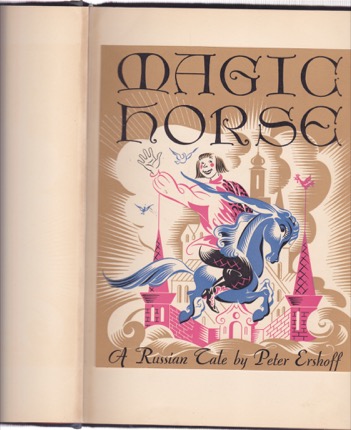
Hardcover. NY, Macmillan, 1st, 1942, Book: Very Good, Dust Jacket: None, Hardcover. Front of dust jacket is cut out and glued onto title-page. Nicely done. Blue cloth covers with mild shelf wear. Translated from Russian by Tatiana Balkoff Drowne. Nice color illustrations by Vera Bock. No markings.
Hardcover. New York , Abrams, 1st, 1991, Book: Very Good, Dust Jacket: Very Good, Hardcover, 135 pages, illustrated throughout in color. Light shelf-wear to dust jacket. Faint foxing to edges, otherwise a clean, tight copy. 100 color plates with 39 black & white illustrations.
NY, Villard, 1st , 1996, Book: Very Good, Dust Jacket: Very Good, Hardcover, 86 pages + paintings from Botkin's portfolio. Illustrated with black & white photos and color paintings by Botkin. Text compiled by Botkin's daughter Marina Schweitzer. Foreword by Greg King. Bright, unclipped dust jacket.
Hardcover. NY, Simon & Schuster, 1st, 1994, Book: Very Good, Dust Jacket: Very Good, Hardcover, 400 pages, b&w illustrations. A touching, brilliant and ground-breaking biography of one of literary history's most famous couple, at once a dual biography, a history, and the portrait of a long and stormy marriage. In a bright, unclipped dust jacket. Remainder line on bottom edge.
Hardcover. NY, Simon & Schuster, 1st, 1994, Book: Very Good, Dust Jacket: Very Good, Hardcover in a bright dust jacket, 400 pages. In 1897 Tolstoy wrote his daughter Tonya, explaining his opposition to her desired marriage: "As far as love is concerned, it's an ignoble and unhealthy sentiment-I would not have opened my door to it." Perhaps this passage reflects the turbulent marriage of Leo and Sonya-first the promise of love and then disillusionment. Certainly, there was a love of sorts-their marriage lasted 48 years and brought forth 13 children-but the later half of the marriage was soured by acrimony, secrecy, and great emotional wounding. The greatest division came with the battle over the rights to Tolstoy's works. Sonya finally got sole possession, outliving Leo by nine years and plagued by the thought that she had been wrong for her genius husband. In intimate and scrupulous detail often drawn directly from Leo and Sonya's diaries, Shirer (The Rise and Fall of the Third Reich) has profiled the disintegration of a marriage. Clean copy.
Philadelpia, Vertex Book/Auerbach Publishers, 1st, 1971, Book: Very Good, Dust Jacket: Good, Hardcover in a worn, lightly soiled dust jacket, 243 pages. Map endpapers One man's story of being arrested on trumped up charges as an enemy of the Soviet State and being sent to Siberia for eight years. Inscription on dedication page (by book jacket designer).
Hardcover. London, Chris Boot, 1st, 2009, Book: Very Good, Dust Jacket: None, Hardcover, 252 pages. In this volume, ten Magnum photographers turn their lenses on contemporary Georgia. Situated on the cusp of Russia and Asia, but with a European culture dating back to the 7th century BC, Georgia was forcibly incorporated into the Soviet Union in 1922. Its independence was restored in 1991, but it then suffered from civil war and a breakdown of its economic infrastructure. In the last decade, however, despite ongoing tensions in its relations with Russia, Georgia has mounted a spirited comeback. Magnum photographers Antoine d'Agata, Jonas Bendiksen, Thomas Dworzak, Martine Franck, Alex Majoli, Gueorgui Pinkhassov, Martin Parr, Paolo Pellegrin, Mark Power and Alec Soth visited the country during spring 2009, each pursuing their own theme (Alec Soth goes in search of the 'most beautiful woman in Georgia', for example). All found themselves enchanted by the Georgian people, something strongly conveyed in their photographs as well as in personal text journals which accompany the images. This well-designed volume also includes a fold-out map, marked with each photographer's journey; a chapter showing the best of Magnum photographers' work over 60 years (including by Magnum's founders Robert Capa from his visit to Georgia with John Steinbeck in 1948 and Henri Cartier-Bresson); and an illuminating introduction by the Paris-based New Yorker writer, and Georgia expert, Wendell Steavenson.

 "From Cold War to Hot Peace: An American Ambassador in Putin's Russia by: McFaul, Michael")
 "Godless at the Workbench: Soviet Illustrated Humoristic Antireligious Propaganda/ Sans-dieu a l'atelierby: Annie Gerin")
 "Gulag Boss: A Soviet Memoirby: Fyodor Vasilevich Mochulsky /Deborah Kaple (Transl.)")
 "Gulag Letters by: Formakov, Arsenii, Editor: Johnson, Emily D.")
 "History of Soviet Russia, Aby: Von Rauch, Georg")
 "History of the Communist Party of USSRby: Schlesinger, Rudolf")
 "I Love Russia: Reporting from a Lost Countryby: Elena Kostyuchenko")
 "I Remember by: Fara Lynn Krasnopolsky")
 "I-Know-Not-What, I-Know-Not-Where - A Russian Taleby: Kimmel / Robert Sauber, Eric A.")
 "Imagine No Possessions: The Socialist Objects of Russian Constructivismby: Kiaer, Christina")
 "Inventing a Soviet Countryside: State Power and the Transformation of Rural Russia, 1917 - 1929 by: James Heinzen")
 "Island of the Blue Foxes: Disaster and Triumph on the World's Greatest Scientific Expeditionby: Bown, Stephen R.")
 "Italics are Mine, Theby: Berberova Nina; Radley Philippe translator")
 "Kazimir Malevich: Suprematismby: Gurianova, Nina/ Jean-Claude Marcade , Tatyana Mikhienko")
 "Kissinger Transcripts, The: The Top-Secret Talks with Beijing & Moscowby: Burr, William (Ed.)")
 "Les Miniatures russes du XIe au XVe siecleby: Popova, O.")
 "Letters of Nikolai Gogolby: Carl R. Proffer (Ed.)")
 "Little Magic Horse: A Russian Taleby: Peter Ershoff, Illustrator: Vera Bock, Translator: Tatiana Balkoff Drowne")
 "Liubov Popovaby: Dabrowski, Magdalena")
 "Lost Tales - Stories For the Tsar's Childrenby: Botkin, Gleb")
 "Love and Hatred: The Stormy Marriage of Leo and Sonya Tolstoyby: Shirer, William L.")
 "Love and Hatred: The Stormy Marriage of Leo and Sonya Tolstoyby: William L. Shirer")
 "Magadan by: Solomon, Michael")
 "Magnum Photos: Georgian Spring-A Magnum Journalby: Wendell Steavenson")