Softcover. London, Korero Press, 1st, 2017, Book: Very Good, Dust Jacket: None, 576 pages. Softcover. Very clean, unmarked copy with only minor edgewear to wrappers. A celebration of the stunning and stylistically varied headline lettering that existed before the advent of phototypesetting or the computer. Collects more than 4500 examples
Softcover. San Francisco, Chronicle Books, 1st, 1993, Book: Very Good, Dust Jacket: None, Softcover, 144 pages. An illustrated history of the fabulous pulp magazines from 1896 to 1953. After tracing the birth of the pulps back to the 1882 launching of Golden Argosy magazine, printed on pulpwood pages, Server organizes his unwieldy subject into categories of pulps: adventure, romance and sex, horror and fantasy, private eye, weird menace, science fiction. Each receives a lively capsule history that covers trends, reader (and sometimes, as in the case of the ``Spicys,'' government) response, and writers' bios--which, though sketchy (Hammett's Hollywood experience gets one sentence), resurrect a number of relatively obscure but seminal and fascinating figures, like Conan- creator Robert E. Howard, who shot himself dead at age 30 on the day his mother died, and Frederick Faust (a.k.a. Max Brand), who sometimes wrote around the clock, piling up two or three million words a year. Server attributes the pulps' demise to, among other factors, the advent of TV, paperbacks, and comic books, and he winds up with a note on pulp-collecting. For all of the author's savvy, though, it's above all the eye- popping illustrations (100 color, 57 b&w) that will have readers beaming. Magazine covers (some lurid, some of eerie beauty), sample pages of text and ads (``Raise Giant Frogs'')--the pulps come alive once again here, in all their eccentric glory.
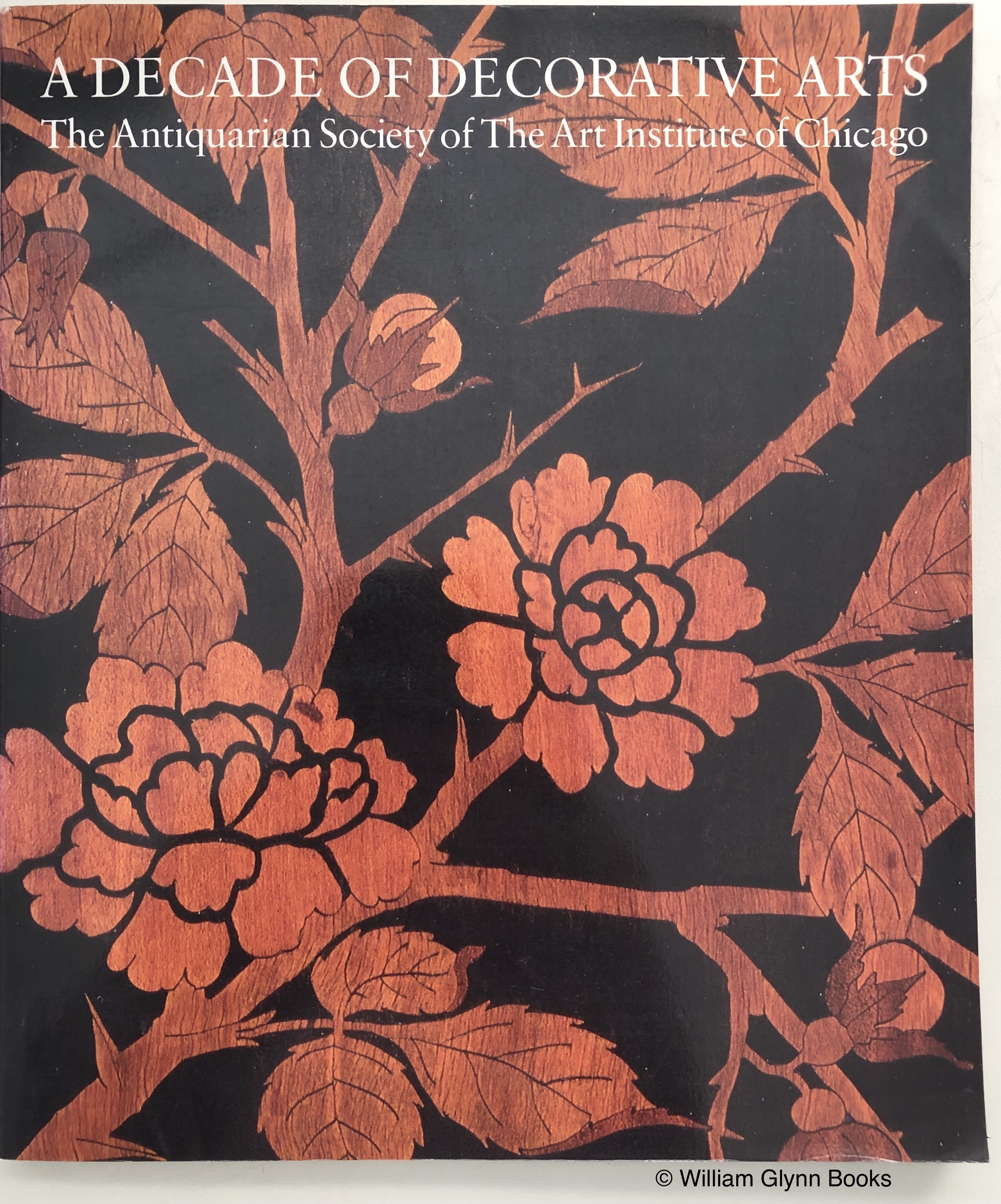
Softcover. The Art Institute of Chicago, 1st, 1986, Book: Very Good, Dust Jacket: None, Softcover. Exhibition catalog of decorative arts of The Art Institute of Chicago. 112 pages; 24 color plates. Text by Milo M. Naeve and Lynn Springer Roberts. In very good condition; no marks on cover.
Softcover. NY, E. P. Dutton & Co., 1st, 1988, Book: Very Good, Dust Jacket: None, Softcover in pictorial wrappers, 116 pages illustrated in color. Documents the superb and amazing Art Deco buildings of Miami Beach. Bright and beautiful full color photos feature mainly the exteriors of these gems. Clean copy.
Hardcover. NY, Simon & Schuster, 1st, 1989, Book: Very Good, Dust Jacket: Very Good, Hardcover, 158 pages. Design writer Siegel takes us on a inspiring tour of the history, stylistic concerns and uses of tiles. Though their cool, hard surface might seem best suited to Mediterranean climates, tiles have enjoyed wide use as far afield as the Netherlands, and any area subject to heavy foot-traffic could benefit from their easily cleaned faces. Lavishly illustrated with color photographs supplied by Country Floors, a well-known tile importing company, the book emphasizes the traditional "country" look; a brief, less successful foray into modern styles relies heavily on simple geometric patterns. In his introduction, Country Floors owner Norman Karlson tells how his fascination with tiles developed. Seemingly meant as a sourcebook for designers and tile enthusiasts, the volume offers scant information on the proper application of tiles--only instructions for care and maintenance. Installation, it is hinted, should be left to a specialist.
Hardcover. Gibbs Smith, 1st, 2005, Book: Very Good, Dust Jacket: Very Good, Hardcover, 192 pages. Sim Van der Ryn is the president of Van der Ryn Architects, a northern California firm known worldwide for its work in sustainable architecture. He taught architecture and design at the University of California, Berkeley for more than thirty years, inspiring a new generation to create buildings and communities that are sensitive to place, climate, and the flow of human interactions. He is the author of six groundbreaking books about planning and design, including Sustainable Communities and Ecological Design. He lives and works in the San Francisco Bay area.
Softcover. Univ of Washington Press, 1st, 1997, Book: Very Good, Dust Jacket: None, Softcover, 111 pages. America between 1885 and 1905 was in the heat of a poster craze. The country's finest artists and illustrators were commissioned to design advertising posters whose popularity soon overshadowed the products they were meant to promote. Designed to Sell presents vintage posters by 45 artists, including Maxfield Parrish, Blanche McManus, and Maurice Prendergast. Essays describe innovations in printing, compare American and European posters, and explain the emergence of a new profession -- graphic design. Biographical notes on the artists include eight women. Special technical notes outline historic printing methods and explain how an artist's drawing becomes a poster.
Softcover. NY, Rizzoli International Publications, 1st, 1999, Book: Very Good, Dust Jacket: None, Softcover, 143 pages. Beautiful examples of the watchmaker's art. The designer wristwatch is a sensation - many people have several watches, one for every mood or whim. "Designers of Time' celebrates what has grown to be one of the most collectible, most practical items of fashion today. Clean, bight copy
Hardcover. New York, Holt, Rinehart, and Winston, 1st, 1975, Book: Very Good, Dust Jacket: None, 412 pages. Hardcover with NO dust jacket. Fading to spine of laminated boards. Foxing to text block, otherwise clean and bright internally. Color pictures throughout.
Hardcover. NY, Stewart, Tabori & Chang, 1st, 2004, Book: Very Good, Dust Jacket: Very Good, Hardcover in a bright dust jacket. 192 pages illustrated in color. A complete guide to using wood in the home offers practical information and hard knowledge about types of wood and their uses, as well as inspiration on the uses for wood, complete with a buying guide and 250 color photos.
Hardcover. AU, Lannoo, 1st, 2010, Book: Very Good, Dust Jacket: Very Good, Hardcover, 184 pages. A glimpse into the private world of an interior designer.
Hardcover. New Haven CT, Yale University Press, 1st, 2005, Book: Very Good, Dust Jacket: Very Good, Hardcover, 320 pages. From the 1920s through the 1950s, two individuals, Joseph Urban and Norman Bel Geddes, did more, by far, to create the image of "America" and make it synonymous with modernity than any of their contemporaries. Urban and Bel Geddes were leading Broadway stage designers and directors who turned their prodigious talents to other projects, becoming mavericks first in industrial design and then in commercial design, fashion, architecture, and more. The two men gave shape to the most quintessential symbols of the modern American lifestyle, including movies, cars, department stores, and nightclubs, along with private homes, kitchens, stoves, fridges, magazines, and numerous household furnishings.Illustrated with more than 130 photographs of their influential designs, this book tells the engrossing story of Urban and Bel Geddes. Christopher Innes shows how these two men with a background in theater lent dramatic flair to everything they designed and how this theatricality gave the distinctive modernity they created such wide appeal. If the American lifestyle has been much imitated across the globe over the past fifty years, says Innes, it is due in large measure to the designs of Urban and Bel Geddes. Together they were responsible for creating what has been called the "Golden Age" of American culture.
Hardcover. Lee Publishers Group, 1st, 1981, Book: Very Good, Dust Jacket: Very Good, Hardcover in a bright dust jacket, 285 pages. Preface by Jean Mailey; Introduction by Zhang Ding. Designs in blue and white, fine bright tight copy, unmarked, very good slightly edge-rubbed dj. Collected from the remote areas of China's southwestern provinces, each decorative pattern is rich in beauty and meaning. This royalty-free volume will be an invaluable resource for artists, designers, craftspeople, and any lover of traditional Chinese folk art. Clean copy.
Hardcover. NY, Assouline Publishing, 1st, 2004, Book: Very Good, Dust Jacket: Very Good, Hardcover, 80 pages. Diane von Furstenberg arrived in the fashion world in 1972 with her simple knit jersey wrap dresses. By 1976, Diane had sold more than 5 million of her signature wrap dresses, which had come to symbolize female power and liberation to an entire generation. Almost 20 years later, with the nostalgia for '70s fashion at its peak, Diane re-emerged on the New York fashion scene with her signature wrap modified for a new generation of chic young women. Now with smaller collars than the original wrap, the new version has been enthusiastically adopted by today's trendsetters and celebrities. This volume looks at the history of the "wrap" phenomenon, from its revolutionary early days to its ever-popular present.
Hardcover. Italy, Damiani, 1st, 2012, Book: Very Good, Dust Jacket: None, 240 pages. Hardcover with no dust jacket. Very clean, unmarked copy still in publishers shrink-wrap. Over 200 color illustrations throughout. Portraits of famous celebrities such as Jessica Alba, Gabriel Byrne, Sofia Coppola, Diane von Furstenberg, Lazaro Hernandez of Proenza Schouler, Jack McCollough, Julianne Moore and Sting, as well as landscape photographs.
Hardcover. NY, Assouline Publishing, 1st, 2005, Book: Very Good, Dust Jacket: Very Good, Hardcover, 80 pages. Since the opening of their studio in 1982, the partnership of Domenico Dolce and Stefano Gabbana has come to symbolize the new generation of Italian fashion design. It is Domenico Dolce's native Sicily that provides the greatest influence on this duo's strong, sensual designs. Constantly evolving and maturing, the quintessential Dolce & Gabbana woman remains sexy, shapely, confident, and above all, Mediterranean.
Hardcover. Taschen, 1st, 2006, Book: N, Hardcover in a bright dust jacket. 792 pages. This volume covers the second half of the 1970s, an era marked by the oil crisis and the related global economic crisis. For the first time, architecture and design dealt with alternative resources, ecological building methods, and recyclable materials. Nevertheless synthetics remained present in many fields, especially in interior design. Examples of projects featured are the postmodern and lightflooded buildings by Richard Meier, the modernistic buildings by Foster Associates, the Centre Georges Pompidou by Renzo Piano and Richard Rogers, and the buildings of the Japanese architects Arata Isozaki and Kisho Kurakawa. The industrial design of modern transport systems, office machines, and electrical appliances is also highlighted.
Hardcover. Taschen, 1st, 2006, Book: Very Good, Dust Jacket: Very Good, Hardcover in a bright dust jacket, 580 pages. The International style of the late 1920's and 1930's is the focal point of this volume. Along with groundbreaking buildings, interior decoration, and furniture by international architects and designers such as Le Corbusier, Ludwig Mies van der Rohe, Marcel Breuer, Robert Mallett-Stevens, Alvar Alto, and Richard Neutra, is above all the work of the Italian avant-garde, including names like Giuseppe Terragne, Carlo Mollino, Gio Ponti, Melchiorre Bega, Franco Albini or Studio BBPR, that provides precise insight into the formative decade of Modernism. Text in English and Italian. Clean copy.
Hardcover. Taschen, 1st, 2006, Book: Very Good, Dust Jacket: Very Good, Hardcover in a bright dust jacket, Taschen's Domus collection is a major publishing achievement and a must-have item for all design and architecture teaching institutions, practicing architects, designers, collectors, students, and anyone who loves design. /// The first half of the 1990s represented a generational change in architecture and design.//// This title covers the years 1990-1994 - the next generation. The first half of the 1990s, this volume's focus, marked a shifting of the generations in architecture and design. "domus" - up to date as always - documented the work of this new generation with elaborate articles and reports. The architects Tadao Ando, Jean Nouvel, David Chipperfield, Philippe Starck, Rem Koolhaas, Peter Eisenman, Jacques Herzog, and Pierre de Meuron made their debuts in domus during this period. In addition, established architectural greats like Frank O. Gehry, Mario Bellini, Richard Meier, Renzo Piano, Norman Foster, Santiago Calatrava, and Zaha Hadid were also featured. In product design, Marc Newson, Rodney Kinsman, Jasper Morrison as well as the brothers Fernando and Humberto Campana appeared in the spotlight.
Hardcover. Taschen, 1st, 2008, Book: Very Good, Dust Jacket: Very Good, Hardcover, 580 pages. 1940-1949: Destruction and Reconstruction. This volume covers the 1940s, when fascism came to a climax and World War II led to the extensive destruction of Europe. But the second half of this decade was also a time of reconstruction, democratization, and the related search for new social values. Unlike in Nazi Germany, in fascist Italy Modernism was able to advance in architecture and design - as proved impressively by the buildings and designs by Carlo Mollino, Gian Luigi Banfi, Franco Albini, and Giuseppe Terragni that are documented herein. After the war, Organic Design emerged alongside the International style. This edition reflects upon the economic, social, and cultural problems of the time, but also shows how the force of the avant-garde continued to thrive in Italy, Switzerland, Scandinavia and the USA. Reports and features on modern industrial design and furniture, as well as domestic and business interiors stand side by side with articles about novel prefabricated houses. In publisher's shrink wrap. Due to size and weight, DOMESTIC SHIPPING ONLY.
Hardcover. Taschen, 1st, 2006, Book: Very Good, Dust Jacket: Very Good, Hardcover, 580 pages. 1960-1954: Design Goes Pop. This volume concentrates on the architecture and design of the first half of the 1960s, characterized by the coexistence of a number of different styles. The aftermath of the International style and Good Design were still noticeable whereas Organic Design, which had developed in parallel since the late 1940s, gradually lost its influence. From the early 1960s onwards, a new force took its place, geared toward Pop Art and popular culture, leading to Pop Design. This trend is particularly recognizable in interior design, where a variety of new synthetics and foam plastics replaced traditional materials such as metal, glass or wood, pointing the way to completely new designs. Volume V documents this with examples of designs by Ray and Charles Eames, Verner Panton, Achille and Pier Giacomo Castiglioni, and Joe Colombo. On the architectural side, the impressive buildings of Gio Ponti, Carlo Scarpa, Angelo Mangiarotti, James Stirling, and others./// Hardcover, 580 pages. 1960-1954: Design Goes Pop. This volume focuses on the architecture and design of the first half of the 1960s. A new force lead to Pop Design. This trend is particularly recognizable in interior design, where a variety of new synthetics and foam plastics replaced traditional materials such as metal, glass or wood.
Softcover. Port Townsend WA, Feral House., 1st, 2008, Book: Very Good, Dust Jacket: None, Softcover in pictorial wraps, 220 pages. Dope Menace boasts hundreds of full color images from the wicked subgenre of drug-exploitation narratives. The covers that made these authors books so easy to pick up are collected here for the first time, in all their seductive glory. While we now enjoy this exploitative genre for its campy kitsch, gloriously bad writing, and outlandish misinformation, drug paperback books were once a transgressive medium with a perversely seductive quality. Dope Menace collects together hundreds of fabulously lurid and collectible covers in color, from xenophobic turn-of-the century tomes about the opium trade to the beatnik glories of reefer smoking and William S. Burroughs' Junkie to the spaced-out psychedelic '60s. Clean copy.
Hardcover. New York, Harper Collins, 1st, 2014, Book: Very Good, Dust Jacket: Very Good, 250 pages. Hardcover. Extensive color photographs throughout. Clean, unmarked copy with only minor wear to dust jacket.
Hardcover. New York, Harper Design, 1st, 2014, Book: Very Good, Dust Jacket: Very Good, 256 pages. Hardcover with dust jacket. Color photographs. Clean, unmarked copy with only minor wear to dust jacket. A lavish, gorgeously designed full-color collection that showcases the designs of Dorothy and Otis Shepard, two groundbreaking giants of early twentieth-century American advertising. Dorothy and Otis Shepard are the unsung heroes of early twentieth-century North American visual culture. Together, they were the first American graphic designers to work in multiple mediums and scales with equal skill and vision, and their work remains brilliant; yet their names are little known today. Dorothy and Otis chronicles their story in detail for the first time. It explores the Shepards' penchant for abstraction and modernism, and shows how the advent of billboard advertising inspired their creativity--large campaigns that matched the grandeur of their lifestyle. Throughout, it demonstrates how their influence touched all aspects of consumer culture--from collaborating on the packaging for Wrigley's Gum and designing uniforms and logos for the Chicago Cubs to planning and promoting the resort island Catalina, where Stan Laurel, Oliver Hardy, Clark Gable, and other celebrities frequented.
Hardcover. NY, Abrams Books, 1st, 2008, Book: Very Good, Dust Jacket: Very Good, Hardcover in a bright dust jacket. 223 pages, illustrated in color and b&w. Introduction by Judith Thurman. Clean copy.
Hardcover. NY, Overlook Press, 1st, 2008, Book: Very Good, Dust Jacket: Very Good, Hardcover in a bright dust jacket. 223 pages, illustrated in color and b&w. Award-winning artist Milton Glaser's Drawing Is Thinking explores language and communication through imagery. Introduction by Judith Thurman The drawings depicted here represent a range of subject matter taken from throughout Milton Glaser's career. They illustrate the author's commitment to the fundamental idea that drawing is not simply a way to represent reality, but a way to understand and experience the world.
Hardcover. NY, Posters Please, 1st, 2003, Book: Very Good, Hardcover, color illustrated catalog for Poster Auctions International. Blue spine with silver text, clean.
Softcover. Paris FR, Paris-Musees, 1st, 1993, Book: Very Good, Dust Jacket: None, Flexible cloth covers, profusely illustrated, 463 pages, FRENCH TEXT. "This well-illustrated catalogue provides a fine review of the early years of the German Expressionist movement through a presentation of some 400 paintings, prints, drawings and sculptures by members of the Brucke in Dresden (Heckel, Kirchner, Mueller, Pechstein, Schmidt-Rottluff and Nolde) , the Blaue Reiter artists in Munich (Jawlensky, Kandinsky, Klee, Macke, Marc, Munter and Werefkin) and Berlin painter Ludwig Meidner. Sixteen wide-ranging essays are supplemented by detailed entries for most of the exhibited works, a selection of texts and letters by the featured artists, and a chronology of important cultural and political events in Dresden, Munich and Berlin from 1905 to 1914." Clean copy.
Softcover. London, Pimlico , reprint, 1998, Book: Very Good, Dust Jacket: None, Softcover, 570 pages. The life of the painter and designer Duncan Grant spanned great changes in society and art from Edwardian Britain to the 1970s from Alma-Tadema to Gilbert and George. This authoritative biography combines an engrossing narrative with an invaluable assessment of Grant's individual achievement and his place within Bloomsbury and in the wider development of British art.
Softcover. London, Victoria & Albert Museum, 1st, Book: Very Good, Dust Jacket: None, 128 pages. Softcover. Very clean, unmarked copy with only minor wear to wrapper edges. 90 color plates, 10 black and white illustrations. This definitive and lavishly illustrated biography is the first to trace Kauffer's life and showcase his best work-posters, book illustrations, and theater designs.
Softcover. IDW/Idea & Design Works, 1st, 2024, Book: Very Good, Dust Jacket: None, Softcover, the smaller (8 1/4 X 12") Artisan Edition. Collects more than 140 EC covers by their best and brightest talents. The luminaries included in this elegant tome include: Wally Wood, Harvey Kurtzman, Graham Ingels, Al Williamson, Johnny Craig, Frank Frazetta, Jack Davis, Al Feldstein, and more. Each cover in this collection has been scanned from the original art. While appearing to be in black and white, these images were scanned in COLOR, enabling the reader to see all the subtle nuances that make original art unique. Blue pencil notations, zip-a-tone, Duoshade, whiteoutall of these and more are clearly visible. Clean, bright copy.
Hardcover. New Haven, CT, Yale University Press, 1st, 2018, Book: Very Good, Dust Jacket: None, 47 pages. Hardcover with no dust jacket. Very clean, LIKE NEW in publishers shrinkwrap. Ruscha's work comprises five black-and-white Los Angeles landscapes made in 1992 paired with color representations of the same sites as they appeared ten years later and draws attention to how often-overlooked changes in the evolving urban landscape are redolent of economic might and globalization or decline and stagnation.
Hardcover. Taschen, reprint, 2007, Book: Very Good, Dust Jacket: Very Good, Hardcover, 160 pages. Though her work has often been overshadowed by that of her peers such as Le Corbusier and Marcel Breuer, Irish designer, lacquer-artist, and architect Eileen Gray (1878-1976) is now widely recognized as a designer of great talent and individuality. She first excelled in the exacting craft of lacquer, creating screens, panels, furniture, and objects of technical virtuosity and poetic strength. Eileen Gray then developed an interest in architecture, designing two houses, "E-1027" (completed 1929) and "Tempe a Pailla" (completed 1934) in the south of France, which are seminal examples of the spirit of the Modern movement. This book analyses and illustrates the full range of her furniture, interiors, and completed architectural projects. Reprint of the edition of 1993.
Hardcover. Taschen, reprint, 2007, Book: Very Good, Dust Jacket: Very Good, Hardcover, 160 pages. Though her work has often been overshadowed by that of her peers such as Le Corbusier and Marcel Breuer, Irish designer, lacquer-artist, and architect Eileen Gray (1878-1976) is now widely recognized as a designer of great talent and individuality. She first excelled in the exacting craft of lacquer, creating screens, panels, furniture, and objects of technical virtuosity and poetic strength. Eileen Gray then developed an interest in architecture, designing two houses, ?E-1027? (completed 1929) and ?Tempe a Pailla? (completed 1934) in the south of France, which are seminal examples of the spirit of the Modern movement. This book analyses and illustrates the full range of her furniture, interiors, and completed architectural projects. Reprint of the edition of 1993.
Hardcover. New York, Monacelli Press, 1st, 2005, Book: Very Good, Dust Jacket: Very Good, 352 pages, numerous illustrations. Pictorial boards in clear plastic dust jacket. Beautiful copy. Like new, in shrinkwrap.
Hardcover. New York, Harper, 1st, 2012, Book: Very Good, Dust Jacket: Very Good, Hardcover, 419 pages, photos in color and b&w. Remainder mark to bottom edge, else a clean, unmarked copy in excellent condition.
New York, Putnam, 1st, 1926, Book: Very Good, Dust Jacket: None, Blue cloth hardcover, 289 pages. Illustrated with b&w drawings. Cover has light edgewear. Clean copy.
Hardcover. New York, E. P. Dutton, 1st, 1989, Book: Very Good, Dust Jacket: Very Good, Hardcover, 240 pages illustrated throughout with 156 plates including 74 in full color. Remainder mark on bottom edge. Large folio. Light edgewear to dust jacket, else a clean, tight copy. Follows the artist from his birth in St. Petersburg, Russia in 1892, through the 1980's. Beautiful color plates include costume design, magazine covers (Harper's Bazar), sculpture, vases, mirrors, medallions, jewelry, labels, bottles, playing cards, watches.
Hardcover. New York, Dutton Studio, 1st, 1992, Book: Very Good, Dust Jacket: Very Good, Hardcover, 208 pages, illustrated throughout with 176 plates in full color. Additional text by Ray Perman and David Rogath and photographs by Daniel Kramer. Light edgewear to dust jacket, else a clean, tight copy. Romain de Tirtoff, who worked under the pseudonym Erte (the French pronunciation of his initials), was a celebrated artist and designer who produced 250 covers for "Harper's Bazaar" as well as fashion designs for some of the world's most glamorous stars, and costume & set designs for Hollywood and stage productions.
Hardcover. UK, Parragon Publishers, reprint, 2004, Book: Very Good, Dust Jacket: Very Good, Hardcover, 256 pages. A comprehensive cross section of the work of C.R. Mackintosh, including paintings from the last period of his life. It also includes photo's and renderings of the built 'House for an Art Lover' in Scotland (originally an entry for a competition) and their reconstructed, relocated own home. The controlled proportion of text to images, and the (sometimes more than) full page photo's and renderings, make it the ideal means to transport you to the world C.R. Mackintosh (and his wife, Margaret McDonald) created.
Hardcover. NY, The Monacelli Press, 1st, 2012, Book: Very Good, Dust Jacket: None, Hardcover, yellow cloth stamped in black. SIGNED BY STERN on the hslf-title page. Robert A. M. Stern is the founding partner of Robert A. M. Stern Architects and dean of the Yale School of Architecture. He is the author of the monumental five-volume history of New Yorka??s architecture and urban development, culminating with New York 2000. Major current architectural projects include the new residential colleges at Yale University and the George W. Bush Presidential Center in Dallas. 400 pages; well illustrated with black and white as well as color images. No dust jacket issued.
Hardcover. Los Angeles, Getty Research Institute, 1st, 2017, Book: Very Good, Dust Jacket: None, Hardcover, pictorial boards, 199 pages. The artists' books made in Russia between 1910 and 1915 are like no others. Unique in their fusion of the verbal, visual, and sonic, these books are meant to be read, looked at, and listened to. Painters and poets--including Natalia Goncharova, Velimir Khlebnikov, Mikhail Larionov, Kazimir Malevich, and Vladimir Mayakovsky--collaborated to fabricate hand-lithographed books, for which they invented a new language called zaum (a neologism meaning 'beyond the mind') that was distinctive in its emphasis on 'sound as such' and its rejection of definite logical meaning. At the heart of this volume are close analyses of two of the most significant and experimental futurist books: Mirskontsa (Worldbackwards) and Vzorval' (Explodity). In addition, Nancy Perloff examines the profound difference between the Russian avant-garde and Western art movements, including futurism. Still sealed in publisher's shrinkwrap.
Hardcover. Weatherhill, 1st, 1996, Book: Very Good, Dust Jacket: Very Good, Hardcover in a bright dust jacket, 239 pages. 266 illustrations including 163 in full color. The batik designs of Java's North Coast are particularly varied in both design and color. With their fanciful, highly imaginative motifs and luminous tints, they are more immediately appealing than the sombre blue and brown batik of Central Java. It was a chance encounter in a Hong Kong antique shop that inspired photojournalist Inger McCabe Elliot to devote over three decades to assembling one of the world's finest collections, which she presented to the Los Angeles Country Museum of Art in 1991. This volume, published in conjunction with an exhibition at the Museum, celebrates Elliott's gift and presents her collection. Essays by authorities on the subject examine the 82 featured batik textiles from historical, cultural and aesthetic perspectives. The essays are followed by biographies of some of the most distinguished batik designers and entrepreneurs and a descriptive catalogue of the batiks. Appendices document design formats and motifs, as well as the complete production process of North Coast batiks. Clean copy,
Hardcover. London, White House Editions, 1st, 1981, Book: Very Good, Dust Jacket: Very Good, Hardcover, 312 pages. b&w and color photos throughout. Beautifully illustrating the art of the Circus, with thematically arranged chapters. Rare. Folio. Red cloth, gilt lettering to spine and front cover. Original slip case decorated by Fred Fowle. Minor wear to slip case opening edge, still very good copy, DUE TO WEIGHT, DOMESTIC SHIPPING ONLY.
Softcover. London, Black Dog Publishing, 1st, 2008, Book: Very Good, Dust Jacket: None, Softcover, 185 pages, color illustrations. Contemporary designers, artists and scientists explore the evolution of this ubiquitous and endlessly malleable material, through its trademarked names - Spandex, Teflon, Nylon, Rayon, Formica, Tupperware - through to looking at how its function and reputation have changed over its lifetime. It is an essential book for designers, academics and everyone interested in our consumer culture.


 "Deco Delights: Preserving The Beauty & Joy Of Miami Beach Architectureby: Capitman, Barbara Baer (Steven Brooke photos)")

 "Design and Figure Carvingby: Tangerman, E.J.")


 "Designers of Timeby: Childers, Caroline")


 "Diane Von Furstenberg: The Wrapby: Talley, Andre Leon")

 "Dolce & Gabbanaby: Sozzani, Franca")
 "Domus, Vol. 8, 1975-1979by: Casati, Cesare Maria")
 "Domus, Volume 1, 1928-1939by: Irace, Luigi Spinelli (Author), Peter Fiell (Editor), Fulvio")
 "Domus, Volume 11: 1990-1994by: Fiell, Peter")
 "Domus, Volume 2, 1940-1949by: Giorgi, Manolo De/ Luigi Spinelli / Charlotte Fiell/Peter Fiell")
 "Domus, Volume 5, 1960-1964by: Casciani, Stefano")


 "Dorothy and Otis: Designing the American Dreamby: Hathaway, Norman")


 "Drawing is Thinking by: Glaser, Milton")
 "Drawing is Thinkingby: Glaser, Milton")








 "Empress of Fashion: A Life of Diana Vreelandby: Stuart, Amanda Mackenzie")
 "English Rooms and Their Decoration at a Glance 1066-1800by: Hayward, Charles H.")


 "Essential Charles Rennie Mackintosh by: Blake, Fanny")


 "Facade of Saint-Gilles-du-Gard - It's Influence on French Sculpture, Theby: Stoddard, Whitney S.")

