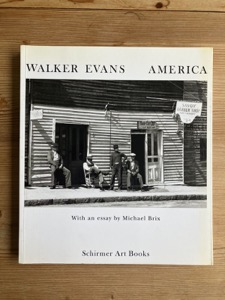
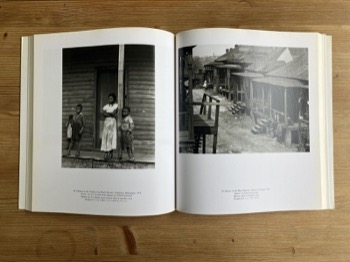
Softcover. Munich/NY, Schirmer/Mosel, reprint, 1997, Book: Very Good, Dust Jacket: None, Softcover, a collection of 123 b&w duotone photographs taken by Evans from 1927 to 1948. Essay by Michael Brix. Clean copy.
Hardcover. GR, Hatje Cantz, 1st, 2010, Book: Very Good, Dust Jacket: Very Good, Hardcover, 272 pages. Illustrated in b&w. Walker Evans (1903-1975) is, without doubt, one of the most influential American photographers ever, and many of his images have become fixed in the collective memory. But while Evans' uncompromising depiction of poverty during the Great Depression of the 1930s, the subject of a series commissioned by the Farm Security Administration, has become a key chapter in the history of photography, his equally innovative images from later decades have generally commanded less attention. Back in print, this bilingual monograph attempts to redress the balance by examining Evans' complete body of work, and features many rarely seen photographs, including his final works, a sequence of Polaroids shot in the early 1970s (a sequence made possible by an unlimited supply of film from its manufacturer). Evans' re-ascendancy in the 1970s and his relationship with legendary Museum of Modern Art curator John Szarkowski are also closely examined, in this essential and definitive volume on a great photographer who certainly achieved his aim to produce pictures that were "literate, authoritative, transcendent."
Softcover. London, Afterall Books, 1st, 2019, Book: Very Good, Dust Jacket: None, Softcover, 88 pages. Illustrated with b&w and color plates. Kitchen Corner, Tenant Farmhouse, Hale County, Alabama shows a painstakingly clean-swept corner in the house of an Alabama sharecropper. Taken in 1936 by Walker Evans as part of his work for the Farm Security Administration, Kitchen Corner was not published until 1960, when it was included in a new edition of Walker Evans and James Agee's classic Let Us Now Praise Famous Men. The 1960 reissue of Evans and Agee's book had an enormous impact on Americans' perceptions of the Depression, creating a memory-image retrospectively through Walker's iconic photographs and Agee's text. In this latest addition to the Afterall One Work series, photographer Olivier Richon examines Kitchen Corner. The photograph is particularly significant, he argues, because it uses a documentary form that privileges detachment, calling attention to overlooked objects and to the architecture of the dispossessed.
Softcover. London, Afterall Books, 1st, 2019, Book: Very Good, Dust Jacket: None, Softcover, 88 pages. Illustrated with b&w and color plates. Kitchen Corner, Tenant Farmhouse, Hale County, Alabama shows a painstakingly clean-swept corner in the house of an Alabama sharecropper. Taken in 1936 by Walker Evans as part of his work for the Farm Security Administration, Kitchen Corner was not published until 1960, when it was included in a new edition of Walker Evans and James Agee's classic Let Us Now Praise Famous Men. The 1960 reissue of Evans and Agee's book had an enormous impact on Americans' perceptions of the Depression, creating a memory-image retrospectively through Walker's iconic photographs and Agee's text. In this latest addition to the Afterall One Work series, photographer Olivier Richon examines Kitchen Corner. The photograph is particularly significant, he argues, because it uses a documentary form that privileges detachment, calling attention to overlooked objects and to the architecture of the dispossessed.
Hardcover. New York, Da Capo Press, 1st, 1973, Book: Very Good, Dust Jacket: Very Good, Hardcover, unpaginated, approx. 250 pages. Profusely illustrated in b&w. Features 488 photographs taken in Georgia, South Carolina, New Orleans, Mississippi, West Virginia, and other environs. Light wear to dust jacket, some mild scaring to inside covers where dust jacket was once taped to cover.
Softcover. New York, Abrams, reprint, 2004, Book: Very Good, Dust Jacket: None, 368 pages, b&w plates. A reduced format softcover edition of the monumental 1993 edition by the same publisher. 300 duotone photographs that survey every significant aspect of his life and work, from his self-education and early specialization of street-life observations to his three-year involvement with the Farm Security Administration and his breakthrough exhibition at the Museum of Modern Art.
Hardcover. NY, Prestel , 1st, 2017, Book: Very Good, Dust Jacket: None, Hardcover, pictorial boards, 320 pages. Some of Walker Evans' most iconic images of 20th-century American culture are showcased in this book celebrating his 50-year career. Walker Evans was one of the most important American photographers of the 20th century. His focus on everyday life in America, in both urban and rural settings, makes him also one of the most relatable. This retrospective volume traces Evans' career through more than 300 images--from his first photographs of the late 1920s to his Polaroids of the 1970s. Organized thematically, the book examines topics such as Evans' relationship with the impresario Lincoln Kirstein, his work in postcards and magazines, and his lifelong exploration of the American vernacular. In addition, this volume features items from the photographer's own collection, including personal writings, signage, postcards, and other ephemera. Through these ancillary objects and a thorough overview of Evans' career, readers will come away with a better understanding of a photographer whose iconic photographs remain timeless.
Softcover. NY, Museum of Modern Art, 3rd pr., 1979, Book: Very Good, Dust Jacket: None, Softcover, 192 pages, 106 illustrations. Clean, tight copy. A reprint of the classic 1971 monograph. Introduction by John Szarkowski.
Hardcover. NY, Museum of Modern Art, 1st, 1971, Book: Very Good, Dust Jacket: Very Good, Hardcover, 192 pages, 106 illustrations. Light edgewear and rubbing to dust jacket. Clean, tight copy.
Softcover. New York, The Metropolitan Museum of Art, 1st, 2000, Book: Very Good, Dust Jacket: Very Good, Softcover, 318 pages. B+W and color photographs throughout. Clean and tight copy. Large exhibition catalog. Although his work has received many awards, been enshrined in the best museums, and been exhibited on several continents, Evans's total corpus is only now being fully examined. This important book revises our appreciation of Evans by presenting previously unknown material in an accessible context. Essays by Maria Morris Hambourg, Jeff L. Rosenheim, Doug Eklund, and Mia Fineman offer novel insights into the sources and legacy of Evans's work. The result is a superb exploration of what was achieved by one of our finest, mostly deeply American artists.
Hardcover. New York, Museum of Modern Art , 1st, 1971, Book: Very Good, Dust Jacket: Very Good, Hardcover, 192 pages, illustrated with 106 b&w photos by Evans. Dust jacket with light edgewear and soil, price-clipped.
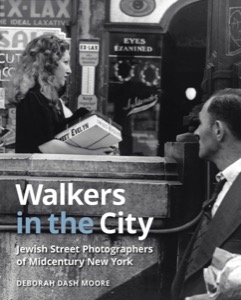
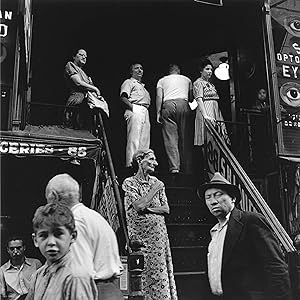
Hardcover. Ithaca NY, Three Hills/Cornell University, 1st, 2023, Book: Very Good, Dust Jacket: Very Good, Hardcover in a bright dust jacket. 290 pages, b&w photos throughout. Drawing on the experiences of and photographs by a generation of young Jewish photographers who belonged to the New York Photo League, Deborah Dash Moore offers a new perspective on New York as seen through their eyes-a cityscape of working-class people and democratizing public transit. With their cameras, they pictured Gotham's abrasive social milieu and its evanescent textures and light, creating an archive of vernacular images of city life and a distinctive tradition of street photography that would be widely imitated. Walkers in the City documents how these roving, imaginative New Yorkers, entranced by the medium of photography, transformed everyday sights into rousing, joyous, and poignant moments of time, creating visual poetry out of the fabric of social life.
Hardcover. Dresden, Verlag der Kunst, 1st, 1990, Book: Very Good, Dust Jacket: Very Good, Hardcover, 211 pages. Illustrated with 140 black & white photographs by Walter Rosenblum. Red remainder stamp on bottom edge. Text in English and German. Clean, tight copy.
Hardcover. Dresden GR, Verlag der Kunst/Weingarten, 1st, 1990, Book: Very Good, Dust Jacket: Very Good, Hardcover in a bright dust jacket. 211 pages. Text in German and English. Survey of the works of the noted American photojournalist, from 1938 to 1980; notable for the documentary photos of Haiti (1958/59) and of the South Bronx (1980). Essays by Rice and Naomi Rosenblum; biographical chronology and selected bibliography. Clean copy.
Hardcover. London, Imperial War Museum, 1st, 1981, Book: Very Good, Dust Jacket: Very Good, 192 pages, hardcover with dust jacket. War time photos from noted photographer. Light fading and edgewear to dust jacket top edge. Foxing to top edge of text block. Unmarked.
Hardcover. Mechanicsburg PA, Stackpole Books, 1st, 2010, Book: Very Good, Dust Jacket: Very Good, Hardcover, 227 pages, b&w photos. Light scratching to dust jacket front cover. Clean, tight copy. They shot some of the most iconic footage of World War II while risking their lives, yet the stories--and sheer guts--of the U.S. Marine Corps combat cameramen have been overshadowed by the heroism of the men with the rifles. War Shots brings these photographers into sharp focus through the career of Norm Hatch, a true American character whose skill with a camera and knack for being in the right place at the right time thrust him to the fore of the effort to record the Marines at war in the Pacific.
Hardcover. Mechanicsburg PA, Stackpole Books, 1st, 2010, Book: Very Good, Dust Jacket: Very Good, Hardcover, 227 pages, b&w photos. Light scratching to dust jacket front cover. Clean, tight copy. They shot some of the most iconic footage of World War II while risking their lives, yet the stories--and sheer guts--of the U.S. Marine Corps combat cameramen have been overshadowed by the heroism of the men with the rifles. War Shots brings these photographers into sharp focus through the career of Norm Hatch, a true American character whose skill with a camera and knack for being in the right place at the right time thrust him to the fore of the effort to record the Marines at war in the Pacific.
Hardcover. New York , powerHouse Books, 1st, 2007, Book: Very Good, Dust Jacket: Very Good, A behind-the-scenes, in-depth record of his photographic life from 1976 to 1987, Warhol Makos In Context , Christopher Makos' newest book, documents the years he spent at Andy Warhol's side. Over 100 original Makos contact sheets, reproduced in full with the photographer's editing marks and comments, have never before been seen. Warhol Makos In Context features unedited, raw material of his work during the years he saw Warhol almost daily--including the experiences and friends he shared with Warhol, the trips the two and others made together, and scenes of work life at Warhol's 860 Broadway Factory and Makos' West 15th Street studio.
Softcover. NY, New American Library, 1st, 1989, Book: Very Good, Dust Jacket: None, Softcover, 128 pages. Over one hundred photos of Warhol, his friends and activities. Name on front fly leaf. otherwise clean.
Hardcover. Baltimore, Johns Hopkins University Press, 1st, 1995, Book: Very Good, Dust Jacket: Very Good, Hardcover in a bright, unclipped dust jacket. In Washington Seen Fredric Miller and Howard Gillette bring together nearly four hundred unique photographs from the Gilded Age to the Great Society. Throughout, the focus is not on streets and monuments but on the complex relationships among the people of Washington-men and women, black and white-and the way they worked and lived. Here are Washingtonians at home and at work, at restaurant tables and lunch counters, in schools and churches, dancing the jitterbug and going to the movies, cheering the Redskins, the Senators, and the Homestead Greys. In the accompanying text, Miller and Gillette invite readers to enter into an intimate "conversation with the past," offering insightful commentary on the images of people whose faces cannot fail to captivate. Clean copy.
Hardcover. Guilford CT, TwoDot, 1st, Book: Very Good, Dust Jacket: None, Hardcover, pictorial boards, 159 pages, b&w photos throughout. Classic Photographs from the Farm Security Administration 1936-1943. Featuring images by such renowned photographers as Dorothea Lange, Arthur Rothstein, Russell Lee, and several others, this book documents ranching culture in western states during the Great Depression and leading up to World War II. This was a period of great change in the ranching West that included the introduction of the automobile, electricity, radio, the telephone, and other technologies that drastically transformed the lives and work of ranching people, and some of the best documentation exists in the powerful documentary photographs by this remarkable group of photographers. Clean copy.
Hardcover. Brooklyn NY, powerHouse Books, 1st, 2008, Book: Very Good, Dust Jacket: Very Good, Hardcover, 256 pages, Clean copy in a bright dust jacket. Edited by Stephen Daiter. Introduction by Fred Ritchin. Essay by Kerry Tremain. A wide ranging collection of 190 duotone images. Miller's work always contained a peculiar empathy, whether he was photographing American servicemen, Italian street urchins, or Japanese survivors of the atomic bomb, and that ethos extends to his subsequent landmark studies of the famous Bronzeville neighborhood in postwar Chicago.
Hardcover. Brooklyn NY, powerHouse Books, 1st, 2008, Book: Very Good, Dust Jacket: Very Good, Hardcover, 256 pages, Clean copy in a bright dust jacket. Edited by Stephen Daiter. Introduction by Fred Ritchin. Essay by Kerry Tremain. A wide ranging collection of 190 duotone images. Miller's work always contained a peculiar empathy, whether he was photographing American servicemen, Italian street urchins, or Japanese survivors of the atomic bomb, and that ethos extends to his subsequent landmark studies of the famous Bronzeville neighborhood in postwar Chicago.
Softcover. Boston, Bulfinch Press, 1st pbk., 2000, Book: Very Good, Dust Jacket: None, Softcover, 262 pages. Essays by Miles Barth, Alain Bergala and Ellen Handy. Includes 265 duotones. A very near fine copy in a French style wrappers. One of the best monographs on Weegee.

 "Walker Evans America: Pictures from the Great Depressionby: Brix, Michael")
 "Walker Evans: Decade by Decadeby: Crump and Walker Evans, James")
 "Walker Evans: Kitchen Corner by: Olivier Richon")
 "Walker Evans: Kitchen Corner by: Olivier Richon")
 "Walker Evans: Photographs for the Farm Security Administration 1935 1938 A Catalog of Photographic Prints Available from the Farm Security Administration Collection in the Library of Congress by:")
 "Walker Evans: The Hungry Eyeby: Evans, Walker, Gilles Mora and John T. Hill")
 "Walker Evansby: Clement Cheroux, Svetlana Alpers, et al.")
 "Walker Evansby: Evans, Walker")
 "Walker Evansby: Evans, Walker")
 "Walker Evansby: Hambourg, Maria Morris and others")
 "Walker Evansby: Szarkowski (Intro.), John")
 "Walkers in the City: Jewish Street Photographers of Midcentury New York by: Deborah Dash Moore")
 "Walter Rosenblum - Photographerby: Rice, Shelley/Naomi Rosenblum")
 "Walter Rosenblumby: Rice, Shelley and Walter Rosenblum")
 "War Photographs 1939-45by: Beaton, Cecil")
 "War Shots: Norm Hatch and the U.S. Marine Corps Combat Cameramen of World War IIby: Jones, Charles")
 "War Shots: Norm Hatch and the U.S. Marine Corps Combat Cameramen of World War IIby: Jones, Charles")
 "Warhol/ Makos in Contextby: Fremont, Vincent")
 "Warhol/Makos: A Personal Photographic Memoirby: Warhol, Andy/Christopher Makos.")
 "Washington Seen: A Photographic History, 1875-1965by: Fredric M. Miller and Jr. Gillette Howard F.")
 "Way Out West: Images of the American Ranchby: Charlie Seemann")
 "Wayne F. Miller: Photographs 1942-1958by: Tremain, Kerry")
 "Wayne F. Miller: Photographs 1942-1958by: Tremain, Kerry")
 "Weegee's World by: Barth, Miles")