Hardcover. London, Chatto & Windus, 2nd pr., 1954, Book: Very Good, Dust Jacket: Good, Hardcover in a bright, lightly worn and chipped dust jacket. 320 pages, b&w photo illustrations. The Chapters are: Gambia; Sierra Leone; The Gold Coast; Nigeria: The West; The North; The Southern Cameroons; and The East; followed by an index. Clean copy.
Softcover. London, ABACUS/Little Brown, reprint, 1994, Book: Very Good, Dust Jacket: None, Softcover, 434 pages. Having travelled across West Africa for over ten years, Peter Biddlecombe's often hilarious account of a long and lingering liaison dangereuse with the sixty per cent of the continent that is French-speaking is a highly readable, hugely entertaining introduction to the je ne sais quoi of French Africa. In countries such as Togo, Mali and Burkina Faso, Biddlecome encounters old-fashioned camel butchers, modern witch doctors who run mail-order companies, gold smugglers and counterfeiters who send their sons to Oxford. He also experiences a delicious foie gras of places: from eerie voodoo ceremonies in the old slave port of Ouidah to Italian ice-cream parlors in the middle of the Sahara desert. And Biddlecombe reveals not only Francophone Africa's politics, often bizarre business traditions and culture, but also provides a mass of practical advice on everything from how to eat a water-rat to talking your way through a road block in the middle of an attempted coup. Clean copy.
Hardcover. New York, Simon and Schuster, 1st, 1938, Book: Very Good, Dust Jacket: None, 398 pages. Hardcover with no dust jacket. Cloth covers with stamped decoration on spine. Light soil, tight copy.
Hardcover. NY, William Morrow, 1st, 1971, Book: Very Good, Dust Jacket: Good, Hardcover in a lightly worn dust jacket, 286 pages. "These thirty five selections, almost all autobiographical, portray what it was like to grow up in Africa". Contributors include Leopold Senghor, Kwame Nkrumah, Camara Laye, James Ngugi, Peter Abrahams, David Diop and many more. Map endpapers.
Hardcover. Greenwich CT, New York Graphic Society, 1st, 1962, Book: Very Good, Dust Jacket: Good, Hardcover in a lightly worn dust jacket, 337 pages. Ibamba is the name of 13 square miles of glorious lion country in Northern Rhodesia (Zambia), and also the African adventure of a young American couple who lived there for four years taming the land and its wild inhabitants as ranchers and zoologists.
Hardcover. NY, The Century Company, 1st, 1926, Book: Very Good, Dust Jacket: None, Hardcover, brown cloth decorated in red, black and gilt. Illustrated throughout with black-and-white images. Includes two fold-out color maps. The publisher's laud Powell's travel book for its "discussion of historical, religious, racial, and political questions for those contemplating a travel to French North Africa, Tunisia, Algeria and Morocco during the 1920s." Rear hinge cracked, spine with small tears/punctures otherwise clean copy.
Chicago, University of Chicago , 6th pr., 1989, Book: Very Good, Dust Jacket: None, Softcover, 236 pages, b&w illustrations. The tale of Paul Stoller's sojourn among sorcerors in the Republic of Niger is a story of growth and change, of mutual respect and understanding that will challenge all who read it to plunge deeply into an alien world.
Hardcover. NY, Harcourt Brace , 1st, 1994, Book: Very Good, Dust Jacket: Very Good, Hardcover in a bright, unclipped dust jacket. Illustrated with 16 pages of black and white photographs, 338 pages. With wry humor and sharp observation, playwright Pifer elegantly mixes memory and research to reconstruct the world of his South African boyhood from 1933 to 1945. Pifer's father, an idealistic mining engineer in search of challenge and stability during the Depression, found it in Africa, but his earnest American egalitarianism soon put him in conflict with Afrikaner mine overseers, and his career under magnate Sir Ernest Oppenheimer stalled. The author deftly evokes his family--"my mother had the freedom of a disobedient daughter"--and the isolation of the desert town of Oranjemund. The book is even more resonant in its snapshots of mid-century Southern Africa: the still-simmering enmity between Afrikaners and the English; the ripples from Hitler's war in what prior to WW I had been the German territory of South West Africa (currently Namibia). Pifer's knowing account of the travails of servants--"the chasm that exists between white mistress and African maid"--still rings true today. Clean copy.
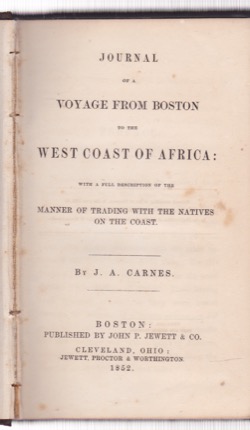
Hardcover. Boston, John P. Jewett & Co., 1st, 1852, Book: Very Good, Dust Jacket: None, Hardcover, original blind stamped cloth with gilt stamped lettering on spine. 479 pages with mild foxing to a few pages. Very good plus, no markings.
Hardcover. New York , Harper and Brothers, 1st US, 1964, Book: Very Good, Dust Jacket: None, Hardcover, 590 pages plus publisher's ads. Frontispiece portrait of Speke, 2 maps (one folding at rear of book). Rebound in brown cloth, gilt lettering on spine. Marbled edges. Clean and bright.
Hardcover. NY, Atheneum, 1st, 1969, Book: Very Good, Dust Jacket: Very Good, Hardcover in an unclipped dust jacket, 224 pages. Color and b&w photos. A memoir by the wife of Toni Harthoorn, one of the best-known vets and animal scientists in Africa. Clean copy.
London, John Murray, 1st, 1963, Book: Very Good, Dust Jacket: Good, Hardcover in a lightly worn dust jacket, 229 pages illustrated in b&w by Victor Ambrus. The early (1914-34) and very readable Kenya memoirs of an administration official. Seaton presents his own particular vision of East Africa as it was from 1913 to 1926, the unsophisticated Africa with its peoples and wild life, before the golden age came to an end. Previous owner's name on front fly leaf, otherwise clean.
Hardcover. NY, National Travel Club, reprint, 1930, Book: Very Good, Dust Jacket: None, Hardcover, black cloth stamped in gilt. 358 pages. Map endpapers, frontispiece, notes, map, appendices. Introduction by Edward Garnett. Frontispiece of the author on a horse as Sheikh Mohammed El Fasi. Mild fade to spine lettering, otherwise a tight, clean copy.
Hardcover. Boston, Little, Brown & Company, 1st, 1925, Book: Fair, Dust Jacket: None, Hardcover, maroon cloth with faded gilt lettering. 245 pages, b&w illustrations. Czech writer, Hans Coudenhove writes of a long stay in Nyasaland (now Malawi) and describes the African people, mongooses, monkeys, lions, ants, kites, ravens and snakes. So immersed in African culture is author Coudenhove that he had not slept in a bed, dined with a human, or seen any entertainment in decades of living there. Quoth he: I have not been in a theatre for twenty-eight years.and I have never seen any of the modern dances--'jazz' I think they are called. So this perspective might be considered unsullied by any 'modern' thinking, and it is pure African to the core--a unique perspective on the fauna of the continent Ex-lib with marking and residue to endpapers.
Hardcover. NY, W W Norton , 2nd pr., 1988, Book: Very Good, Dust Jacket: Very Good, Hardcover in a bright, unclipped dust jacket. Illustrations with black & white drawings by Bob Kuhn, 221 pages. Myles Turner, born in London in 1921, spent most of his life in Africa. After serving in World War Two, he worked with various companies leading tours through the African Wild. A avid consevationist, Turner began working for the Serengeti in 1956. This book is the memoirs of this time. Clean copy.
Hardcover. New York, Alfred Knopf, 2nd pr., 1997, Book: Very Good, Dust Jacket: Very Good, 462 pages. Hardcover with dust jacket. Clean, tight copy with minor wear to covers and edges.
Hardcover. New York, Alfred Knopf, 1st, 1997, Book: Very Good, Dust Jacket: Very Good, 462 pages. Hardcover with dust jacket. Clean, tight copy with minor wear to covers and edges. A modern classic of travel literature: "Ostensibly a quest for Mokele-mbembe, the Congo dinosaur , this story of travel through the jungles and swamp forests of the northern Congo is Tolstoyan in its depth, scope and range of characters, and as vivid as Nabokov in its image and detail. A portrait of a country, it is alive with natural history: eagles and parrots, hornbills and sunbirds, forest cobras and crocodiles, gorillas and elephants. A search for the meaning of sorcery, the purpose of religion (and a celebration of the comfort and mysteries of science), it is also an adventure told with great narrative force. Of course there is a darker side to the Congo, and that too is recorded here." Kazuo Ishiguro called this a "unique messy masterpiece."
Hardcover. NY, Crown Publishers, 1st, 1993, Book: Very Good, Dust Jacket: Very Good, Hardcover in a bright dust jacket, 324 pages. This is a rivetting chronicle by two visitors to a complex world rarely seen by outsiders: the vibrant daily lives of West African villagers, and the parellel, invisible realm of spirits that surround them. This beautifully written memoir recounts the deepening knowledge slowly acquired by Alma Gottlieb, a cultural anthropologist, and Philip Graham, a fiction writer, as they lived among the Beng, a previously unstudied people of Cote d'Ivoire. Clean copy.
Softcover. Washington DC/NY, Infantry Journal and Penguin Books, reprint, 1944, Book: Very Good, Dust Jacket: None, Paperback, 305 pages. Frontis map. The author became the oldest Junior Subaltern (Second Lieutenant) in the British forces and became known later as the "water bloke" by building an ever-extending pipeline to furnish filtered fresh-water to the British troops pursuing Rommel's army into Tunisia. From the very beginning and especially from the Battle of El Alamein onwards, he traveled the whole 2,000 mile mine-ridden way providing life-sustaining water to the British Eighth Army who spearheaded the allied Tunisian Campaign in a dozen bitter battles that ended in victory on 13 May 1943. The Sappers retired Peter William Rainier as a Major in June 1943 just after the hostilities in Africa had ended. He is remembered as one of the few original members of The Army of the Nile (General Wavell's "thirty thousand") who survived the three long years of fighting allowing him to witness the final victory over the Axis powers in Africa. Clean, bright copy.
Hardcover. NY, Harper, 1st, 2009, Book: Very Good, Dust Jacket: Very Good, Hardcover in a bright dust jacket, 183 pages. Illustrated with photos. Basketball immortal Bill Russell provides this memoir of his deep friendship with Boston Celtics coach red Auerbach. Russell was the center on the Auerbach teams that one 11 championships in 13 years. At the time, he said little about his deeply personal relationship with his coach but Russell and Auerbach--one a short, brash Jew from Brooklyn, the other a tall, intense African American from Louisiana and Oakland--were far more than just coach and player. Through the 13 years of the Celtics dynasty together their relationship evolved into a rare, telling example of deep male friendship: confident, supportive, understanding, founded in common goals, even as their feelings went largely unspoken. Clean copy.
Hardcover. NY, Harcourt Brace, 1st, 1993, Book: Very Good, Dust Jacket: Very Good, Hardcover in a bright, unclipped dust jacket. The painter, writer, and political activist returns to his native South Africa, where he was once imprisoned for working for the African National Congress, and reflects on the decline of apartheid and his own attachment to the Boer state. He describes the travail of his country riven by racial conflict. He recounts his seven-year imprisonment for treason and shares the passionate love of an exile--he resides in Paris--for his native land. In the recent period of "stability laced with blood" as De Klerk and Mandela's forces struggle to maintain a precarious political equilibrium, Breytenbach has been allowed to return for visits with his Vietnamese wife. Part travelogue and part memoir, this account offers frequent political discussions about the rivalry between the African National Congress and the Inkatha Freedom Party. A careful observer of people, their surroundings, fauna and flora, Breytenbach weaves richly colored narrative history, local lore and personal allusions. Clean copy.
Hardcover. London, Hutchinson, 1st, 1956, Book: Very Good, Dust Jacket: Good, Hardcover in a worn dust jacket, 190 pages, 5 b&w illustrations. A true account of the author's adventures as a young man prospecting for gold in Africa, and the region that he believes is the legendary Ophir, famous in Old Testament times for it's fine gold. Name on inside front cover otherwise clean.
Softcover. Ithaca NY, Cornell University Press, reprint, 1990, Book: Very Good, Dust Jacket: None, Softcover, 309 pages. A major contribution to the cultural and literary history of the Victorian age, Rule of Darkness maps the complex relationship between Victorian literary forms, genres, and theories and imperialist, racist ideology. Critics and cultural historians have usually regarded the Empire as being of marginal importance to early and mid-Victorian writers. Patrick Brantlinger asserts that the Empire was central to British culture as a source of ideological and artistic energy, both supported by and lending support to widespread belief in racial superiority, the need to transform "savagery" into "civilization," and the urgency of promoting emigration. Rule of Darkness brings together material from public records, memoirs, popular culture, and canonical literature. Brantlinger explores the influence of the novels of Captain Frederick Marryat, pioneer of British adolescent adventure fiction, and shows the importance of William Makepeace Thackeray's experience of India to his novels. He treats a number of Victorian best sellers previously ignored by literary historians, including the Anglo-Indian writer Philip Meadows Taylor's Confessions of a Thug and Seeta. Brantlinger situates explorers' narratives and travelogues by such famous author-adventurers as David Livingstone and Sir Richard Burton in relation to other forms of Victorian and Edwardian prose. Through readings of works by Arthur Conan Doyle, Joseph Conrad, H. Rider Haggard, Rudyard Kipling, John Hobson, and many others, he considers representations of Africa, India, and other non-British parts of the world in both fiction and nonfiction. Clean, bright copy.
Hardcover. NY, G.P. Putnam's Sons, 8th pr., 1928, Book: Good, Dust Jacket: None, Hardcover, orange cloth with gilt lettering, 294 pages. Illustrated with 66 photographs by the author, the famous explorer Martin Johnson, who later became the noted documentary filmmaker in Africa with his wife, Osa. A story of adventure and exploration in Africa, with much information about the extraordinary wildlife, including elephants, lions, rhinos, and gorillas. Fold-out map in rear. Minor edge wear, slight dust soiling, a bit of pitting to the cloth along spine edge. Inscription on first blank page otherwise clean.

 "Four Guineas: A Journey through West Africa by: Elspeth Huxley")
 "French Lessons in Africa: Travels with My Briefcase Through French Africa by: Peter Biddlecombe")
 "Frontiers of Enchantment: An Artist's Adventures in Africa by: Leigh, W.R.")
 "Growing Up African: Black Africans Recount Their Childhoods by: David, Jay and Harrington, Helise, (Edited by)")
 "Ibamba by: Hubbard, Wynant Davis")
 "In Barbary: Tunisia Algeria Morocco And The Sahara by: Powell, E. Alexander")
 "In Sorcery's Shadow: A Memoir of Apprenticeship among the Songhay of Niger by: Stoller, Paul/ Olkes, Cheryl")
 "Innocents In Africa: An American Family's Story by: Pifer, Drury")
 "Journal of a Voyage From Boston to the West Coast of Africa; with a Full Description of the Manner of Trading with the Natives on the Coast by: J. A. Carnes")

 "Journal of the Discovery of the Source of the Nile by: Speke, John Hanning")
 "Life with Daktari: Two Vets in East Africa by: Hart, Susanne")
 "Lion in the Morning by: Seaton, Henry")
 "Mogreb-el-Acksa: A Journey in Morocco by: Cunninghame Graham, R.B.")
 "My African Neighbors: Man, Bird, and Beast in Nyasaland by: Coudenhove, Hans")
 "My Serengeti Years: The Memoirs of an African Games Warden by: Turner, Myles")
 "No Mercy: A Journey to the Heart of the Congo by: O'Hanlon, Redmond")
 "No Mercy: A Journey to the Heart of the Congo by: O'Hanlon, Redmond")
 "Parallel Worlds: an Anthropologist and a Writer Encounter Africa by: Alma Gottlieb and Philip Graham")
 "Pipeline to Battle; An Engineer's Adventures with the British Eighth Army by: Rainier, Maj. Peter W.")
 "Red and Me: My Coach, My Lifelong Friend by: Bill Russell /Alan Steinberg")
 "Return to Paradise by: Breyten Breytenbach")
 "Road To Ophir: The Autobiography Of A Prospector by: Rex Tremlett")
 "Rule of Darkness: British Literature and Imperialism, 1830 1914 by: Patrick Brantlinger")
 "Safari: A Saga of the African Blue by: Johnson, Martin")