Softcover. NY, Prentice Hall, 1st pbk, 1970, Book: Very Good, Dust Jacket: None, Softcover, 184 pages. Revealing and disturbing study of the racist ideas and fantasies of southern whites after the Civil War and examines their racial fantasies and the social and psychological roots of those fantasies. He reveals how a complex set of anxieties and repressions in Southern life led whites to need "Negro" Inferiority." Name on title page otherwise clean.
Athens GA, University of Georgia Press, 1st, 1969, Book: Very Good, Dust Jacket: Very Good, Hardcover in a bright dust jacket, 78 pages. Mercer University Lamar Memorial Lectures, No. 12. Name on front fly leaf, otherwise clean.
Hardcover. New Haven, Yale University, 1st, 1938, Book: Very Good, Dust Jacket: None, 29 pages. Hardcover. INSCRIBED ON FRONT ENDPAPER BY AUTHOR. Portrait of Winthrop opposite title page. Darkening to title on spine, with chip missing at very top. Moderate rubbing with small section of abrasion at bottom right corner of front cover. Clean, unmarked copy.
Softcover. Baltimore MD, Gateway Press, 1st, 2002, Book: Very Good, Dust Jacket: None, Softcover. 272 pages. INSCRIBED BY AUTHOR on the title page. 226 men with ties to College Point, New York took part in the Civil War. They served in 82 different Army units, and in the Navy, both on land and on sea. They were infantry men, engineers and artillerists, and one was a musician in the Marine Band. The majority claimed Germany as their country of birth, and 24 died in the service of their adopted homeland. This Gunner at His Piece tells their stories, before, during and after the American Civil War. Clean copy.
Hardcover. NY, Time Life, reprint, 1984, Book: Very Good, Dust Jacket: None, 436 pages. Hardcover with no dust jacket. Dark blue leather bound with gilt titles to front cover and spine. Embossed decoration on front cover. Gilt text block edges, red ribbon marker. Clean, tight copy.
Softcover. Cambridge MA, Harvard University Press, reprint, 1998, Book: Very Good, Dust Jacket: None, Softcover, 311 pages. As the Civil War drew to a close, newly emancipated black women workers made their way to Atlanta-the economic hub of the newly emerging urban and industrial south-in order to build an independent and free life on the rubble of their enslaved past. In an original and dramatic work of scholarship, Tera Hunter traces their lives in the postbellum era and reveals the centrality of their labors to the African-American struggle for freedom and justice. Household laborers and washerwomen were constrained by their employers' domestic worlds but constructed their own world of work, play, negotiation, resistance, and community organization. Hunter follows African-American working women from their newfound optimism and hope at the end of the Civil War to their struggles as free domestic laborers in the homes of their former masters. We witness their drive as they build neighborhoods and networks and their energy as they enjoy leisure hours in dance halls and clubs. We learn of their militance and the way they resisted efforts to keep them economically depressed and medically victimized. Finally, we understand the despair and defeat provoked by Jim Crow laws and segregation and how they spurred large numbers of black laboring women to migrate north. Clean copy.
Hardcover. NY, Oxford University Press, 4th pr., 2000, Hardcover in a bright dust jacket. 670 pages, b&w illustrations. Written by the most prominent of the new generation of historians, this superb volume offers the most up-to-date and authoritative account available of African-American history, ranging from the first Africans brought as slaves into the Americas, to today's black filmmakers and politicians. Here is a panoramic view of African American life, rich in gripping first-person accounts and short character sketches that invite readers to relive history as African Americans experienced it. We begin in Africa, with the growth of the slave trade, and follow the forced migration of what is estimated to be between ten and twenty million people, witnessing the terrible human cost of slavery in the colonies of England and Spain. We read of the Haitian Revolution, which ended victoriously in 1804 with the birth of the first independent black nation in the New World, and of slave rebellions and resistance in the United States in the years leading up to the Civil War. There are vivid accounts of the Civil War and Reconstruction years, the backlash of notorious "Jim Crow" laws and mob lynchings, and the founding of key black educational institutions. The contributors also trace the migration of blacks to the major cities, the birth of the Harlem Renaissance, the hardships of the Great Depression and the service of African Americans in World War II, the struggle for Civil Rights in the 1950s and '60s, and the emergence of today's black middle class. From Harriet Tubman and Frederick Douglass to Martin Luther King, Jr., and Louis Farrakhan, To Make Our World Anew is an unforgettable portrait of a people. Clean copy.
Hardcover. NY, Columbia University, 1st, 1907, Book: Good, Dust Jacket: None, Hardcover, black cloth with gilt stamping, 126 pages. Ex-library with light markings and stamping. Much on the fur trade, early agriculture, gold dust and Civil War currency and trade in Oregon during the 1800s.
Hardcover. NY, Simon & Schuster, 1st, 2002, Book: Very Good, Dust Jacket: Very Good, Hardcover in a bright dust jacket, 352 pages. Alfred Lee Loomis (1887-1975) made his fortune in the 1920s by investing in public utilities, but science was his first love. In 1928, he established a premier research facility in Tuxedo Park, N.Y., that attracted such brilliant minds as Einstein, Bohr and Fermi and became instrumental in the Allies' WWII victory. Conant, a magazine writer, draws on studies, family papers and interviews with Loomis's friends, family and colleagues (she's a relative of two scientists who worked with Loomis) to trace the story of the tycoon's professional and social life (the latter fairly racy). At the Tuxedo Park lab, Loomis attracted top-flight scientists who experimented with sound, time measurement and brain waves. During WWII, he established a laboratory at MIT (the "rad lab") where radar was developed. He also served as a conduit between civilian scientists and Roosevelt's military establishment. Although he lost some of his top people to the Manhattan Project, the "rad lab" was a major contributor to the allies' defense. In his well-publicized personal life, Loomis angered family members by trying to have his emotionally unstable wife institutionalized while he pursued an affair with another woman. Through Conant's spare, unobtrusive prose and well-paced storytelling, Loomis emerges as a contradictory man who craved scientific accomplishment and influence, but rarely took credit for himself.
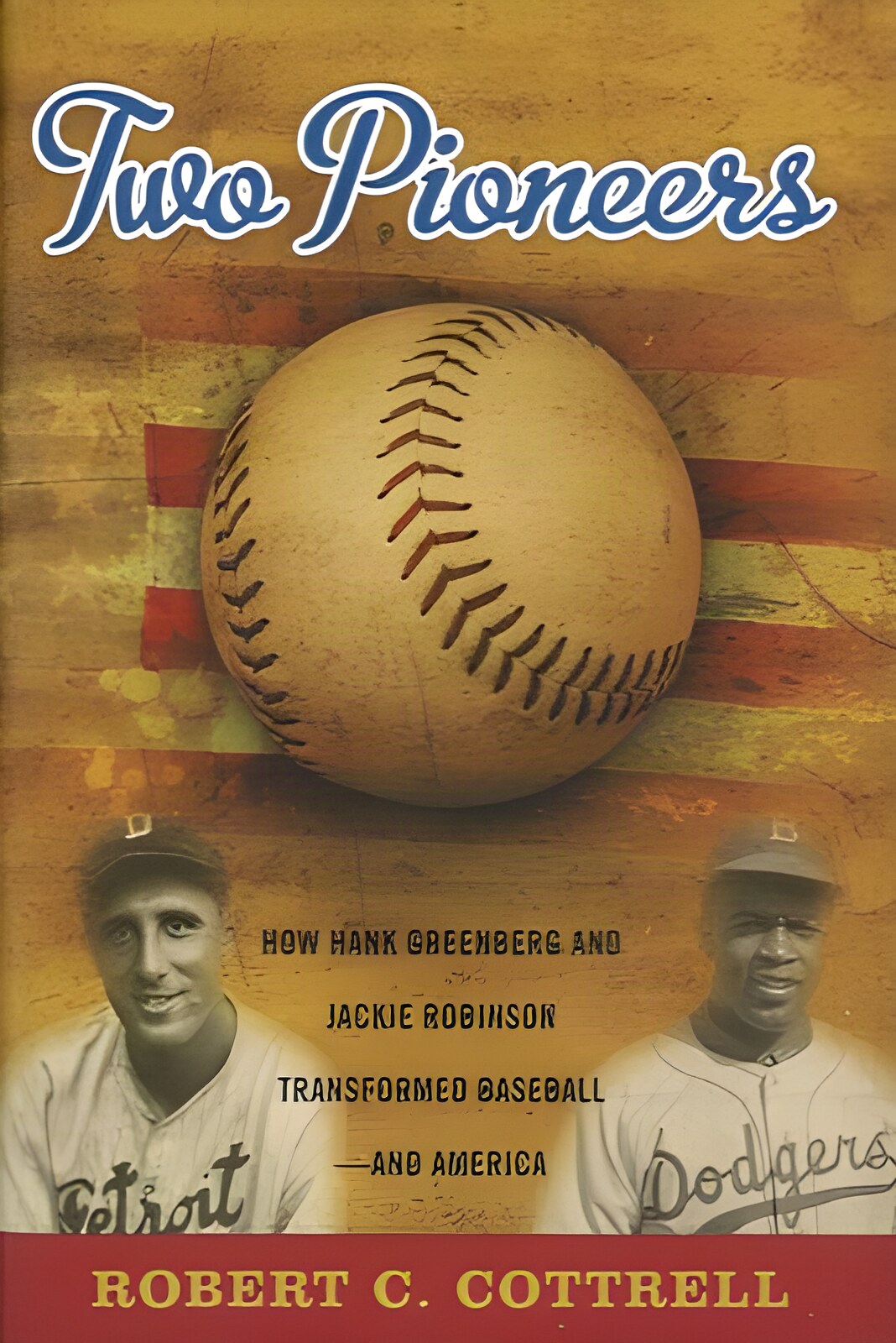
Hardcover. Washington DC, Potomac Books, 1st, 2012, Book: Very Good, Dust Jacket: Very Good, Hardcover in a bright dust jacket, 270 pages, b&w illustrations. As the first great Jewish player in the major leagues and the first African American to play major-league baseball during the twentieth century, respectively, Hank Greenberg and Jackie Robinson are forever linked because of the barriers they encountered, the discrimination they endured, the athletic gifts they exhibited, and especially the courage and dignity they displayed. Both suffered ridicule and abuse as they participated in the national pastime. Nevertheless, each excelled. Greenberg became one of the preeminent sluggers of the 1930s and 1940s who took a break from baseball to serve in the war. Robinson, from the mid-1940s into the following decade, helped bring back speed and a thinking man's approach to the game, both of which had largely been discarded for a generation. Two Pioneers presents these remarkable players' experiences while competing in a nation that was deeply divided on social issues such as anti-Semitism and racism. Both men earned nearly as much attention off the field as they did on it. Greenberg called into question the idea of a "master race" as Adolf Hitler rose to power and gained supporters all over the world. Likewise, Robinson contested racial notions regarding the supposed inferiority of people of African ancestry, even though segregationists proved determined to maintain social barriers separating blacks and whites. It is only fitting that when Robinson finally crossed baseball's color line, Greenberg was one of the first players to welcome him publicly. Robert Cottrell's well-researched work shows how two baseball superstars became important figures in the civil rights crusade to ensure that all Americans, no matter their religion or race, are given equal opportunity. Clean, bright copy.
Hardcover. New Haven, CT, Yale University Press, 1st thus Edition, 1948, Book: Very Good, Dust Jacket: Very Good, 211 pages. Hardcover. Dust jacket price clipped, in very good condition with some tanning from age. Dj wrapped in protective clear plastic brodart. Cover boards bound in tan cloth, black title on spine, boards very good, clean. Edges and pages clean, with a touch of tanning from age. Young Union officer and great American writer, De Forest wrote about what he saw with quiet precision and humor, without favor or prejudice or any concessions to the cherished beliefs of the orthodox in the North or the South.
Hardcover. New York, Richmond, Croscup & Co., 1st Edition, 1893, Book: Very Good, Dust Jacket: None, 314 pages. Hardcover. B/w illustrations including frontispiece with tissue guard. Tan, textured cover boards, Blue title on spine and front cover board, agewear to covers (see image). Gilt top edge. Tanning to pages and edges. Binding tight. In great shape for its age.
Hardcover. Claremont, Tracy, Chase and Company, 1st, 1869, Book: Very Good, Dust Jacket: None, 288 pages. Hardcover. Green cloth with titles in gilt on cover and spine. Black & white illustrations. Light wear. Clean, tight copy.
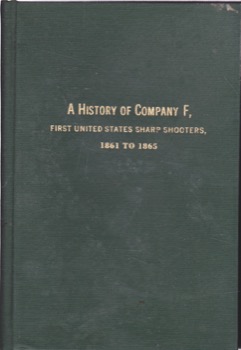
Hardcover. Rochester MI, Grand Army Press, reprint, 1981, Book: Very Good, Dust Jacket: None, Hardcover, green cloth with gilt lettering, 204 pages plus 50 page appendix. A History of Company F, First United States Sharp Shooters. A limited printing (#119 of 750), a facsimile from the 1883 edition. The 1st United States Sharpshooters were an infantry regiment that served in the Union Army during the American Civil War. During battle, the mission of the sharpshooter was to kill important enemy targets, i.e., officers, NCOs, and artillery crews from long range.
Hardcover. NY, Time Life, reprint, 1985, Book: Very Good, Dust Jacket: None, 308 pages. Hardcover with no dust jacket. Dark blue leather bound with gilt titles to front cover and spine. Embossed decoration on front cover. Gilt text block edges, red ribbon marker. Clean, tight copy. From a captain who served in three manor battles the full story of their hardships and trials during the war. 40% casualties being the norm for 9 months service. Inspirational writings on a period of time that continues to have an effect on our country.
Hardcover. Gretna LA, Pelican Publishing, 1st, 2003, Book: Very Good, Dust Jacket: Very Good, Hardcover in a bright dust jacket. In June 1892, a thirty-year-old shoemaker named Homer Plessy bought a first-class railway ticket from his native New Orleans to Covington, north of Lake Pontchartrain. The two-hour trip had hardly begun when Plessy was arrested and removed from the train. Though Homer Plessy was born a free man of color and enjoyed relative equality while growing up in Reconstruction-era New Orleans, by 1890 he could no longer ride in the same carriage with white passengers. Plessy's act of civil disobedience was designed to test the constitutionality of the Separate Car Act, one of the many Jim Crow laws that threatened the freedoms gained by blacks after the Civil War. This largely forgotten case mandated separate-but-equal treatment and established segregation as the law of the land. It would be fifty-eight years before this ruling was reversed by Brown v. Board of Education. Keith Weldon Medley brings to life the players in this landmark trial, from the crusading black columnist Rodolphe Desdunes and the other members of the Comite des Citoyens to Albion W. Tourgee, the outspoken writer who represented Plessy, to John Ferguson, a reformist carpetbagger who nonetheless felt that he had to judge Plessy guilty. Clean copy.
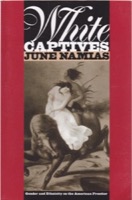
Softcover. Chapel Hill, University of North Carolina, reprint, 2002, Book: Very Good, Dust Jacket: None, Softcover, 378 pages. Namias shows that visual, literary, and historical accounts of the capture of Euro-Americans by Indians are commentaries on the uncertain boundaries of gender, race, and culture during the colonial Indian Wars, the American Revolution, and the Civil War. She compares the experiences and representations of male and female captives over time and on successive frontiers and examines the narratives of captives Jane McCrea, Mary Jemison, and Sarah Wakefield. Clean copy.
Hardcover. Hartford CT, S. S. Scranton & Co., 1st, 1866, Book: Very Good, Dust Jacket: None, Hardcover, embossed green cloth covers with gilt stamping on front cover and spine. Frontispiece, 'Before the Battle, with tissue intact shows a few light spots. Steel engraved portraits throughout with tissues intact. 596 pages. Clean, tight copy.
Hardcover. Fleischmanns NY, Purple Mountain Press, 1st, 1996, Book: Very Good, Dust Jacket: Very Good, Hardcover in a bright, unclipped dust jacket. 178 pages.Award-winning biographer and historian Lincoln Diamant introduces a diverse group of men and women who contributed in unique ways to the eight-year American Revolution. . . . Among them are soldiers and civilians, veteran generals and three-week militiamen, patriots and spies, a host of Native American and African-American volunteers, and more than a few courageous women. Clean copy.


 "Theodore Winthrop (SIGNED COPY)by: Eliot, Jr., Ellsworth")
 "Three Years in the Sixth Corps: A Concise Narrative of Events in the Army of the Potomac, from 1861 to the Close of the Rebellion, April, 1865 (Collector's Library of the Civil War)by:")
 "To Make Our World Anew: A History of African Americansby: Kelley, Robin D. G./ Lewis, Earl (Editor)")
 "Trade and Currency in Early Oregon. A Study in the Commercial and Monetary History of the Pacific Northwestby: James Henry Gilbert")

 "Union Officer in the Reconstruction, Aby: De Forest, John William, James, H. Croushore, David M. Potter (Editors)")

 "Unknown Heroine, An: An Historical Episode of the War Between the Statesby: Chittenden, L.E.")



 "War from the Inside -The Story of the 132nd Regiment Pennsylvania Volunteer Infantry in the War for the Suppression of the Rebellion, 1862-1863 (Collector's Library of the Civil War)by:")
 "We As Freemen: Plessy v. Fergusonby: Keith Weldon Medley")
 "Women of the War: Their Heroism and Self-Sacrificeby: Frank Moore")