Hardcover. Cleveland, Cleveland Women's Golf Association, 1st, 1940, Book: Very Good, Dust Jacket: None, Hardcover. SIGNED BY EDITOR/COMPILER on bookplate on front end paper. 148 pages, b&w photographs. Maroon covers w/ gilt lettering; spine faded. Light foxing to top edge. Else a very clean, tight copy.
Hardcover. NY, Pantheon, 1st, 2007, Book: Very Good, Dust Jacket: Very Good, Hardcover in a bright, unclipped dust jacket. Grand Avenues tells the riveting story of Pierre Charles L'Enfant and the creation of Washington D.C.--from the seeds of his inspiration to the fulfillment of his extraordinary vision. L'Enfant's story is one of consuming passion, high emotion, artistic genius, and human frailty. As a boy he studied drawing at the most prestigious art institute in the world. As a young man he left his home in Paris to volunteer in the army of the American colonies, where he served under George Washington. There he would also meet many of the people who would have a profound impact on his life, including Alexander Hamilton and James Monroe. And it was Washington himself who, in 1791, entrusted L'Enfant with the planning of the nation's capital--and reluctantly allowed him to be dismissed from the project eleven months later. The plan for the city was published under another name, and for the remainder of his life L'Enfant fought for recognition of his achievement. But he would not live to see that day, and a century would pass before L'Enfant would be given credit for his brilliant design. Scott W. Berg recounts this tale, richly evocative of time and place, with the narrative verve of a novel and with a cast of characters that ranges from Thomas Jefferson and the other Founding Fathers to the surveyor who took credit for L'Enfant's plans, the assistant who spent a week in jail for his loyalty to L'Enfant, and the men who finally restored L'Enfant's reputation at the beginning of the twentienth century.
Hardcover. Princeton Architectural Press, 1st, 2006, Book: Very Good, Dust Jacket: Very Good, Hardcover, 256 pages. The Breakers, the Waldorf, the Biltmore, the Sherry, the Pierre--these landmark hotels are synonymous with grand luxury and style. When they were built, in the 1920s, their refined elegance and grandeur set the bar for hotels and resorts the world over. Responsible for creating these and countless other hotels throughout the United States, were the partners of a single architectural firm: Schultze & Weaver. Together, this duo--an architect and an engineer--virtually invented the glamorous lifestyle made famous in films like Grand Hotel. Catering to the social elite of which they were themselves a part, Schultze & Weaver synthesized the Old World style of Renaissance Italy, Moorish Spain, and Georgian England with all of the modern amenities that made hotel living luxurious. This book presents portfolios of fifteen of the firm's most spectacular hotels, culminating in the Art Moderne masterpiece of the Waldorf-Astoria. Over two hundred period photographs and hand-colored architectural renderings chart the ascent of the American hotel in all its glory and glamour, before the Great Depression forever changed the lifestyles of America's rich and famous. Essays address the cultural and technological developments that underpin the creation of resort and residential hotels, including the elemental role played by Schultze & Weaver.
Hardcover. New York , Knopf, 1st, 1993, Book: Very Good, Dust Jacket: None, 42 pages illustrated in color by Wiktor Sadowski. Color illustrated boards, no dust jacket issued for this library edition. NOT ex-library, clean and bright copy.
Hardcover. Hartford CT, J. B. Burr & Company, 1st, 1868, Book: Good, Dust Jacket: None, Hardcover in polished calf, black spine label with gilt lettering. Frontis portrait of Grant, additional full page engravings, 631 pages plus publisher's ads. Both cover hinges cracked but holding, and text block is solid. No foxing in text.
Hardcover. Boston, MA, Da Capo Press, 1st, 2011, Book: Very Good, Dust Jacket: Very Good, 288 pages. Hardcover. Dust jacket unclipped. Gilt title on spine. B/w illustrations throughout. In excellent condition, binding tight, clean and unmarked inside and out. Looks barely read.
Hardcover. New York , De Vinne Press, 1st, 1916, Book: Very Good, Dust Jacket: None, Hardcover, 269 pages. Light blue and white cover. Printed for the Naval History Society. Pages untrimmed. Worn slipcase. Clean condition inside and out. Number 582 of 650 copies. B&w illustrations with tissue guards by various artists. Includes one page insert addressed to members of the Naval History Society. With introduction stressing the importance of Naval campaigns in the American Revolution.
Hardcover. London, Chartwell Books, reprint, 2006, Book: Very Good, Dust Jacket: Very Good, 160 pages. Hardcover. Extensive b&w photography throughout. Slight edge wear, otherwise clean, tight copy. Many photos of old saloons, both interior and exterior shots. From Alaska, Arizona, California, Minnesota, Texas, and all over the country.
Softcover. San Francisco, Ten Speed Press, 1st, 2007, Book: Very Good, Dust Jacket: None, Softcover, 224 pages. Early in the 20th century, as Americans climbed into their Model-Ts and took to the open road, American manufacturers and retailers discovered miles and miles of new advertising space, and the audaciously oversized billboard was born. For a century, billboards have recruited, congratulated, teased, sold, and seduced us, promoting everything under the sun, from hosiery to war bonds, presidential candidates to rock shows. GREAT AMERICAN BILLBOARDS not only offers a lively look back at changing styles, products, and tastes, but is also an important visual record of this largely unheralded yet ubiquitous American art form.
Hardcover. NY, Hawthorn Books, 1st, 1973, Book: Very Good, Dust Jacket: Good, Hardcover in a worn, lightly soiled dust jacket, 243 pages. Name on front fly leaf, otherwise clean.
Hardcover. Columbia SC, University of South Carolina Press, 1st, 1970, Book: Very Good, Dust Jacket: Very Good, Hardcover in a lightly worn, unclipped dust jacket, 311 pages. To illustrate the changing conception of colonies and the tensions with London, the author selected 50+ revealing documents that explore the economic and political relationships between Great Britain and her American Colonies from 1607 to 1763. Name on front fly leaf, otherwise clean.
Chicago, Follett , unknown , 1965, Book: Very Good, Dust Jacket: Very Good, Hardcover in a bright, price-clipped dust jacket. Translated from French by John Mills. 70 pages, including glossary. First American edition. Profusely illustrated. 71 pages, giving information of various types of ships from Galleys, Clippers, Whalers, Glossary of sailing terms. Famous sailers James Cook & others.
Hardcover. Boston, Benjamin B. Mussey and Company, Second Edition, 1853, Book: Very Good, Dust Jacket: None, 364 pages. Hardcover. Two volumes in one, revised edition to the original published work by the author of "May Martin or The Money Diggers;" "Locke Amsden or The Schoolmaster." Green cloth boards with embossed decoration to cover & gilt titles to spine. Scuffed edges to boards, frayed edge to spine. Moderate foxing throughout. Otherwise clean, tight copy.
Hardcover. New York, E. P. Dutton , 2nd Printing, 1936, Book: Very Good, Dust Jacket: None, 253 pages, gilt titles on green board cover. Previous owner's stamp on front fly leaf and minor edge fade, otherwise, very clean and tight copy.
Hardcover. NY, Henry Holt, 1st, 2003, Book: Very Good, Dust Jacket: Very Good, Hardcover in a bright dust jacket, 320 pages. Money has always been at the heart of the American experience. Paper money, invented in Boston in 1698, was a classic of American ingenuity-and American disregard for authority and tradition. With the wry and admiring eye of a modern Tocqueville, Jason Goodwin has written a biography of the dollar, giving us the story of its astonishing career through the wilds of American history. Clean copy.
Hardcover. Chicago, IL, University of Chicago Press, 1st, 1987, Book: Very Good, Dust Jacket: Very Good, 171 pages. Hardcover with dust jacket. Minor foxing to front flyleaf. An otherwise clean, unmarked copy. Black and white photographs throughout. SIGNED BY AUTHOR ON FRONT FLYLEAF.
Hardcover. NY, Walker Books, 1st, 1997, Book: Very Good, Dust Jacket: Very Good, Hardcover in a bright, unclipped dust jacket, 214 pages. Over the past couple of decades, our national debt has become a favorite political football for Democrats and Republicans alike. Yet few Americans seem aware that the debt has a long and (mostly) honorable history. Alexander Hamilton considered it a kind of political Krazy Glue, which would also spur American industry by keeping taxes high. This borrowing power enabled the North to win the Civil War without wrecking its economy and rescued us from the Great Depression. John Steele Gordon doesn't deny the dangers of an entire nation living on credit; indeed, he believes that our fiscal affairs are a mess. But he puts this mess in fascinating perspective. And he's quick to see the human side of economic behavior: "One problem," he writes, "is that human nature predisposes us to recognize depression easily and quickly, but prosperity, like happiness, is most easily seen in retrospect." Name on front fly leaf, otherwise clean.
Hardcover. NY, G.P. Putnam's Sons, 1st, 1874, Book: Very Good, Dust Jacket: None, Hardcover, 256 pages. Fold-out frontis, b&w Illustrations, very nice, clean copy. Written by "two of its teachers." Includes "Fifty Cabin and Plantation Songs" arranged by Thomas P. Fenner. Illustrated with a four-fold engraved frontispiece, depicting several of the school's buildings as seen from the water, and many other engravings. An interesting account of the school, including a brief history of Virginia and of slavery and its aftermath in that state, and one of the earliest publications of slave music.
Hardcover. Washington DC, Government Printing Office, 1st, 1948, Book: Very Good, Dust Jacket: None, Hardcover, olive green cloth hardcover with gilt lettering on spine. 986 pages, includes drawings, photographs, maps (some fold-out) and an extensive bibliography. Super condition with just a small ownership sticker on inside front cover, otherwise a clean, tight copy. DUE TO WEIGHT, DOMESTIC SHIPPING ONLY.
Hardcover. Washington DC, Government Printing Office, 1st, 1949, Book: Very Good, Dust Jacket: None, Hardcover, olive green cloth hardcover with gilt lettering on spine. This is Smithsonian Institution Bureau of American Ethnology Bulletin 143; 818 pages, includes drawings, photographs, maps and an extensive bibliography. Super condition with just a small ownership sticker on inside front cover, otherwise a clean, tight copy. DUE TO WEIGHT, DOMESTIC SHIPPING ONLY.
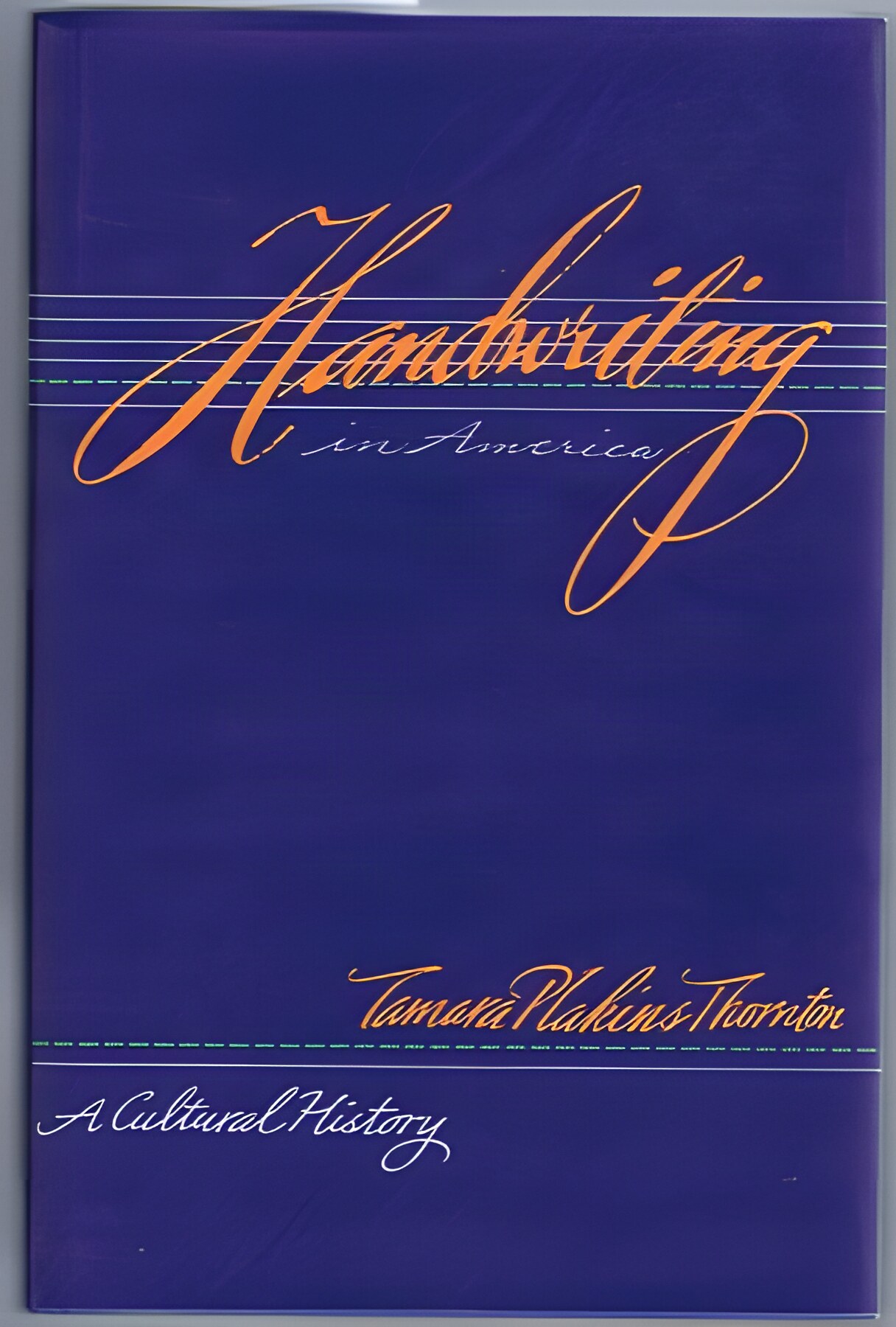
Softcover. New Haven CT, Yale University Press, reprint, 1996, Book: Very Good, Dust Jacket: None, Softcover, 248 pages. Copybooks and the Palmer method, handwriting analysis and autograph collecting - these words conjure up a lost world, in which people looked to handwriting as both a lesson in conformity and a talisman of individuality. In this engaging history, ranging from colonial times to the present, Tamara Plakins Thornton explores the shifting functions and meanings of handwriting in America.
Hardcover. NY, McGraw-HIll Books, 1st, 1975, Book: Very Good, Dust Jacket: Very Good, Hardcover in a bright, price-clipped dust jacket. 412 pages with index, b&w photos. A chronicle of the Hollywood that was, a mythic playground where cinema of both enduring and dubious value was created. .Into this world of illusion and disillusion came some of the greatest literary figures in our history. This is their story, from the 1930's and the early days of sound to the House Un-American Activities Committee. Clean copy.
Hardcover. NY, Time Life, reprint, 1982, Book: Very Good, Dust Jacket: None, 402 pages. Hardcover with no dust jacket. Dark blue leather bound with gilt titles to front cover and spine. Embossed decoration on front cover. Gilt text block edges, red ribbon marker. Clean, tight copy. Most histories of the Civil War focus on battles and top brass. Hardtack and Coffee is one of the few to give a vivid, detailed picture of what ordinary soldiers endured every dayaEUR"in camp, on the march, at the edge of a booming, smoking hell. John D. Billings of Massachusetts enlisted in the Army of the Potomac and curvived the conditions he recorded. The authenticity of his book is heightened by the many drawings that a comrade, Charles W. Reed, made in the field. This is the story of how the Civil War soldier was recruited, provisioned, and disciplined. Described here are the types of men found in any outfit; their not very uniform uniforms; crowded tents and makeshift shelters; difficulties in keeping clean, warm, and dry; their pleasure in a cup of coffee; food rations, dominated by salt pork and the versatile cracker or hardtack; their brave pastimes in the face of death; punishments for various offenses; treatment in sick bay; firearms and signals and modes of transportation. Comprehensive and anecdotal, Hardtack and Coffee is striking for the pulse of life that runs through it.
Hardcover. NY, Random House, BC Ed., 1968, Book: Very Good, Dust Jacket: Very Good, Hardcover in a bright dust jacket. Copyright page states first printing, but no price on flap, probably a book club edition. Colorfully illustrated boards with black cloth spine, with gilt lettering; white DJ with red and orange illustration and lettering; 255 pages, profusely illustrated. Long before Harlem became one of the trendiest neighborhoods in the red-hot real estate market of Manhattan, it was a metaphor for African American culture at its richest. Allon Schoener's celebrated Harlem on My Mind is the classic record of Harlem life during some of the most exciting and turbulent years of its history, a beautiful and poignant reminder of a powerful moment in African America history. Including the work of some of Harlem's most treasured photographers, among them James Van Der Zee and Gordon Parks, there are photographs of Harlem's literary lights Langston Hughes, Countee Cullen, and Richard Wright; its politicians Marcus Garvey, Malcolm X, and Adam Clayton Powell Jr.; and its musicians Ethel Waters, Duke Ellington, and Billie Holiday. The book also includes the photographs of the everyday folk who gave life to this legendary community. Clean copy.

 "Golf Retold: The Story of Golf in Cleveland (SIGNED COPY)by: Seagrave, Alice D. (Ed.)")





 "Graves Papers, The: And Other Documents Relating to the Naval Operations of the Yorktown Campaign, July to October, 1781.by: Chadwick (ed), French Ensor")
 "Great American Bars and Saloons, Theby: Weiser, Kathy")




 "Green Mountains to Sierrasby: Humphrey, Zephine")



 "Hampton and Its Students by Two of Its Teachers with 50 Cabin and Plantation Songsby: Armstrong, Mrs. M.I. and Helen W. Ludlow")
 "HANDBOOK OF SOUTH AMERICAN INDIANS Volume 3: The Tropical Forest Tribes by: Steward Julian H. (ed.)")
 "HANDBOOK OF SOUTH AMERICAN INDIANS Volume 5: The Comparative Ethnology of South American Indians by: Steward Julian H. (ed.)")
 "Hanging on in Paradiseby: Guiles, Fred Lawrence")
 "Hard Tack and Coffee, or The Unwritten Story of Army Life (Collector's Library of the Civil War)by: Billings, John D./Charles W. Reed")