Softcover. Marquette University Press, 1st, 2004, Book: Very Good, Dust Jacket: None, Softcover, 429 pages. Spanish Jesuit philosopher and theologian Suarez (1548-1617) commented on Aristotle's work by asking and answering a series of questions that it raises. Doyle (Saint Louis U.) translates Suarez's preface to the 1597 edition, his introduction, the Index of questions through the 12 books, and an index of the disputations. He also includes corresponding Latin texts and an index of people mentioned. Clean, bright copy.
Hardcover. NY, Clark Austin and Smith, 1st, 1854, Book: Good, Dust Jacket: None, Hardcover, embossed brown cloth, 283 pages. This is the original 1854 edition. Mild water stain to margins of first 30 pages, scattered foxing throughout. A comprehensive exploration of the origins, practices, and beliefs of various secret societies throughout history, with a particular focus on Freemasonry. The book delves into the philosophical and spiritual underpinnings of these societies, examining their rituals, symbols, and traditions. Arnold also explores the historical context in which these societies emerged, tracing their evolution from ancient mystery cults to modern-day fraternal organizations. The book provides a nuanced and objective analysis of these secretive groups, debunking myths and misconceptions while also acknowledging their enduring cultural significance. The secret societies of all ages considered in their relations with and influence on, the moral, social and intellectual progress of man. Through them came the new revelations of life, which contributed to the progress of Humanity. Contents: Importance of this History; Providential Character of these Institutions; Egyptian Mysteries; Secret Institution of Orpheus; Initiation at Eleusis; Secret Order of Pythagoras; Templars; Freemasonry; Second Period of Masonic History; Present Position of the Order; Christianity and Freemasonry; Thomas Paine's Essay on Freemasonry, with Comments. Gilt lettering on spine faded but readable. Bottom corner of front cover bumped. No markings.
Softcover. Lanham, University Press of America, 1st, 1983, Book: Good, Dust Jacket: None, Softcover, 311 pages. INSCRIBED BY AUTHOR ON FRONT ENDPAPER. Light foxing to edges and covers. Clean, unmarked copy.
Hardcover. Ithaca NY, Cornell University Press, 1st, 1992, Book: Very Good, Dust Jacket: Very Good, Hardcover in a dust jacket with mild fading to spine. 224 pages. Clean copy.
Hardcover. NY, Columbia University Press, 1st, 1960, Hardcover, blue cloth covers with gilt lettering to spine, 249 pages, two b&w plates. Through criticism and analysis of ancient traditions, Kahn reconstructs the pattern of Anaximander's thought using historical methods akin to the reconstructive techniques of comparative linguists. Name on front fly leaf, light pencil marking to a dozen pages. Cloth spine faded.
Softcover. Amsterdam, North - Holland Publishing, 2nd pr., 1957, Book: Very Good, Dust Jacket: Very Good, Thin card covers in a lightly sunned dust jacket, 122 pages. Remarkable work in which the author aimed to collect some of the data available in the state of science of Bochenski's times and to arrange them in a kind of outline, which showed forth some of our indebtedness to Greek Logicians, and allowed the reader to see how their results were reached.
Hardcover. Cambridge UK, Cambridge University Press, 1st, 2015, Book: Very Good, Dust Jacket: Very Good, Hardcover in a bright dust jacket, pages. Seventeenth-century England has long been heralded as the birthplace of a so-called 'new' philosophy. Yet what contemporaries might have understood by 'old' philosophy has been little appreciated. In this book Dmitri Levitin examines English attitudes to ancient philosophy in unprecedented depth, demonstrating the centrality of engagement with the history of philosophy to almost all educated persons, whether scholars, clerics, or philosophers themselves, and aligning English intellectual culture closely to that of continental Europe. Drawing on a vast array of sources, Levitin challenges the assumption that interest in ancient ideas was limited to out-of-date 'ancients' or was in some sense 'pre-enlightened'; indeed, much of the intellectual justification for the new philosophy came from re-writing its history. At the same time, the deep investment of English scholars in pioneering forms of late humanist erudition led them to develop some of the most innovative narratives of ancient philosophy in early modern Europe. Name on front fly leaf, otherwise clean.
Hardcover. UK, Clarendon Press, 1st, Book: Very Good, Dust Jacket: Very Good, Hardcover in a bright dust jacket, 303 pages. Aristotle, great Greek philosopher, researcher, reasoner, and writer, born at Stagirus in 384 BCE, was the son of Nicomachus, a physician, and Phaestis. He studied under Plato at Athens and taught there (367 47); subsequently he spent three years at the court of a former pupil, Hermeias, in Asia Minor and at this time married Pythias, one of Hermeias s relations. After some time at Mitylene, in 343 2 he was appointed by King Philip of Macedon to be tutor of his teen-aged son Alexander. After Philip s death in 336, Aristotle became head of his own school (of Peripatetics ), the Lyceum at Athens. Previous owner's name on front fly leaf, otherwise clean, like new.
Softcover. Berkeley, University of California Press, 1st pbk, 1987, Book: Very Good, Dust Jacket: None, Softcover, 839 pages. Traces the history of bribery from ancient Egypt to ABSCAM, examines changing perceptions of bribery, and discusses the legal, ethical and religious injunctions against bribes. Clean, bright copy.
Hardcover. UK, Oxford University Press, reprint, 2003, Hardcover in pictorial boards, 309 pages. Byzantine philosophy is an almost unexplored field. Being regarded either as mere scholars or as primarily religious thinkers, Byzantine philosophers have not been studied on their own philosophical merit. The eleven contributions in this volume, which cover most periods of Byzantine culture from the 4th to the 15th century, for the first time systematically investigate the attitude the Byzantines took towards the views of ancient philosophers, to uncover the distinctive character of Byzantine thought. Clean, bright copy.
Softcover. UK, Clarendon Press, reprint, 2004, Book: Very Good, Dust Jacket: None, Softcover, 499 pages. R. J. Hankinson traces the history of ancient Greek thinking about causation and explanation, from its earliest beginnings through more than a thousand years to the middle of the first millennium of the Christian era. He examines ways in which the Ancient Greeks dealt with questions about how and why things happen as and when they do, about the basic constitution and structure of things, about function and purpose, laws of nature, chance, coincidence, and responsibility. Clean copy.
Softcover. UK, Oxford University Press, reprint, 2006, Book: Very Good, Dust Jacket: None, Softcover, 435 pages. Cicero's Topica is one of the canonical texts on ancient rhetorical theory. This is the first full-scale commentary on this work, and the first critical edition of the work that is informed by a full analysis of its translation. Marcus Tullius Cicero was a Roman philosopher, politician, lawyer, orator, political theorist, consul, and constitutionalist. He came from a wealthy municipal family of the Roman equestrian order, and was one of Rome's greatest orators and prose stylists. Name on front fly leaf otherwise clean.
Hardcover. New Haven CT, Yale University Press, 1st, 2016, Book: Very Good, Dust Jacket: Very Good, Hardcover in a bright, unclipped dust jacket. 1176 pages. We live in an age of disenchantment. The number of self-professed "atheists" continues to grow. Yet many still feel an intense spiritual longing for a connection to what Aristotle called the "eternal and divine." For those who do, but demand a God that is compatible with their modern ideals, a new theology is required. This is what Anthony Kronman offers here, in a book that leads its readers away from the inscrutable Creator of the Abrahamic religions toward a God whose inexhaustible and everlasting presence is that of the world itself. Kronman defends an ancient conception of God, deepened and transformed by Christian belief--the born-again paganism on which modern science, art, and politics all vitally depend. Brilliantly surveying centuries of Western thought--from Plato to Augustine, Aquinas, and Kant, from Spinoza to Nietzsche, Darwin, and Freud--Kronman recovers and reclaims the God we need today. Clean copy.
Hardcover. NY, John Day, 1st, 1949, Book: Good, Dust Jacket: Good, Hardcover in a bright, edgeworn and chipped dust jacket. Explores the life and teachings of the ancient Chinese philosopher, Confucius. The book delves into Confucius' background, upbringing, and the cultural and political context in which he lived. It also examines the various interpretations of Confucianism throughout history and how his teachings have influenced Chinese society and beyond. The author offers a critical analysis of Confucius' philosophy and challenges some of the popular myths and misconceptions that have surrounded him. Mild musty smell, clean copy.
Hardcover. Cambridge, Mass., Harvard University Press, 1st thus, 1951, Book: Very Good, Dust Jacket: None, 4 volume set of Geldner's German translation from the original Sanskrit, GERMAN TEXT, Volumes 33-36 of the Harvard Oriental Series edited by Charles Rockwell Lanman. Volume 4 has publication date of 1957. Previous owner's signature on front fly leaf, otherwise, unmarked, bright, and crisp copies. The Rigveda or Rig Veda is an ancient Indian collection of Vedic Sanskrit hymns (suktas). It is one of the four sacred canonical Hindu texts (sruti) known as the Vedas. DOMESTIC SHIPPING ONLY.
Hardcover. New York, Aperture, 1st, 1998, Book: Very Good, Dust Jacket: Very Good, Hardcover in a bright, unclipped dust jacket. 96 pages, color photographs, Like new in publisher's shrinkwrap. Doors of the Kingdom is a unique collection of photographs depicting the ancient and disappearing craft of doormaking in Arabia. The Islamic concept of hurma, or sanctity of a place of dwelling or worship, is recurrent throughout Arabic poetry and literature. The door (bab), preserver of sanctity, becomes symbolic of the boundary between public and private space, and between the profane and the sacred. In 1995, Haajar Gouverneur traveled throughout the Arabian Peninsula photographing each region's distinctive doorways and the remaining artisans who make them. The doors of Arabia, painstakingly hand-carved from the wood of the Al-Athel trees, last in their exquisite variety for hundreds of years. This ancient craft, passed down from generation to generation in the central and northern regions of Saudi Arabia, is now nearly extinct. Modern materials, technology, and changing priorities threaten the continuity of the sacred and artisanal tradition of doormaking.
Hardcover. Oxford UK, Oxford University Press, 1st, 2016, Book: Very Good, Dust Jacket: Very Good, Hardcover in a bright dust jacket, 382 pages. This study addresses the need for a more current understanding of Cartesian philosophy by considering the different constructions of Descartes's thought that emerged in the Calvinist United Provinces (Netherlands) and Catholic France, the two main centers for early modern Cartesianism, during the period dating from the last decades of his life to the century or so following his death in 1650. It turns out that we must speak not of a single early modern Cartesianism rigidly defined in terms of Descartes's own authorial intentions, but rather of a loose collection of early modern Cartesianisms that involve a range of different positions on various sets of issues. Though more or less rooted in Descartes's somewhat open-ended views, these Cartesianisms evolved in different ways over time in response to different intellectual and social pressures. Chapters of this study are devoted to: the early modern Catholic and Calvinist condemnations of Descartes and the incompatible Cartesian responses to these; conflicting attitudes among early modern Cartesians toward ancient thought and modernity; competing early modern attempts to combine Descartes's views with those of Augustine; the different occasionalist accounts of causation within early modern Cartesianism; and the impact of various forms of early modern Cartesianism on both Dutch medicine and French physics. Name on front fly leaf, otherwise clean.
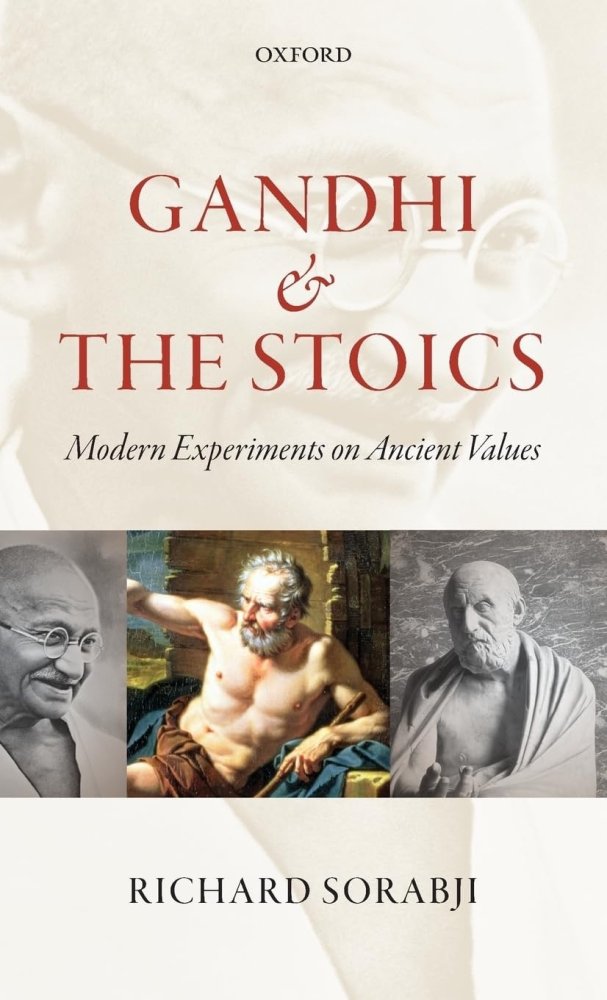
Hardcover. NY, University of Chicago, 1st, 2012, Book: Very Good, Dust Jacket: Very Good, Hardcover in a bright dust jacket, 224 pages. Richard Sorabji presents a fascinating study of Gandhi's philosophy in comparison with Christian and Stoic thought. Sorabji shows that Gandhi was a true philosopher. He not only aimed to give a consistent self-critical rationale for his views, but also thought himself obliged to live by what he taught--something that he had in common with the ancient Greek and Christian ethical traditions. Understanding his philosophy helps with re-assessing the consistency of his positions and life. Clean copy.
Hardcover. New Haven CT, Yale University Press, 1st, 2012, Book: Very Good, Dust Jacket: Very Good, Hardcover in a bright dust jacket, 232 pages. Political theorist Michael Walzer reports his findings after decades of thinking about the politics of the Hebrew Bible. Attentive to nuance while engagingly straightforward, Walzer examines the laws, the histories, the prophecies, and the wisdom of the ancient biblical writers and discusses their views on such central political questions as justice, hierarchy, war, the authority of kings and priests, and the experience of exile. Because there are many biblical writers with differing views, pluralism is a central feature of biblical politics. Yet pluralism, Walzer observes, is never explicitly defended in the Bible; indeed, it couldn't be defended since God's word had to be as singular as God himself. Yet different political regimes are described in the biblical texts, and there are conflicting political arguments--and also a recurrent anti-political argument: if you have faith in God, you have no need for strong institutions, prudent leaders, or reformist policies. At the same time, however, in the books of law and prophecy, the people of Israel are called upon to overcome oppression and "let justice well up like water, righteousness like an unfailing stream." Name on front fly leaf, light pencil marking to pages.
Softcover. Boston, Brill Academic, 1st, 2003, Book: Very Good, Dust Jacket: None, Softcover, 562 pages. This monograph demonstrates why humanism began in Italy in the mid-thirteenth century. It considers Petrarch a third generation humanist, who christianized a secular movement. The analysis traces the beginning of humanism in poetry and its gradual penetration of other Latin literary genres, and, through stylistic analyses of texts, the extent to which imitation of the ancients produced changes in cognition and visual perception. The volume traces the link between vernacular translations and the emergence of Florence as the leader of Latin humanism by 1400 and why, limited to an elite in the fourteenth century, humanism became a major educational movement in the first decades of the fifteenth. It revises our conception of the relationship of Italian humanism to French twelfth-century humanism and of the character of early Italian humanism itself. Clean, bright copy.
Softcover. Amherst MA, Warring States Project, 1st, 2017, Book: Very Good, Dust Jacket: None, Softcover, 191 pages. This book is an overview of the history of Early Christianity. Each chapter is based on one selection from Jewish texts or from those produced by the Jesus sect of Judaism. It gives a sense of how things happened, from the words of certain ancient prophets, to Jesus' effort to bring about those prophecies, to the efforts of his followers to reshape their expectations after his death. It follows the movement as it came to regard Jesus himself as divine, a process which eventually led to the separation of the sect from the parent religion. It ends with a glimpse of a surviving early Christian church on the shores of the Black Sea, and how it appeared to the Roman administrator who was in charge of executing those who, like the Early Christians, refused Emperor worship. From the evidence of two deaconesses whom he tortured, which Pliny reported to Emperor Trajan, we too learn what were the regular practices of that church. Clean copy.
Hardcover. Edinburgh, T and T Clark, 1st, 1998, Book: Very Good, Dust Jacket: Very Good, Hardcover in a bright dust jacket, 342 pages. Jewish-Christian contact and controversy were central to early Christian experience. An understanding of this contact and controversy and its continuation over the centuries is also central to any true understanding of the history of Christianity and of the history of Judaism. The twelve chapters of this book deal especially with the interconnected subjects of polemic and biblical interpretation. Nine are concerned with the ancient world, beginning with post-exilic Jewish writing and the New Testament and going on to later pagan, Jewish and Christian controversies. Three concentrate on medieval and early modern Jewish controversies. Clean copy.





 "A Philosophy of the Religions of Ancient Greeks and Israelites(SIGNED COPY)by: Kimpel, Ben")


 "Aristotle on Coming-to-Be and Passing-Away: De Generatione Et Corruptioneby: Harold H. Joachim")
 "Bribes: The Intellectual History of a Moral Idea by: John T. Noonan, Jr.")

![Byzantine Philosophy and Its Ancient Sources by: Ierodiakonou, Katerina [Editor]](https://www.browsingisarousing.com/shop/images/Byzantine-Philosophy-and-Its-Ancient-Sources_by_Ierodiakonou-Katerina-Editor386262-438221.jpg "Byzantine Philosophy and Its Ancient Sources by: Ierodiakonou, Katerina [Editor]")


 "Confessions of a Born-Again Paganby: Anthony T. Kronman")

 "Doors of the Kingdomby: Gouverneur/Khaled Azzam (Author), Mohamed Zakariya , Haajar")

 "In God's Shadow: Politics in the Hebrew Bibleby: Walzer, Michael")