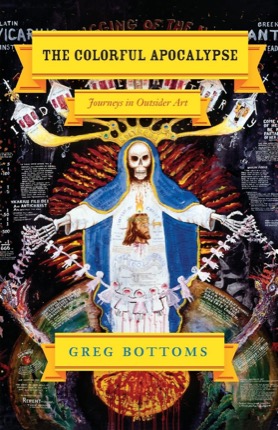
Hardcover. Chicago, University Of Chicago Press, 1st, 2007, Book: Very Good, Dust Jacket: Very Good, Hardcover in a bright dust jacket, 182 pages. The Reverend Howard Finster was twenty feet tall, suspended in darkness. Or so he appeared in the documentary film that introduced a teenaged Greg Bottoms to the renowned outsider artist whose death would help inspire him, fourteen years later, to travel the country. Beginning in Georgia with a trip to Finster's famous Paradise Gardens, his journey--of which The Colorful Apocalypse is a masterly chronicle--is an unparalleled look into the lives and visionary works of some of Finster's contemporaries: the self-taught evangelical artists whose beliefs and oeuvres occupy the gray area between madness and Christian ecstasy. With his prodigious gift for conversation and quietly observant storytelling, Bottoms draws us into the worlds of such figures as William Thomas Thompson, a handicapped ex-millionaire who painted a 300-foot version of the book of Revelation; Norbert Kox, an ex-member of the Outlaws biker gang who now lives as a recluse in rural Wisconsin and paints apocalyptic visual parables; and Myrtice West, who began painting to express the revelatory visions she had after her daughter was brutally murdered. These artists' works are as wildly varied as their life stories, but without sensationalizing or patronizing them, Bottoms--one of today's finest young writers--gets at the heart of what they have in common: the struggle to make sense, through art, of their difficult personal histories. Clean copy.
Softcover. Seattle, Fantagraphics, 1st, 2008, Book: Very Good, Dust Jacket: None, Softcover, 200 pages. Gary Groth interviews father and son cartoonists Gene and Kim Deitch. Academy-award-winning Gene Deitch, whose wide-ranging career has spanned over 60 years, talks about doing illustrations for The Record Changer, directing cartoons such as Munro and Krazy Kat, and creating his comic strip Terr'ble Thompson. Underground comics pioneer Kim Deitch, touches on his father's influence, reminisces about the New York-based scene and outlines the evolution of Waldo the Cat. Plus: The innovative Grant Morrison fills us in on his X-Men run, All Star Superman, the ambitious Seven Soldiers "maxiseries," and how he became one of the architects of the current DC Comics universe. Finally, the comics gallery presents an historical essay and highlights from the turn-of-the-19th-century work of Puck cartoonist, F. M. Howarth.
Softcover. Seattle, Fantagraphics, 1st, 2009, Book: Very Good, Dust Jacket: None, Softcover, 207 pages. A career-spanning interview with Mort Walker, the creator of Beetle Bailey and Hi & Lois. Jordan Crane discusses The Clouds Above: comics by the famous 17th century caricaturist Thomas K. Rowlandson.
Hardcover. Boston, G. K. Hall & Co., reprint, 1981, Book: Very Good, Dust Jacket: Very Good, Hardcover in a bright, lightly worn dust jacket, 413 pages. This incomparable collection of essays, manifestos, and illustrations was prepared by Robert Motherwell with the collaboration of some of the major Dada figures: Marcel Duchamp, Jean Arp, and Max Ernst among others. Here in their own words and art, the principals of the movement create a composite picture of Dada - its convictions, antics, and spirit. First published in 1951, this treasure trove remains, as Jack Flam states in his foreword to the second edition, "the most comprehensive and important anthology of Dada writings in any language, and a fascinating and very readable book." It contains every major text on the Dada movement, including retrospective studies, personal memoirs, and prime examples. The illustrations range from photos of participants, in characteristic Dadaist attitudes, to facsimiles of their productions. Embossed name stamp on front fly leaf, otherwise clean.
Hardcover. NY, Grossman Publishers, 1st, 1976, Book: Very Good, Dust Jacket: Very Good, Hardcover in a bright, lightly worn dust jacket, 272 pages. Discussion of Wilkie Collins, Arthur Conan Doyle, G.K. Chesterton, John Buchan, Eric Ambler, Graham Greene, Georges Simenon, Raymond Chandler and Alfred Hitchcock. Clean copy.
Softcover. Minneapolis, University of Minnesota Press , 1st, 1993, Book: Very Good, Dust Jacket: None, Softcover, 305 pages. "In The Dark End of the Street, Maria Damon brings a new sensitivity to modern poetic criticism. She adds an important dimension to cultural theory, revealing the struggles of one group of artists as they address improtant questions about art, social life, and the oppression they encounter. Taking as her premise that the intensity of poetic language is an appropriate venue for representing the 'dark end of the street' of social pain, Damon foregrounds the work and lives of a number of modern American poets in order to argue that the American avant-garde is located in the experimental literary works of social 'outsiders."
Hardcover. NY, Random House, 1st, 1954, Book: Very Good, Dust Jacket: Good, 403 pages. Hardcover. 65 illustrations, 40 in full color. Price clipped dust jacket worn with tape repairs, fading - jacket now protected with clear plastic cover. "An account of the life and death of an art, of the men who made it and of the lusty age in which they flourished. 65 illustrations, including 40 in full color." Index, glossary, bibliography, appendices, artist biographies, chronology. Clean, tight copy.
Hardcover. University of Chicago Press, 1st, 1991, Book: Good, Dust Jacket: Good, Hardcover in a bright dust jacket, 307 pages. This book analyzes the thought behind practices of government and argues that criticism represents a true force for change in attitudes and actions, and that extending the limits of some practices allows the invention of others. This unique and extraordinarily useful collection of articles and primary materials will open the way for a whole new set of discussions of the work of Michel Foucault as well as the status of liberalism, social policy, and insurance. Some yellow high-lighting in the first 50 pages.
Softcover. Cambridge MA, Harvard University Press, 1st, 1995, Book: Very Good, Dust Jacket: None, Softcover, 139 pages. How does a poet repeatedly make art over a lifetime out of an arbitrary assignment of fate? By asking this question of the work of four American poets--two men of the postwar generation, two young women writing today--Helen Vendler suggests a fruitful way of looking at a poet's career and a new way of understanding poetic strategies as both mastery of forms and forms of mastery. Fate hands every poet certain unavoidable "givens." Of the poets Vendler studies, Robert Lowell sprang from a family famous in American and especially New England history; John Berryman found himself an alcoholic manic-depressive; Rita Dove was born black; Jorie Graham grew up trilingual, with three words for every object. In Vendler's readings, we see how these poets return again and again to the problems set out by their givens, and how each invents complex ways, both thematic and formal, of making poetry out of fate. Clean copy.
Hardcover. Chicago, University of Chicago, 1st, 1921, Book: Very Good, Dust Jacket: None, Hardcover, 315 pages. B&w illustrations throughout.Compilation of lectures given by Pennell in 1920 on the print-making methods and techniques used by artists of the day. Very good in light brown cloth with gilt lettering to front board and spine. Hinge cracked at title page, light wear to cloth at top and bottom of spine. Otherwise a clean, bright copy.
Hardcover. Ithaca NY, Cornell University Press, 1st thus, 1976, Book: Very Good, Dust Jacket: None, Hardcover, tan cloth covers, 250 pages illustrated in color and b&w. Gilt title on spine. Chapters include: The heritage of Apelles; Light, form, and texture in fifteenth-century painting north and south of the Alps; The form of movement in water and air; The grotesque heads; The earliest description of the Triptych; 'As it was in the days of Noe'; From the revival of letters to the reform of the arts: Niccolo Niccoli and Filippo Brunelleschi; The leaven of criticism in Renaissance art: texts and episodes; The pride of Apelles: Vives, Durer and Bruegel. No dust jacket, clean copy.
Hardcover. NY, Free Press, 1st, 1987, Book: Very Good, Dust Jacket: Very Good, Hardcover in a bright dust jacket, 270 pages, b&w illustrations. Light edgewear to dust jacket, else a clean, tight copy. Recounts the life of the English poet who died during World War I, looks at the group of his friends and fellow poets known as the Neo-Pagans, and discusses the influence of homosexuality on his life. His sonnet "The Soldier" and early death in World War I made British poet Rupert Brooke a key figure in the nation's myth of patriotism and youthful valor. Biographer Delaney places him among the Neo-pagans, a small circle of writers, artists, and intellectuals who flourished from 1908 to 1912. The group honored youth, comradeship, and the simple life and aimed to set aside the constraints of Victorianism. Delany shows how the internal dynamics of the group, not shock of war, led to its disintegration.
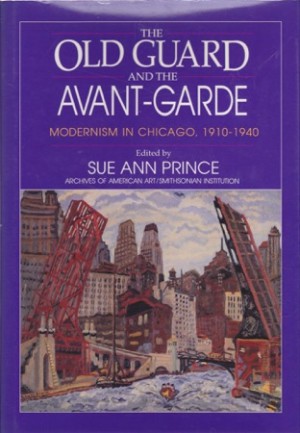
Hardcover. Chicago, University Of Chicago Press, 1st, 1990, Book: Very Good, Dust Jacket: Very Good, Hardcover in a bright dust jacket, 280 pages. This American art history book explores the early cultural development of the movement in Chicago, pulling from previously unpublished primary sources. 20 color reproductions along with black and white photographs and sketches and a timeline in the back. First study of Modernism in Chicago, examining the struggle between the "old guard's" ideals of traditional 19th century art versus an "avant garde" of painters, illustrators, photographers, and sculptors. Focuses on the cultural context in which art evolved. Clean copy.
Hardcover. Madison WI, University of Wisconsin Press, reprint, 1989, Book: Very Good, Dust Jacket: None, Hardcover, brown cloth with white lettering on spine. 276 pages. Between 1868 and 1897 Henry James wrote a number of short essays and reviews of artists and art collections; these essays were published in magazines such as "Atlantic Monthly" and "Harper's Weekly" and in newspapers such as the "New York Tribune". They included James' comments on Ruskin, Turner, Whistler, Sargent, and the Impressionists, among many others. Thirty of these essays were collected and first published in a modern edition in 1956, accompanied by John Sweeney's introduction which sketched James' interests in the visual arts over a period of years, focusing on the ways in which painting and painters entered his work as subjects. Susan Griffin's new foreword places James' observations in a contemporary context. Some of the novelist's judgements will seem wrong to today's readers: he was very critical of the Impressionists, for example, but all of these essays bear the stamp of James' critical intelligence, and they tell us a great deal about his development as a writer during those years. Bight, clean copy.
Hardcover. NY, The Monacelli Press, 1st, 2008, Book: Very Good, Dust Jacket: None, Hardcover, 208 pages. Debate and banter between the irascible Philip Johnson and the equally articulate and opinionated Robert A. M. Stern generates a provocative combination of astute commentary and personal observation on the state of architecture in the twentieth century. Philip Johnson's multifaceted career as an architect, curator, and collector extended from the early 1920s to his death in 2005. Captivated by the work of the European modernists Gropius, Le Corbusier, and Mies van der Rohe, Johnson assembled the seminal exhibition "Modern Architecture--International Exhibition" at the Museum of Modern Art in 1932. Among his most notable achievements are the famous Glass House in Connecticut, designed for his own use, and the Seagram Building in New York, in association with Mies van der Rohe. Recognized as the dean of American architecture, Johnson had a profound influence on the next generation of architects, including Robert A. M. Stern. Stern has conducted a series of ten interviews with Johnson, each covering a decade of his life, that provide an illuminating assessment of a significant period of American architecture. No dj issued.
Hardcover. NY, Abrams, 1st, 2008, Book: Very Good, Dust Jacket: Very Good, Hardcover, 300 pages. In this lavishly produced volume, journalist Gaudriault accompanies photographer Rancinan to Africa, Asia, Europe and the United States to interview 23 masters of contemporary photography, paying homage to fashion photographers and photojournalists, traditional chroniclers of their times and conceptual artists. Rancinan's photographs record each encounter in portraits that encapsulate each subject's relationship with his shared discipline. Readers follow paparazzo Ron Galella fending off the camera; Martin Parr, the sardonic chronicler of middle-class British life, having tea in a cafe; Rankin, the creator of the hip magazine Dazed and Confused, hopping into a trashcan filled with his own cast-off images. Gaudriault's short essays quote liberally from her interviews and provide both biographical information and incisive commentary. Several of the older photographers strike an elegiac tone and confess to finding themselves at the end of the eras that gave birth to their visions, but optimism reigns among younger practitioners: David LaChapelle is reinventing himself in Hawaii; Rankin is bearing witness to an age that is still young; and Oliviero Toscani, the radical combination of journalist and marketer behind the Benetton campaigns, describes billboards as the church frescoes of today.
Softcover. NY, Museum of Modern Art, reprint, 2007, Book: Very Good, Dust Jacket: None, Softcover, 156 pages. A guide to the mediums visual language through works by such early masters as Atget, Cartier-Bresson, Evans, Strand and Weston. It contains 172 illustrations that reveal the range of the photograph from the early days of the mediums development to the mid-1960s.
Hardcover. Chicago, University of Chicago Press, 1st, 1988, Book: Very Good, Dust Jacket: Very Good, Hardcover in a bright dust jacket, 178 pages. The drama is the most social of the arts, depending upon physical space, audience, and social factors for its existence. It is no surprise, therefore, that the most successful criticism approaches theater the way Barber and Mullaney do: as historical artifact. Barber is the better known, having authored the classic Shakespeare's Festive Comedy (1959); the present volume is based on his papers and examines three early Elizabethan tragedies"Tamburlaine" and "Dr. Faustus" by Marlowe and "The Spanish Tragedy" by Kyd. Particularly interested in locating these plays in the unstable religious atmosphere of the late 16th century, Barber ably demonstrates his understanding of the social, historical, and economic factors that defined the era. Mullaney takes the novel approach of examining the theater in light of London topography; the title thus refers to the physical location of the playhouses as well as the social importance of the theater. Mullaney points out that the prejudice that forced the great theaters of the age to operate outside the city walls encouraged a drama that was radical and iconoclastichence its greatness. Mullaney's argument is fascinating and thought-provoking, convincingly presented. Clean copy.
Softcover. Ithaca NY, Cornell University Press, 1st pbk, 1996, Book: Very Good, Dust Jacket: None, Softcover, 324 pages. An illustrated history of the theory and practice of perspective, looking at key texts from the Renaissance to the present. Fifty-six b&w plates. Appendix: Mathematics and Perspective. References. Index. Crease to front cover, Clean copy.
Hardcover. Giles , 1st, 2019, Book: Very Good, Dust Jacket: None, Hardcover, red cloth with a color illustration label, 64 pages. Marking the 350th anniversary of the death of Rembrandt van Rijn, this fourth volume in the Frick Diptych series offers fresh insight into one of the artist's most romantic and enigmatic portraits-The Polish Rider. This painting has been on view at The Frick Collection since the museum opened to the public in December 1935, and has inspired countless theories about its subject, meaning and history. An illuminating essay by Xavier F. Salomon, the Frick's Peter Jay Sharp Chief Curator, addresses the many questions of provenance, attribution, and historical and artistic context. In a creative, vibrant piece, New York based author and illustrator Maira Kalman, captures the elusive nature of the painting; an imaginary musing about Rembrandt, being Polish, a traveller, and her enduring fascination with the Frick. Still in publisher's shrinkwrap.
Hardcover. NY, Pantheon Books, 1st, 1966, Book: Very Good, Dust Jacket: Good, Hardcover, 12th volume of the A.W. Mellon lectures in the fine arts. The Bollingen Series XXXV. Profusely illustrated with b/w plates. Arntzen calls this book `a good critical treatment of the development of the Renaissance portrait.' Light edgewear to dust jacket.
Softcover. Overlook Books, reprint, 2003, Book: Very Good, Dust Jacket: None, Softcover, 144 pages. The adorable squash-shaped character was so popular it immediately spawned the largest merchandising craze in the nation's history. In the words of Life magazine, the nation was "Shmoo-struck." The Short Life and Happy Times of the Shmoo collects, for the first time in one volume, Capp's essential comic strips about the Shmoo. This is Al Capp and his incisive social criticism at its best.
Softcover. NY, Oxford University Press, repriny, 1989, Book: Very Good, Dust Jacket: None, Softcover, 290 pages. Henry Louis Gates, Jr.'s original, groundbreaking study explores the relationship between the African and African-American vernacular traditions and black literature, elaborating a new critical approach located within this tradition that allows the black voice to speak for itself. Examining the ancient poetry and myths found in African, Latin American, and Caribbean culture, and particularly the Yoruba trickster figure of Esu-Elegbara and the Signifying Monkey whose myths help articulate the black tradition's theory of its literature, Gates uncovers a unique system for interpretation and a powerful vernacular tradition that black slaves brought with them to the New World. His critical approach relies heavily on the Signifying Monkey--perhaps the most popular figure in African-American folklore--and signification and Signifyin(g). Exploring signification in black American life and literature by analyzing the transmission and revision of various signifying figures, Gates provides an extended analysis of what he calls the "Talking Book," a central trope in early slave narratives that virtually defines the tradition of black American letters. Gates uses this critical framework to examine several major works of African-American literature--including Zora Neale Hurston's Their Eyes Were Watching God, Ralph Ellison's Invisible Man, and Ishmael Reed's Mumbo Jumbo--revealing how these works signify on the black tradition and on each other. Clean copy.
Softcover. Los Angeles, Museum of Contemporary Art, 1st, 2000, Book: Very Good, Dust Jacket: None, Softcover, pages. A photograph can serve as as both witness and catalyst, art object and call to action. In this catalog of a pivotal exhibition of works from the Ralph R. Parsons Photography Collection at the Museum of Contemporary Art, Los Angeles, photographs capture the heartbeat and mindset of America. Works by French photographer Brassai set the stage; the bulk of the exhibition features photographs by Robert Frank, Helen Levitt , Diane Arbus, Lee Friedlander and Garry Winogrand, among others. When many of these works were first shown, they were met with criticism and outrage, but today, we've accepted them as profound documents of our nation and era. Includes essays by exhibition curator Cornelia H. Butler, as well as Max Kozloff, A.D. Coleman, Liz Kotz and Emily Aer. Dimension: 9 1/4 x 11 1/2 inches, 125 duotone & 11 color reproductions, Exhibition Catalog.

 "The Comics Journal #292 (No. 292)by: Gary Groth, Mike Dean & Kristy Valenti (Ed.)")
 "The Comics Journal #297 (No. 297)by: Gary Groth (Ed.)")


 "The Foucault Effect: Studies in Governmentality by: Burchell, Graham; Colin Gordon and Peter Miller, eds.")

 "The Heritage of Apelles: Studies in the art of the Renaissance by: Gombrich, E.H.")


 "The Philip Johnson Tapes: Interviews by Robert A. M. Sternby: Robert A.M. Stern")
 "The Photographer by: Gerard Rancinan and Caroline Gaudriault")
 "The Photographer's Eyeby: John Szarkowski")
 "The Place of the Stage: License, Play, and Power in Renaissance Englandby: Mullaney, Steven")



 "The Short Life and Happy Times of the Shmooby: Capp, Al")
 "The Signifying Monkey: A Theory of African American Literary Criticism by: Gates Jr, Henry Louis")
 "The Social Scene, The Ralph R. Parsons Foundation, Photography Collectionby: Cornelia H. Butler, et al.")