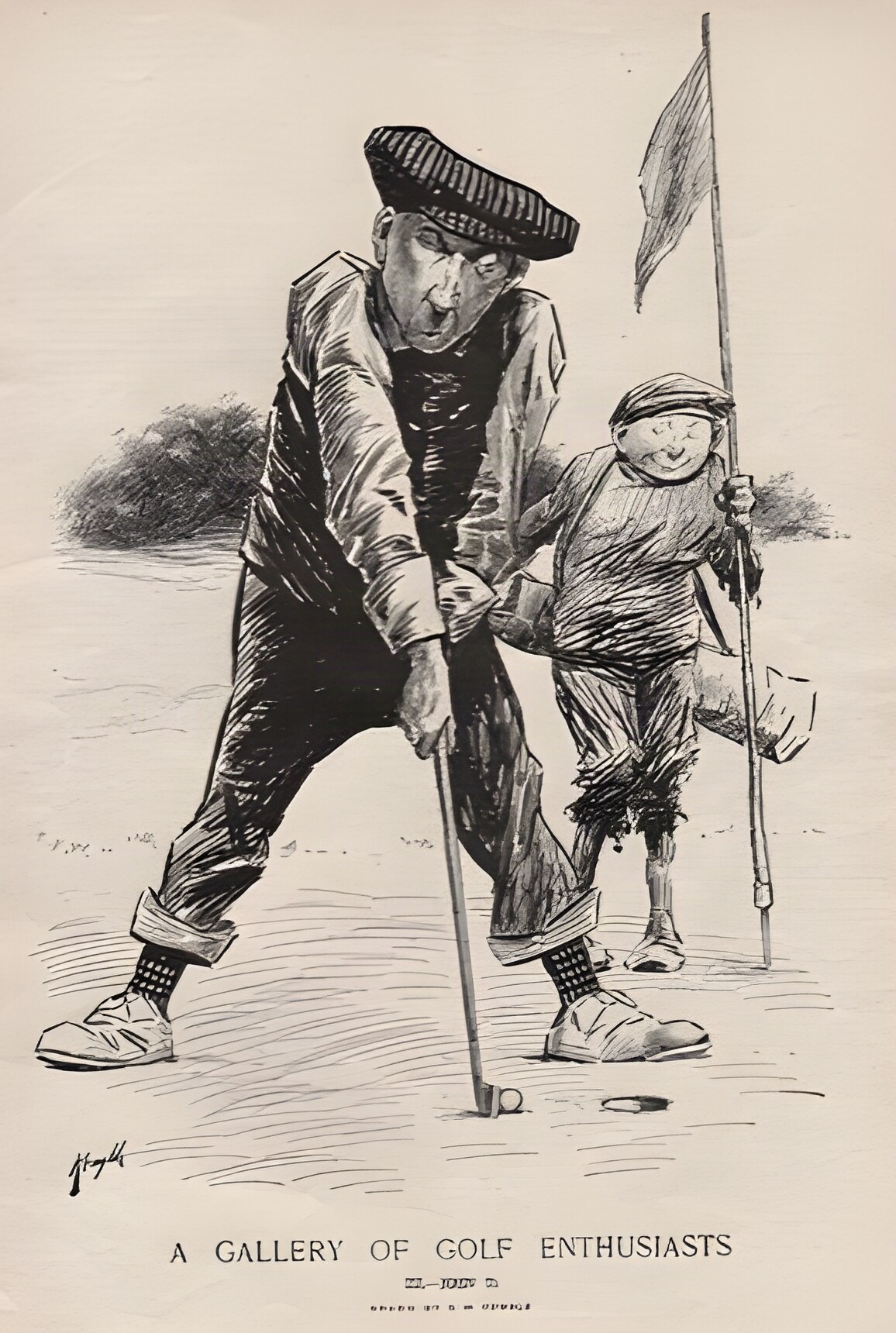
Harper & Brothers, Harper's Weekly, Book: Very Good, Dust Jacket: None, Full-page pen and ink drawing of a golfer putting ball. One in a series by E.W. Kemble, himself a golf enthusiast. Approx. 10 X 13". PLEASE NOTE The image shown is a scan of the actual product you are purchasing. What you see is what you get. The sheet may have some imperfections beyond the cropped area shown. You are buying THIS PAGE ONLY- not the entire magazine. Your order will be placed carefully between stiff paper and an acetate overlay, then packed in a rigid cardboard sleeve to prevent bending.
Harper & Brothers, Harper's Weekly, 1911, Book: Very Good, Dust Jacket: None, Full-page pen and ink drawing of a golfer waiting to tee off One in a series by E.W. Kemble, himself a golf enthusiast. Approx. 10 X 13". PLEASE NOTE The image shown is a scan of the actual product you are purchasing. What you see is what you get. The sheet may have some imperfections beyond the cropped area shown. You are buying THIS PAGE ONLY- not the entire magazine. Your order will be placed carefully between stiff paper and an acetate overlay, then packed in a rigid cardboard sleeve to prevent bending.
Harper & Brothers, Harper's Weekly, Book: Very Good, Dust Jacket: None, Full-page pen and ink drawing of a golfer (Sherman) cleaning dirt from club, standing in the rough. One in a series by E.W. Kemble, himself a golf enthusiast. Approx. 10 X 13". PLEASE NOTE The image shown is a scan of the actual product you are purchasing. What you see is what you get. The sheet may have some imperfections beyond the cropped area shown. You are buying THIS PAGE ONLY- not the entire magazine. Your order will be placed carefully between stiff paper and an acetate overlay, then packed in a rigid cardboard sleeve to prevent bending.
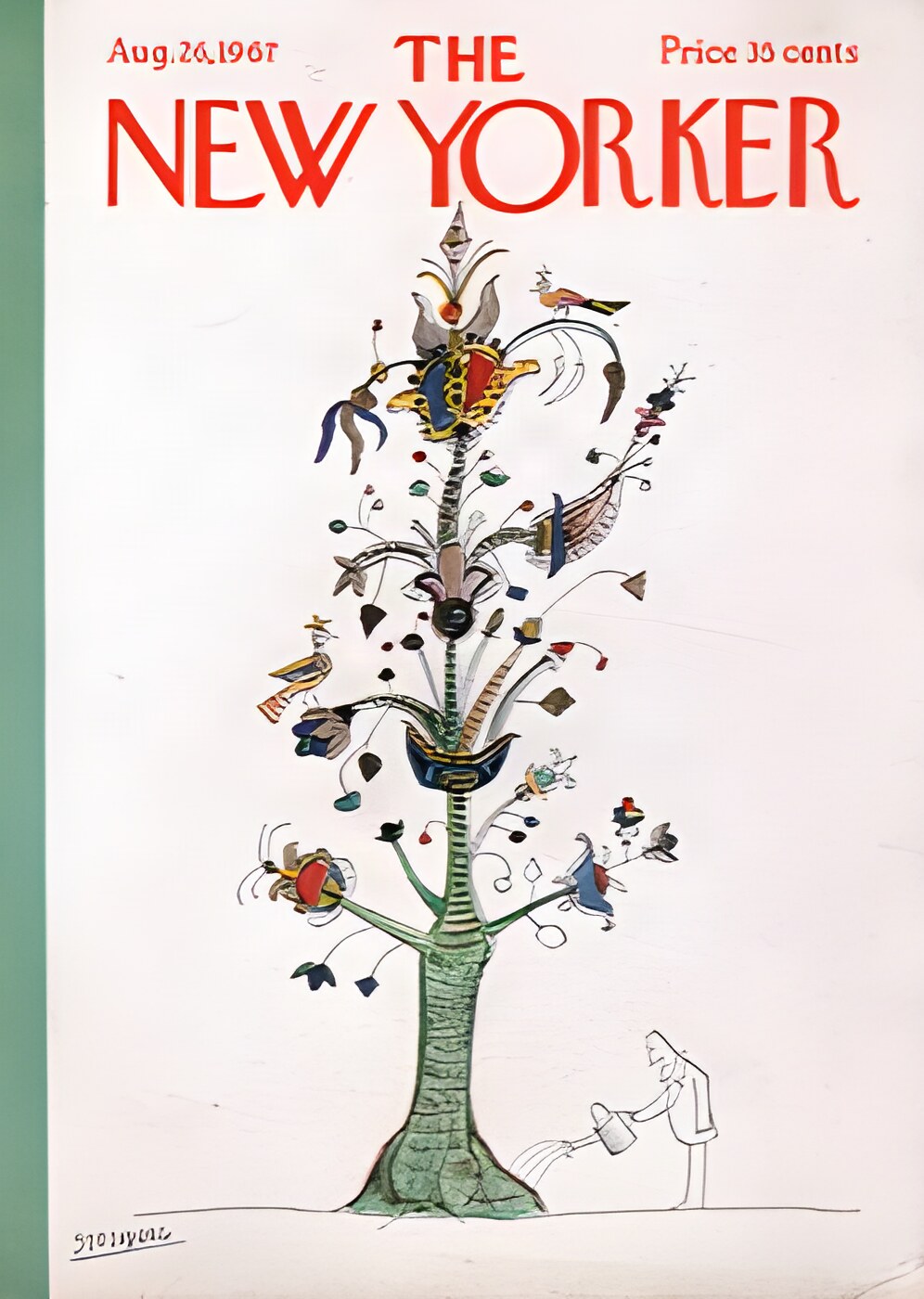
Book: Very Good, Color drawing of man with watering can under a surreal tree. 8 3/4 X 12", very good. PLEASE NOTE: The image shown is a scan of the actual product you are purchasing. What you see is what you get. The sheet may have some imperfections beyond the cropped area shown. You are buying THE COVER ONLY- not the entire magazine. Your order will be placed carefully between stiff paper in clear plastic envelope, then packed in a rigid cardboard sleeve to prevent bending.
Hardcover. Jackson MS, University Press of Mississippi, 1st, 2014, Book: Very Good, Dust Jacket: None, Like new in publisher's shrink-wrap. Hardcover, 168 pages. In The Origins of Comics: From William Hogarth to Winsor McCay, Thierry Smolderen presents a cultural landscape whose narrative differs in many ways from those presented by other historians of the comic strip. Rather than beginning his inquiry with the popularly accepted "sequential art" definition of the comic strip, Smolderen instead wishes to engage with the historical dimensions that inform that definition. His goal is to understand the processes that led to the twentieth-century comic strip, the highly recognizable species of picture stories that he sees crystallizing around 1900 in the United States. Featuring close readings of the picture stories, caricatures, and humoristic illustrations of William Hogarth, Rodolphe Topffer, Gustave Dore, and their many contemporaries, Smolderen establishes how these artists were immersed in a very old visual culture in which images--satirical images in particular--were deciphered in a way that was often described as hieroglyphical. Across eight chapters, he acutely points out how the effect of the printing press and the mass advent of audiovisual technologies (photography, audio recording, and cinema) at the end of the nineteenth century led to a new twentieth-century visual culture. In tracing this evolution, Smolderen distinguishes himself from other comics historians by following a methodology that explains the present state of the form of comics on the basis of its history, rather than presenting the history of the form on the basis of its present state. This study remaps the history of this influential art form.
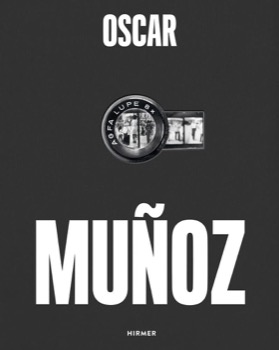
Hardcover. Munich, Hirmer Publishers, 1st, 2021, Book: Very Good, Dust Jacket: None, Hardcover in pictorial boards, 288 pages. Oscar Munoz: Invisibilia is Colombian artist Oscar Munoz's first retrospective in the United States. Addressing the entire span of Munoz's career--from the 1970s to 2020--this exhibition catalog is the most substantive book on Oscar Munoz's work in English to date. Invisibilia includes artworks ranging from Munoz's early charcoal drawings to his later conceptual photographic, video, and installation works. The bilingual catalog includes essays in both Spanish and English from a diverse cadre of scholars who offer fresh takes on Munoz's best-known works and illuminate his more obscure experiments. It also features interviews with the artist as well as a recent text he has written on his practice. A comprehensive chronology charts Munoz's artistic evolution alongside the development of the artistic scene in Cali, Colombia, where he began his career and continues to live and work, rooting the artist's works in their cultural and historical context. Clean, still in publisher's shrinkwrap.
Hardcover. New Haven CT, Yale University Press , 1st, 2020, Book: Very Good, Dust Jacket: Very Good, Hardcover in a bright dust jacket. 438 pages, profusely illustrated in color and b&w. An intimate glimpse into the professional and romantic relationship between Harriet Pattison and the renowned architect Louis Kahn. On a winter day in 1953, a mysterious man in a sheepskin coat stood out to Harriet Pattison, then a theater student at Yale. She would later learn he was the architect Louis Kahn (1901-1974). This chance encounter served as preamble to a fifteen-year romance, with Pattison becoming the architect's closest confidante, his intellectual partner, and the mother of his only son. Here for the first time, Pattison recounts their passionate and sometimes searing relationship. Married and twenty-seven years her senior, Kahn sent her scores of letters--many from far-flung places--until his untimely death. This book weaves together Pattison's own story with letters, postcards, telegrams, drawings, and photographs that reveal Kahn's inner life and his architectural thought process, including new insight into some of his greatest works, both built and unbuilt. What emerges is at once a poignant love story and a vivid portrait of a young woman striving to raise a family while forging an artistic path in the shadow of her famous partner. Clean copy.
Hardcover. np, self-published, 1967, Book: Good, Dust Jacket: None, Hardcover, green cloth covers with gilt title on spine, ship drawing on front cover. 280 pages. A collection of articles and a manuscript written by Julia Louisa Keyes (1828-1877). She was the daughter of novelist Caroline Lee Hentz and wife of Dr. John W. Keyes of Montgomery, Ala. The collection is a typescript of "Our Life in Brazil," a combination of diary, reminiscences, and letter copies, compiled in 1874 by Julia Louisa Hentz Keyes about her experiences in Brazil, 1867-1870. Keyes and her husband emigrated to Brazil after the Civil War. This volume was compiled by Nancy Hamlin Huber on the 100th anniversary of that first voyage. Blank prelim page gone, clean copy. Scarce.
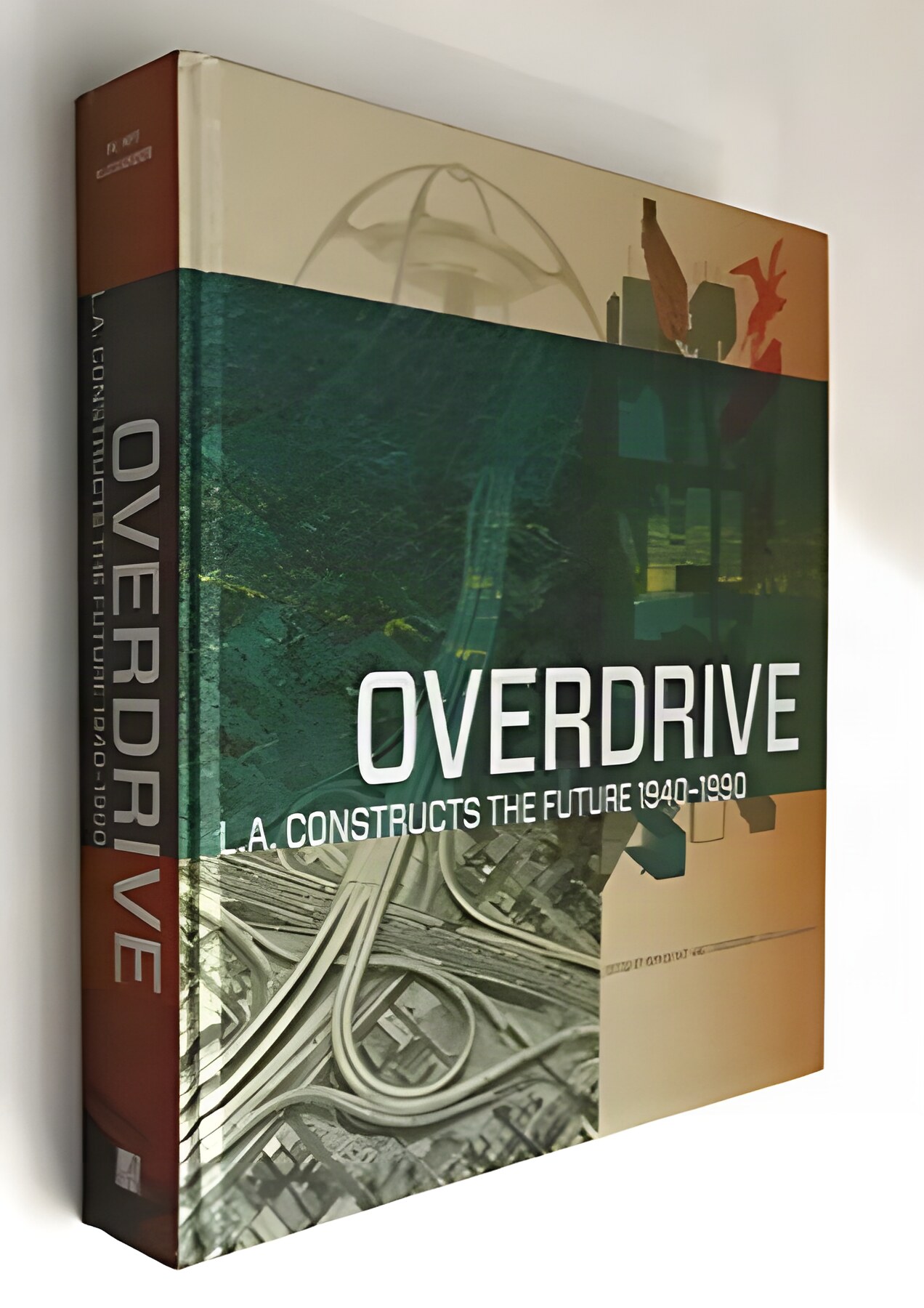
Hardcover. Los Angeles, Getty Research Institute, 1st, 2013, Book: Very Good, Dust Jacket: None, Hardcover in pictorial boards. From 1940 to 1990, Los Angeles rapidly evolved into one of the most populous and influential industrial, economic, and creative capitals in the world. During this era, the region was transformed into a laboratory for cutting-edge architecture. Overdrive: L. A. Constructs the Future, 1940 - 1990 examines these experiments and their impact on modern design, reframes the perceptions of Los Angeles's dynamic built environment, and amplifies the exploration of the city's vibrant architectural legacy. The drawings, models, and images highlighted in the Overdrive exhibition and catalogue reveal the complex and often under-appreciated facets of Los Angeles and illustrate how the metropolis became an internationally recognized destination with a unique design vocabulary, canonical landmarks, and a coveted lifestyle. Clean copy. In publisher's shrinkwrap.
Hardcover. New York, Rizzoli, 1st, 2006, Book: Very Good, Dust Jacket: Very Good, 275 pages, color illustrations throughout. In publisher's shrinkwrap. Owen Jones was, and still remains, a highly influential force in the world of architecture and design. His prolific and impressive work--captured here in its various stages through drawings, architectural plans, and photographs--is as current, imaginative, and important now as when it first emerged more than 125 years ago. Owen Jones: Design, Ornament, Architecture & Theory in an Age in Transition fills a serious gap in the history of Victorian design. In his early career Jones was recognized as an authority on Oriental design. In the 1850s he was commissioned to decorate the interior of Joseph Paxton's magnificent World's Fair Crystal Palace in London. Other signature projects include St. James' Hall, the Crystal Palace Bazaar, Osler's Glass Shop, and Eynsham Hall at Oxford. In 1856 he completed his monumental Grammar of Ornament, which remains one of the most influential works on design ever published and is a source for many artists and designers today. More than just an architect, Jones' skills were applied to designing interiors, books, textiles, furniture, and carpet. His philosophy can most accurately be expressed in his words, "Form without color is like a body without a soul."
Hardcover. New York, Rizzoli, 1st, 2006, Book: Very Good, Dust Jacket: Very Good, 275 pages, color illustrations throughout. In publisher's shrinkwrap. Owen Jones was, and still remains, a highly influential force in the world of architecture and design. His prolific and impressive work--captured here in its various stages through drawings, architectural plans, and photographs--is as current, imaginative, and important now as when it first emerged more than 125 years ago. Owen Jones: Design, Ornament, Architecture & Theory in an Age in Transition fills a serious gap in the history of Victorian design. In his early career Jones was recognized as an authority on Oriental design. In the 1850s he was commissioned to decorate the interior of Joseph Paxton's magnificent World's Fair Crystal Palace in London. Other signature projects include St. James' Hall, the Crystal Palace Bazaar, Osler's Glass Shop, and Eynsham Hall at Oxford. In 1856 he completed his monumental Grammar of Ornament, which remains one of the most influential works on design ever published and is a source for many artists and designers today. More than just an architect, Jones' skills were applied to designing interiors, books, textiles, furniture, and carpet. His philosophy can most accurately be expressed in his words, "Form without color is like a body without a soul."
Hardcover. NY, Metropolitan Museum of Art , 1st, 2004, Book: Very Good, Dust Jacket: Very Good, Hardcover, 272 pages. Painters of Reality, titled after an exhibition held in Milan more than fifty years ago, is the first study in English of this major aspect of Italian art. It builds on the work of the art historian Roberto Longhi. Reexamining the subject in light of copious subsequent scholarship, the authors of this volume contribute major essays that define and discuss naturalism as it appeared in both Lombard paintings and drawings. There is also a fresh consideration of the North Italian predecessors whose influence is apparent either directly or indirectly, in the paintings of Caravaggio. More detailed discussions of the subject center on the precise elements that constituted Leonardo's "hypernaturalism": the important schools of paintings that arose in Brescia, Bergamo, Cremona, and Milan; and Caravaggio's most notable successors in northern Italy, who kept Lombard realism alive into the eighteenth century. Among the 136 paintings and drawings, many never before seen outside of Italy, are influential drawings by Leonardo and major paintings by Caravaggio. Other acknowledged masters in the history of European art are represented, including Lorenzo Lotto, Giovanni Girolamo Savoldo, Giovanni Battista Moroni, and Giacomo Ceruti. Works also appear from significant but less widely known artists such as Sofonisba, Anguissola, Vincenzo Campi, Moretto da Brescia, and Fra' Galgario.
Softcover. New York, American Art Association, 1st, 1978, Book: Very Good, Dust Jacket: None, Softcover. 150 pages. Reprint of 1926 auction catalog. Orange wrappers with black titles, perfect binding, profusely illustrated with b&w plates, foreword by Dana H. Carroll. Slight rubbing to covers; a very clean, tight copy.
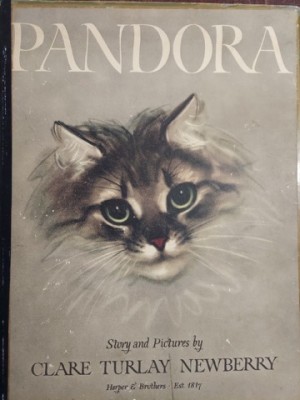
Hardcover. NY, Harper & Brothers, 1st, 1944, Book: Very Good, Dust Jacket: None, Hardcover, blue boards with color pictorial label on front cover. 36 pages with b&w sketches and drawings by Newberry. A charming story of the author's Persian cat and young son by a writer/artist who was very popular and loved cats. No dust jacket. bright. clean copy.
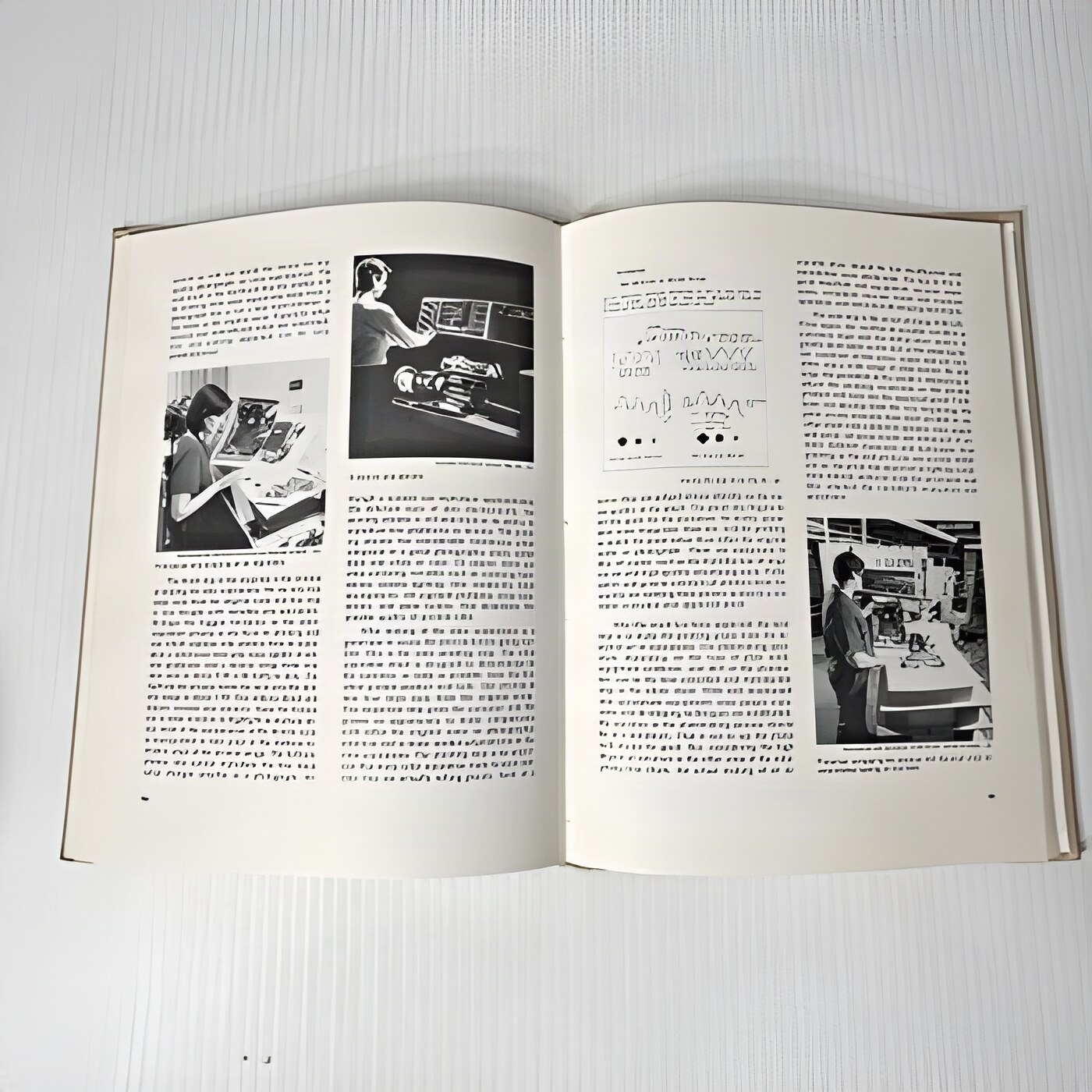
Hardcover. Manhattan KS, Privately Published, 1st, 1985, Book: Very Good, Dust Jacket: None, Hardcover, gray cloth with blue stamping, 150 pages. Contains 12 chapters on paper-making, paper testing, printing paper grades, ink manufacturing, printing ink properties and classifications, press designs and their influence on printing, paper and ink at the Nip, densitometry and ink measurements, color and process-color printing, paper and ink in process-color printing, paper and ink problems, etc. Well illustrated throughout with drawings, diagrams, and photographs -- some highly magnified. Bibliography. Index. Five pages with light underlining, otherwise clean.
Hardcover. NY, Hyperion, 2nd Ed., 2006, Book: Very Good, Dust Jacket: Very Good, Hardcover, 288 pages. Canemaker's second volume on Disney animation (his first was Before the Animation Begins, pub. 11/15/96) covers new territory. Focusing on the birth and progression of the storyboard method, the noted animator/historian explores both the history and the personalities of the Disney storyboard department. He takes readers from the early Disney days (when Walt created the storyboard to add depth and substance to the animated shorts the early studio produced) to today (when ever-changing teams of story specialists gather material and prepare sequence drawings before artists flesh out those Disney masterpieces). Along the way, Canemaker reveals the human effort required to bring an animated film to life and throws in juicy tidbits garnered from his interviews with animation pioneers. Lavish illustrations accompany the text. Recommended for larger public libraries and essential for collections in film and animation history.
Hardcover. NY, Hyperion, 2nd Ed., 2006, Book: Very Good, Dust Jacket: Very Good, Hardcover, 288 pages. Canemaker's second volume on Disney animation (his first was Before the Animation Begins, pub. 11/15/96) covers new territory. Focusing on the birth and progression of the storyboard method, the noted animator/historian explores both the history and the personalities of the Disney storyboard department. He takes readers from the early Disney days (when Walt created the storyboard to add depth and substance to the animated shorts the early studio produced) to today (when ever-changing teams of story specialists gather material and prepare sequence drawings before artists flesh out those Disney masterpieces). Along the way, Canemaker reveals the human effort required to bring an animated film to life and throws in juicy tidbits garnered from his interviews with animation pioneers. Lavish illustrations accompany the text. Recommended for larger public libraries and essential for collections in film and animation history.
Hardcover. NY, Prestel, 1st, 2018, Book: Very Good, Dust Jacket: None, Hardcover in pictorial boards. While sheets of paper are disappearing from our homes and offices, the medium is experiencing a renaissance in the worlds of art, design, and architecture. Suddenly, paper is everywhere--but not only in the old familiar places or forms. This fascinating book looks at every aspect of paper: its history, composition, production, application, and trade. Beginning with the anatomy of paper and its earliest forms, this book looks at paper as a symbol of political and economic importance and as a carrier of ideas, from literature to art, design, and music. It looks at the different surfaces, opacities, weights and volumes of paper and how it is used for printing, typography, graphics, and maps as well as a vehicle for origami, architecture, and fashion. Sumptuously illustrated with photographs and drawings, this book includes a variety of papers for readers to examine and feel, highlighting the sensual aspects of this seemingly ordinary product. Engaging, entertaining, and informative, this book contains a wealth of useful and surprising information on every printed, colored, and textured page
Hardcover. New York, Knopf, 1st, 1991, Book: Very Good, Dust Jacket: Very Good, Hardcover, unpaginated, b&w cartoons throughout. Translated from the French by Helen Graves. From the New Yorker cartoonist, an evocation of New York life. Drawings and droll imaginary letters home from a visiting Frenchman. Bright, clean copy in a similar dust jacket.
Hardcover. New York , Harper & Brothers, 1st, 1954, Book: Very Good, Dust Jacket: Good, Hardcover, 224 pages. Oversized. Tan cloth cover, minor wear to edges. Dust jacket has light wear. Inside is nice and clean with 350 b&w drawings.
Softcover. Pittsfield MA, The Berkshire Museum, 1st, 1987, Book: Very Good, Dust Jacket: None, Softcover, 70 pages. Profusely illustrated in color and b&w. Clean copy.
Softcover. New York, Derrydale Press, 1st, 2010, Book: Very Good, Dust Jacket: None, 149 pages. Softcover. Extensive b&w and color illustrations throughout. Clean, unmarked copy with only minor wear to wrappers.
Softcover. New York, Derrydale Press, 1st, 2010, Book: Very Good, Dust Jacket: None, 149 pages. Softcover. Extensive b&w and color illustrations throughout. Clean, unmarked copy with only minor wear to wrappers.



 "Origins of Comics, The: From William Hogarth to Winsor McCayby: Smolderen, Thierry/Bart Beaty, et al.")



 "Our Life in Brazilby: Julia Keyes")
 "Owen Jones: Design, Ornament, Architecture, and Theory in an Age in Transitionby: Flores, Carol A. Hrvol")
 "Owen Jones: Design, Ornament, Architecture, and Theory in an Age in Transitionby: Flores, Carol A. Hrvol")
 "Painters of Reality: The Legacy of Leonardo and Caravaggio in Lombardy (Metropolitan Museum of Art Series)by: Andrea Bayer and Mina Gregori")
 "Paintings and Drawings by J. Francis Murphyby: Murphy, J. Francis")
 "Paintings and Drawings of Picassoby: Sabartes, Jaime")


 "Paper Dreams: The Art & Artists of Disney Storyboardsby: Canemaker, John")

 "Paper: Material, Medium, Magicby: Nicola Von Velsen (Editor), Neil Holt (Editor)")
 "Par Avionby: Sempe, Jean-Jacques")
 "Passport, Theby: Steinberg, Saul")
 "Paul Brown: Master of Equine Artby: Biscotti, M. L.")
 "Paul Brown: Master of Equine Artby: Biscotti, M. L.")