Hardcover. New Haven CT, Yale University Press, 1st, 2009, Book: Very Good, Dust Jacket: Very Good, Hardcover, 344 pages. The abstract paintings of Jackson Pollock, Willem de Kooning, Barnett Newman, Lee Krasner, Clyfford Still, Helen Frankenthaler, and others revolutionized the art world in the 1940s and 1950s and continue to inspire passionate arguments to this day. What were these artists trying to achieve? Who were the critical voices of the time that rallied public interest in Abstract Expressionism and sparked rancorous debate? Drawing on recent critical, historical and biographical work, this lavishly illustrated book offers a sharp new focus on a pivotal art movement.
Softcover. NY, Albright-Knox Gallery, 1st, 1995, Book: Very Good, Dust Jacket: None, Softcover, This solid, authoritative presentation of Gorky's pivotal art of the 1940s accompanies an exhibit of paintings and drawings showing this year at the National Gallery in Washington, D.C., as well as Buffalo and Fort Worth. Biographical and art-historical essays by Auping, a Modern Art Museum of Fort Worth curator, as well as Dore Ashton and Matthew Spender summarize the critical consensus of Gorky, placing him between Surrealism and Abstract Expressionism in the development of 20th-century art. Excellent reproductions of the paintings and drawings in the show are supplemented by close-ups from several paintings, photographs of Gorky, and selections from Gorky's letters. While not a comprehensive or groundbreaking work, this volume is an excellent summary of or introduction to Gorky for both general and informed lay readers. Clean copy.
Hardcover. Merrell, 1st, 2008, Book: Very Good, Dust Jacket: Very Good, Hardcover. 176 pages. This illustrated volume - the first major monograph ever devoted to Stillman - is a timely and revealing examination of a remarkable talent, encompassing every phase of Stillman's stylistic development, from his early representational painting to his striking post-war Abstract Expressionist works. With contributions from prominent curators, critics, and art historians, the book comprises o detailed overview of the artist's life and achievements together with essays on more specific aspects of his oeuvre, including Stillman's Paris period, his innovative "white line" drawings, his Mexican paintings, and the influence on his work of his Jewish identity. Featuring a comprehensive selection of Stillman's drawings and paintings, this beautiful book restores the artist to his rightful place among the most important names of twentieth-century art.
Hardcover. London, Merrell, 1st, 2008, Book: Very Good, Dust Jacket: Very Good, Hardcover. Orange cloth with black lettering on the spine; 176 pages; 125+ color and bw plates and figures. Includes essays on the artist and his work by Donald Kuspit, James Wechsler, Susan Power, Michael Betancourt, Helen A. Harrison, David Craven, and Rachel Garfield; Artist biography also included.
Hardcover. NY, Prestel, 1st, 2015, Book: Very Good, Dust Jacket: Very Good, Hardcover in a bright dust jacket, 208 pages, color plates. Celebrating an experimental decade in the career of Alex Katz, this book introduces audiences to a relatively unknown body of his work. Coming of age as an artist in the 1950s, Alex Katz set out to reinvent representational painting in the wake of Abstract Expressionism. At first, Katz struggled to find an audience, destroying hundreds of canvases. This book surveys the artwork that survived from this momentous decade, one in which he first painted outdoors, innovated with collages, and met Ada del Moro, his wife and muse. The essays in this book contextualize Katz's painting, consider how he and his peers looked at one another, mined 19th-century portraiture, and borrowed from television, advertising, and cinema. The result is a fascinating study of a young artist laying the groundwork for an astonishingly successful career. Fans of Katz will be inspired by the radicality of his early work, and those being introduced to the artist will be struck by its freshness and relevance.
Softcover. US, Block Museum/Northwestern Univ., 1st, 1988-01-01, Book: Very Good, Dust Jacket: None, Softcover, 321 pages, illustrated throughout in color and b&w. Contains works by Erich Heckel, Ernst Ludwig Kirchner, Otto Mueller, Emil Nolde, Max Pechstein, and Karl Schmidt-Rottluff. Light edgewear to wrappers, faint foxing to top edge, else a clean, tight copy.
Softcover. Newport Beach CA, Newport Harbor Art Museum, 1st, 1977, Book: Very Good, Dust Jacket: None, Unpaginated, softcover exhibition catalog, illustrated in color and b&w. Essay by Betty Turnbull. Clean, tight copy. David Park, an artist who fused representational figuration with abstract expressionism and was one of the creators of the Bay Area Figurative style is featured here in a career retrospective exhibition containing work from throughout his life.
Softcover. Paris FR, Paris-Musees, 1st, 1993, Book: Very Good, Dust Jacket: None, Flexible cloth covers, profusely illustrated, 463 pages, FRENCH TEXT. "This well-illustrated catalogue provides a fine review of the early years of the German Expressionist movement through a presentation of some 400 paintings, prints, drawings and sculptures by members of the Brucke in Dresden (Heckel, Kirchner, Mueller, Pechstein, Schmidt-Rottluff and Nolde) , the Blaue Reiter artists in Munich (Jawlensky, Kandinsky, Klee, Macke, Marc, Munter and Werefkin) and Berlin painter Ludwig Meidner. Sixteen wide-ranging essays are supplemented by detailed entries for most of the exhibited works, a selection of texts and letters by the featured artists, and a chronology of important cultural and political events in Dresden, Munich and Berlin from 1905 to 1914." Clean copy.
Hardcover. New York , Arts, Inc., 1st, 1961, Book: Very Good, Dust Jacket: Very Good, Hardcover, 164 pages, 128 illustrations, 57 in color, including many tipped-in. Bright dust jacket with price-clipped flap. Previous owner's signature on front fly leaf otherwise clean, very good.
Hardcover. US, Prestel, 1st, 2013, Book: Very Good, Dust Jacket: Very Good, 128 pages. Like new in publisher's shrink-wrap. The first publication dedicated to Rose Mandel, a pioneering woman in photography, introduces her remarkable, if often overlooked, body of work to a wider audience. Born in Poland, Rose Mandel immigrated to California in 1942. A love of photography soon brought her into contact with Edward Weston, and then with Ansel Adams and Minor White, both of whom had a strong influence on Mandel's work. Including her important sequence The Errand of the Eye, this book presents the sensitivity and clarity of Mandel's vision. Images from natural and man-made environments, eloquent portraits, and abstract landscapes convey Mandel's delight in the compositions and patterns that can be found anywhere, whether walking along a city street or a country path. These photographs are the result of a highly refined sense of craftsmanship and a complex understanding of psychology and abstract expressionism that caused Mandel to be described as "a painter with a camera." The first monograph on the artist, this volume features an enlightening overview of Mandel's life and work, along with an illustrated chronology and exhibition history.
Softcover. Berkeley CA, University of California Press, 1st, 2001, Book: Near Fine, Dust Jacket: Near Fine, Still wrapped in plastic. Accompanied the exhibition "Expressionist Utopias" at the Los Angeles County Museum in 1993. In great condition. Color illustrations throughout. A nice, tight copy.The notion of utopia exists in every culture, capturing shared dreams and common goals. This book--prepared to accompany the exhibition Expressionist Utopias mounted at the Los Angeles County Museum in 1993--explores how the optimistic themes of utopia and fantasy sustained faith among artists and architects in the power of art to shape a better world during the tumultuous World War I era in Germany. The exhibition's curator, Timothy O. Benson along with David Frisby, Reinhold Heller, Anton Kaes, Wolf Prix, and Iain Boyd White present the diverse manifestations of the utopia metaphor in its progression throughout Expressionism from Arcadian to manmade utopias.
Hardcover. Galerie Raeber, 1st, 1976, Book: Very Good, Dust Jacket: Very Good, Hardcover in a bright dust jacket. GERMAN TEXT. 190 pages plus a photo gallery showing 572 works in b&w in rear. The main section has a generous selection of paintings reproduced in color. Georges Einbeck was born in 1871 in the West Prussian town Golluschutz (Goluszyce). After several trips to Paris, Einbeck begins self-taught with painting in 1897, followed by studies at the Academy of Arts in Munich and at the Ecole des Beaux Arts as well as the Academie de la Grande Chaumiere in Paris. He also studied with Henri Matisse. In the 1920s, he lived in Switzerland for some time. His early works still show influences of Art Nouveau style, the later works, however, are influenced by Expressionism especially the Fauvism painting. He died in 1951. Book is clean and tight.
Softcover. New York, WMAA/Prestel, 1st, 1990, Book: Very Good, Dust Jacket: None, 200 pages. Softcover. Full color illustrations. Shallow crease at bottom right corner of front cover. Clean, unmarked copy. Goodman's book, with essays by Clement Greenberg and Irving Sandler and the artist's own statements, provides an excellent introduction to the life and work of the man frequently called the dean of the New York School of Abstract Expressionism.
Hardcover. Philadelphia, Pennsylvania Academy of the Fine Arts/Universe Publishing, 1st, 1993, Book: Very Good, Dust Jacket: Very Good, Hardcover, 210 pages, 191 illustrations most in color. Bibliography and index. One of the foremost African-American artists of the twentieth century, Horace Pippin came to prominence in the late 1930s between the heyday of the American Scene painters and the ascendancy of Abstract Expressionism. An unschooled painter who was a disabled World War I veteran, Pippin is represented in public and private collections across America. I Tell My Heart features over 110 Pippin paintings including many never before reproduced nor shown in public since the artist's lifetime, as well as many black and white archival photographs of Pippin and his contemporaries.
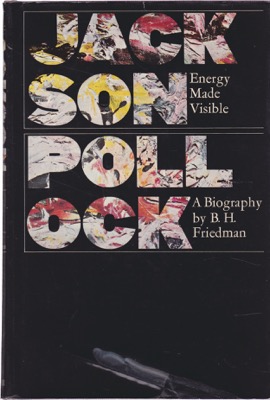
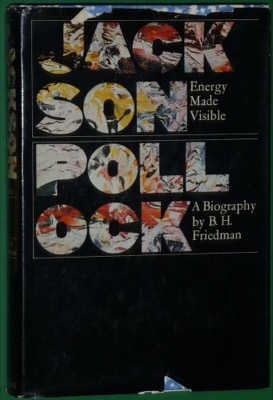
Hardcover. NY, McGraw-Hill, 1st, 1972, Book: Very Good, Dust Jacket: Good, Hardcover in a price-clipped dust jacket with light wear, 293 pages, b&w illustrations. Nowhere is the complex and destructive painter Jackson Pollock (1912-1956) revealed with more compassion and insight than in this exemplary biography. Friedman, a friend of Pollock's and active in the art world, shows him to be a brilliant man tormented by his relationship to his family; an artist who worked hard through years of poverty to achieve his controversial painting technique; the first American painter to gain an international reputation for himself and for what has been variously called Action Painting or Abstract Expressionism; and a man who struggled with alcohol and the tension between gentleness and violence. Light tape repair to dust jacket on reverse. Otherwise clean.
Hardcover. NY, McGraw-Hill , 1st, 1972, Book: Very Good, Hardcover, 293 pages, b&w photographs. Edge wear, small tears to dust jacket. Dark blue top edge decorative stain w/ light spots, else a very clean, tight copy. Nowhere is the complex and destructive painter Jackson Pollock (1912-1956) revealed with more compassion and insight than in this exemplary biography. Friedman, a friend of Pollock's and active in the art world, shows him to be a brilliant man tormented by his relationship to his family; an artist who worked hard through years of poverty to achieve his controversial painting technique; the first American painter to gain an international reputation for himself and for what has been variously called Action Painting or Abstract Expressionism; and a man who struggled with alcohol and the tension between gentleness and violence.Newly illustrated with seminal Pollock paintings, this book takes the reader inside the art world of New York during the '40s and '50s, when Action Painting first emerged. Friedman reveals what it meant to Pollock to experience the invasion of his studio and of the very act of painting by the external pressures of shows, reviews, films, dealers, critics, hostile publicity; and how, despite it all, Pollock created many of the most graceful and powerful paintings ever made in America.
Hardcover. Germany, Hatje Cantz, reprint, 2009, Book: Very Good, Dust Jacket: Very Good, 480 pages. Hardcover with dust jacket with slip case. Clean, unmarked copy with only minor wear to dust jacket. Color/ Black and white pictures throughout. Coinciding with renewed interest in James Ensor, this catalogue raisonne comes as an essential and definitive volume for Ensor buffs and all serious libraries of modern art. A legend in his own lifetime, Ensor (1860-1949) was--alongside Vincent van Gogh and Edvard Munch--a fearless independent whose work led directly to the development of German Expressionism and French Surrealism. Ensor achieved fame as the "painter of masks," and for his bizarre still lifes and grotesque carnival scenes, in harsh, contrasting, brilliant colors, evolving out of the traditional Flemish dance of death. Now, the reader can explore the Belgian painter's oeuvre thoroughly, in this opulently illustrated, full-color, slipcased catalogue raisonne. A comprehensive illustrated chronology offers additional details about the artist's life and work, and forms an integral part of this splendid, highly valuable contribution to art historical research, ensuring the legacy of a great artist who continues to inspire contemporary art.
Hardcover. New York, American Federation of Arts, 1st, 1961, Book: Near Fine, Dust Jacket: Very Good, Catalogue of the sculpture of Jose de Rivera, with a chronology and introductory essay. Approximately 50 pages, illustrated with 15 black/white plates in addition to several other illustrations. Small cloth bound book is in near fine condition, dust jacket is slightly faded on the spine but in very good condition.
Hardcover. US, Foggy Notion Books/Pasadena Museum of California Art, 1st, 2012, Book: Very Good, Dust Jacket: None, 208 pages. Hardcover with no dust jacket. Clean, unmarked copy with only minor wear to boards. Like new in publisher's shrink-wrap. Until recently, the figurative artists who dominated the Los Angeles art scene of the 1940s and 50s had largely been written out of art history. L.A. Raw is an attempt to right that wrong. Bringing together works by 41 artists in a variety of media, it traces a lineage that connects postwar figurative expressionism to the 1960s and 70s investigations of politics, gender and ethnicity in art. The featured artists include John Altoon, Wallace Berman, William Brice, Hans Burckhardt, Chris Burden, Cameron, Judy Chicago, Connor Everts, Llyn Foulkes, Charles Garabedian, David Hammonds, Robert Heinecken, John Paul Jones, Kim Jones, Ed and Nancy Kienholz, Rico Lebrun, Paul McCarthy, Arnold Mesches, Betye Saar, Ben Sakoguchi, Barbara Smith, James Strombotne, Jan Stussy, Edward Teske, Joyce Treiman, Howard Warshaw, June Wayne, Charles White and Jack Zajac.
Hardcover. 2012, Book: Very Good, Dust Jacket: None, Hardcover, 208 pages illustrated in color and b&w. Until recently, the figurative artists who dominated the Los Angeles art scene of the 1940s and 50s had largely been written out of art history. L.A. Raw is an attempt to right that wrong. Bringing together works by 41 artists in a variety of media, it traces a lineage that connects postwar figurative expressionism to the 1960s and 70s investigations of politics, gender and ethnicity in art. The featured artists include John Altoon, Wallace Berman, William Brice, Hans Burckhardt, Chris Burden, Cameron, Judy Chicago, Connor Everts, Llyn Foulkes, Charles Garabedian, David Hammonds, Robert Heinecken, John Paul Jones, Kim Jones, Ed and Nancy Kienholz, Rico Lebrun, Paul McCarthy, Arnold Mesches, Betye Saar, Ben Sakoguchi, Barbara Smith, James Strombotne, Jan Stussy, Edward Teske, Joyce Treiman, Howard Warshaw, June Wayne, Charles White and Jack Zajac. No dj issued, clean copy.
Hardcover. Saint Louis, Saint Louis Art Museum/Prestel-Verlag, 1st US, 1984, Book: Very Good, Dust Jacket: Very Good, 482 pages. Hardcover with dust jacket. illustrated throughout with 297 plates in full color and black & white. Light wear. Clean, tight copy.
Hardcover. Munch/London/NY, Prestel, 1st, 2022, Book: Very Good, Dust Jacket: Very Good, Hardcover in a bright dust jacket. Still in publisher's shrinkwrap. 656 pages. Published on the twentieth anniversary of the founding of Neue Galerie New York, this stunning volume celebrates the varied achievements of modern art history in the German-speaking world by examining historical developments in Austria and Germany from 1890 to 1940. Illustrated throughout with exquisite reproductions of the museum's holdings, this book considers the influence of Friedrich Nietzsche and his writings on the fine arts and examines the founding of the Secessionist artists' organizations in Germany and Austria. Insightful essays trace the emergence of Expressionism and abstraction, as well as the development of such movements as Dada and New Objectivity. Evolutions in architecture and design are appraised through the legacy of the Arts and Crafts movement, as well as the establishment of the Darmstadt Artists' Colony and the Wiener Werkstatte. The book also examines the role of the German Werkbund and the founding of the Bauhaus school. Finally, the book briefly addresses the horrific impact of the National Socialists' degenerate art campaign, which resulted in incalculable damage and led to the exile and death of artists and designers of the era. From well-known artists such as Otto Dix, Josef Hoffmann, Vasily Kandinsky, Gustav Klimt, and Egon Schiele, to lesser recognized but equally important figures, including Albert Birkle, Alfred Kubin, Felix Nussbaum, and Dagobert Peche, this book offers an authoritative and kaleidoscopic look at a crucial moment in history and a portrait of radical thought that changed forever the way we experience art in our lives. DOMESTIC SHIPPING ONLY.
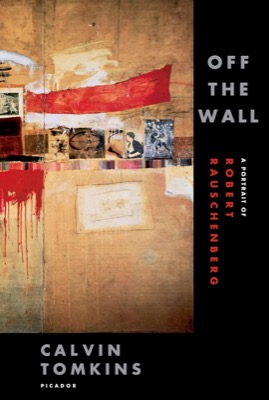
Softcover. NY, Picador, reprint, 2005, Book: Very Good, Dust Jacket: None, Softcover, 318 pages. Calvin Tomkins first discovered the work of Robert Rauschenberg in the late 1950s, when he began to look seriously at contemporary art. While gazing at Rauschenberg's painting Double Feature, Tomkins felt compelled to make some kind of literal connection to the work, and it is in that sprit that "for the last forty years it's been [his] ambition to write about contemporary art not as a critic or a judge, but as a participant." Tomkins has spent many of those years writing about Robert Rauschenberg, whom he rapidly came to see as "one of the most inventive and influential artists of his generation." So it seemed natural to make Rauschenberg the focus of Off the Wall, which deals with the radical changes that have made advanced visual art such a powerful force in the world.Off the Wall chronicles the astonishingly creative period of the 1950s and 1960s, a high point in American art. In his in his collaborations with Merce Cunningham and John Cage, and as a pivotal figure linking abstract expressionism and pop art, Rauschenberg was part of a revolution during which artists moved art off the walls of museums and galleries and into the center of the social scene. Clean, bright copy.
Hardcover. Berkeley CA, University of California Press, 1st, 2007, Book: Very Good, Dust Jacket: Very Good, Hardcover, 318 pages. In Origins of the Chinese Avant-Garde, Xiaobing Tang studies the art and art theories of the first half of the twentieth century, when modern Chinese art and literature emerged. He argues that the most consequential expression of the avant-garde was the modern woodcut movement that thrived in China in the 1930s. In this innovative study--also the first comprehensive account of this Chinese movement available in English--Tang examines the aesthetic, intellectual, and social appeal of the modern woodcut and places the movement at the intersection of historical events, individual efforts, and competing discourses on art. He also shows how the woodcut movement drew upon international inspiration--from German Expressionism, Soviet wood engravings, and Japanese creative prints.

 "Action/Abstraction: Pollock, de Kooning, and American Art, 1940-1976by: Norman L. Kleeblatt , Maurice Berger , et al.")
 "Arshile Gorky: The Breakthrough Yearsby: Spender, Matthew,Auping, Michael,Ashton, Dore")
 "Ary Stillman: From Impressionism to Abstract Expressionismby: STILLMAN, Ary: WECHSLER, James (Edited by)")
 "Brand-New and Terrific: Alex Katz in the 1950sby: Diana Tuite , Sharon Corwin, et al.")
 "Brucke German Expressionist Printsby: Heller, Reinhold")
 "David Park 1911-1960: A Retrospective Exhibitionby: Park, David")
 "E. L. Kirchnerby: Grohmann, Will")
 "Errand of the Eye, The: Photographs by Rose Mandelby: Ehrens, Susan")
 "Expressionist Utopias: Paradise, Metropolis, Architectural Fantasyby: Benson, Timothy O.")
 "Georges Einbeck (Malerei Text- und Bilddokumente Werkverzeichnis)by: Kneubuhler, Theo/Einbeck, Georges")
 "Hans Hofmannby: Goodman, Cynthia/Irving Sandler/Clement Greenberg")
 "I Tell My Heart: The Art of Horace Pippinby: Stein, Judith E.")
 "James Ensor: The Complete Paintingsby: Tricot, Xavier")
 "Jose de Riveraby: Gordon, John")
 "L.A. Raw: Abject Expressionism in Los Angeles, 1945-1980: From Rico Lebrun to Paul McCarthyby: Duncan, Michael")
 "L.A. Raw: Abject Expressionism in Los Angeles, 1945-1980: From Rico Lebrun to Paul McCarthyby: Michael Duncan , Peter Selz, et al.")
 "Max Beckmann: A Retrospectiveby: Schulz-Hoffmann , Carla/Judith C. Weiss")
 "Modern Worlds: Austrian and German Art, 1890-1940by: Price, Renee / Lauder, Ronald S./Peters, Olaf/ Staggs, Janis")