Hardcover. Boston, Houghton Mifflin, 3rd Ed., 1891, Book: Good, Dust Jacket: None, Hardcover, 3/4 leather over marbled boards, ribbed spine with gilt lettering. Frontispiece with tissue guard. Marbled endpapers with gilt pattern. Black and white plates and illustrations. 349 pages. Front cover starting to split from spine but still holding. Mild edgewear to covers, bookplate on inside front cover, otherwise clean copy.
Hardcover. Chicago, University of Chicago Press, 1st, 2007, Book: Good, Dust Jacket: Good, Hardcover in a lightly worn dust jacket. 553 pages, b&w illustrations. A spectacular reading of Western philosophy, religion, and mythology that draws on early maps and atlases, Plato, Kant, and Wittgenstein, Thomas Pynchon, Gilgamesh, and Marcel Duchamp, Abysmal is itself a minimalist guide to the terrain of Western culture. Olsson roams widely but always returns to the problems inherent in reason, to question the outdated assumptions and fixed ideas that thinking cartographically entails. A work of ambition, scope, and sharp wit, Abysmal will appeal to an eclectic audience--to geographers and cartographers, but also to anyone interested in the history of ideas, culture, and art. Name written on front fore-edge of book, otherwise clean.
Hardcover. London, England, Macmillan and Co. , 2nd Edition, 1922, Book: Very Good, Dust Jacket: None, 503 pages. Hardcover. Previous owner's name on front flyleaf. Blue cloth cover boards, gilt title on spine, some chipping to edges of boards. Tanning to pages and edges from age. Binding very good. Spine straight. Benedetto Croce is one of the most influential philosophers of the twentieth century. His work in aesthetics and historiography has been controversial, but enduring.
Hardcover. Ithaca NY, Cornell University Press, 1st, 1992, Book: Very Good, Dust Jacket: Very Good, Hardcover in a dust jacket with mild fading to spine. 224 pages. Clean copy.
Softcover. NY, Liberal Arts Press, 1st, 1956, Book: Very Good, Softcover, 615 pages. Translated with an introduction by Merritt H. Moore. Some light fading to edges of yellow wrappers, name on front fly leaf, otherwise clean. Out of print and uncommon.
Hardcover. New Haven, Princeton University Press, 1st, 2001, Book: Very Good, Dust Jacket: Very Good, Hardcover, 192 pages. 55 B&w illustrations and 21 plates in full color. Debates the relationship between art, science and religion by exploring the 19th century landscape painters fascination with geology. Scarce. Pictorial boards, black cloth spine. Pictorial dust jacket. Like new. In original shrinkwrap.
Hardcover. Paris, Zodiaque, 1st, 1983, Book: Very Good, Dust Jacket: Very Good, 374 pages plus index. Color, b&w gravure photographs, plans of churches, cathedrals, abbeys and monasteries in England. Text in French. Ribbon marker.
Softcover. NY, Aperture Foundation, 1999, Book: Very Good, Dust Jacket: None, Softcover, 80 pages. A large, beautifully designed photography publication with many full page photographs in black and white and color. Glossy wraps. Aperture's second Explorations issue presents heretofore undiscovered images by photographers whose work is bound to become widely known. They probe the metaphysical through ritual, invoke dark metaphors in circus performance, find religion in nocturnal deserts, and study the ties that bind. The convergence of these uniquely powerful images and the artists' personal stories provokes an examination of the ever expanding boundaries of contemporary photography. Artists included are Stephen Barker, Neil Folberg, Jill Graham, Kimberly Gremillion, Jan van Leeuwen, Anne Arden McDonald, Andreas Rentsch, Maruch Santiz Gomez, and Dayanita Singh.
Softcover. Paris, Reunion des Musees Nationaux, 1st, 1990, Book: Very Good, Dust Jacket: None, 204 pages. Softcover. French text only. Previous owners stamp on front endpaper. Illustrated with beautiful full color and black & white examples of religious art and artifacts of Tibet and Nepal. Slight toning to page edges. Clean, tight copy.
Hardcover. San Francisco, Chronicle Books, 1st, 2007, Book: Near Fine, Dust Jacket: Near Fine, 244 pages illustrated in color. Scholarly essays accompany this monograph on the Japanese-American artist. In publisher's shrinkwrap. Published to coincide with a series of major exhibitions extending beyond 2007, Ascending Chaos is the first major retrospective of Japanese-American artist Masami Teraoka's prolific and acclaimed work thus far. In Teraoka's paintings which have evolved from his wry mimicry of Japanese woodblock prints to much larger and complex canvasses reminiscent of Bosch and Brueghel the political and the personal collide in a riot of sexually frank tableaux. Populated by geishas and goddesses, priests, and politicians, and prominent contemporary figures, these paintings are the spectacular next phase of a wildly inventive career. With essays by renowned art critics who discuss how Teraoka's work inventively marries east and west, sex and religion, Ascending Chaos is a critical overview of this cultural trickster.
Hardcover. Black Dog Publishing, 1st, 2006, Book: Very Good, Dust Jacket: Very Good, Hardcover, 189 pages. Blasphemy: Art that Offends is a prescient examination of the perpetually troubled, often explosive relationship between religion, politics and art. This book draws on a rich wealth of visual material, tracing both the history of blasphemy as a concept and re-positioning the term in the twenty-first century. Questions of censorship and freedom of expression are today extremely volatile, a fact evinced by the recent international backlash against the Danish newspaper Islamic caricatures and the murder of the Dutch filmmaker Theo Van Gogh following the release of his notorious Submission. Blasphemy: Art that Offends provides a vital vantage point from which to view the complicated, compelling interrelations between religion, politics and the visual arts.
Hardcover. Oxford UK, Clarendon Press, 1st, 1981, Book: Very Good, Dust Jacket: Very Good, Hardcover in a bright dust jacket, 313 pages. The Consolations of Philosophy by Boethius, whose English translators include King Alfred, Geoffrey Chaucer, and Queen Elizabeth I, ranks among the most remarkable books to be written by a prisoner awaiting the execution of a tyrannical death sentence. Its interpretation is bound up with his other writings on mathematics and music, on Aristotelian and propositional logic, and on central themes of Christian dogma. Chadwick begins by tracing the career of Boethius, a Roman rising to high office under the Gothic King Theoderic the Great, and suggests that his death may be seen as a cruel by-product of Byzantine ambitions to restore Roman imperial rule after its elimination in the West in AD 476. Subsequent chapters examine in detail his educational programme in the liberal arts designed to avert a threatened collapse of culture and his ambition to translate into Latin everything he could find on Plato and Aristotle. Name on front fly leaf, otherwise bright and clean.
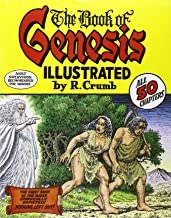
Hardcover. New York , W.W. Norton & Co., 1st, 2009, Book: Very Good, Dust Jacket: Very Good, Hardcover, 224 pages, b&w art throughout by Crumb. Envisioning the first book of the bible like no one before him, R. Crumb, the legendary illustrator, reveals here the story of Genesis in a profoundly honest and deeply moving way. Originally thinking that we would do a take off of Adam and Eve, Crumb became so fascinated by the Bible's language, "a text so great and so strange that it lends itself readily to graphic depictions," that he decided instead to do a literal interpretation using the text word for word in a version primarily assembled from the translations of Robert Alter and the King James bible. As Crumb writes in his introduction, "the stories of these people, the Hebrews, were something more than just stories. They were the foundation, the source, in writing of religious and political power, handed down by God himself." Crumb's Book of Genesis, the culmination of 5 years of painstaking work, is a tapestry of masterly detail and storytelling which celebrates the astonishing diversity of the one of our greatest artistic geniuses.
Hardcover. New York , W.W. Norton & Co., 1st, 2009, Book: Very Good, Dust Jacket: Very Good, Hardcover, 224 pages, b&w art throughout by Crumb. Envisioning the first book of the bible like no one before him, R. Crumb, the legendary illustrator, reveals here the story of Genesis in a profoundly honest and deeply moving way. Originally thinking that we would do a take off of Adam and Eve, Crumb became so fascinated by the Bible's language, "a text so great and so strange that it lends itself readily to graphic depictions," that he decided instead to do a literal interpretation using the text word for word in a version primarily assembled from the translations of Robert Alter and the King James bible. As Crumb writes in his introduction, "the stories of these people, the Hebrews, were something more than just stories. They were the foundation, the source, in writing of religious and political power, handed down by God himself." Crumb's Book of Genesis, the culmination of 5 years of painstaking work, is a tapestry of masterly detail and storytelling which celebrates the astonishing diversity of the one of our greatest artistic geniuses.
Hardcover. New York, Doubleday, 1st, 1961, Book: Very Good, Dust Jacket: Very Good, Hardcover, 95 pages, b&w cartoons by Chon Day. The third collection of Brother Sebastian cartoons which ran in Look Magazine. Dust jacket with light edge wear, price clipped. Clean copy.
Hardcover. New York, Doubleday, 1st, 1959, Book: Very Good, Dust Jacket: Very Good, Hardcover, 95 pages, b&w cartoons by Chon Day. The second collection of Brother Sebastian cartoons which ran in Look Magazine. Dust jacket with light edge wear, price clipped. Previous owner's inscription on front fly leaf.
Hardcover. New York, Hanover House, 1st, 1957, Book: Very Good, Dust Jacket: Very Good, Hardcover, unpaginated, b&w cartoons by Chon Day. The first collection of Brother Sebastian cartoons which ran in Look Magazine. Dust jacket with light edge wear, price clipped. Clean.
Hardcover. Dublin, Hodges Figgis & Co., 1st, 1908, Book: Good, Dust Jacket: None, 106 pages, 51 plates, 6 in color. Large format, bound in green cloth covers with gilt lettering. Ex-library with usual stamping and residue to end papers, sticker to bottom of spine. Covers show corner wear, top of spine frayed with a one inch tear to cloth at top. Interior of book is clean and tight. Green of cloth spine faded.
Hardcover. Israel/New York, Steimatzky/LeonAmiel, 1st, 1983, Book: Very Good, Dust Jacket: Very Good, Hardcover, 191 pages, 50 color and 40 b&w plates. Includes color lithograph at front of book. Blue cloth covers, gilt lettering on spine, bright dust jacket.
Softcover. Cambridge MA, Harvard University Press, 4th pr., 2001, Book: Very Good, Dust Jacket: None, Softcover, 656 pages. John Rawls's work on justice has drawn more commentary and aroused wider attention than any other work in moral or political philosophy in the twentieth century. Rawls is the author of two major treatises, A Theory of Justice (1971) and Political Liberalism (1993); it is said that A Theory of Justice revived political philosophy in the English-speaking world. But before and after writing his great treatises Rawls produced a steady stream of essays. Some of these essays articulate views of justice and liberalism distinct from those found in the two books. They are important in and of themselves because of the deep issues about the nature of justice, moral reasoning, and liberalism they raise as well as for the light they shed on the evolution of Rawls's views. Some of the articles tackle issues not addressed in either book. They help identify some of the paths open to liberal theorists of justice and some of the knotty problems which liberal theorists must seek to resolve. A complete collection of John Rawls's essays. Owner's name on front fly leaf otherwise clean.
Hardcover. New Haven CT, Yale University Press, 1st, 2016, Book: Very Good, Dust Jacket: Very Good, Hardcover in a bright, unclipped dust jacket. 1176 pages. We live in an age of disenchantment. The number of self-professed "atheists" continues to grow. Yet many still feel an intense spiritual longing for a connection to what Aristotle called the "eternal and divine." For those who do, but demand a God that is compatible with their modern ideals, a new theology is required. This is what Anthony Kronman offers here, in a book that leads its readers away from the inscrutable Creator of the Abrahamic religions toward a God whose inexhaustible and everlasting presence is that of the world itself. Kronman defends an ancient conception of God, deepened and transformed by Christian belief--the born-again paganism on which modern science, art, and politics all vitally depend. Brilliantly surveying centuries of Western thought--from Plato to Augustine, Aquinas, and Kant, from Spinoza to Nietzsche, Darwin, and Freud--Kronman recovers and reclaims the God we need today. Clean copy.
Softcover. Albuquerque, NM, University of New Mexico Press, 1st, 1995, Book: Very Good, Dust Jacket: None, 237 pages. Softcover. A very clean, unmarked copy with only minor edgewear. Color photographs throughout.
Hardcover. Boston, Houghton Mifflin, 1st, 1974, Book: Very Good, Dust Jacket: Very Good, Hardcover in a lightly worn dust jacket. Dust jacket art and b&w drawings by Marvin Friedman. A young girl's difficulties with her family and her religion result in a consciousness-raising trip to Israel. Joanne reads the Torah to escape from her nonreligious Jewish family,who prefer her younger sister's company. She decides to go to Israel for a year and is waylaid by a horrible terrorist incident, which helps her to see her life freshly. Clean copy.
Hardcover. Washington, D.C., Prestel, 1st, 1999, Book: Very Good, Dust Jacket: Very Good, Hardcover in a bright dust jacket, 408 pages, illustrated throughout in color. Large oversized book. Devi, the Great Goddess of India is beautiful, beneficent, terrifying, all-powerful, and glorious. Ubiquitous in India's social and spiritual fabric, she has, over the millennia, been painted, sculpted, carved, and wrought from silver and bronze in a myriad of shapes and forms. Devi: The Great Goddess brings together one hundred and twenty of these diverse examples of Devi and a group of distinguished essayists who explore facets of Devi worship and tradition, including ritual, architecture, literature, history and contemporary issues such as feminism and gender politics. Light edgewear to dust jacket, else a clean, tight copy. PLEASE NOTE: DUE TO SIZE & WEIGHT, DOMESTIC SHIPPING ONLY.

 "A Handbook of Christian Symbols and Stories of the Saints As Illustrated in Art by: Clara Erskine Clement, Editor: Katherine Eleanor Conway")
 "Abysmal: A Critique of Cartographic Reasonby: Gunnar Olsson")
 "Aesthetic as Science of Expression and General Linguisticby: Croce, Benedetto, Douglas Ainslie (Translation)")


 "Alexander of Aphrodisias: On Aristotle's Metaphysics 2 & 3 by: Aristotle Alexander of Aphrodisias. William E. Dooley and Arthur Madigan (transl.)")
 "An Essay on the Foundations of Our Knowledge by: Cournot, Antoine Augustin, 1801-1877")
 "Anatomy of Nature, The: Geology & American Landscape Painting 1825-1875by: Bedell, Rebecca")

 "Aperture 154: Explorations: Nine Portfolios (Aperture Magazine)by: Aperture Foundation Inc. Staff")
 "Art esoterique de L'Himalaya - Catalogue de la donation Lionel Fournierby: Beguin, Gilles")
 "Ascending Chaos: The Art of Masami Teraoka 1966-2006by: Bing, Alison and others")
 "Blasphemy: Art That Offendsby: Plate, S. Brent")
 "Boethius: The Consolations of Music, Logic, Theology, and Philosophy by: Chadwick, Henry")
 "Book of Genesis Illustrated by R. Crumbby: Crumb, R.")




 "Brother Sabastian At Largeby: Day, Chon")
 "Brother Sabastian Carries Onby: Day, Chon")
 "Brother Sabastianby: Day, Chon")
 "Celtic Illuminative Art: In the Gospel Books of Durrow Lindisfarne and Kellsby: Robinson, Stanford F.H.")
 "Chagall in Jerusalemby: Amiel, Leon")

 "Confessions of a Born-Again Paganby: Anthony T. Kronman")
 "Crafting Devotions: Tradition in Contemporary New Mexico Santosby: Kalb, Laurie Beth")
 "Dance Around the Fire by: Cone, Molly, Illustrator: Friedman, Marvin")