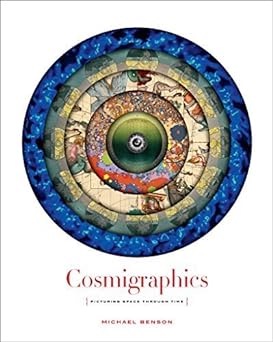
Hardcover. NY, Harry N. Abrams, 2nd pr., 2014, Book: Very Good, Dust Jacket: Very Good, Hardcover in a bright dust jacket. 320 pages, 9.9x1.2x12.3 inches. Color illustrations throughout. Michael Benson, one of the world's leading authorities on the visual legacy of space exploration and astronomy, tells a riveting story of the discovery of the universe through pictures. Selecting strikingly powerful and intriguing illustrations and maps, many hidden away in the world's great science libraries and virtually unknown today, he chronicles more than three thousand years of humanity's ever-expanding understanding of the size, shape and visual texture of the cosmos from the planets of our Solar System to the Milky Way and to the large-scale structure of the greater universe, with its teeming swarms of galaxies. These illustrations - some are maps, some are diagrams, some are speculative works of representation- are among history's most powerfully compelling works of data visualization, an art that is increasingly necessary in today's data-intensive world. NOTE: DUE TO WEIGHT, DOMESTIC SHIPPING ONLY.
Hardcover. Bristol/Philadelphia, Institute of Physics Publishing, 1st , 2005, Book: Very Good, Dust Jacket: Very Good, Hardcover in a bright dust jacket, 330 pages, b&w illustrations. All physicists are familiar with Hooke's law of springs, but few will know of his theory of combustion, that his Micrographia was the first book on microscopy, that his astronomical observations were some of the best seen at the time, that he contributed to the knowledge of respiration, insect flight and the properties of gases, that his work on gravitation preceded that of Newton's, that he invented the universal joint, and that he was an architect of distinction and a surveyor for the City of London after the Great Fire. England's Leonardo is a biography of Hooke covering all aspects of his work, from his early life on the Isle of Wight through his time at Oxford University, where he became part of a group who would form the original Fellowship of the Royal Society. The author adopts a novel approach at this stage, dividing the book by chapter according to the fields of research-Physiology, Engineering, Microscopy, Astronomy, Geology, and Optics-in which Hooke applied himself. The book concludes with a chapter considering the legacy of Hooke and his impact on science.
Hardcover. New York, Stewart, Tabori & Chang, Publishers, Revised Ed., 1986, Book: Very Good, Dust Jacket: Very Good, 240 pages. Very minor dust jacket edge wear. Small crease on front dust jacket cover. SIGNED BY FORMER ASTRONAUT ALLEN on half title page and dated 1988. Lots of color photographs throughout. A very clean and tight copy.
Hardcover. New Haven CT, Yale University Press, 1st, 2010, Haerdcover in a bright dust jacket. 354 pages, b&w illustrations. Galileo (1564-1642) is one of the most important and controversial figures in the history of science. Tackling Galileo as astronomer, engineer and author, the author places him at the centre of Renaissance culture. He traces Galileo through his early rebellious years onwards: his move to Florence seeking money, status, and greater freedom to attack intellectual orthodoxies; his trial for heresy and narrow escape from torture; and his house arrest and physical (though not intellectual) decline. Clean copy.
Hardcover. Princeton NJ, Princeton University Press, 1st, 2009, Book: Very Good, Dust Jacket: Very Good, Hardcover, 307 pages, 60 color illustrations. 81 halftones. Provides an in-depth look at one artist's intense fascination with the science of astronomy. Joseph Cornell (1903-72) has often been viewed as a recluse, isolated in his home on Utopia Parkway, lost in the fairy tales and charming objects of his collages and assemblage boxes. Less commonly known has been Cornell's vested and serious interest in the history of astronomy and the cutting-edge discoveries made during his own lifetime. In a bright, unclipped dust jacket.
Hardcover. London, Sherwood and Co., Later Edition, 1825, Book: Fair, Dust Jacket: None, 463 pages. Hardcover. Reprint edition dated 1825 - "A New and Improved Edition, Adapted to the Present State of Science by C. F. Partington". Illustrated with black & white drawings, diagrams. Body of book rebound in current covers at some point. Front hinge cracked, cloth tape along spine is weak, with faint remains of title label. Top 2" of title page missing. Light to moderate foxing to some plates/pages. Sold 'As-Is'.
Hardcover. Cambridge MA, MIT Press, 1st, 1983, Book: Very Good, Dust Jacket: Very Good, Hardcover, 199 pages, b&w illustrations, blue cloth covers with white lettering on spine, bright dust jacket. Edited by Stephen Brush, C.W.F. Everitt and Elizabeth Garber.
Softcover. NY, Seven Stories Press, reprint, 2012, Book: Very Good, Dust Jacket: None, Softcover, 431 pages. A fascinating document of an extraordinary life, Memoirs of A Breton Peasant reads with the liveliness of a novel and bristles with the vigor of an opinionated autodidact from the very lowest level of peasant society. Brittany during the nineteenth century was a place seemingly frozen in the Middle Ages, backwards by most French standards; formal education among rural society was either unavailable or dismissed as unnecessary, while the church and local myth defined most people's reasoning and motivation. Jean-Marie Deguignet is unique not only as a literate Breton peasant, but in his skepticism for the church, his interest in science, astronomy and languages, and for his keen--often caustic--observations of the world and people around him. Born into rural poverty in 1834, Deguignet escapes Brittany by joining the French Army in 1854, and over the next fourteen years he fights in the Crimean war, attends Napoleon III's coronation ceremonies, supports Italy's liberation struggle, and defends the hapless French puppet emperor Maximilian in Mexico. He teaches himself Latin, French, Italian and Spanish and reads extensively on history, philosophy, politics, and literature. He returns home to live as a farmer and tobacco-seller, eventually falling back into dire poverty. Throughout the tale, Deguignet's freethinking, almost anarchic views put him ahead of his time and often (sadly, for him) out of step with his contemporaries. Deguignet's voluminous journals (nearly 4,000 pages in total) were discovered in a farmhouse in Brittany a century after they were written. This narrative was drawn from them and became a surprise bestseller when published in France in 1998. Clean copy.
Hardcover. Boston, Lothrop & Co., 1st, 1878, Book: Very Good, Dust Jacket: None, Hardcover, color illustrated boards with a black cloth spine, 247 pages, b&w illustrations. Introduction by Leonard Waldo of Harvard College Observatory. An introductory study of Astronomy for the young reader. Previous owner's inscription on front fly leaf otherwise clean. Corner chip to paper on bottom of front cover A fragile binding but still solid.
Hardcover. New York, McGraw-Hill, 2nd, 1986, Book: Very Good, Dust Jacket: Very Good, 298 pages. Hardcover with dust jacket. Clean, unmarked copy with only minor wear to dust jacket. Black and white pictures throughout. ames Oberg (Red Star in Orbit, Mission to Mars, etc.) is a spaceflight engineer at Houston Mission Control; Alcestis Oberg is the author of Spacefarers of the 80s and 90s. Here they offer an engrossing and vivid account of what life is like in an earth-orbiting spacecraft. Because relatively few American space-travelers have published tales of their experiences, the Obergs lean heavily on the diaries and memoirspublished in Russia and little known hereof pioneering Soviet astronauts, notably veterans of long-term Salyut missions like Ryumin and Berezovoy. Here is the human side of life in orbit. Few readers can fail to be grippedand occasionally amusedby revelations of the immediate problems (how astronauts contend with toilets, hygiene, sleeping), their technical perils (e.g., air contamination) and the psychological hazards they face, from crewmate incompatibility to depression and homesickness for Earth. Photos.
Hardcover. Toronto, Groundwood Books, 1st, 1999, Book: Very Good, Dust Jacket: Very Good, Hardcover in a bright dust jacket, 85 pages, color plates by Luis Garay. The Mayans have long fascinated modern readers with their complex written language, sophisticated mathematics, and advanced astronomy. In Guatemala in 1558, a young Mayan Kiche man transcribed what he called a sacred book that we can no longer see. This was the Popul Vuh, the Mayans' written account of the creation of the universe, the gods and demi-gods who occupied that universe, and the story of how man was created by them. Furthermore, it traced, generation by generation, the lineage of the Mayan lords down to their imprisonment and torture by the Spanish invaders. Considered the Mayan bible, the Popol Vuh appears here in an authoritative, gorgeously illustrated version by noted Maya anthropologist Victor Montejo, who has captured all the drama and excitement of one of the worlds great creation stories. Clean copy.
Hardcover. Edinburgh, Edinburgh University Press, 1st, 1996, Book: Very Good, Dust Jacket: Very Good, Hardcover in a bright dust jacket, 340 pages. Proclus was the most important figure in Neo-Platonism when it was established as the dominant philosophy of Late Antiquity. Neo-Platonism is not only the final flowering of Greek thought but also the mode in which it was transmitted to the Byzantine, Western European and Islamic civilisations. Stripping away the complexities surrounding this traditionally difficult philosopher, Lucas Siorvanes takes the reader through Proclus' metaphysics and theory of knowledge with original research examining all aspects of Proclus' work. This is the first book which places Proclus in his complete intellectual context and sheds new light on aspects of Proclus' thought, to which previous scholars have rarely done justice. - Presents a general survey of Proclus and his Neo-Platonism- Introduces results of original research, mainly on his metaphysics, theory of knowledge and science. All areas of Proclus' philosophical interest are covered including religion, physics, astronomy, mathematics and poetry. His philosophy is found in all these because concern with being and truth is central to all. Also introduced is the neglected area of his natural philosophy with its remarkable freshness of thought punctuated by the rejection of Aristotelian science and Ptolemy's cosmology. In this book, Proclus is shown as much more than just a metaphysician.
Hardcover. New York, Plenum Press, 1st, 1997, Book: Very Good, Dust Jacket: Very Good, 293 pages. Hardcover with dust jacket. Clean, unmarked copy with only minor wear to dust jacket. Black and white pictures throughout.
Hardcover. Cambridge MA, Harvard University Press, 1st, 1963, Book: Very Good, Dust Jacket: Very Good, Hardcover in a lightly worn dust jacket, 242 pages, b&w illustrations and diagrams. Light underlining to 3 pages in front, otherwise a clean, tight copy.
Hardcover. NY, Oxford University Press, 1st, 2013, Book: Very Good, Dust Jacket: Very Good, Hardcover in a bright dust jacket, 286 pages. In Science before Socrates, Daniel Graham argues against the prevalent belief that the Presocratic philosophers did not produce any empirical science and that the first major Greek science, astronomy, did not develop until at least the time of Plato. Instead, Graham proposes that the advances made by Presocratic philosophers in the study of astronomy deserve to be considered as scientific contributions. Whereas philosophers of the sixth century BC treated astronomical phenomena as ephemeral events continuous with weather processes, those of the fifth century treated heavenly bodies as independent stony masses whirled in a cosmic vortex. Two historic events help to date and account for the change: a solar eclipse in 478 BC and a meteoroid that fell to earth around 466. Both events influenced Anaxagoras, who transformed insights from Parmenides into explanations of lunar and solar eclipses, meteors, and rainbows. Clean copy.
Hardcover. New York, Cambridge University Press, 1st, 1996, Book: Very Good, Dust Jacket: Very Good, 314 pages. Hardcover with dust jacket. Clean, unmarked copy with only minor wear to dust jacket. Black and white pictures.
Hardcover. New York, The Monacelli Press, 1st, 2009, Book: Very Good, Dust Jacket: None, Hardcover, 127 pages, color plates. Like new in publishers shrink-wrap. Lynn Davis, known for surveys of natural and man-made wonders, has long been fascinated with the objects and venues of space exploration. Her photographs of the architectural icons, cornerstones, and abandoned sites of the space race reflect the many facets of a historically complex industry: the beginnings of space exploration; the changing nature of technology; and a fascination with otherworldly ruins. She emphasizes the bold modernism of these sites while evoking the presence of obsolete technologies. Davis traveled to historic sites in Kazakhstan, Russia, Germany, French Guiana, and the United States. She received special permission to visit Baikonur in Kazakhstan, a leading launch site shrouded in secrecy since the 1950s, and her photographs offer one of the first inside glimpses of launches, transmission towers, fuel lines, and satellites.
Hardcover. NY, Garden City Publishing, 1st, 1940, Book: Very Good, Dust Jacket: Good, Hardcover, pictorial boards in a edgeworn dust jacket, unclipped (1.00). Notable for the illustrations by Ralston Crawford. Ralston Crawford (1906-1978) was an American abstract painter, lithographer, and photographer. Clean copy.
Hardcover. Nantucket Maria Mitchell Association, reprint, 1959, Book: Very Good, Dust Jacket: None, Hardcover, blue cloth with gilt lettering on spine, 253 pages. The interesting life of a remarkable person- America's first woman astronomer, who lived from 1818 to 1889. Yet Maria Mitchell's life in Nantucket Island was not devoted entirely to astronomy. She was a librarian of the Athenaeum for twenty years, and she came to know many of the famous men of the age who came to lecture there. When the Vassar College Observatory was founded in 1865, Maria Mitchell became its first Director. And finally, Maria Mitchell was an ardent leader in the woman's rights movement and President of the Association for the Advancement of Women. No dust jacket, clean copy.
Hardcover. Cambridge MA, The MIT Press, 1st, 2016, Book: Very Good, Dust Jacket: Very Good, Hardcover in a bright dust jacket. The daguerreotype, invented in France, came to America in 1839. By 1851, this early photographic method had been improved by American daguerreotypists to such a degree that it was often referred to as "the American process." The daguerreotype-now perhaps mostly associated with stiffly posed portraits of serious-visaged nineteenth-century personages-was an extremely detailed photographic image, produced though a complicated process involving a copper plate, light-sensitive chemicals, and mercury fumes. It was, as Sarah Kate Gillespie shows in this generously illustrated history, something wholly and remarkably new: a product of science and innovative technology that resulted in a visual object. It was a hybrid, with roots in both fine art and science, and it interacted in reciprocally formative ways with fine art, science, and technology. Gillespie maps the evolution of the daguerreotype, as medium and as profession, from its introduction to the ascendancy of the "American process," tracing its relationship to other fields and the professionalization of those fields. She does so by recounting the activities of a series of American daguerreotypists, including fine artists, scientists, and mechanical tinkerers. She describes, for example, experiments undertaken by Samuel F. B. Morse as he made the transition from artist to inventor; how artists made use of the daguerreotype, both borrowing conventions from fine art and establishing new ones for a new medium; the use of the daguerreotype in various sciences, particularly astronomy; and technological innovators who drew on their work in the mechanical arts.
Hardcover. NY, Dodd, Mead & Co., 4th pr., 1940, Book: Very Good, Dust Jacket: None, Hardcover, half leather maroon binding over white boards, ribbed spine with gilt lettering. 368 pages, drawings, diagrams and b&w photographs. The 200-inch Hale Telescope at Mount Palomar was one of the great achievements of the 20th century. Long the largest reflector (eclipsed eventually with new technology and the Hubble). this book chronicle the difficulties of construction and the many discoveries made with the aid of the Hale. No dust jacket. Gift bookplate on inside front cover, otherwise clean.
Hardcover. NY, Garden City Books, BC Ed., 1956, Book: Very Good, Dust Jacket: Very Good, Hardcover in a bright dust jacket. Book Club edition, 192 pages. Bright, clean copy.

 "England's Leonardo: Robert Hooke and the Seventeenth-Century Scientific Revolution by: Chapman, Allan")
 "Entering Space: An Astronaut's Odyssey (SIGNED COPY)by: Allen, Joseph P., with Russel Martin")




 "Joseph Cornell and Astronomy: A Case for the Starsby: Hoving, Kirsten")
 "Lectures on Select Subjects in Mechanics, Hydrostatics, Pneumatics, Optics, and Astronomyby: Ferguson, James/C. F. Partington")
 "Maxwell on Saturn's Ringsby: Maxwell, James Clerk")
 "Memoirs of a Breton Peasant, 1834-1905by: Jean-Marie D?©guignet")
 "Overhead: Or What Harry and Nelly Saw In the Heavensby: Moore, Annie and Laura Nichols")


 "Pioneering Space: Living on the Next Frontierby: Oberg, James E. and Alcestis R.")


 "Quest for Alien Planets, The: Exploring Worlds Outside the Solar Systemby: Halpern, Paul")
 "Round the Year with the Stars: The Chief Beauties of the Starry Heavens as Seen with the Naked Eyeby: Serviss, Garrett P.")

 "Solar System Astronomy in America: Communities, Patronage, and Interdisciplinary Science, 1920-1960by: Doel, Ronald E.")
 "Space Projectby: Davis, Lynn")
 "Stars: Their Facts and Legends by: Florence Armstrong Grondal/Ralston Crawford")
 "SWEEPER IN THE SKY: The Life Of Maria Mitchell First Woman Astronomer in Americaby: Wright, Helen")
 "The Early American Daguerreotype: Cross-Currents in Art and Technologyby: Sarah Kate Gillespie")
 "The Glass Giant of Palomarby: Woodbury, David O.")