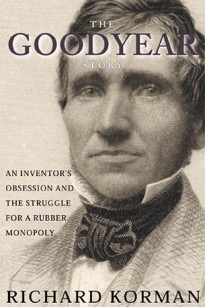
Hardcover. San Francisco, Encounter Books, 1st, 2002, Book: Very Good, Dust Jacket: Very Good, Hardcover in a bright dust jacket, 222 pages. SIGNED BY AUTHOR ON HALF TITLE PAGE. Clean, unmarked copy. Black and white pictures in center. Goodyear was an entrepreneur who actually made good on the ever-popular claim that his company would change the world. Korman, senior editor of Engineering News-Record, dryly traces the life of the rubber pioneer and American industrial legend in this part scientific history lesson and part American business story. Goodyear (1800-1860) became an inventor not out of any great scientific thirst; he was self-taught and wanted to make money. He earned success, but endured continual patent monopoly battles and numerous trips to debtors' prison as he steadfastly and compulsively held onto his dream of using rubber to change just about every aspect of life. (According to Korman, Goodyear frequently wore a coat made of rubber in his early inventing days to underscore the versatility of his product.) Korman waxes scientific at times, offering in-depth descriptions of how Goodyear cooked rubber and sulfur compounds, yet his technical discourses are not so esoteric that they will turn away amateurs. His book is also valuable for its accurate portrayal of factory life in the 1830s and '40s; his accounts of the aproned men who chopped rubber with axes and knives and the machines that ground it are lively examples of industrial age America. Clean copy.
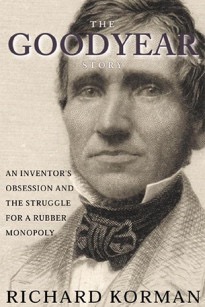
Hardcover. San Francisco, Encounter Books, 1st, 2002, Book: Very Good, Dust Jacket: Very Good, Hardcover in a bright dust jacket, 222 pages. Clean, unmarked copy. Black and white pictures in center. Goodyear was an entrepreneur who actually made good on the ever-popular claim that his company would change the world. Korman, senior editor of Engineering News-Record, dryly traces the life of the rubber pioneer and American industrial legend in this part scientific history lesson and part American business story. Goodyear (1800-1860) became an inventor not out of any great scientific thirst; he was self-taught and wanted to make money. He earned success, but endured continual patent monopoly battles and numerous trips to debtors' prison as he steadfastly and compulsively held onto his dream of using rubber to change just about every aspect of life. (According to Korman, Goodyear frequently wore a coat made of rubber in his early inventing days to underscore the versatility of his product.) Korman waxes scientific at times, offering in-depth descriptions of how Goodyear cooked rubber and sulfur compounds, yet his technical discourses are not so esoteric that they will turn away amateurs. His book is also valuable for its accurate portrayal of factory life in the 1830s and '40s; his accounts of the aproned men who chopped rubber with axes and knives and the machines that ground it are lively examples of industrial age America. Clean copy.
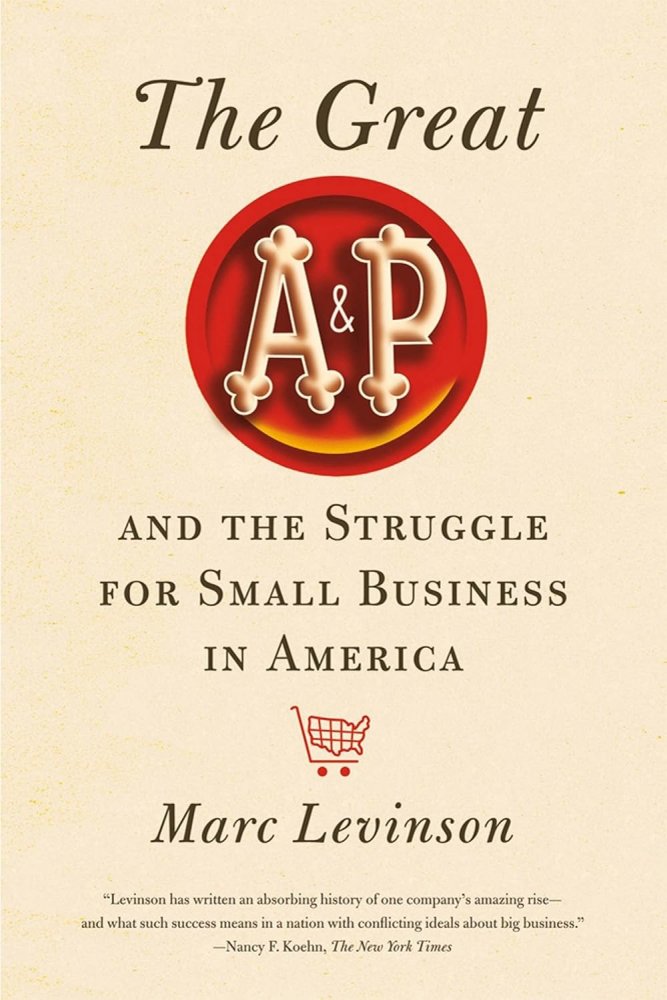
Hardcover. NY, Hill & Wang, 3rd pr., 2011, Book: Very Good, Dust Jacket: Very Good, Hardcover in a bright dust jacket, 358 pages, b&w illustrations. From modest beginnings as a tea shop, the Great Atlantic & Pacific Tea Company became the largest retailer in the world. It was a juggernaut, with nearly sixteen thousand stores. But its explosive growth made it a mortal threat to mom-and-pop grocery stores across the nation. Main Street fought back tooth and nail, leading the Hoover, Roosevelt, and Truman administrations to investigate the Great A&P. In a remarkable court case, the government pressed criminal charges against the company for selling food too cheaply-and won. The acclaimed historian Marc Levinson tells the story of a struggle between small business and big business that tore America apart. George and John Hartford took over their father's business and reshaped it again and again, turning it into a vertically integrated behemoth that paved the way for every big-box retailer to come. George demanded a rock-solid balance sheet; John was the marketer-entrepreneur who led A&P through seven decades of rapid changes. Together, they set the stage for the modern consumer economy by turning an archaic retail industry into a highly efficient system for distributing food at low cost. Clean copy.
Hardcover. NY, Liveright, 1st, 2023, Book: Very Good, Dust Jacket: Very Good, Hardcover in a bright, unclipped dust jacket. Years before Charles Lindbergh's flight from New York to Paris electrified the nation, a group of daredevil pilots, most of them veterans of the World War I, brought aviation to the masses by competing in the sensational transcontinental air race of 1919. The contest awakened Americans to the practical possibilities of flight, yet despite its significance, it has until now been all but forgotten. In The Great Air Race, journalist and amateur pilot John Lancaster finally reclaims this landmark event and the unheralded aviators who competed to be the fastest man in America. His thrilling chronicle opens with the race's impresario, Brigadier General Billy Mitchell, who believed the nation's future was in the skies. Mitchell's contest--critics called it a stunt--was a risky undertaking, given that the DH-4s and Fokkers the contestants flew were almost comically ill-suited for long-distance travel: engines caught fire in flight; crude flight instruments were of little help in clouds and fog; and the brake-less planes were prone to nosing over on landing. The race was a test of endurance that many pilots didn't finish: some dropped out from sheer exhaustion, while others, betrayed by their engines or their instincts, perished. For all its tragedy, Lancaster argues, the race galvanized the nation to embrace the technology of flight. A thrilling tale of men and their machines, The Great Air Race offers a new origin point for commercial aviation in the United States. Clean copy.
Hardcover. NY, St. Martin's Press, 1st, 1988, Book: Very Good, Dust Jacket: Very Good, Hardcover in a bright, unclipped dust jacket. 1948 is a leap year and a good one for Harry S. Truman. The second-hand book dealers on Manhattan's Fourth Avenue are in full swing. Howard inherits his father's shabby bookshop, but Howard isn't a true bookman, and he knows how little money there is in the business--until a seemingly priceless manuscript falls into his lap. But there's something odd about it. Howard decides to check out his treasure with an acerbic fellow in Baltimore, a man Howard's late father believed could solve all literary problems: H. L. Mencken. The results are deadly. Clean copy.
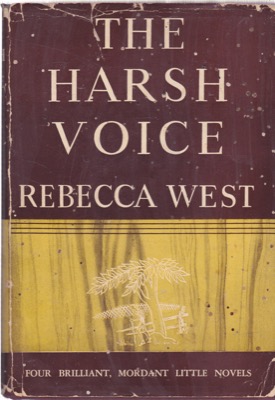
Hardcover. NY, Doubleday, Doran & Co., 1st, 1937, Book: Very Good, Dust Jacket: Fair, Hardcover in a very worn and chipped dust jacket, 294 pages. In these four short novels set in America, England and Paris, Rebecca West explores the lives and relationships of rich women and men who are ruled by 'the harsh voice we hear when money talks, or hate'. There is Josie, a flower of American girlhood with boundless ambition for wealth. There is Etienne de Sefavenac, a dilettante French aristocrat whose courtly stratagems are intended to ensnare Nancy Sarle - a plain American businesswoman. There is Alice Pemberton, a sensible Englishwoman - the very salt of the earth - in her own estimation. And lastly there is Sam Hartley, an American businessman who has fought his way to riches with his wife at his side, but whose life is now haunted by visions of beautiful young women.
Hardcover. NY, Doubleday, Doran & Company, 1st, 1928, Book: Very Good, Dust Jacket: None, Hardcover, tan cloth with dark blue lettering, 293 pages. Early book on Adolph Zuckor & the pioneer days of the motion picture industry. 15 photos. Zukor was a Hungarian-American who produced one of the first feature-length films (The Prisoner of Zenda, 1913) and was one of the three founders of Paramount Studios. The book covers his rise from nickelodeon arcades to the heights of Hollywood. No dust jacket. Clean copy.
Hardcover. NY, Harper & Row, 1st, 1979, Book: Very Good, Dust Jacket: Very Good, Hardcover in a bright, unclipped dust jacket. A thriller set in the world of big business and high finance featuring the murder of a bridegroom-to-be on New York's upper west side.
Hardcover. NY, Viking, 1st, 1994, Book: Very Good, Dust Jacket: Very Good, Hardcover in a bright, unclipped dust jacket. 521 pages, b&w photos. A biography of the Russian Jewish emigrant who introduced American audiences to ballet and brought live music, dance, and theater to small towns discusses his work in Moscow and his work with Isadora Duncan, Marian Anderson, Nureyev, and other greats. Remainder line to bottom edge otherwise clean.
Hardcover. Boston, David R. Godine, 1st, 2010, Book: Very Good, Dust Jacket: Very Good, Hardcover in a bright, unclipped dust jacket. This is the story of one of the last remaining phone booths in New York City, the Phone Booth on the corner of West End Avenue and 100th Street. Everyone used it from ballerinas and girl scouts, zookeepers and birthday clowns, to cellists and even secret agents! The Phone Booth was so beloved that people would sometimes wait in line to use it. Kept clean and polished, the Phone Booth was proud and happy...until the day a businessman strode by and shouted into a shiny silver object, "I'll be there in ten minutes!" Soon everyone was talking into these shiny silver things, and the Phone Booth stood alone and empty, unused and dejected. Clean copy
Softcover. Blue Mountain Lake NY, Adirondack Museum, 2nd pr., 1976, Softcover, 28 pages, b&w illustrations. A history of a mining enterprise started in 1826 in the Adirondack Mountains that went from business failure to success in the 1940s. Light tanning to covers, otherwise clean.
Hardcover. Hoboken NJ, John Wiley, 1st, 2002, Book: Very Good, Dust Jacket: Very Good, Hardcover in a bright dust jacket, 367 pages, with illustrations. Like Morgan, Rockefeller, Carnegie, Marshall Field was one of the overlords of capitalism in the Gilded Age of the late 19th C. His wealth and philanthropy masked a disastrous personal life. Alienated from his children, deserted by his wife, he left a legacy of immense wealth and misery. This multigenerational saga of money, madness, and mystery tells a Jekyll-and-Hyde story of American capitalism--a tale of drive and nerve and moral stumbles. Clean copy.
Softcover. NY, National Railway Publication Company, 1939, Book: Very Good, Dust Jacket: None, Softcover, original printed paper wrappers, 1536 pages. Thick handbook for the railroad steamboat trade, with detailed schedules, maps, advertisements, all pertaining to the shipment of goods. Printed on thin, cheap stock that's tanning. Still very good wth clear tape reinforcement to spine.
Hardcover. NY, Anchor Press/Doubleday, 1st, 1983, Book: Very Good, Dust Jacket: Very Good, Hardcover in a bright, unclipped dust jacket, 590 pages. Investigative reporting exposes the oil companies' complete control over the supplies and shortages during the 1970s. Clean copy.
Softcover. University of Pittsburgh Press, 1st pbk., 1980, Book: Very Good, Dust Jacket: None, Softcover, 283 pages. George Grayson examines the influence of oil and the oil sector both within Mexican society and in its relations with other nations, as he traces the development of the oil industry from its beginnings in 1901 up until the 1980s. Clean copy.
Hardcover. London, Strathearn, 1st, 2001, Book: Very Good, Dust Jacket: Very Good, Hardcover, 188 pages, b&w photos. A personal and business biography by the founder of the Polly Peck clothing line, a successful company that boomed in postwar Britain. SIGNED BY ZELKER on half-title page. Clean copy.
Hardcover. Fort Worth,TX, P&T Publishing Co., 1st, 1998, Book: Very Good, Dust Jacket: None, History and Development of Printing Presses from the Fifteenth to the Twenty-First Century. Hardcover in a bright dust jacket, 297 pages plus index and glossary. B&w illustrations. Previous owner's name and date on front fly leaf, otherwise clean.
Hardcover. NY, Farrar Straus Giroux, 1st, 2006, Book: Very Good, Dust Jacket: Very Good, Hardcover in a bright dust jacket, 347 pages. In this first biography focusing on John Hammond, the charismatic American music producer is brought to life by journalist Dunston Prial. Hammond was renowned for his ability to spot new talent, introducing the world to some of most gifted musicians of early jazz- Billie Holiday, Count Basie, and Charlie Christian. Then, as jazz gave way to pop and rock, Hammond staged an amazing second act discovering Bob Dylan, Aretha Franklin, Bruce Springsteen, and Stevie Ray Vaughan. 'The Producer' covers Hammond's entire story from his heyday as a music producer to his privileged upbringing as a Vanderbilt. This is a story of an American music in all its rough-edged vitality. Clean copy.
Softcover. Jefferson NC, Mcfarland & Co , 1st, 1998, Book: Very Good, Dust Jacket: None, Softcover, 174 pages. In early 1869, Harry Wright of the Cincinnati Base Ball Club made an announcement to the sporting press: the Red Stockings would be the first all-professional club in the history of the game. The outcry could be heard in nearly every town in which the sport was played. Wright, however, paid little heed to their protests and went about his business of signing players. By the start of the season he had inked ten players to contracts, with salaries ranging from $600 to $1,400 annually. By June of 1870, the Red Stockings had compiled a 90-game winning streak and were recognized as the finest team in the game. How the Red Stockings were formed, who the players were, and why things came to an end are all fully covered in this detailed history.
Softcover. NY, Harper Torchbooks, reprint, 1966, Book: Very Good, Dust Jacket: None, Softcover, 302 pages. This book presents the historical setting of the industrial revolution in a form suitable for the general reader. It seeks to explain why 18th-century England was the theatre of the great series of mechanical inventions that caused the revolution, and what were the great social changes that preceded, accompanied and followed it. Clean copy.
Hardcover. Indianapolis, Liberty Press, 1st, 1976, Book: Very Good, Dust Jacket: Good, Hardcover in a worn, chipped dust jacket. 293 pages. SIGNED BY CHAMBERLAIN on title page, also INSCRIBED by him on the front fly leaf. Capitalism is a system that can stand on its own attainments, says John Chamberlain, and he offers here a fast-paced, provocative look at the intellectual forces and practical accomplishments that have created American capitalism. In clear, unequivocal language he discusses the ideas responsible for our economic institutions, the originators of these ideas, and the times in which they first became important. The political theories of the men who hammered out the Magna Carta and the Declaration of Independence; the thinking of John Locke, James Madison, and Adam Smith; the deeds and discoveries of the James Watts, Eli Whitneys, and Henry Fords-all these diverse elements are shown to be part of the tradition of a free society in which American capitalism has grown and flourished. A unique blend of political and economic theory and the practical accomplishments of businessmen and innovators, The Roots of Capitalism provides valuable insights into the ideas underlying the free economy. Clean copy.

 "The Grand Tradition: Seventy Years of Singing on Record 1900 to 1970 by: J. B. Steane")
 "The Great Air Race: Glory, Tragedy, and the Dawn of American Aviationby: Lancaster, John")
 "The H.L. Mencken Murder Caseby: Don Swaim")



 "The Koberg Link by: Arthur Maling")

![The Lonely Phone Booth by: Ackerman, Peter; Dalton, Max [Illustrator]](javascript:largeIMTop('https://www.browsingisarousing.com/shop/images/The-Lonely-Phone-Booth_by_Ackerman-Peter-Dalton-Max-Illustrator379240-418362.jpg','https://www.browsingisarousing.com/shop/images/The-Lonely-Phone-Booth_by_Ackerman-Peter-Dalton-Max-Illustrator379240-418362.jpg',0,'379240',0,'') "The Lonely Phone Booth by: Ackerman, Peter; Dalton, Max [Illustrator]")
 "The Official Guide of the Railways and Steam Navigation Lines of the United States, Canada, Porto Rico, Mexico and Cuba. 72d Year, No. 9, October 1939by: National Rai")
 "The Oil Follies of 1970-1980: How the Petroleum Industry Stole the Show (and Much More Besides)by: Robert Sherrill")

 "The Polly Peck Story: A Memoir (SIGNED COPY)by: Raymond Zelker")

 "The Red Stockings of Cincinnati Base Ball's First All Professional Team and its Historic 1869 and 1870 Seasons by: Guschov, Stephen D.")
 "The Rise of Modern Industry by: Hammond, J. L. and Barbara")